Insurance That Covers Being Sued
An ATV or UTV liability policy is mainly about what happens when someone else says your riding caused an injury or damaged their property. In Nova Scotia, coverage is required when residents ride on land they do not own or occupy. Here’s what that requirement means, what liability insurance may respond to, and what to check before a ride.
What “insurance that covers being sued” means
Third-party liability insurance is intended to help protect you if another person claims you are legally responsible for injury or property damage. For example, a claim might follow a collision with another rider, damage to someone’s fence, or an incident involving a person near a trail. Whether a particular event is covered depends on the policy wording and the circumstances.
A claim does not automatically mean you owe money, and insurance does not guarantee that every legal dispute will be covered. A policy may provide a legal defence for a covered claim, as well as payment toward covered damages, subject to its terms, exclusions, and limits. Ask your insurer how defence costs are handled and whether they reduce the amount available to pay a claim.
The key distinction is that liability protection concerns claims made by other people. It is not the same as coverage for damage to your own machine, theft, or your own injuries. Those may require different coverage or may not be included. For a closer look at that distinction, see Insurance That Does Not Cover Your Crash.
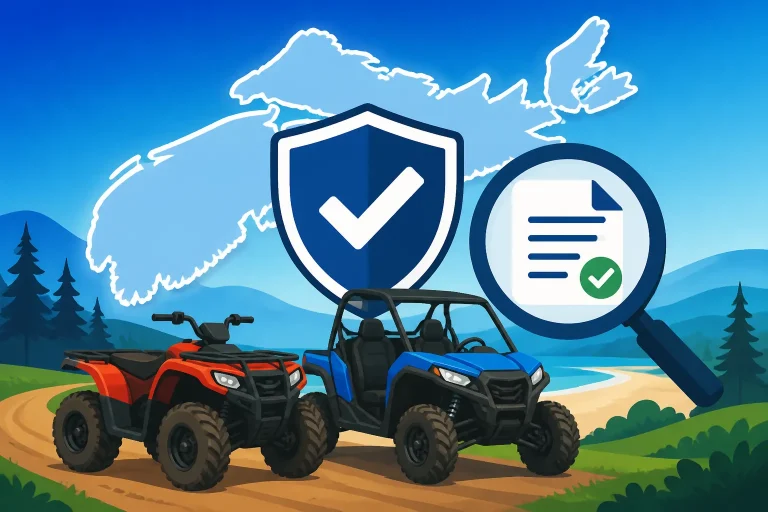
Nova Scotia residents operating an off-highway vehicle on land they do not own or occupy must carry a motor vehicle liability policy, according to Service Nova Scotia – Registry of Motor Vehicles. Natural Resources sets the minimum third-party liability coverage at $500,000. That minimum is a legal requirement, not a promise that every loss will be fully covered.
| Situation | What liability insurance may address | What to check |
|---|---|---|
| Another person says your riding caused an injury | A covered claim for which you are legally responsible | Who and what the policy covers, and how a claim is handled |
| Your machine damages someone else’s property | A covered claim for damage to another person’s property | Exclusions, conditions, and the policy limit |
| Your own ATV or UTV is damaged | Usually not a third-party liability claim | Whether separate physical-damage coverage applies |
| You are injured while riding | Not the same as liability coverage for another person’s claim | Whether any separate benefits or coverage apply |
Treat the table as a starting point, not a coverage decision. The insurer’s policy wording determines what is covered. If you are unsure whether a particular machine, rider, land type, or activity is included, ask the insurer before riding.
When Nova Scotia requires liability coverage
The practical test is where you ride. Service Nova Scotia – Registry of Motor Vehicles says Nova Scotia residents operating off-highway vehicles on land they do not own or occupy must carry a motor vehicle liability policy. That makes insurance a separate question from whether the machine is registered or whether you have permission to use the land.
Natural Resources says owners who ride an off-highway vehicle exclusively on property they own or occupy are not required to have third-party liability coverage. That exception is narrow: riding beyond that property can change the insurance requirement. If you regularly use trails, a neighbour’s land, or other property, confirm your obligations with your insurer and the relevant official source rather than assuming an own-property exception follows the machine everywhere.
Registration is also separate. Service Nova Scotia and Municipal Relations says off-highway vehicles must be registered unless they are used exclusively on the owner’s property. A registration document does not replace an insurance policy, and proof of insurance does not replace registration. For registration requirements and related paperwork, see Do You Need to Register an ATV in Nova Scotia?.
The coverage requirement applies to Nova Scotia residents operating off-highway vehicles on land they do not own or occupy. If you are visiting from another province, do not assume your home policy or permit automatically satisfies every Nova Scotia requirement. Ask your insurer whether your existing policy applies to the machine and riding location, and check the rules for visiting riders. The separate considerations for visitors are covered in Nova Scotia Registration for a Visiting Rider.
Riding on a designated road trail
A designated road trail can involve shared space and other people’s property, so confirm that your policy applies to that use. Carrying a policy does not itself authorize you to ride on a road or trail. You still need to follow the rules for where you may ride, and the land or route must be open to your machine.
If your ride includes a road trail, check both the insurance requirement and the operating rules before setting out. Nova Scotia Road Trail Rules Explained covers the separate rules that apply to road-trail riding.
Riders, machines, and permitted use
Do not assume a policy for one machine automatically covers every ATV or UTV in a household. Insurers may ask which vehicles are covered, who may operate them, and what kinds of use are intended. A machine used for recreation, work, or organized activity may raise different questions under the policy.
When comparing or renewing coverage, describe how and where you actually ride. Ask whether household members or other permitted operators are covered, whether passengers affect coverage, and whether the policy applies on trails, private land, and designated areas. Get the answers from the insurer rather than relying on a general description of the policy.
What liability insurance may and may not cover
The phrase “covers being sued” is useful shorthand, but it can make coverage sound broader than it is. Liability insurance generally responds to covered claims that you are legally responsible for harm to someone else. It does not mean that every demand, lawsuit, injury, or damage is automatically paid.
The policy limit is the most the insurer will pay for covered liability, subject to the policy’s terms. Natural Resources identifies $500,000 as the minimum third-party liability amount for an off-highway vehicle in Nova Scotia. If you are concerned about a serious claim exceeding the minimum, ask your broker or insurer whether a higher limit is available and what it would cover. Do not assume that meeting the legal minimum is the same as having enough protection for every situation.
| Coverage question | Liability insurance is for | It does not automatically mean |
|---|---|---|
| Someone claims you injured them | A covered third-party injury claim | Every injury is covered, regardless of who was involved |
| Someone claims you damaged their property | A covered claim for another person’s property damage | Damage to your own machine is covered |
| A claim becomes a legal dispute | The policy may address defence and covered damages under its terms | Every legal cost is paid outside the policy limit |
| You meet the minimum legal requirement | You have at least the required liability limit | You have collision, theft, or personal-injury coverage |
Ask specifically how the policy treats legal defence costs, whether those costs count toward the liability limit, and what exclusions apply. Also check whether there are conditions about authorized operators, the machine’s use, or where it is being operated. These details can matter more than a short product summary.
For questions about injury benefits, see Nova Scotia Accident Benefits Coverage. If you want to understand what protection may apply when an at-fault driver lacks insurance, see Nova Scotia Uninsured Motorist Coverage. Those topics are related to the broader consequences of a crash, but they are not substitutes for checking your ATV or UTV liability policy.
Fines for riding without insurance
The financial consequence of riding without required coverage is another reason to check your documents before using land you do not own or occupy. Natural Resources lists a fine of $257 for a first offence, $507 for a second offence, and $757 for a third offence, as of November 2026. The rules and penalties should be confirmed with the official source if you need to rely on them for a specific situation.
A fine is not the only potential cost. If a rider is held legally responsible for a covered or uncovered loss, the financial consequences can extend beyond the penalty. That is why it is worth confirming both that a policy is in force and that it applies to the person, machine, and riding activity involved. See Nova Scotia Penalties for Riding Uninsured for more on the consequences.
How to check your policy before riding
A quick check can uncover gaps before an incident. If you cannot tell whether the documents apply to your planned ride, contact the insurer or broker and ask for a clear answer. Keep proof of coverage accessible, and make sure the policy has not expired or been cancelled.
- Confirm the machine is insured. Check the policy documents for the ATV or UTV you plan to ride. If the machine has changed owners or you have added another vehicle, ask whether the policy needs updating.
- Check the liability limit. Confirm that the policy meets Nova Scotia’s minimum. Natural Resources sets that minimum at $500,000.
- Confirm who may operate it. Ask whether the people who will ride are covered under the policy, including family members or other authorized operators.
- Describe where and how you ride. Tell the insurer whether you use trails, designated road trails, private property, or the machine for work. Ask about any restrictions that could affect coverage.
- Ask what is excluded. Find out whether the policy excludes particular activities, locations, or types of claims. Do not assume that a general liability description settles these details.
- Keep proof available. Check what proof of insurance you should carry and how to present it if asked. Nova Scotia Pink Card Rules explains the role of the insurance card.
If you ride only on your own or occupied property, ask the insurer how the exception applies to your actual use. If you sometimes leave that land, make sure you understand when coverage becomes required and whether the same policy applies to the rest of your riding.
For riders using shared or club trails, confirm the policy separately from any trail permit or club membership. A permit may allow access under its own rules, but it is not the same thing as motor vehicle liability insurance. Nova Scotia Insurance Proof at a Trailhead offers related guidance on carrying proof.
The safest approach is to treat registration, trail access, and insurance as separate checks. Confirm that the machine is registered when required, that you are allowed to ride the route, and that a valid liability policy covers the planned use. If a policy document is unclear, get the insurer’s explanation before you head out rather than trying to interpret an uncertain clause after a claim.
Sources
- Service Nova Scotia – Registry of Motor Vehicles — Service Nova Scotia – Registry of Motor Vehicles – Off-Highway (off-road) Vehicles (checked November 3, 2026)
- Natural Resources — Insurance for Off-highway Vehicles | novascotia.ca (checked November 3, 2026)
Disclaimer
This article is for general informational purposes only and does not constitute professional advice. Laws, prices and regulations vary by location and change over time. Consult a qualified professional for guidance on your specific situation.