A Woodlot Machine and Nova Scotia Paperwork
It can be incredibly confusing trying to figure out if that trusty ATV or UTV you use primarily for managing your woodlot needs to be registered with Access Nova Scotia. Many folks assume that if a machine stays mostly on private property, it’s exempt from all the official paperwork, but the reality can be a bit more nuanced. This guide is here to cut through that confusion, explaining when your woodlot machine needs to be on the books and what kind of paperwork you'll need to make it happen.
Understanding the Nova Scotia Rules for Woodlot Machines
The Nova Scotia Off-highway Vehicles Act and its associated regulations are what govern ATVs, UTVs, and other off-highway vehicles in the province. When it comes to machines used for work, especially on private land like a woodlot, there are specific exemptions that can apply. However, it's crucial to understand these exemptions fully, because stepping even a little outside their boundaries can land you in a bind.
When a Woodlot Machine Is Exempt from Registration
The primary exemption for woodlot machines comes under the "farm and forestry" umbrella. If your ATV or UTV is used primarily for agricultural purposes or for the commercial harvesting of timber, and it never operates on public roads (except to directly cross one at a designated crossing point, or a specific road that has been designated as an Off-highway Vehicle Trail by a municipality), it might be exempt from the general registration requirement.
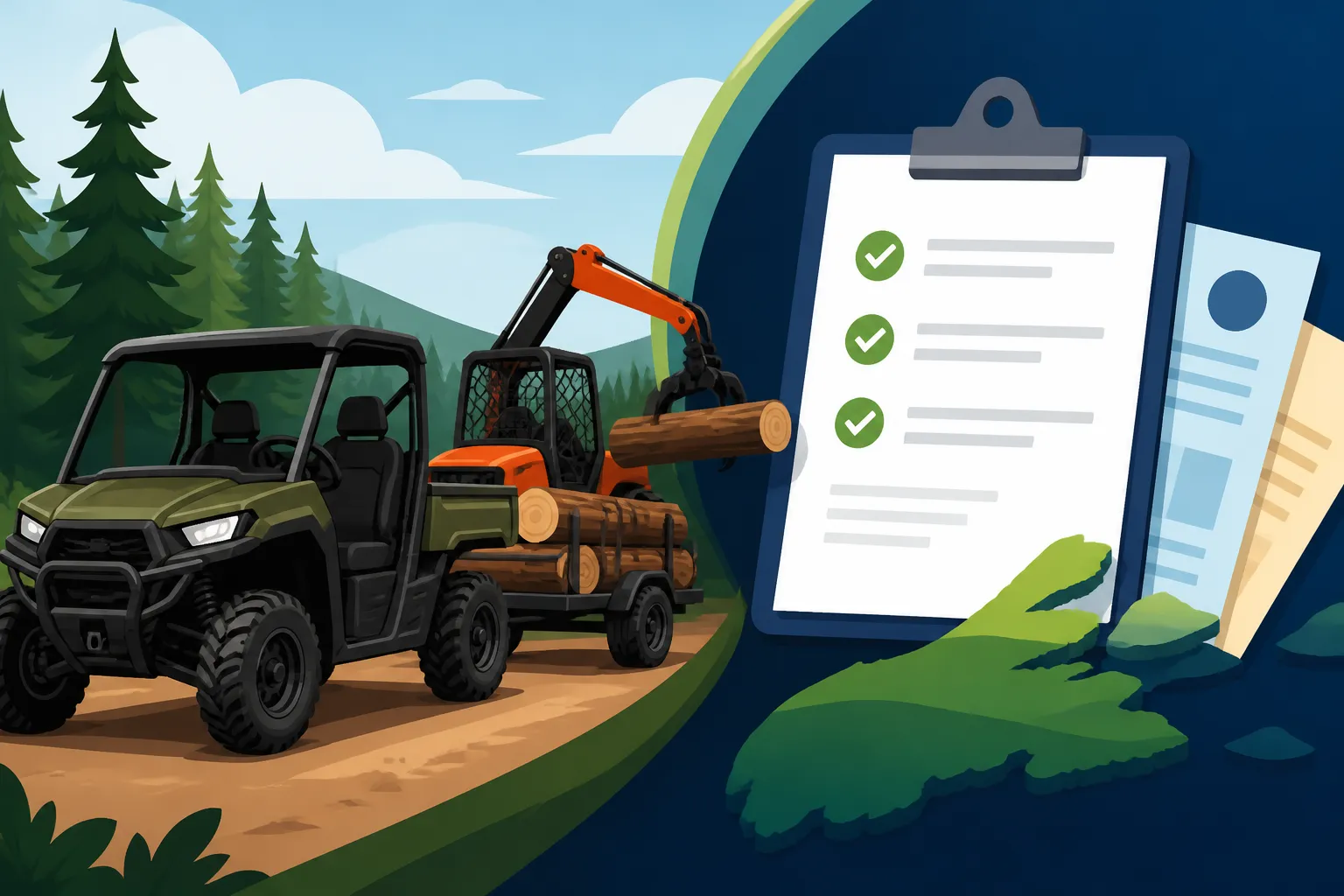
Think about it: if your quad lives on your property, is used solely for hauling firewood from the back forty, or for checking your woodlot boundaries, and you load it onto a trailer to move it between properties rather than driving it on any public access points, you're likely in the clear. This is about the primary use and the location of operation. If your machine is genuinely confined to the private property of the woodlot, dedicated to tasks like hauling logs, clearing brush, or maintaining forest roads, the province understands its utility. [When Forestry Work Exempts a Machine From Registration] goes into more detail about these specific scenarios.
When Your Woodlot Machine Needs Registration
Here’s where many woodlot owners can get tripped up. The moment your ATV or UTV leaves your private woodlot and touches any public land or designated off-highway vehicle trail, even briefly, it typically needs to be registered and insured. This includes situations like:
- Riding on designated OHV trails: Even if those trails are adjacent to your woodlot or you use them to access different parts of your property, they are public access points.
- Operating on shared private roads: If your woodlot borders a private road or access lane that is also used by other property owners, or if it's considered a deeded right-of-way, clarity on registration is essential. If the public has a right to travel on it, then your machine needs to be registered.
- Crossing any public highway or road (beyond a direct crossing): The exemption for direct crossings is very specific. If you ride along the shoulder, or use the road to get to another section of your property even for a short distance, your machine must be registered.
- Using it for recreational purposes: Even if you sometimes use it for woodlot work, if you also take it out on weekends just for fun rides, then it absolutely needs to be registered. The "primarily used" clause is key here.
It’s all about protecting yourself and others. An unregistered and uninsured machine, even one that just accidentally nips onto public land, can lead to significant penalties. [Nova Scotia Penalties for Riding Unregistered] outlines the potential fines you could face. Don't leave yourself open to that kind of stress just because you thought your machine was always exempt.
The Paperwork You Need for a Woodlot ATV/UTV
Whether your machine is exempt or not, having proper documentation for ownership is always paramount. Even if you never register it, you need to be able to prove that it’s yours.
Proof of Ownership and Bill of Sale
Every ATV or UTV, regardless of its intended use, should have a clear chain of ownership. This typically starts with a bill of sale or a manufacturer's statement of origin if it was purchased new. If you bought your machine used, that bill of sale from the previous owner is your most important document. This document should clearly state:
- The date of sale
- The names and contact information of both the buyer and seller
- A detailed description of the machine (make, model, year, and crucially, the Vehicle Identification Number or VIN)
- The purchase price
It's amazing how often people overlook this, especially when buying from a friend or family member. A simple handwritten note might suffice for family, but for clarity and legal protection, a formal bill of sale is always best. Services like LawDepot offer templates for bills of sale that can be customized to ensure all necessary details are included, providing a clear record for both parties. [Nova Scotia Used Machine Paperwork] has more pointers on this.
When Original Papers are Missing
Life happens. Sometimes you buy a machine, especially an older one, and the previous owner just can't locate the original bill of sale or any old registration papers. This doesn't mean you're out of luck, but it does mean a bit more work.
If you don't have a bill of sale, Nova Scotia generally requires you to fill out a Sworn Statement (Form 14) and potentially a Declaration for Missing Documents. This is where a clear description of how you came to own the machine, along with any supporting details (like a previous owner’s contact information, if available), becomes critical. You might even need to get it notarized. Having robust documentation, even if you have to create a new one using a template from a service like LawDepot, is better than having nothing.
Insurance for Your Woodlot Machine
Even if your machine qualifies for a registration exemption, liability insurance is still a very smart idea, if not an outright requirement depending on how and where you operate. In Nova Scotia, any OHV operating on public land or designated trails must carry liability insurance. The minimum coverage is generally set at $500,000.
While the primary use exemption for registration applies to certain work scenarios, it usually doesn't extend to insurance if you ever leave private land. Imagine an accident occurs while you're briefly crossing a public road with your "exempt" woodlot machine, and you cause damage or injury. Without insurance, you could be personally on the hook for substantial costs. Always check with your insurance provider to ensure you have adequate coverage, especially if there's any chance your machine will operate outside your purely private property. [Nova Scotia Insurance Requirements for Riders] offers more insight into this.
Steps to Registering Your Woodlot Machine
If, after reviewing the exemptions, you determine your woodlot machine needs to be registered (or if you simply want the peace of mind that comes with it), the process is straightforward but requires attention to detail.
Gathering Your Documents
Before you head to an Access Nova Scotia centre, make sure you have everything in order. This typically includes:
- Proof of Ownership: Your bill of sale or previous registration certificate. If it's a new machine, the Manufacturer's Statement of Origin.
- Identification: A valid government-issued photo ID.
- Proof of Insurance: Your pink card or insurance policy document showing the minimum liability coverage.
- Funds for Fees and Tax: Be prepared to pay the registration fees and any applicable provincial sales tax (HST) on the purchase price if it hasn't already been paid. [Nova Scotia Tax Collected at Registration] explains how this works.
A complete list of items you’ll need can usually be found on the Access Nova Scotia website, or you can use a checklist like the one provided in [Nova Scotia Registration Paperwork Checklist].
Visiting Access Nova Scotia
Registration is generally completed in person at an Access Nova Scotia Service Centre. While some initial inquiries might be handled over the phone, the actual paperwork and payment usually require a visit.
When you arrive, a service representative will guide you through the process. They'll review your documents, verify the VIN, calculate any taxes owed (if applicable), and process your fees. Once complete, you’ll receive your Certificate of Registration and your Vehicle Permit. The Certificate is a one-time fee, while the Vehicle Permit is an annual renewal. [Nova Scotia's Certificate and Vehicle Permit] breaks down these two essential documents.
What to Expect Regarding Fees and Taxes
There are two main components to the initial registration cost for an OHV in Nova Scotia:
- The Certificate of Registration: This is a one-time fee that establishes your ownership record in the provincial system.
- The Vehicle Permit: This is an annual fee that allows your machine to be operated on public lands and designated trails. This fee also includes a contribution to the Off-Highway Vehicle Infrastructure Fund, which helps maintain and develop trails across the province.
In addition to these fees, if you purchased your machine from a private seller, you will likely need to pay Harmonized Sales Tax (HST) on the declared purchase price at the time of registration. If you bought it from a dealer, they would typically have collected the HST at the point of sale.
The costs can seem like a lot upfront, but it’s an investment in legal operation and trail infrastructure. [Nova Scotia OHV Registration Cost] provides a detailed overview of the various fees involved.
Common Misconceptions and What to Watch Out For
Navigating government regulations can be tricky, and there are several common misunderstandings surrounding woodlot machines in Nova Scotia.
"It's a Work Machine, So It's Totally Exempt."
This is probably the biggest misconception. While there are work-related exemptions, they are very specific about where and how the machine is used. As discussed, the moment your machine leaves your private property and interacts with public land or designated trails, the exemption likely evaporates, and registration becomes mandatory. Always err on the side of caution. If there's even a small chance it will touch public ground, get it registered.
"I Only Ride on My Own Land, So I Don't Need Anything."
While you might not need to register your machine if it never leaves your private property, you still need to be able to prove ownership. Without a clear bill of sale or other documentation, you could run into problems if your machine is stolen, if there's a dispute over ownership, or if you ever decide to sell it. Even if it's never registered, keep those ownership papers in a safe place. [Riding Your Own Land Without a Registration] clarifies this more.
"My Neighbour Knows I Own It, That's Enough."
While community knowledge is great, it doesn't hold up in court or at Access Nova Scotia. When it comes to official records, you need actual documents. Relying on verbal agreements or shared understanding can lead to significant headaches down the road. This is another area where a simple, clear bill of sale (perhaps a LawDepot template) can save a lot of grief.
Potential Changes to Regulations
It's also important to remember that laws and regulations can change. What was exempt last year might not be this year, or vice-versa. Always check the most current information available from official sources like the Nova Scotia government or Access Nova Scotia, especially if you haven't checked the rules in a while. Being proactive with your paperwork can save you from unexpected fines or complications later on.
It's clear that owning an ATV or UTV for your woodlot in Nova Scotia brings with it specific responsibilities regarding paperwork and registration. While exemptions exist for machines used strictly for work on private land, understanding the precise limits of these exemptions is vital. By ensuring you have solid proof of ownership and by registering your machine if there's any chance it will operate on public trails or roads, you protect yourself, your investment, and contribute to the safe and responsible enjoyment of off-highway vehicles in our beautiful province.
Disclaimer
This article is for general informational purposes only and does not constitute professional advice. Laws, prices and regulations vary by location and change over time. Consult a qualified professional for guidance on your specific situation.