Nova Scotia Penalties for Riding Uninsured
It's easy to assume that because your off-highway vehicle (OHV) spends most of its time off the pavement, churning through mud, rocks, and forest trails, the same rules about insurance don't apply. Many riders feel that if they're not on a public road, insurance is an unnecessary expense. This guide will walk you through the very real and often surprising penalties you could face in Nova Scotia if you're caught riding your ATV or UTV without the required insurance coverage, helping you understand why that "extra" cost is actually essential protection.
The Mandate: Why Nova Scotia Requires OHV Insurance
Let's cut right to it: Nova Scotia has made it clear that owning and operating an off-highway vehicle comes with certain responsibilities, and one of the biggest is ensuring your machine is properly insured. This isn't just a suggestion; it's a legal requirement designed to protect you, other riders, and the public at large. Ignoring this mandate can lead to serious headaches, both financial and legal.
Understanding Nova Scotia's Minimum Insurance Requirements
Since 2007, the province has required all off-highway vehicles to carry a minimum level of liability insurance. This isn't just about covering your own machine if something goes wrong; it's primarily about protecting others from financial hardship if you cause an accident. Imagine hitting another rider, or damaging someone's property—without insurance, you're on the hook for all of those costs, which can quickly become astronomical. The provincial standard dictates that you must have at least $500,000 in third-party liability coverage. This means if you cause an accident, your insurance company steps in to cover damages and injuries to other people or their property, up to that half-million-dollar limit. It’s a significant amount, but it reflects the potential for severe damage and injury when powerful machines are involved. You can learn more about [Nova Scotia's $500,000 Liability Minimum].
This required coverage also typically includes Accident Benefits. These benefits are there to help cover medical expenses, rehabilitation costs, and income replacement if you or your passengers are injured in an accident, regardless of who was at fault. This is a crucial safety net that many people overlook when considering their insurance options. Without it, even if you weren't at fault, your personal health insurance might not cover everything, leaving you with hefty bills.
Who Needs to Be Insured and When
The short answer is almost everyone operating an OHV in Nova Scotia needs to be insured. This includes owners, operators, and even passengers in some scenarios. The only major exceptions are for machines used exclusively for competitive racing on a closed course, or for specific types of work on your own private land where public access is strictly controlled. Even if you're just riding your ATV or side-by-side on designated trails, through Crown land, or crossing a municipal road where permitted, that insurance policy needs to be in force.
It's also important to remember that this requirement applies to all types of OHVs, whether you're on a traditional ATV, a more robust side-by-side, or even a dirt bike. The law is broad and inclusive. The moment your wheels leave your private, fenced-in property and enter any public or permitted access area, that insurance needs to be active. This is why you should always carry your [Nova Scotia Pink Card Rules] with you when you ride.
The Immediate Financial and Legal Consequences
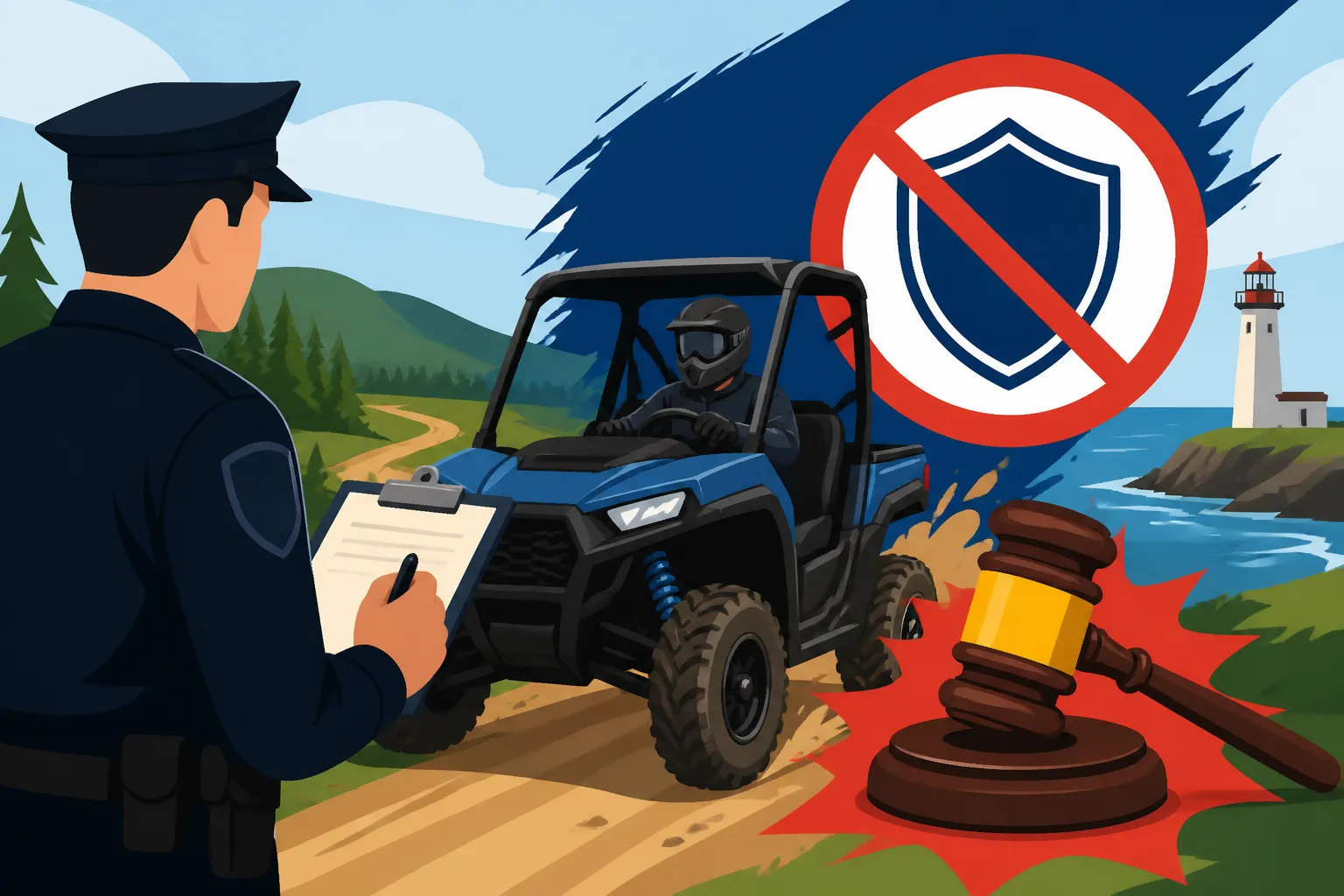
Being caught without valid OHV insurance in Nova Scotia isn't a slap on the wrist; it comes with immediate, tangible penalties that can quickly drain your wallet and complicate your life. Law enforcement officers are vigilant, and checks are increasingly common, especially on popular trail systems and at trailheads.
Fines That Will Make Your Eyes Water
One of the most immediate consequences of riding uninsured is a substantial fine. These aren't minor infractions; they're serious penalties designed to deter non-compliance. While specific figures can change, you can expect the minimum fine to be significant, often in the hundreds of dollars for a first offense. This immediate financial hit can put a serious damper on your riding day, turning a fun outing into an expensive regret. Remember, this is separate from any fines for an unregistered machine; you could face both if you're truly non-compliant across the board. The penalties for an unregistered machine can be severe, too. For instance, [Nova Scotia Fines for an Unregistered Machine] start at a minimum of $250.
But it doesn't stop there. Repeat offenses, or riding uninsured in conjunction with other infractions, can lead to even higher fines, potentially escalating into the thousands. Imagine planning a weekend trip, only to have your machine impounded and be hit with a fine that could have paid for several seasons of insurance. It’s a very real scenario that many riders have unfortunately experienced. These fines aren't just about revenue; they're about emphasizing the importance of responsible OHV operation.
Impoundment and Towing Fees
Beyond the immediate fine, an officer has the authority to impound your uninsured off-highway vehicle. This means your machine will be towed away and stored at an impound lot. And guess what? You're responsible for all the associated costs. This includes the towing fee, which can be considerable, especially if you're in a remote area, and daily storage fees that quickly add up. These fees accrue until you can prove that you have rectified the insurance situation and paid all outstanding fines and charges.
The impoundment process isn't just costly; it's a massive inconvenience. Your machine is suddenly inaccessible, you might be stranded, and you'll have to navigate the administrative hurdles of getting it back. This can involve trips to various offices, providing proof of new insurance, and showing receipts for fines and fees. It’s a time-consuming and frustrating ordeal that underscores the importance of being prepared before you even start your engine.
Court Appearances and Driving Record Impacts
Depending on the severity of the infraction or if it's a repeat offense, you might find yourself summoned to court. A court appearance means taking time off work, potential legal fees if you choose to get counsel, and the added stress of a formal proceeding. While riding an OHV doesn't typically require a driver's license for trail use, certain infractions, including uninsured operation, can still impact your overall driving record or lead to further penalties like a prohibition from operating an OHV for a period.
For example, if you were involved in an accident while uninsured, even a minor one, the legal ramifications become far more complex. The courts might impose stricter penalties, especially if there were injuries or significant property damage. The goal of the system is to ensure accountability, and being uninsured severely undermines that principle.
The Heavier Burden: Accidents and Long-Term Consequences
The immediate penalties are certainly a deterrent, but the true nightmare of riding uninsured in Nova Scotia comes into sharp focus if you're involved in an accident. This is where the lack of a simple insurance policy can unravel your financial stability and future.
Personal Liability for Damages and Injuries
Let's imagine the worst: you're riding your OHV, and through an unfortunate series of events, you cause an accident. Perhaps you misjudged a turn and collided with another machine, or maybe you lost control and damaged a fence on private property. If you're uninsured, you are personally, 100% liable for all damages and injuries that result from that incident.
This means if another rider is injured, you're on the hook for their medical bills, lost wages, rehabilitation costs, and pain and suffering. If their machine is totaled, you have to pay for its replacement. If you damaged a farmer's fence, you're buying a new fence. These costs can easily climb into tens of thousands, hundreds of thousands, or even millions of dollars, depending on the severity of the accident. Without insurance to cover these expenses, your personal assets—your savings, your home, your future earnings—could all be at risk. This is the core reason for the mandatory insurance requirement: to protect innocent parties from suffering devastating financial losses due to someone else's negligence.
Impact on Future Insurance and Financial Stability
Being caught riding uninsured, especially if it involves an accident, will almost certainly make it much harder and more expensive to obtain insurance in the future, not just for your OHV, but potentially for other vehicles like your car or truck. Insurance companies view uninsured operation as a high-risk activity, and a record of it will flag you as a less desirable client. This can lead to significantly higher premiums, or even outright denial of coverage from some insurers.
Furthermore, if you are found liable for damages and injuries from an accident while uninsured, the victims can sue you directly. A judgment against you could lead to wage garnishments, liens on your property, and severe damage to your credit score. This can affect your ability to get loans, buy a home, or even secure certain types of employment in the future. The ripple effect of a single uninsured accident can truly last for years, if not decades.
A Comparative Look: Insured vs. Uninsured Accident Scenario
To really drive home the difference, let's look at two hypothetical scenarios for an accident involving significant injury to another rider.
| Scenario Feature | Insured Rider (Nova Scotia Compliant) | Uninsured Rider (Nova Scotia Non-Compliant) |
|---|---|---|
| Initial Police Contact | Proof of insurance provided (Pink Card). | Immediate fine for no insurance, machine impounded. |
| Accident Investigation | Insurer handles communication and legal aspects. | Rider is solely responsible for all communication and legal defense. |
| Medical Bills for Injured Party | Covered by rider's $500,000 liability policy. | Rider personally liable. Out-of-pocket costs could be hundreds of thousands. |
| Machine Damage to Injured Party | Covered by rider's $500,000 liability policy. | Rider personally liable for repairs or replacement. |
| Legal Fees | Insurer provides legal defense, up to policy limits. | Rider pays all legal fees out of pocket to defend against lawsuits. |
| Future Insurance | Potential premium increase. | Significant difficulty finding new insurance; extremely high premiums if found. |
| Financial Impact | Covered by insurance, minimizing personal financial strain. | Personal assets (home, savings, wages) at risk due to potential lawsuit judgments. |
| Credit Score Impact | Minimal to none (unless at-fault claim record). | Severely negative due to judgments, collections, and inability to pay debts. |
This table vividly illustrates that while insurance might seem like an upfront cost, it's a critical investment in your financial future and peace of mind.
Common Misconceptions and Staying Compliant
It's clear that the penalties for riding uninsured are severe. However, many riders still fall into traps of misunderstanding or misinformation. Let's tackle some common misconceptions and clarify how to stay on the right side of the law.
"My Car Insurance Covers My ATV" – Not Usually!
This is perhaps the most common misconception. Many people assume that because they have automobile insurance for their car or truck, their ATV or side-by-side is automatically covered. In almost all cases, this is simply not true. Standard auto policies are designed for road-going vehicles and typically exclude off-highway vehicles. You need a separate, specific OHV insurance policy to meet Nova Scotia's requirements.
Always verify directly with your insurance provider. Don't assume. Call your broker, explain what type of machine you have, and clarify its intended use. Get specific confirmation in writing that your OHV is insured for third-party liability according to Nova Scotia's legal minimums. There are reputable insurance companies that specialize in OHV coverage, so it's worth shopping around to ensure you get the right policy at a competitive rate. Don't forget, [Nova Scotia Insurance Requirements for Riders] apply specifically to OHVs.
"I Only Ride on My Own Land, So I Don't Need It" – Be Careful!
While there are specific exemptions for using an OHV for farming or forestry purposes exclusively on land you own or lease, or for racing on a closed course, simply "riding on your own land" doesn't automatically grant you an exemption from insurance. The moment you cross a property line onto a shared trail, Crown land, or even briefly traverse a public road to get from one section of your property to another, the requirement for insurance kicks in.
It's also crucial to remember that even on your own property, if a guest or another person is injured while you're operating your OHV, your personal liability could still be immense. While the provincial mandate for third-party liability might be waived in certain strict private property scenarios, the risk of a personal injury lawsuit never goes away. Carrying comprehensive liability coverage is always a wise decision, regardless of where you predominantly ride. The province's [Nova Scotia Own-Property Exemption] details these specific rules.
Ensuring Your Paperwork is Always in Order
Staying compliant means more than just having a policy; it means having proof of that policy readily available when you ride. Nova Scotia law requires you to carry your "Pink Card" – your proof of insurance – whenever you operate your OHV. This card confirms that you have the minimum required liability coverage. Officers conduct routine checks, and not having your Pink Card can lead to delays, questioning, and even fines, even if you are technically insured.
It's a good practice to keep your Pink Card laminated or in a waterproof pouch on your machine, along with your [Nova Scotia Certificate and Vehicle Permit] and any other necessary documentation. A photograph on your phone might be accepted in a pinch, but having the physical card is always best. Just like your OHV registration, which has its own strict rules, your insurance proof is essential. Make sure you understand [Nova Scotia Registration Paperwork Checklist] for all the documents you should carry.
For those situations where you might need to prove ownership or document an agreement, resources like LawDepot can be helpful for creating general legal forms. While not directly related to buying insurance, having proper documentation for things like a bill of sale or a declaration of ownership can indirectly support your legal standing should any questions arise about your machine’s history, especially after a private sale.
Final Thoughts: The Cost of Peace of Mind
The penalties for riding an uninsured OHV in Nova Scotia are far-reaching and can be financially devastating. From hefty fines and impoundment fees to direct personal liability for injuries and damages in an accident, the risks far outweigh the perceived savings of skipping insurance.
Think of that annual premium not as an expense, but as an investment in your peace of mind and financial security. It’s about being a responsible rider, protecting yourself, and protecting others who share the trails and rural roads of our beautiful province. Before your next ride, double-check your insurance, make sure your Pink Card is accessible, and enjoy the trails knowing you’re fully compliant and protected. When considering the total [Nova Scotia OHV Registration Cost], factor in that essential insurance piece as well.
Disclaimer
This article is for general informational purposes only and does not constitute professional advice. Laws, prices and regulations vary by location and change over time. Consult a qualified professional for guidance on your specific situation.