Nova Scotia Visitor Permits Without a Sticker
A visitor permit can make an eligible Nova Scotia trail ride possible, but it may arrive as a letter rather than a decal for your ATV or UTV. That raises practical questions: what proves you paid, whether your machine still needs home-jurisdiction papers, and where the permit lets you ride. Here’s how to handle the paperwork before you unload.
What a Nova Scotia visitor permit is for
A Nova Scotia visitor permit is a trail-access permit for eligible riders visiting from outside the province. It is separate from your machine’s registration, permit or insurance documents issued by your home jurisdiction. It also does not give blanket permission to ride on every road, trail or piece of land in Nova Scotia.
The provincial trail system includes corridors maintained or supported by ATV clubs, as well as routes with different owners and access rules. A trail permit addresses one part of the ride: access to trails where that permit is accepted. It does not override a closure, a landowner’s restrictions, a municipal rule or the conditions attached to a particular route.
Visitors often confuse the trail permit with provincial vehicle registration. They serve different purposes:
| Document or requirement | What it generally establishes | What it does not replace |
|---|---|---|
| Visitor trail permit | Eligibility to use participating trail routes during the permit period | Registration, insurance or permission to ride on every property |
| Home-jurisdiction registration | The machine is registered under the rules where it is normally kept | Nova Scotia trail access |
| Insurance documents | The machine has the required coverage for the planned use | A trail permit or landowner permission |
| Trail and route information | Whether a specific segment is open and suitable to ride | Legal registration or insurance |
A visitor should confirm the permit’s duration, eligibility and delivery method before travelling. The visitor option is commonly described as a thirty-day permit, but the current conditions should be checked with the issuing organization before purchase. See Nova Scotia’s Thirty-Day Visitor Permit for the questions to settle, including when the permit period starts and what proof you receive.
The permit is meant for a temporary visit, not as a workaround for a Nova Scotia resident who needs the ordinary permit arrangement. If you live in the province, ask about the standard trail-permit options instead. Can a Local Rider Buy the Visitor Permit? explains why the visitor category and a local rider’s permit needs should not be treated as interchangeable.
It is also important to distinguish organized trail access from general off-road access. A pass does not grant permission to cross private land that is not part of an open trail, ride through a closed segment, enter a park where machines are prohibited or use a beach simply because it appears accessible. Check the route and the land-access rules independently. For help understanding the difference between a trail permit and route access, start with Nova Scotia Crown Land Riding Rules and Nova Scotia Private Woodlot Permission.
Who needs one, and when reciprocity may apply
Whether you need to purchase a visitor permit depends partly on where you are coming from and what permit or membership you already hold. Do not assume that a pass valid in your home province automatically works on Nova Scotia club trails. Reciprocity arrangements can differ by province and can change, so check the current rules before you travel.
Visitors from provinces with different arrangements
Nova Scotia’s arrangements are not necessarily the same for every neighbouring province. In particular, do not assume that a New Brunswick or Prince Edward Island permit is accepted just because the provinces are nearby. The reciprocity arrangements for those provinces have changed, and riders should verify the current position before setting out. The relevant background is covered in [Nova Scotia Riders Visiting New Brunswick] and Nova Scotia Riders Visiting PEI.
A rider with an Ontario permit may have a different arrangement. Nova Scotia is listed as honouring Ontario permits, but confirm that your particular permit type and intended riding activity qualify. See Nova Scotia Visitors From Ontario for the province-specific details. If you are visiting from somewhere else, ask the permit issuer whether a home permit is recognized or whether you must buy a Nova Scotia visitor permit.
The practical rule is simple: verify reciprocity using current information rather than relying on a friend’s past trip, an old social-media post or a decal that looks similar. A permit from another province can be valid at home without being valid on a Nova Scotia trail.
Residents and newcomers are not necessarily visitors
A temporary visit and a move to Nova Scotia are different situations. If you have moved to the province or plan to keep your machine here, a short-term visitor permit may not meet your obligations. You may need provincial registration and the regular trail permit, depending on how and where you ride. Nova Scotia Registration for a Visiting Rider can help separate registration questions from trail access.
That distinction matters even if your machine still has an out-of-province plate, registration certificate or insurance policy. The place where you bought or registered the ATV or UTV does not by itself settle what rules apply to a person who has become a resident. If your visit is extended, you are unsure whether you count as a visitor, or you are storing the machine in Nova Scotia, ask the relevant agencies and permit issuer before relying on a short-term pass.
Each machine and rider must be considered
Do not assume one visitor permit covers every machine in a group, or that a permit attached to one rider automatically covers another rider’s machine. Ask whether the permit is tied to a specific vehicle, rider or period, and whether every machine needs its own permit. This is particularly important when a family brings several ATVs, a side-by-side and a youth machine.
A passenger does not usually need a separate vehicle permit merely to ride as a passenger, but that does not make age, equipment or passenger rules optional. Riders should check the applicable rules for the machine, route and age group. A trail permit is not a substitute for a safety certificate where one is required, and it does not remove the need to follow supervision or equipment requirements.
Why a visitor permit may arrive without a sticker
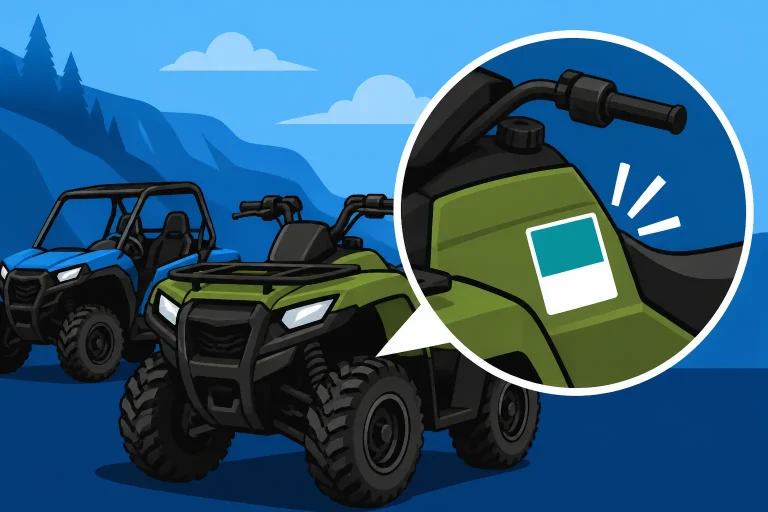
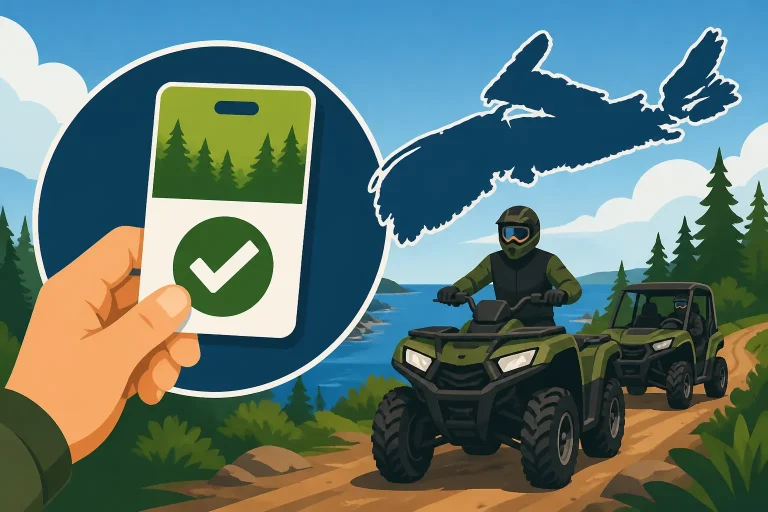
Some riders expect a coloured decal that can be stuck to the fender or placed beside the registration label. A visitor permit may instead be supplied as a letter or other proof of purchase. That can feel less obvious on the trail, but the key is to keep the proof available and be able to show which machine it relates to.
The delivery format is not the same thing as the permit’s validity. If the issuer provides a letter, email or printable document, follow its instructions. Do not assume that the lack of a decal means the permit was not issued, and do not invent your own marking or attach paperwork to the machine in a way that could damage or obscure its identifiers. For more detail on this format, see Why Your Permit Arrives as a Letter, Not a Sticker.
Keep the actual proof accessible
Before leaving home, save the permit confirmation and any attachment in a place you can reach on the ride. A printed copy is a useful backup if your phone battery dies, the screen becomes difficult to read in rain or you lose reception. If the permit is issued by email, keep the message and any receipt together rather than relying on a screenshot that cuts off the important details.
Make sure the proof is legible and includes the information needed to establish what was purchased. Check the machine description, permit period, any identifying number and the purchaser information against the documents you submitted. If something is wrong, contact the issuer before riding rather than hoping a trail volunteer or enforcement officer will sort it out roadside.
A sensible document setup is:
- Keep the visitor permit confirmation or letter with your registration and insurance papers.
- Store a digital copy on the phone of the rider responsible for the machine.
- Carry a paper copy in a protected pouch as a backup.
- Make sure every rider in the group knows where the proof is kept.
- Keep a separate record for each machine if the group has more than one permit.
The permit letter is not a replacement for vehicle registration paperwork. Keep the machine’s home-jurisdiction registration document available as well. If you are uncertain what officers or trail staff may ask to see, Nova Scotia Registration for a Visiting Rider and Nova Scotia Insurance Proof at a Trailhead cover the separate documentation questions.
Do not treat the letter as a trail map
A permit confirmation tells you that you obtained a permit; it does not necessarily identify every open route or tell you that a particular trail is suitable for your machine. Plan the route separately and check for closures, washouts, construction, seasonal restrictions and landowner changes. Current trail information matters especially when a route connects club trails, public roads and private property.
Use the permit issuer’s directions for placement or carrying proof. If the instructions say to retain the document rather than display it, keep it with you instead of trying to imitate a sticker system used elsewhere. If the directions are unclear, contact the issuer before the trip. A quick clarification is better than arriving at a trailhead with only a payment receipt and no clear proof of permit status.
What to check before riding in Nova Scotia
The easiest way to avoid a problem is to treat the visitor permit as one item in a pre-ride checklist, not as the entire trip’s legal paperwork. Confirm that the machine, rider, route and documents are all suitable for the ride.
Verify the permit and its dates
Check the permit’s start and end conditions, including whether its validity begins on the date of purchase or another date. Confirm the allowed length of the visit, whether it applies to the whole machine or a named rider, and whether there are any special restrictions. If you are arriving near the end of a planned trip or staying longer than expected, ask about options before the permit expires.
Keep the confirmation from the purchase and any communication that explains its conditions. If you bought the pass well before travel, make sure it is still valid for the dates you intend to ride. Do not rely on an old permit letter from a prior trip; a previously issued permit may have expired even if you still have the document.
Confirm registration and insurance separately
Your visitor permit does not make an unregistered or uninsured machine legal. Bring valid registration or other required home-jurisdiction documents and confirm that your insurance covers the machine for the kind of riding you plan to do in Nova Scotia. Ask your insurer whether out-of-province trail riding is covered, and whether there are exclusions for racing, commercial use or particular terrain.
Carry proof that you can present if asked. A policy document stored at home is not much help at a trailhead, so make sure the rider has access to the relevant insurance card or proof of coverage. The insurance rules and the documents you may be asked to show are discussed in Nova Scotia Insurance Proof at a Trailhead.
Do not confuse liability coverage with coverage for damage to your own machine. A policy can provide protection for certain claims without paying for every rollover, collision or mechanical failure. If you are unsure what your policy covers, ask your insurer directly before departing.
Check the route, not just the permit
A visitor permit does not open every route. Before the trip, check the current trail map and any notices from the club or organization responsible for the segment. A route that appears on an older map could be closed, diverted or subject to a seasonal restriction. If the ride uses a road trail, verify the local rules for that route rather than assuming the trail permit covers public-road use.
Pay particular attention to:
- Temporary closures and detours
- Private property sections and posted restrictions
- Bridge or culvert limits that may not suit a larger UTV
- Seasonal conditions such as thaw, flooding or storm damage
- Routes that require a separate local permission or event arrangement
- Fuel, parking and unloading locations
Current conditions can change after heavy rain or a storm, and a legal route may be unsafe or impassable. Use Nova Scotia Trail Conditions and Closures to plan around status changes. If there is no current confirmation for a questionable segment, choose a route you can verify instead of assuming that an old track or GPS file remains valid.
Bring the right safety and identity documents
Registration, insurance and permit proof are only part of a lawful ride. Riders must also follow applicable helmet, age, passenger and operating rules. A visitor permit does not exempt an out-of-province rider from Nova Scotia’s local requirements while riding here.
Before the first ride, confirm that each machine is identified clearly and that its serial number or VIN is readable. Keep a photo of the identifier with your paperwork as a practical backup, but do not treat a photo as a substitute for the machine’s actual identification. If the number is missing or unreadable, resolve that issue before travelling.
For a group, choose one person to keep the permit and shared trip records, but make sure every operator knows where the documents are. If the group splits up, each rider should have access to the papers needed for their machine. A document left in the tow vehicle does not help the person who has taken the ATV down a separate trail.
Common problems and how to avoid them
“I paid, but I only have an email”
An email or letter may be the intended form of proof for a visitor permit. Read the issuer’s instructions and keep the full confirmation available. If you have only a bank or card statement showing a charge, that may not identify the permit, dates or machine. Contact the issuer and request the proper permit confirmation before riding.
“My home province issued a permit, so Nova Scotia must accept it”
Reciprocity is not universal. Acceptance may depend on the province, permit type and current agreement. Verify it specifically for Nova Scotia and your planned trail use. If you cannot confirm that your home permit qualifies, ask whether you need the visitor permit instead of taking a chance at the trailhead.
“The sticker is missing, so I must be missing a permit”
A visitor permit may not come with a physical sticker. Check your email, order confirmation or paperwork for the actual permit document and instructions. If the issuer says a decal should have been provided, contact them to resolve the missing item. Do not assume that a receipt alone proves every condition has been met.
“The visitor permit covers registration and insurance”
It does not. Keep your machine’s registration and insurance papers separate and current. A trail permit provides trail access only under its terms. If any of those documents are missing, expired or unclear, sort that out before the trip.
“The route is on my map, so I can ride it”
Maps can be outdated, and a permit does not create permission across private property or override a closure. Confirm the status of each important segment with current trail information and respect signs, gates and local instructions. If a route is closed or access is uncertain, do not bypass a barrier or create an alternate track.
“One visitor permit should cover the whole group”
That depends on the permit terms. Check how many machines are covered and whether each machine requires a separate purchase. A group receipt does not necessarily show that every machine is included. Ask the issuer if the purchase page or confirmation is unclear.
“I’m staying longer, but the permit should still be fine”
A visitor permit has a defined period and eligibility conditions. A longer stay may require a new permit or a different arrangement, particularly if the machine is being kept in Nova Scotia or the rider’s residency status has changed. Contact the issuer before the original permit expires. Do not extend the dates by keeping an expired letter on the machine.
“A trail permit means we can ride wherever we find a trail”
Trail access is specific, not universal. Roads, beaches, dunes, parks, woods roads and Crown land may each have distinct rules. Check the route and property status before entering, and do not assume that a mapped line is open to ATVs or UTVs. Leave gates as found and stay on the marked corridor where access is permitted.
If a counter, club or permit issuer gives you information that conflicts with an older webpage or document, ask for clarification in writing and confirm which instruction applies to your trip. Keep the response with your other papers. For general questions and practical points to raise before you travel, see Nova Scotia Permit Questions Clubs Hear.
Frequently Asked Questions
Does a Nova Scotia visitor permit have to be displayed as a sticker?
Not necessarily. Visitor permits may be issued as a letter or other proof rather than a decal. Follow the issuer’s instructions and keep the permit proof accessible while riding.
Is the visitor permit the same as vehicle registration?
No. The trail permit and vehicle registration are separate. Keep valid registration and insurance documents for the machine, in addition to any Nova Scotia trail permit required for your visit.
Will a permit from another province work in Nova Scotia?
It depends on the province and the current reciprocity arrangement. Confirm that your exact permit is accepted before travelling. Do not assume that a permit valid in a neighbouring province is automatically valid in Nova Scotia.
Can I use the visitor permit if I live in Nova Scotia?
The visitor permit is intended for eligible visitors, not as a substitute for the ordinary arrangement for residents. If you have moved to Nova Scotia or keep your machine there, check which registration and trail-permit rules apply to you.
Does a visitor permit let me ride any Nova Scotia trail?
No. It does not override closures, private-property restrictions, local road rules or other access conditions. Check the status and rules for every route you plan to use.
Disclaimer
This article is for general informational purposes only and does not constitute professional advice. Laws, prices and regulations vary by location and change over time. Consult a qualified professional for guidance on your specific situation.