Nova Scotia’s 14 Percent HST Since 2025
Nova Scotia’s lower HST rate can make an ATV or UTV purchase less expensive than it would have been under the previous rate, but tax is only one part of the bill. This guide explains how to think about the tax, what to confirm on a dealer or private-sale invoice, and how to budget for registration, insurance and trail access separately.
What Nova Scotia’s HST rate means for an ATV or UTV
Since April 1, 2025, Nova Scotia’s HST rate has been 14%, made up of a 9% provincial portion and the 5% federal GST, according to the Government of Nova Scotia. That rate is the starting point when estimating tax on a taxable ATV or UTV purchase in the province.
A simple way to understand the tax is to separate the machine’s taxable price from other costs. If the taxable amount is P, the HST calculation is P multiplied by 14%. The amount you pay will depend on the taxable price and on how the transaction is treated. Use the tax figure on the seller’s written quote or invoice rather than assuming every advertised amount includes it.
The rate reduction matters most when comparing final, out-the-door prices. A listing price alone may not show tax, freight, setup, dealer charges, registration or insurance. Ask each seller for a written breakdown so you can compare the same things. If one quote includes a charge that another leaves out, the lower headline price may not be the better deal.
It also helps to distinguish a tax rate from a tax amount. The rate is a percentage; the amount charged depends on the taxable base for the transaction. A machine’s advertised price may not be the only figure on an invoice, and individual charges may be treated differently. Ask the seller to identify what is being taxed and how the final tax amount was calculated.
For a broad starting point, Buying an ATV in Nova Scotia: Taxes and Fees can help you put purchase tax alongside the other costs involved in acquiring a machine. If you are comparing tax rates, Nova Scotia HST Rate on an ATV focuses on that part of the purchase.
How to estimate the tax without confusing it with the full bill
A useful estimate begins with a written price and a clear question: what amount is the seller using as the taxable price? Once you have that figure, apply the 14% rate to estimate HST on that amount. The estimate is not a substitute for the seller’s invoice, but it can help you spot a quote that needs explanation.
Use this basic sequence:
- Ask for the selling price of the machine, before tax.
- Request a list of any additional charges, such as freight, setup or documentation.
- Ask which amounts are included in the taxable base and why.
- Confirm the HST amount shown on the written quote.
- Add the tax and the other charges to arrive at the amount due to the seller.
- Budget separately for registration, insurance, any trail permit and equipment.
This approach makes it easier to see where your money is going. It also helps prevent a common comparison mistake: calculating tax on the advertised price for one machine while comparing it with a second quote that includes dealer charges in the taxable amount.
| Cost item | How to treat it in your estimate | What to confirm |
|---|---|---|
| Machine price | Use the seller’s stated pre-tax price as the starting point | Whether the figure is a cash price, a financed price or an advertised price with conditions |
| HST | Estimate using the 14% rate on the amount the seller identifies as taxable | Which parts of the invoice are included in the taxable base |
| Freight and setup | Keep each charge visible rather than burying it in the machine price | Whether the charge is mandatory and how it is taxed |
| Dealer or document charges | List separately from the machine price | What service each charge covers and whether it is optional |
| Registration and permit | Treat as government registration costs, separate from sales tax | Which charges apply to your machine and when they are due |
| Insurance | Get a quote based on your use and circumstances | Required coverage, policy terms and payment schedule |
| Trail access | Check whether you need a separate trail permit | Where you plan to ride and which permit applies |
The table is a budgeting tool, not a statement that every line is charged on every purchase. A dealer may combine charges, a private seller will not issue a dealer-style invoice, and the tax treatment of a particular amount can depend on the transaction. Ask for clarification rather than trying to infer the rules from a short online listing.
For a dealer transaction, get the quoted total in writing before you agree to the purchase. Ask whether tax is included in the advertised price, whether the seller is adding freight or setup, and whether there are any conditions attached to a promotion or trade-in. If you are financing, ask for both the total purchase amount and the financing terms. The monthly payment by itself does not show the full cost of the machine.
For a private transaction, keep the sale price, payment record and bill of sale. A private seller’s receipt may not answer how tax will be handled when you register the machine, so confirm that question with the registry before you finalize the deal. Nova Scotia Tax on a Private ATV Sale and [Nova Scotia Tax Paid at Registration] are useful related topics when you are trying to understand that part of the process.
Dealer purchase, private sale and trade-in: what to ask
A dealer purchase usually gives you a formal quote or invoice with the machine and charges itemized. That makes it easier to see the amount on which the seller calculated tax. Still, an itemized invoice is not automatically self-explanatory: ask what each charge covers and whether the tax line reflects the full transaction.
A private sale can have less paperwork, which makes it especially important to document the agreement. A buyer and seller should be clear about the price, what is included in the sale, and which documents will be provided. Do not rely on an informal message or a verbal description if the paperwork you later need is incomplete. If the seller says tax was already paid, ask what documentation supports that statement and verify what the registry will require.
A trade-in can also make a quote harder to interpret. Ask the dealer to show the new machine’s price, the trade-in value, any balance, and the tax calculation as distinct lines. That lets you see how the transaction is being presented and gives you a better basis for comparing the offer with another seller. Do not assume that the price advertised before negotiation is the amount used in the final calculation.
The same care applies to a used machine bought from a dealer. Ask whether the stated price is before tax, whether the machine is being sold with any accessories, and whether charges apply for delivery or preparation. A used machine can have a lower selling price than a new one while still carrying separate costs that change the amount due at delivery.
Keep these questions handy when reviewing a quote:
- Is the listed price before or after HST?
- What exact amount is being treated as taxable?
- Which fees or charges are included in that amount?
- Are freight, setup or documentation charges included in the advertised price?
- Is a trade-in changing the figures on the invoice?
- What is due at delivery, and what will be paid later?
- Which documents will you receive for registration?
- If the purchase is private, what will the registry need to see?
If the answer to a tax question is unclear, ask the seller to show the calculation in writing. For a private sale, confirm the process with Service Nova Scotia before handing over payment. A clear answer before the sale is easier to act on than a disagreement after the machine has changed hands.
Use Nova Scotia Dealer Out-the-Door Price as a companion topic if you are comparing dealer quotes, and Nova Scotia Private Sale vs Dealer Purchase if you are weighing the paperwork and cost differences between those routes. The key is to compare full, documented transactions rather than a dealer’s advertised amount against a private seller’s bare asking price.
Tax is only one part of the ownership cost
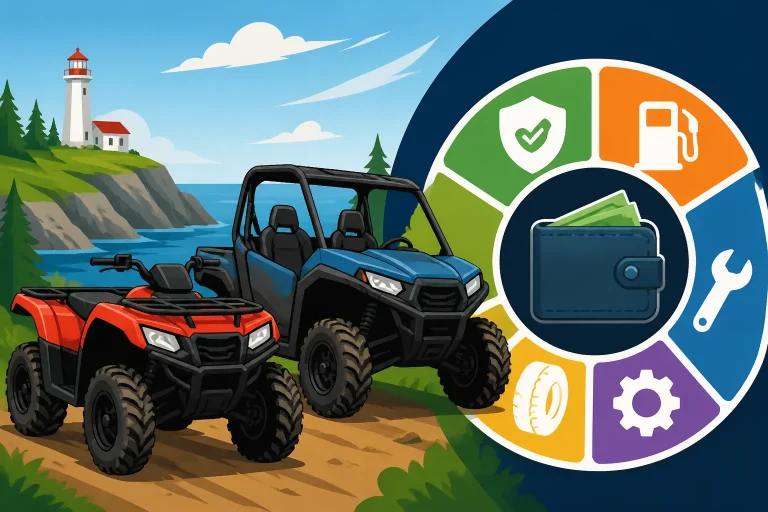
HST is a purchase cost. Registration, insurance, trail access and ongoing upkeep are separate parts of the ownership budget. Treating all of them as one vague “extra” makes it difficult to know what you owe at purchase and what you will need to pay to use the machine.
Nova Scotia’s registration rules are a separate issue from sales tax. Service Nova Scotia and Municipal Relations says off-highway vehicles must be registered unless they are used exclusively on the owner’s property. If you plan to ride away from your own property, check the registration steps and required documents before making the purchase. The rules may affect what paperwork you need from the seller.
According to Service Nova Scotia – Registry of Motor Vehicles, Nova Scotia residents operating an off-highway vehicle on land they do not own or occupy must carry a motor vehicle liability policy. That insurance requirement is not part of HST, and it is not necessarily included in a dealer’s purchase quote. Contact an insurer or broker for a quote based on the machine and the way you intend to use it.
Trail access can involve another cost. A trail permit is not the same thing as vehicle registration, and neither replaces the other. Check whether the routes you intend to use require a trail permit and whether the permit is tied to a club or offered separately. Nova Scotia Trail Permit Cost and How to Buy a Nova Scotia Trail Permit can help you investigate that budget line.
The costs also continue after the purchase. Fuel, scheduled service, replacement parts, tires, storage and repairs can add up over time. A machine that is cheaper to buy may need immediate work or may cost more to transport and maintain for your type of riding. Before deciding, ask the seller about service history and condition, and consider getting an inspection if you are uncertain about the machine’s mechanical state.
A practical ownership budget can separate costs this way:
- At purchase: machine price, HST and any seller charges.
- Before riding: registration, insurance and any required trail permit.
- During ownership: fuel, maintenance, repairs, protective equipment and storage.
- When selling: paperwork, transfer arrangements and any costs needed to prepare the machine for sale.
This separation is useful whether you are buying new or used. It helps you avoid treating the tax reduction as a discount on every part of ownership. The lower rate affects the tax calculation; it does not remove registration, insurance or trail-access requirements.
For more detail on the first-year picture, see Nova Scotia Cost of a First Year of Ownership and Nova Scotia Annual Costs After Year One. If insurance is the main uncertainty, [Nova Scotia Insurance Costs for Riders] can help you identify what to ask when requesting a quote.
What to check before you sign or pay
A few minutes spent checking the paperwork can prevent delays and unexpected costs. Before paying, make sure the seller’s name, the machine details and the agreed price are consistent across the documents. If the machine is used, ask what registration documents are available and whether the vehicle identification information is readable and matches the paperwork.
For a dealer purchase, review the quote line by line. Do not hesitate to ask for a revised quote if the price, tax or fees are unclear. You should be able to tell which amount is the machine price, which amount is HST, and what each additional charge covers. If the dealer is arranging registration, ask what is being done on your behalf and what documents you will receive.
For a private sale, arrange a bill of sale and retain proof of payment. Confirm the seller’s authority to transfer the machine and check the identifying details before you complete the transaction. If paperwork is missing, do not assume that a low price makes the risk worthwhile. Find out what the registry will accept before paying. Nova Scotia Used Machine Paperwork and Nova Scotia Registration Without a Bill of Sale cover common documentation questions.
If the seller says the machine is already registered, remember that registration details and ownership-transfer steps matter. Service Nova Scotia – Registry of Motor Vehicles says the owner must remove the off-highway vehicle plate when the vehicle is sold. Ask what documents will accompany the machine and confirm how to complete the next registration step. Selling a Registered Machine in Nova Scotia and Nova Scotia Registration After a Private Sale address related parts of the process.
Before completing the purchase, use this checklist:
- Get a written purchase price and tax breakdown.
- Confirm whether the price is before or after HST.
- Ask what charges are added and what each one covers.
- Keep the invoice, bill of sale and proof of payment.
- Check that the machine’s identifying information matches its paperwork.
- Confirm which registration documents the seller will provide.
- Ask how and when the machine must be registered.
- Arrange an insurance quote before planning to ride away.
- Check trail permit requirements for your intended riding area.
- Leave room in the budget for maintenance, equipment and transportation.
If a seller is pressuring you to pay before you can review the documents, slow the transaction down. A legitimate opportunity should still allow you time to check the machine’s identity, price, paperwork and expected registration process.
Common budgeting mistakes to avoid
Comparing a taxed price with a pre-tax price. Ask whether each quote includes HST. If it does not, add the estimated tax to the same taxable base for a fair comparison. If a quote does include tax, ask how the seller arrived at the total.
Treating every added charge as part of the machine price. A quote can include freight, setup or document charges. Ask for each amount to be itemized and described. This keeps the tax calculation visible and makes it easier to decide whether a charge is expected or negotiable.
Assuming a lower asking price means a lower total cost. A private-sale price may not include tax or other costs you will face, while a dealer quote may already include some items. Compare the full transaction and account for the condition of the machine, paperwork, registration and insurance.
Budgeting only for the day you buy. Registration, liability insurance and trail access may be necessary before riding. Plan for those costs early rather than spending the entire budget on the machine itself.
Confusing registration with a trail permit. They serve different purposes. Check the requirements for the vehicle and for the riding area instead of assuming one document covers both.
Assuming a machine can be ridden anywhere. A machine’s purchase and registration do not automatically grant permission to use every trail or property. Check access rules and landowner permission for the places where you plan to ride.
Relying on an old price list. Fees and administrative details can change. Confirm current amounts and procedures with Service Nova Scotia before going to a counter or completing a purchase. Reference pages with historical figures can be useful for background, but do not treat them as a current quote. Nova Scotia Fee Regulations Updated April 2026 is relevant if you have found conflicting registration-cost information.
Forgetting the cost of ownership after the first season. Repairs, tires, storage and routine service can affect the real cost more than a small difference in the purchase price. Ask about maintenance records and make a realistic reserve for wear and repairs.
A practical way to compare two machines
When comparing machines, use the same worksheet for each one. Start with the seller’s written price, then list the tax and every other charge. Keep costs you will pay to third parties in separate rows, so they do not disappear inside a dealer quote or a loan payment.
For each option, record:
| Comparison point | Machine A | Machine B |
|---|---|---|
| Seller’s stated price | ||
| Whether price includes HST | ||
| Taxable amount identified by seller | ||
| HST shown on quote | ||
| Freight, setup or other seller charges | ||
| Documents included | ||
| Registration steps still required | ||
| Insurance quote | ||
| Trail permit needed for planned rides | ||
| Known repairs or maintenance needs | ||
| Total amount needed before first ride |
Use the same assumptions for both machines. If one is a dealer sale and the other is private, note the difference clearly rather than forcing both into the same invoice format. A dealer may provide a formal tax breakdown; a private sale may require you to confirm tax and registration procedures separately.
If you are financing, compare the total amount payable under each offer, not only the payment schedule. Ask whether insurance, registration or accessories are being added to the financing and whether the quoted total includes any fees. Financing can make the initial outlay feel smaller, but it does not make those costs disappear.
A useful decision is not necessarily the machine with the lowest amount due today. Consider whether the machine suits your intended riding, whether its condition is documented, whether the paperwork is complete, and whether you can afford the ongoing costs. When the purchase is a stretch before insurance and trail access are included, it may be worth considering a less expensive machine or waiting until the complete budget is comfortable.
Frequently Asked Questions
Does the 14% HST rate apply to every ATV or UTV purchase?
The Government of Nova Scotia sets the HST rate at 14%. The tax amount depends on the transaction and taxable amount. Ask the seller or Service Nova Scotia how the tax applies to your specific purchase, particularly for a private sale or a transaction involving a trade-in.
Is HST included in a dealer’s advertised price?
Do not assume it is. Ask the dealer whether the advertised amount includes HST and request a written breakdown of the final price, tax and added charges.
Is registration included in the HST?
Registration is a separate administrative requirement, not the HST calculation. Service Nova Scotia and Municipal Relations requires registration for off-highway vehicles unless they are used exclusively on the owner’s property. Confirm current registration charges and steps with Service Nova Scotia.
Do I need insurance as well as registration?
The requirements are separate. According to Service Nova Scotia – Registry of Motor Vehicles, Nova Scotia residents operating an off-highway vehicle on land they do not own or occupy must carry a motor vehicle liability policy. Confirm your coverage with an insurer before riding.
What should I do if I cannot understand the tax on my quote?
Ask the seller to identify the taxable amount, the HST charged and each additional fee in writing. If the transaction is a private sale or the answer remains unclear, check with Service Nova Scotia before completing the purchase.
Sources
- Government of Nova Scotia — Road Trails Act for Off-highway Vehicles – Government of Nova Scotia, Canada (checked November 3, 2026)
- Government of Nova Scotia — Nova Scotias Hst Drop (checked November 3, 2026)
Disclaimer
This article is for general informational purposes only and does not constitute professional advice. Laws, prices and regulations vary by location and change over time. Consult a qualified professional for guidance on your specific situation.