Nova Scotia Rules for Carrying a Firearm
Riding an ATV or UTV through Nova Scotia's beautiful backcountry is a cherished pastime for many, whether for trail riding, accessing a remote fishing spot, or heading to a hunting stand. However, when you add a firearm to the mix, a whole new layer of rules and responsibilities comes into play. It's a common point of confusion for riders: how exactly can you legally and safely transport your rifle or shotgun on your off-highway vehicle (OHV) without breaking the law or risking an accident? This guide is here to untangle those regulations and provide clear, practical advice for carrying a firearm responsibly on your Nova Scotia ATV or UTV.
The Basics of Firearm Transportation on Off-Highway Vehicles in Nova Scotia
Navigating the rules for carrying a firearm on your ATV or UTV in Nova Scotia can feel a bit like reading two different rulebooks at once. That's because you're dealing with both federal firearm legislation, which governs how you possess and transport a firearm anywhere in Canada, and provincial off-highway vehicle regulations, which dictate how you operate your machine and what equipment you can carry. Ignoring one set of rules could land you in serious trouble, so understanding both is absolutely key.
Understanding the Legal Framework
Federally, the core principle for transporting non-restricted firearms – which includes most common hunting rifles and shotguns – is that they must be unloaded and securely cased or wrapped. This isn't just a suggestion; it's the law. "Unloaded" means there's no ammunition in the chamber or in any attached magazine. If the magazine is detachable, it should ideally be removed and stored separately from the firearm itself, and of course, no ammunition should be in the chamber.
When it comes to your ATV or UTV, the provincial OHV Act doesn't specifically detail how a firearm must be carried, but it reinforces the general safety principles. This means that while federal law tells you what state the firearm must be in, provincial common sense and safety expectations come into play for how it's secured to your machine. For instance, having a firearm uncased and strapped to your handlebars, even if unloaded, would likely be seen as a violation of the spirit of safe transport and could potentially lead to charges. The idea is that the firearm should not be readily accessible for immediate use, nor should it pose a danger to you or others if you hit a bump or, heaven forbid, have a rollover.
This legal overlap is why many riders find themselves scratching their heads. They know their firearm needs to be unloaded, but then they wonder about the specifics of cases, mounting racks, and what's considered "secure." The safest approach is always to err on the side of caution: unloaded, in a proper case, and securely fastened to the machine where it can't fall off or be grabbed quickly.
Different Types of Firearms and Their Rules
The kind of firearm you're carrying dramatically impacts the transportation rules. For most ATV and UTV riders in Nova Scotia, especially those heading out for hunting or land management, we're talking about non-restricted firearms. These are your standard hunting rifles, shotguns, and some older military-style rifles. For these, the "unloaded and securely cased" rule is the main takeaway. You need a valid Possession and Acquisition Licence (PAL) to own and transport these.
Things get much stricter if you're dealing with restricted firearms, like most handguns or certain semi-automatic rifles. Transporting these typically requires an Authorization to Transport (ATT) issued by the RCMP's Canadian Firearms Program, specifying the exact route and purpose. They must also be unloaded, rendered inoperable with a locking device, and transported in a locked, opaque container. It's highly, highly unlikely you'd be legally transporting a restricted firearm on an ATV for typical recreational or hunting purposes. The logistics and legal requirements make it impractical and often impossible without specific, prior authorization.
Prohibited firearms, such as fully automatic weapons, are generally not permitted for civilian ownership or transport at all, except under very rare and specific circumstances for licensed collectors or businesses, and certainly not for general OHV use. So, for the vast majority of riders, the focus remains squarely on understanding the rules for non-restricted firearms. Don't forget that bows and crossbows, while not firearms, also have their own transport rules, often requiring them to be unstrung or cased when transported on an OHV, especially on trails or public lands. Always check the hunting regulations for the specific season and type of weapon.
The Importance of a Valid Licence and Registration
Just as you need a valid PAL to possess and transport a firearm, you also need to ensure your off-highway vehicle is properly registered and permitted to be on the trails or land you're traversing. This might seem obvious, but it's another area where riders can run into trouble if they overlook provincial requirements. In Nova Scotia, registering your ATV or UTV is mandatory for use on any land other than your own private property, with very few exceptions.
The cost associated with this registration includes both a one-time Certificate of Registration fee and an annual Vehicle Permit fee. This is crucial because an officer encountering you on a trail will expect to see proof of both your valid firearm licence and your machine's valid registration. Ignoring OHV registration can lead to fines, even if your firearm transport is otherwise perfectly legal. You can learn more about the costs involved by checking out articles like [Nova Scotia OHV Registration Cost]. Furthermore, understanding whether [Do You Need to Register an ATV in Nova Scotia?] is a question you still have can save you a lot of grief. It’s an easy step to ensure you’re compliant before you even think about loading up your hunting gear. Think of it this way: both your firearm and your OHV are specialized pieces of equipment that come with their own set of legal paperwork. Ensure all your ducks are in a row before you head out.
Practical Scenarios and Specific Nova Scotia Regulations for OHV Riders
When you’re out on the trails or heading into the woods, real-world situations often crop up that require you to apply these rules. From heading to your hunting blind to working on your woodlot, understanding how the regulations translate to your actions is essential. It's not just about knowing the law; it's about practicing safe and responsible outdoor habits that reflect well on all OHV and firearm owners.
Hunting Season and Transporting Your Gear
Hunting season is undoubtedly the most common time when Nova Scotia ATV and UTV riders need to transport firearms. The ability to access remote areas, retrieve game, or carry heavy equipment makes OHVs invaluable tools for hunters. However, this convenience comes with strict rules for firearm transport. As emphasized earlier, your non-restricted hunting rifle or shotgun must be unloaded and securely cased when being transported on your ATV or UTV. This applies whether you’re on a public trail, a woods road, or private land (unless that private land is your own and you're actively engaged in certain permitted activities).
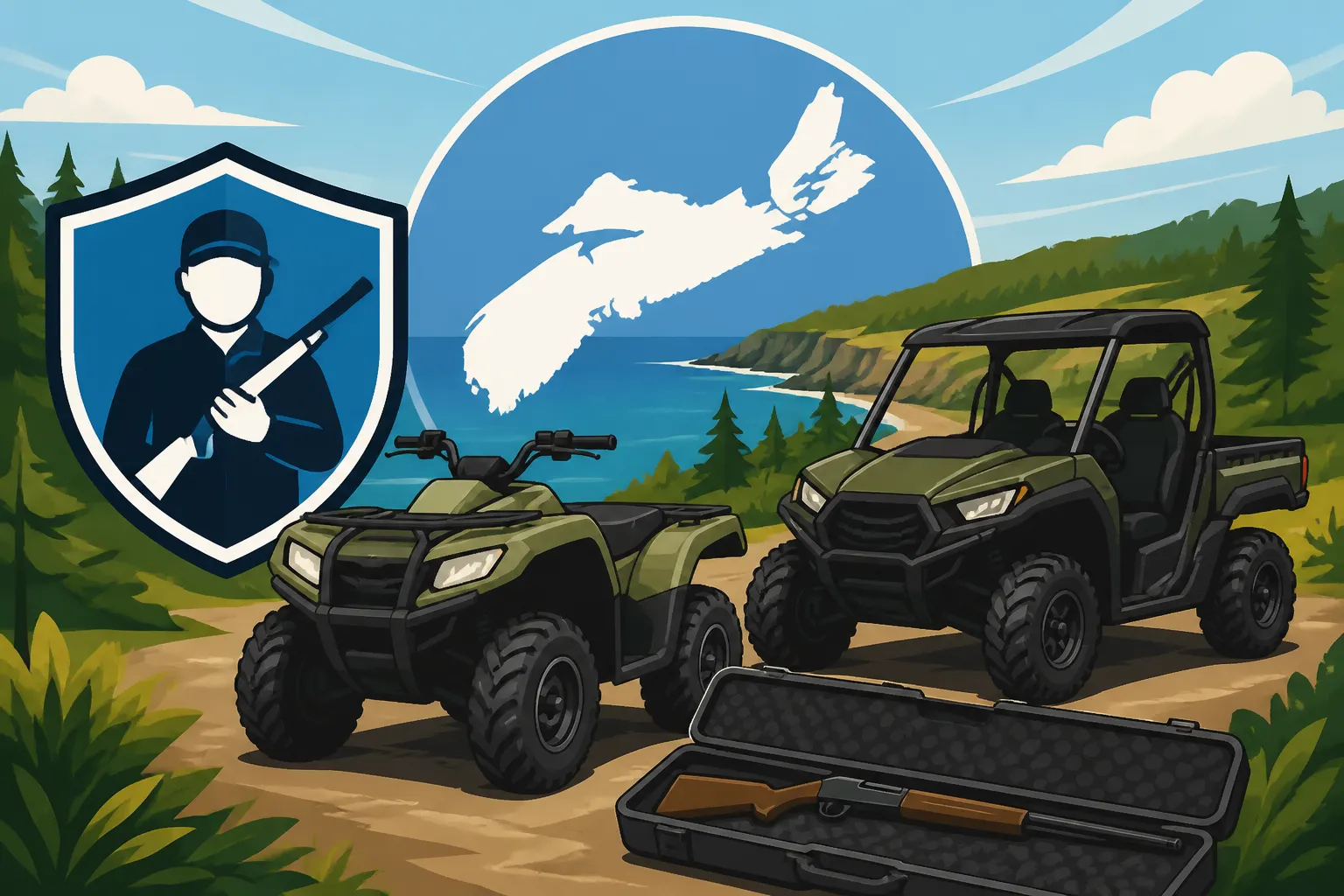
Many riders utilize specialized firearm racks or scabbards designed to attach to ATVs or UTVs. While these are convenient, they must comply with the "securely cased" rule. A soft scabbard is often acceptable if it fully encloses the firearm, protects it, and is securely fastened to the machine. Hard cases, which many manufacturers like SuperATV offer, provide even greater protection against impacts and the elements, and are typically considered an excellent choice for secure transport. The key is that the firearm cannot be readily accessible or exposed in a way that suggests immediate use. Ammunition should also be stored separately, in its own container, away from the cased firearm. This minimizes any risk of accidental loading or discharge.
It’s also important to remember that provincial hunting regulations dictate when and where you can carry a loaded firearm, even if walking. These rules are separate from, but complementary to, the OHV and federal firearm regulations. For instance, you generally cannot have a loaded firearm in or on any conveyance, including an ATV or UTV, at any time. When you reach your hunting location, you would dismount, uncase your firearm, and then load it, always following proper firearm safety procedures. Understanding [Nova Scotia Hunting Access by Quad] can further clarify the nuances of using your machine in conjunction with hunting.
Carrying a Firearm for Self-Defence or Protection on Your Property
This is a really important area to clarify, because Canadian law regarding self-defence with a firearm is very different from what you might see in other countries. In Canada, you generally cannot carry a firearm on an ATV or UTV for the purpose of general self-defence while out on public trails or Crown land. The legal use of a firearm in self-defence is extremely limited, and carrying one in anticipation of needing it is typically not permitted.
However, there are specific situations where a firearm might be carried on your own private property for purposes like pest control or protection from wildlife, particularly in remote agricultural or forestry settings. For example, a farmer might carry a shotgun on their quad for coyote control on their own fields. Even in these scenarios, the general principle of safe handling and transport still applies: the firearm should be unloaded until needed, and handled responsibly. But the context of "your own land" offers a slightly different legal landscape, mainly concerning the operation of the OHV itself. While you might be exempt from certain OHV registration requirements when operating strictly on your own land, as explored in [Riding Your Own Land Without a Registration], this exemption does not extend to federal firearm laws. The federal rules around firearm possession, storage, and transport remain in full effect, regardless of where you are.
If you're operating on Crown land or public trails, the only individuals who might have specific authorization to carry a firearm for protection against wildlife would be licensed trappers in very remote areas, and this would be under specific conditions and authorizations. For the average recreational rider, the idea of carrying a firearm for self-defence on public lands or trails is simply not supported by Canadian law.
What to Expect During an Encounter with Law Enforcement
No one likes the thought of being stopped by an officer, but knowing what to expect can make the encounter smoother and stress-free. If you're stopped on your ATV or UTV in Nova Scotia and you're transporting a firearm, law enforcement will likely want to verify a few key things. First and foremost, they'll ask to see your Possession and Acquisition Licence (PAL). This is your proof that you're legally entitled to possess the firearm. Make sure it's current and you have it with you.
Secondly, they will want to inspect the firearm itself. This means they'll be checking to ensure it's unloaded and securely cased, as per federal regulations. Be cooperative, calmly inform the officer you have a firearm, and follow their instructions precisely. Do not reach for the firearm or attempt to uncase it without explicit direction. They might ask you to step away from your machine while they conduct the check. They're ensuring public safety and confirming you're compliant with the law. This is a critical moment where your knowledge of the rules and your calm demeanor can make all the difference.
Finally, they will likely check your OHV's registration and your permit. They’ll want to see your Nova Scotia registration paperwork, proving your machine is legally allowed on the trails or roads you're using. Remember, [Nova Scotia Equipment Checks by Officers] are routine for OHV riders, and this is just part of ensuring everyone is operating safely and legally. If your machine isn't registered, you could face [Nova Scotia Fines for an Unregistered Machine], regardless of your firearm's status. It's about being fully compliant on all fronts.
| Aspect | Proper Transport | Improper Transport |
|---|---|---|
| Firearm Status | Unloaded (no ammo in chamber/magazine) | Loaded (ammo in chamber/magazine) |
| Casing | Securely cased (hard or soft case, fully enclosed) | Uncased, exposed, or not fully enclosed |
| Security | Firmly attached to OHV, cannot fall off | Loosely strapped, rattling, or easily dislodged |
| Accessibility | Not readily accessible for immediate use | Easily grabbed, on lap, or within arm's reach while riding |
| Ammunition | Stored separately from the firearm in a container | In the firearm, or loose with the firearm |
| Documentation | Valid PAL, OHV registration, any required permits | Missing PAL, expired OHV registration |
| Interaction with Law | Cooperative, informs officer of firearm's presence | Non-cooperative, attempts to handle firearm without direction |
Common Mistakes, Safety, and Best Practices
Even with the best intentions, it's easy to make mistakes if you're not absolutely clear on the rules. Carrying a firearm, especially on an OHV, requires a heightened sense of responsibility. Understanding common pitfalls and adopting best practices will not only keep you legal but also ensure your safety and the safety of those around you.
Misconceptions and Violations
One of the biggest misconceptions riders have is that if a firearm is unloaded, it can be carried openly, perhaps in a holster on their hip while riding, or strapped uncased to the outside of the machine. This is a significant violation for non-restricted firearms. The federal law is clear: it must be unloaded and securely cased. A holster on your hip, while perhaps a good way to carry a handgun (a restricted firearm, which typically requires an ATT to transport), is completely inappropriate and illegal for a non-restricted rifle or shotgun while mounted on an ATV or UTV.
Another common error is assuming that because you're on a woods road or a remote trail, the rules are relaxed. This couldn't be further from the truth. Federal firearm laws apply across Canada, regardless of how remote your location is. Provincial OHV rules also apply to virtually all trails and Crown lands. Getting caught with an improperly transported firearm can lead to severe penalties, including hefty fines, seizure of your firearm, and potential criminal charges. This is far more serious than, say, forgetting your [Nova Scotia ATV Helmet Law] compliance. While [Nova Scotia Penalties for Riding Unregistered] can be substantial, firearm violations often carry even greater weight.
Furthermore, some riders might mistakenly believe that a firearm "rack" on an ATV is implicitly approved for open carry. While these racks are incredibly useful, they are intended to secure a cased firearm. Using them to openly display an uncased firearm, even unloaded, is a violation of the secure transport requirements. Always prioritize safety and legality over convenience or perceived practicality.
Safe Storage and Transport Practices
So, what are the best practices for safe and legal firearm transport on your ATV or UTV? It starts with the right equipment and the right mindset. Invest in a good quality firearm case. This could be a hard-sided case that offers superior protection against impacts, dust, and moisture, or a durable soft case designed specifically for OHV use. Cases from brands like SuperATV are designed with the rigour of off-road use in mind, often featuring secure mounting points and durable materials. The key is that it must fully enclose the firearm and protect it.
Once your firearm is safely cased, you need to securely fasten it to your OHV. Use heavy-duty straps, bungee cords, or a purpose-built mounting system that ensures the case cannot shift, bounce loose, or fall off, even on rough terrain. Test its security before you leave by gently tugging and shaking the case. The last thing you want is your valuable firearm tumbling off your machine on a bumpy trail. When carrying two machines, say for yourself and a buddy, ensuring both are properly secured to the ATV or UTV is crucial.
Always double-check that your firearm is unloaded before placing it in its case and mounting it on your OHV. This should be a routine habit, like checking your fuel level. Visually and physically inspect the chamber and magazine. Store ammunition in a separate, secure container, away from the firearm itself. This might seem like an extra step, but it's a fundamental safety practice that prevents accidental loading and discharge. These practices are not just legal requirements; they are essential safety measures that protect you, your companions, and the public. When considering [Nova Scotia Rules for Riding a Woods Road] or even [Nova Scotia Crown Land Riding Rules], these transport requirements remain paramount.
When in Doubt, Ask the Experts
The world of firearm and OHV regulations can be intricate, with nuances that might not be immediately obvious. If you ever find yourself uncertain about a specific rule or scenario, the absolute best course of action is to consult the official sources. Do not rely solely on hearsay or internet forums.
The RCMP Canadian Firearms Program is the authoritative source for federal firearm laws. Their website contains extensive information, and they have a dedicated phone line where you can speak to an expert. For provincial regulations related to OHVs, hunting, and land use in Nova Scotia, the Department of Natural Resources and Renewables (DNRR) is your primary resource. They can clarify aspects of the Off-highway Vehicles Act, as well as hunting and trapping regulations that might impact how you transport a firearm.
Remember, laws can change, and interpretations can sometimes vary based on specific circumstances. Proactively seeking clarification from official sources is a sign of a responsible firearm and OHV owner. It demonstrates a commitment to safety and compliance, which ultimately benefits everyone who enjoys Nova Scotia's outdoors. Whether you're trying to figure out [Nova Scotia Private Woodlot Permission] or the specific ins and outs of firearm transport, a quick call or website visit to the right department is always a smart move.
Disclaimer
This article is for general informational purposes only and does not constitute professional advice. Laws, prices and regulations vary by location and change over time. Consult a qualified professional for guidance on your specific situation.