Reflective Gear in Fog
Fog can turn a familiar Nova Scotia road trail into a low-visibility ride surprisingly quickly, especially near the coast, wooded stretches, and open fields. Reflective gear helps other road users notice you, but it does not replace required machine lighting or make riding in unsafe conditions a good idea. This guide explains what to wear, how to use it, and what to check before heading out.
Why fog changes the visibility problem
Being visible is different from being able to see
Fog makes it harder to judge distance, speed, and where the road or trail edge lies. A driver approaching from behind may also have less time to notice an ATV or UTV, particularly when the machine blends into a dark, wet background. Reflective material can help show where you are when light from headlights reaches it, but it does not improve your view of the trail ahead.
That distinction matters. A reflective vest may help another driver spot your torso, while your headlight helps you identify the route and your tail light helps people behind you notice the machine. None of those measures guarantees that others will see you in dense fog. Slow down, leave more room to stop, and consider postponing the ride if you cannot confidently see the way ahead.
Fog often arrives in patches rather than as an even blanket. You might leave a clear stretch near Truro and meet thick mist along a low, wooded section, or find visibility changing as you approach the coast. Treat every sudden change as a reason to ease off the throttle and reassess, not as a cue to rely more heavily on reflective clothing.
Reflective gear works best as part of a visibility plan
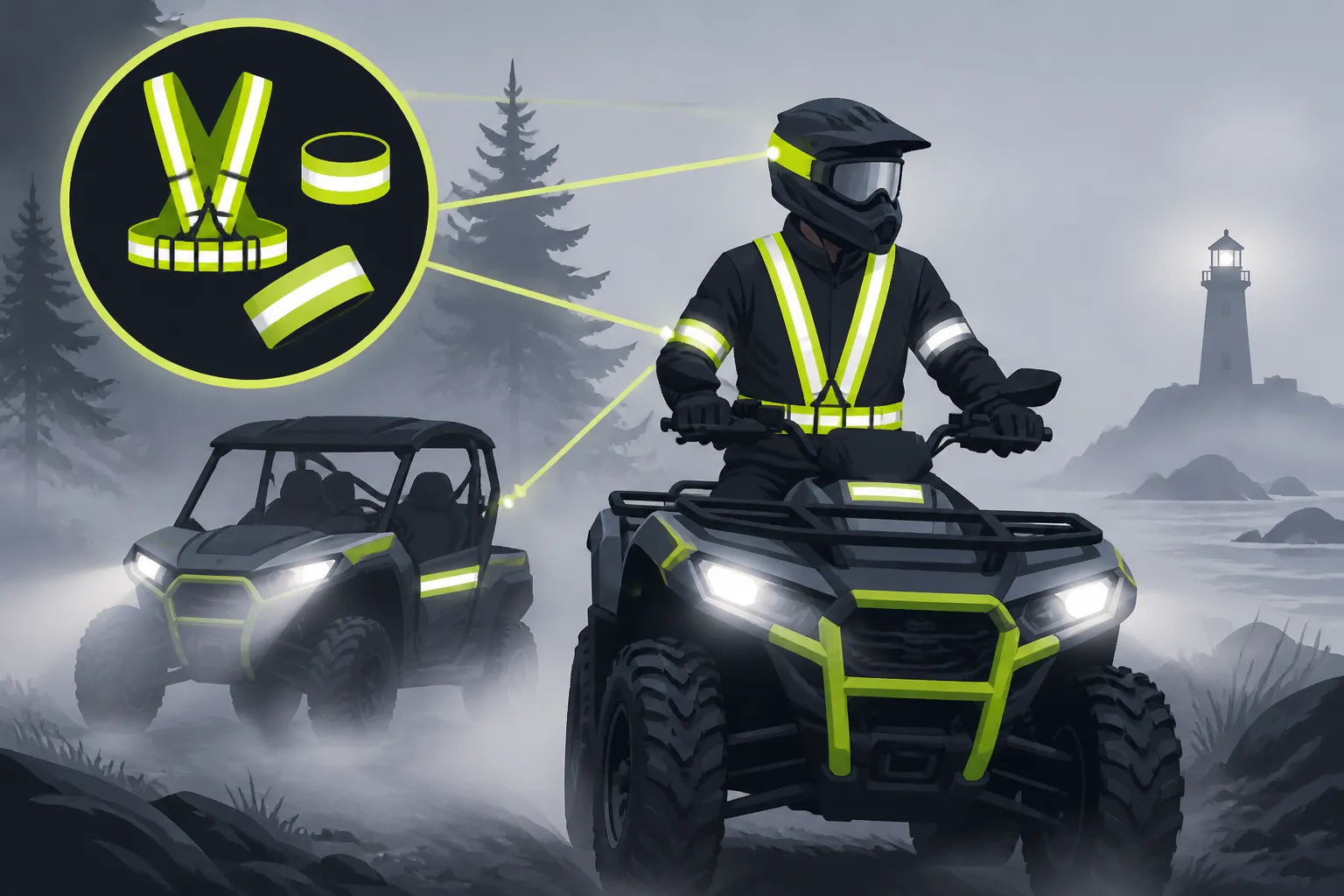
Reflective surfaces return light toward its source. That is why they can stand out when illuminated by headlights, but appear much less noticeable in a place with no light directed at them. Bright fluorescent colours can help during daylight and some twilight conditions; reflective trim is especially useful when a vehicle’s lights shine on it. Wearing both can provide a more practical combination than relying on either alone.
Visibility also depends on where the material sits. A small reflective patch hidden under a jacket, muddy across the back, or covered by a backpack cannot do much. Consider the view from several directions: the front, sides, and rear. On a UTV, passengers may obscure each other, and gear or a cargo load can cover reflective areas on the machine. Check your setup from outside the vehicle before setting off.
Reflective clothing is not a substitute for operating lights or following applicable rules. For road-trail riding, review [Nova Scotia Night Riding Equipment Rules] and [Nova Scotia Headlight and Tail Light Rules] before you ride after dark or in poor visibility. A vest can improve conspicuity; it cannot make an unlit or improperly equipped machine safe.
Choosing and wearing reflective gear
Pick gear that stays visible while you ride
A practical starting point is a high-visibility outer layer with reflective sections that remain exposed when you sit, lean, or turn. The fit should allow comfortable movement without catching on controls, and the material should not interfere with your helmet, eye protection, or ability to operate the machine. A vest can be easy to put on over a jacket, while reflective bands or panels may work better for someone who finds a loose layer distracting.
Think about how you actually ride, not just how the gear looks on a hanger. If you wear a backpack, check whether it covers the vest. If you carry tools or a saw, make sure straps and equipment do not block the reflective areas. For a passenger, choose gear that remains visible beside the driver rather than disappearing behind them. On a side-by-side, make sure each occupant has visible clothing and that doors, windshields, or cargo do not hide it from the side.
When comparing accessories, read the description carefully and check whether the item is apparel, a reflective add-on, or a vehicle-mounted accessory. A company name by itself does not tell you whether a specific product is suitable for fog or road use. If you are browsing listings from SuperATV, for example, confirm the item’s intended purpose and how it would fit your particular machine before treating it as a visibility aid.
| Visibility measure | What it can help with | What it cannot do |
|---|---|---|
| High-visibility clothing | Make the rider easier to distinguish in daylight and changing light | Illuminate the trail or replace required equipment |
| Reflective panels or bands | Return light toward an approaching light source | Guarantee visibility when no light reaches them |
| Headlight and tail light | Help the rider see and help others identify the machine | Remove the need to adjust speed and following distance |
| Clean mirrors, visor, and lights | Keep available sightlines and lighting clearer | Make dense fog safe to ride through |
| Reduced speed and increased space | Allow more time to react to hazards | Compensate for visibility that is too poor to proceed |
Keep reflective surfaces clean and uncovered
Mud, dust, salt spray, and wet leaves can make reflective material less effective or harder to distinguish. Coastal rides can leave a film on clothing and machine surfaces, while a wet trail may throw grime onto lower panels. Check your vest, jacket, reflective strips, and lights before the ride and again if conditions become especially dirty. Follow the care instructions on the garment; rough cleaning or unsuitable detergents can damage some materials.
Pay attention to placement. A reflective strip on a boot may be hidden by a footwell, while a bright patch on the back may be covered by a pack. On a UTV, reflective clothing on the occupants does not necessarily make the vehicle’s sides or rear easier to identify. If you add vehicle-mounted reflective material, make sure it does not cover lights, obscure the permit number, or conflict with other equipment.
SuperATV may appear in searches for off-road accessories, but judge any item by its actual specifications and placement rather than assuming it is designed for fog visibility. The useful question is not simply whether an accessory is reflective; it is whether it stays exposed, can be kept clean, and helps make the rider or machine easier to notice from the directions that matter.
Preparing for a foggy Nova Scotia ride
Check the machine before leaving
Before riding, make sure the headlight and tail light work and are not obscured by mud, cargo, or a damaged lens. Check the electrical connections and controls if a light flickers or fails. Clean your helmet visor, glasses, and mirrors, and carry a way to clear them if they fog or become wet. A clean visor matters because external fog and internal condensation can combine to make an already difficult view much worse.
A quick walk-around helps catch problems that are easy to miss from the driver’s seat. Look at the front and rear lights from a distance, check that reflective material is visible, and confirm that clothing or gear is not snagging on the machine. For road-trail riding, review [Why Your Headlight Must Show at 300 Feet] and [Why Your Tail Light Must Show at 200 Feet] for the specific lighting points riders should understand. Reflective apparel supplements a properly equipped machine; it does not correct a lighting problem.
It also helps to know where you are going and whether the route is appropriate for your machine and conditions. Check the route’s operating rules and any local restrictions before departure. [Nova Scotia Road Trail Operating Hours] is useful background when planning a ride that could extend into dimmer conditions. If fog arrives unexpectedly, do not feel committed to finishing the planned loop.
Adjust how you ride when visibility drops
Reduce speed before visibility becomes severely limited. At a slower pace, you have more time to recognize a stopped vehicle, a bend, a gate, a pedestrian, or debris on the trail. Increase the gap behind the machine ahead, too. Following closely can leave you with little time to respond if the leader brakes suddenly or disappears in a pocket of fog.
On a group ride, keep the group organized and avoid trying to maintain the pace you would use in clear weather. Agree on a safe place to stop, and make sure riders know how to communicate if they lose sight of one another. Do not stop in a spot where approaching traffic or trail users are unlikely to see you; move to a safe location where possible and make yourself visible before anyone gets off the machine.
Fog can make familiar landmarks seem unfamiliar. If you are unsure of the route, stop safely and consult your map rather than guessing at a turn. Carrying useful ride information and required paperwork is sensible preparation; [Carrying Papers on a Coastal Ride] covers the practical side of keeping documents with you. For road-trail use, also confirm that the machine meets the relevant registration and insurance requirements, including the information in [Nova Scotia Requires Registration and Insurance].
When to turn around or wait
Set a limit before the ride
It is easier to make a cautious decision when you have already agreed on what conditions will make you stop. For example, decide that you will slow down substantially if you can no longer see the next safe stopping point, and that you will pull off or turn back if you cannot identify the route clearly. Choose a safe stopping area before the fog gets thick rather than waiting until you feel rushed.
A rider might be tempted to continue because the trailhead is only a short distance away or because the group has already travelled most of the route. That pressure is understandable, but distance does not make poor visibility safer. If you cannot see hazards in time to respond, the better choice is to wait in a safe place or return by a route you can navigate confidently.
Be especially cautious where a trail meets a road, where sightlines are restricted, or where other vehicles may approach from an unexpected direction. Reflective clothing can help someone notice you when their lights reach you, but it cannot guarantee that a driver will have enough time to react. [Night Visibility on a Rural Nova Scotia Road] offers related guidance for thinking about visibility around rural traffic.
Make the final check before setting off again
If fog lifts, do not assume the entire route has cleared. Conditions can vary between valleys, wooded sections, exposed areas, and coastal stretches. Pause in a safe place, inspect your lights and clothing, wipe away any dirt or moisture that blocks visibility, and make a fresh decision about whether continuing is sensible.
If you ride with others, make sure every person is ready before moving. Confirm that nobody has lost a light, had reflective gear covered by a pack, or developed a problem with a visor or eye protection. If the route remains difficult to see, wait longer or choose a safer alternative. A planned ride is optional; getting home safely is not.
SuperATV is one name riders may encounter while comparing off-road accessories, but no clothing or add-on can replace sound judgment in poor visibility. The useful combination is simple: visible clothing, clean and functioning lights, a clear view through your own eye protection, a slower pace, and the willingness to stop when conditions are beyond your comfort or ability.
Disclaimer
This article is for general informational purposes only and does not constitute professional advice. Laws, prices and regulations vary by location and change over time. Consult a qualified professional for guidance on your specific situation.