Nova Scotia Wildlife on the Trail
A quiet trail can change in a moment when a moose steps from the brush, a bear crosses ahead, or deer bolt across the corridor. Wildlife encounters are part of riding in Nova Scotia, but a little planning helps you avoid startling animals, protect yourself and your group, and leave the trail undisturbed.
Why wildlife encounters happen on Nova Scotia trails
Animals use the same corridors riders do
Many Nova Scotia ATV routes pass through forest, wetlands, old rail corridors, and working woodlots. These places are not separate from wildlife habitat: trails can cut across feeding areas, travel routes, and spots where animals seek shelter. A straight, open section may seem easy to scan, while a bend, tall growth, or low-light patch can hide an animal until you are close.
Wildlife may also be more active on trails at particular times of day or in certain seasons. Dawn and dusk can make it harder to see animals, and vegetation can limit sightlines during warmer months. In autumn, animals may be moving around more, while spring brings its own challenges, including muddy or soft trail conditions that can make stopping and turning around less predictable. Before choosing a route, check [Nova Scotia Riding in Spring] and [Nova Scotia Riding in Fall] for seasonal riding considerations.
An animal crossing the corridor is not necessarily trapped or lost. It may be moving between habitat areas and will often leave if given space. The safest response is usually to stop at a distance, avoid crowding it, and give it an unobstructed way to move away.
Which wildlife might you see
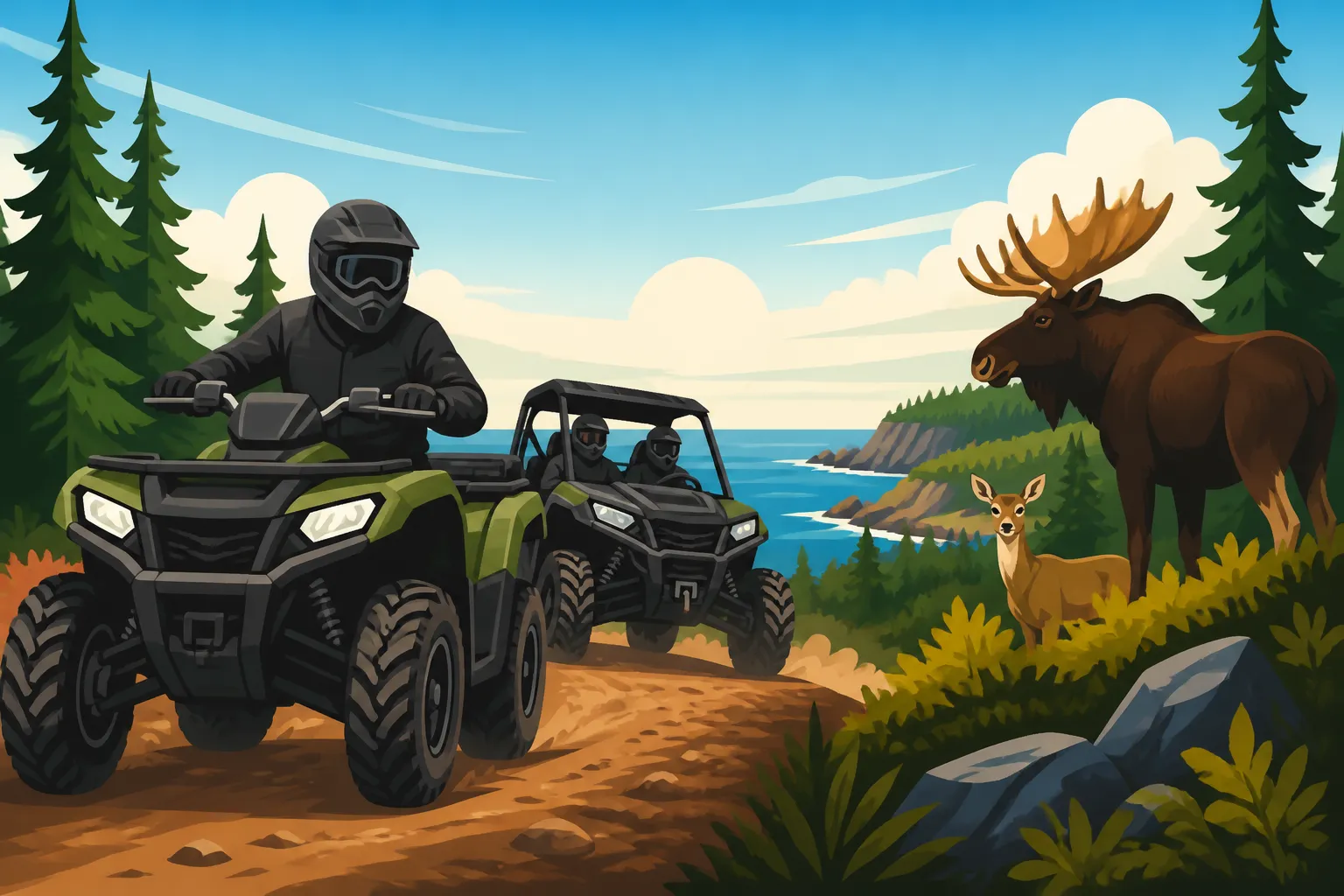
Riders may encounter black bears, moose, white-tailed deer, coyotes, foxes, porcupines, and smaller animals. Birds and reptiles may also use the trail margins. The particular animals you see will depend on where and when you ride, but the practical rule is the same: treat any wild animal as unpredictable, even if it appears calm or is familiar with people.
Large animals deserve special caution. A moose can be difficult to see in dense cover and may react defensively if it feels pressured, especially when a calf is nearby. Deer may startle and run across the trail, sometimes followed by other deer. A bear may simply be travelling through, but getting closer to take a photograph or trying to drive it off can turn an ordinary sighting into a dangerous situation.
Smaller animals also need room. A porcupine on the trail is not a reason to approach, poke, or drive around it at speed. Snakes and other small wildlife can be difficult to spot in vegetation or on warm surfaces. Keep your eyes on the trail edges as well as the route ahead, and avoid swerving suddenly to miss an animal.
What the trail setting can tell you
Fresh tracks, droppings, disturbed vegetation, or a strong smell can suggest that wildlife has been nearby. These signs do not tell you exactly where an animal is now, so use them as a reason to stay alert rather than as an invitation to investigate. Do not leave the machine to follow tracks into the woods.
Local trail conditions matter, too. A washout or reroute can funnel riders into unfamiliar terrain or bring them closer to brush where animals are harder to see. Check [Nova Scotia Trail Conditions and Closures] before leaving, and obey any signs or temporary closures you encounter. If you use onX Offroad to help plan a route, treat it as one planning aid, not a substitute for current trail notices, club information, or signs on the ground.
How to respond when wildlife is on the trail
Stop, create space, and let the animal choose its route
If you see an animal ahead, slow down smoothly and stop well before reaching it. Avoid revving the engine, accelerating toward it, or surrounding it with other riders. A group should stop together at a safe distance rather than having riders crowd forward one by one.
Give the animal an open path away from you. If it is beside the trail, wait quietly and let it move off. If it blocks the route or appears unsettled, turn back when you can do so safely. Do not assume that an animal will move just because a machine is approaching. A bear, moose, or deer may react in a way that is difficult to predict.
Keep passengers and children close to the group. Do not let anyone walk toward the animal for a better view. If you have stopped on a narrow trail, make sure other riders know what is happening and do not continue into the encounter from behind. This is one reason to agree on group signals and stopping procedures before setting out.
Respond carefully to a bear or moose
For a bear sighting, do not approach, feed, or try to chase the animal. Give it room to leave, and avoid placing yourself between it and its route away from you. If it does not move off, or if the situation feels unsafe, back away slowly when there is a clear way to do so. Do not run toward or past the bear, and do not make a sudden move to take a close-up photo.
A moose can be especially hazardous when it is close, agitated, or with a calf. Do not ride between a cow and calf, and do not try to push a moose along the trail. If it lowers its head, raises its hackles, or moves toward you, increase distance and put a solid barrier, such as a tree, between yourself and the animal if one is safely available. If you cannot pass without getting close, turn around.
These are general safety practices, not a guarantee that an encounter will unfold in a particular way. The animal’s behaviour, terrain, and your distance all matter. When in doubt, prioritize leaving the area over completing your planned route.
Keep the group calm and together
A sudden wildlife sighting can make riders react differently: one person may brake, another may try to pass, and someone else may pull out a phone. Agree in advance that the lead rider will signal a stop and that nobody moves forward until the group has assessed the situation. Keep enough space between machines that riders can stop without colliding.
If someone is separated from the group during an encounter, do not send a rider toward the animal to retrieve them. Move away if it is safe, regroup at a distance, and use a phone or other communication method if available. Remote areas can have unreliable cell coverage, so plan for that possibility before the ride. [Nova Scotia Cell Coverage on Remote Trails] is useful reading when you are choosing routes beyond easy reach of services.
| Situation | Safer response | Avoid |
|---|---|---|
| Animal ahead on the trail | Stop at a distance and leave it room to move away | Riding closer to get a photo |
| Bear near the trail | Stay calm, give it space, and back away slowly if needed | Feeding, chasing, or surrounding it |
| Moose blocking the route | Wait or turn back, especially if a calf is nearby | Riding between a cow and calf |
| Deer crossing | Slow down and watch for more animals following | Accelerating immediately after the first deer |
| Small animal at the trail edge | Reduce speed and pass only when safe | Swerving sharply or driving over vegetation |
Plan your ride to reduce wildlife risk
Choose routes with current information
Before the ride, review the route, check for closures, and learn where the trail enters remote or heavily wooded areas. A map can help you understand the general route and identify possible turnarounds, but it may not show every temporary change or local hazard. onX Offroad can help with route planning, but confirm access and conditions through local club updates and signs wherever possible.
Read [Nova Scotia Trail Maps Worth Downloading] alongside current trail information. When a map shows a corridor crossing private land, do not assume that a line on a screen means you have permission to ride there. Follow posted restrictions and respect gates. For background on access, see [Nova Scotia Crown Land Riding Rules] and [Nova Scotia Private Woodlot Permission].
Plan enough time to ride without rushing. Riders who are trying to make a distant turnaround before dark are more likely to overlook animals at the trail edge or take a blind corner too quickly. Tell someone where you expect to ride and when you plan to return, especially for a remote outing. Carry basic supplies and a way to contact help if your group becomes delayed.
Adjust speed and spacing for visibility
Ride at a speed that lets you stop within the distance you can see. Reduce speed before blind corners, narrow sections, brushy edges, and places where the trail dips or rises. On a multi-use route, be prepared for people, other machines, and animals to appear ahead with little warning. [Nova Scotia Trail Etiquette Locals Expect] covers the courtesy and awareness that help everyone share a corridor safely.
Leave enough room between machines for the rider behind to respond if the lead rider brakes. On dusty trails, increase spacing so the dust from the machine ahead does not reduce visibility. If vegetation or terrain blocks your view, treat the hidden section as a potential hazard rather than assuming it is clear.
Rain and soft ground can also affect stopping and steering. If the trail is slick, muddy, or rutted, slow down further instead of trying to make up time. [Nova Scotia Trail Riding After Rain] explains why conditions after a shower can call for extra care. Do not ride around a wet or damaged section through vegetation; that can widen the trail and disturb habitat.
Be especially cautious at low light
Early morning and evening rides can be rewarding, but reduced light makes animals harder to see and judge. Make sure your machine’s lights are working, keep your speed conservative, and avoid staring only at the centre of the trail. Scan the edges for movement and watch for reflective eyes without assuming you can identify an animal from them.
If fog, heavy rain, or darkness makes it difficult to see far enough ahead to stop, pause in a safe place or turn back. A familiar trail can feel very different when visibility drops. Do not rely on another rider’s lights to reveal every obstacle, and keep enough distance to see the trail rather than only the machine in front of you.
Night riding can also increase the chance of surprising wildlife at close range. If an animal is visible ahead, avoid flashing lights repeatedly or driving toward it. Stop, give it room, and wait for it to move or choose a safe route back.
Protect wildlife and handle an incident responsibly
Leave no food or attractants behind
Never feed wildlife, whether from your machine, a camp, or a trailhead. Feeding can draw animals closer to people and vehicles, and it can encourage them to return to places where they may be at risk. Store food and garbage securely during stops and take all waste back with you.
Do not stop to leave fruit, snacks, or other food for an animal. Even well-intended feeding changes the encounter and can create problems for the animal and future riders. Keep dogs under control where they are permitted, and do not let a dog chase or corner wildlife.
Stay on the designated corridor and avoid cutting through brush to get around an animal. Riding off-trail can damage vegetation, disturb nesting or feeding areas, and put you closer to wildlife than you intended. If a trail is blocked by an animal, waiting or turning back is generally a better choice than making a new route.
Know what to do after a collision or close call
If your machine strikes an animal, first check whether anyone is injured and move riders out of immediate danger if you can do so safely. Do not approach an injured large animal. It may be frightened, in pain, or capable of causing serious injury. If there is a danger to people or traffic, contact emergency services or local authorities.
If the animal is injured but not an immediate threat, seek direction from the appropriate local authorities rather than trying to handle it yourself. Make a note of the location and what happened. If the incident also caused trail damage, a spill, or a hazard for other users, notify the relevant trail club or land manager. For guidance on reporting damage to a corridor, see [Reporting Trail Damage to a Nova Scotia Club].
If a rider is injured, treat that as the priority and get help. Do not put another person at risk by approaching an animal that is still nearby. When conditions are unsafe, move the group away and wait for assistance from a secure location.
Make wildlife awareness part of group riding
Before leaving the trailhead, remind everyone to watch for animals, keep food packed away, and follow the lead rider’s signals. Families riding together can review these expectations with children in simple terms: stay with the group, do not approach animals, and tell an adult if they spot wildlife. [Nova Scotia Riding With Kids on the Trail] offers more planning considerations for family outings.
At the end of the ride, share useful information about a hazard or trail closure with the appropriate club or land manager. Stick to observable details, such as the trail segment and time of day, rather than encouraging others to seek out an animal. That kind of responsible reporting can help riders make safer choices without turning wildlife into a roadside attraction.
A respectful encounter is often a brief one: slow down, leave space, and let the animal continue on its way. When you plan for that possibility, you can enjoy Nova Scotia’s trails without treating the forest as if it belongs only to riders.
Disclaimer
This article is for general informational purposes only and does not constitute professional advice. Laws, prices and regulations vary by location and change over time. Consult a qualified professional for guidance on your specific situation.