Riding Out of Digby
A ride starting in Digby can look straightforward on a map, then get complicated when a route reaches a public road, private woodlot, closed trail, or foggy stretch near the coast. This guide explains how to plan an ATV or UTV ride from Digby, verify where machines are allowed, prepare for local conditions, and choose a sensible route without assuming every visible track is open.
Planning an ATV ride from Digby
Start with permission, not the map
Digby is a useful base for exploring southwestern Nova Scotia, but a trail line on a map does not automatically mean the route is open to ATVs or UTVs. A line might show a road, an old rail corridor, a woods road, or a route intended for another kind of recreation. Before setting out, confirm that the specific segment allows your machine and that you have any required trail permit.
Begin with the local club or trail information for the area, then check municipal road-trail information if your planned route uses public roads. Current permissions can vary from one segment to the next, even when trails appear to connect. For a broader starting point, use [Nova Scotia ATV Trail Map Downloads] and [Nova Scotia Road Trail Site Lists], then verify important details with the relevant club or municipality.
A digital mapping tool such as onX Offroad can help you sketch a route and keep track of where you intend to go. Treat it as a planning aid, not proof of access. If a mapped track crosses a private property boundary, enters a closed area, or seems to continue along a road where machines may not be permitted, stop and confirm before riding.
Choose a route that fits the day
For a first outing from Digby, plan a modest loop or out-and-back route rather than trying to connect distant communities in one ride. A short route gives you room to learn the trail surface, assess how quickly your group travels, and turn around if conditions are poor. It also makes it easier to respond when a gate is closed or a trail segment is unexpectedly unavailable.
Think about what you want from the ride. A group looking for a relaxed day may prefer an established, clearly marked trail with straightforward access and a nearby place to stop. Riders looking for a longer outing may be tempted by routes toward communities such as Smith’s Cove or Weymouth, or by a broader exploration of the Digby Neck area. Those place names can help orient your planning, but they do not establish that a continuous ATV route exists between them. Check each segment individually rather than assuming that a road or trail connection is legal.
When comparing possible routes, use details that matter on the ground: trail surface, access points, distance between safe stops, likely cell coverage, and whether the route crosses roads or private land. onX Offroad may be helpful for visualising a proposed ride, while local trail maps and direct permission checks should guide the final decision. If you cannot confirm a segment, leave it out of the day’s plan.
Check trail access before you leave
A good pre-ride check saves the frustrating moment of reaching a locked gate with a group waiting behind you. Review [Nova Scotia Trail Conditions and Closures] before travelling, and contact a local club when a route crosses club-maintained land or you are unsure about access. Ask whether the segment is open to your machine, whether there are temporary restrictions, and where the best legal access point is.
Access can be especially easy to misunderstand where a route meets a road. A road that appears quiet may not be an approved road trail, and rules may differ between municipalities. Review [Nova Scotia Road Trail Rules Explained] if your trip could involve an authorized road-trail segment. Do not ride along a shoulder or use a road to bridge a gap in your trail route unless that specific use is permitted.
Keep a backup plan that uses confirmed routes. If a trail is closed, do not ride around a barrier or cut across adjacent land to rejoin the route. A detour can put you on private property or into a sensitive area, and it may create problems for the club or landowner who maintains access. A second, shorter route is a much better fallback than improvising at a junction.
| Planning question | What to confirm before riding |
|---|---|
| Is the trail open? | Check current club or trail information and any posted notices |
| Are ATVs or UTVs allowed? | Confirm that the segment permits your machine type |
| Is a permit required? | Review [Nova Scotia Trail Permits From ATVANS] and the rules for the route |
| Does the route use public roads? | Verify that each road segment is approved for off-highway vehicles |
| Does it cross private land? | Confirm access and follow posted gates and landowner directions |
| Is the route manageable? | Consider surface, daylight, fuel, weather, and the least experienced rider |
What to expect on trails around Digby
Coastal weather can change the ride quickly
The coast around Digby brings its own planning challenge: conditions can feel different from inland weather, and fog, wind, or damp air can affect visibility and comfort. A route that seems easy to follow in clear daylight may feel much less obvious when visibility drops or the trail surface gets slick. Check the forecast for the route area, not only the town where you start, and be prepared to shorten the ride.
Bring layers and rain protection, even if the morning looks promising. Coastal weather can make a long stop uncomfortable, especially if riders are damp and exposed to wind. Before leaving, agree that anyone in the group can call for a stop or turn-around without being pressured to continue. That simple understanding can prevent a minor weather change from becoming a bigger safety issue.
Fog deserves special attention near exposed or coastal sections. Slow down if visibility is reduced, increase the space between machines, and do not assume that the rider ahead can see hazards for the whole group. A tool such as onX Offroad may help you keep your planned route in view, but it cannot make a poorly visible trail safe. For more local planning considerations, see [Nova Scotia Coastal Fog and Riding].
Trail surfaces and land access deserve respect
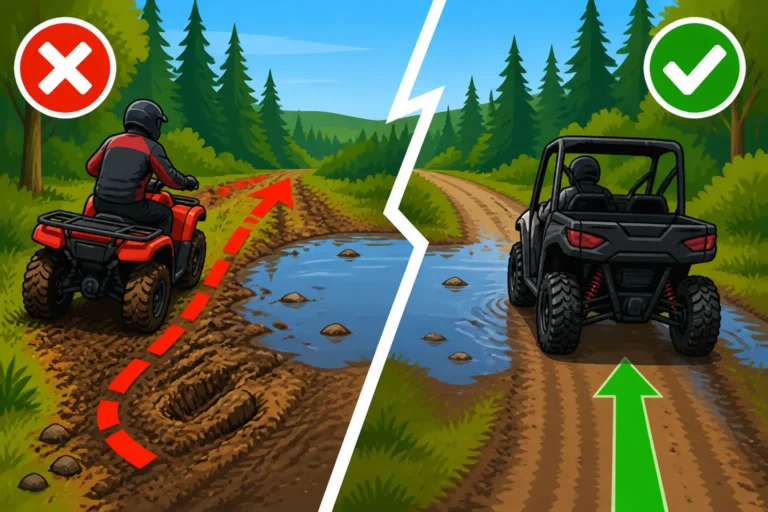
Trail conditions can change after rain, heavy use, maintenance work, or seasonal closures. Mud can hide ruts and rocks, while riding around a wet or damaged patch can widen the trail and create a new problem for the next rider. Stay on the marked corridor and avoid cutting across vegetation to bypass a rough spot. If a section looks unsafe, turn back or use a confirmed detour.
Some routes in rural Nova Scotia pass through private woodlots. A trail may depend on a landowner’s permission, and that permission can come with expectations: stay on the marked route, leave gates as found, keep noise down, and do not leave litter. A trail shown in a mapping app is not a substitute for permission. Review [Nova Scotia Trails That Cross Private Woodlots] and [Nova Scotia Private Woodlot Permission] before riding a route where ownership or access is unclear.
The same cautious approach applies to Crown land. Do not assume that a public-land location means every trail or activity is allowed. Confirm the access rules for the specific area, and avoid entering protected, restricted, or closed sections. [Nova Scotia Crown Land Riding Rules] is a useful companion when you are planning beyond a clearly established club trail.
Plan around fuel, daylight, and communications
A route’s distance on a screen does not tell you how long it will take. A rocky, rutted, or muddy trail can slow a group considerably, and frequent stops for navigation or regrouping add time. Estimate fuel needs conservatively, especially if the route takes you away from services. Do not plan to reach a fuel stop at the last possible moment; leave a reserve for a detour or an unexpected slowdown.
Before departure, identify where your group can safely stop and regroup. Set a clear rule for junctions: riders wait for the person behind them, and no one continues through a turn alone because the group ahead has disappeared. Share the route and expected return time with someone who is not riding. If you use onX Offroad to review the route, make sure everyone understands that the group follows confirmed trail access, not simply the shortest line between two points.
Cell service can be inconsistent outside populated areas. Carry a charged phone, but do not make a phone signal the only part of your emergency plan. Consider what the group will do if a machine breaks down, a rider becomes injured, or you need to return by a different route. Pack basic first-aid supplies, water, a tool kit suited to your machines, and any recovery gear appropriate for the terrain.
A safer, smoother ride from Digby
Set expectations before the group starts
A mixed group usually moves at the pace of its least experienced rider, not its fastest machine. Before leaving, talk about the route, likely conditions, expected stops, and how the group will handle a separation. Make sure every rider knows the planned turn-around point and what to do if they lose sight of the machine ahead.
Keep a safe following distance and slow down near driveways, trail entrances, road crossings, and places where people may be walking or working. Dust, engine noise, and sudden movement can affect nearby residents and other trail users. The habits in [Nova Scotia Trail Etiquette Locals Expect] help keep access welcoming for everyone who shares the area.
If children or newer riders are joining, choose a route that suits their experience and the rules that apply to them. A short, well-understood ride is more enjoyable than a long day that becomes tiring or stressful. Build in breaks before anyone is exhausted, and be willing to turn back if the route proves more demanding than expected.
Keep your route flexible without riding off-route
A flexible plan means having a confirmed alternative, not making up a detour at the trailhead. Save or note the approved route, access points, and possible return options before you leave. If a closure or hazard blocks the trail, stop in a safe place and consult your plan. If the alternative route is not verified, return the way you came.
Use onX Offroad as one layer of your preparation if it helps you understand the shape of a route, but cross-check the route against local information and access permissions. Digital maps can be useful for orientation, yet trails can change, and a mapped line may not show a gate, closure, or landowner restriction. When in doubt, ask the local club or choose another route.
Before leaving the trail, check that the group is together, the machines are secure for the trip home, and no one has left equipment or garbage behind. If you noticed a washout, damaged sign, blocked corridor, or other hazard, report it to the appropriate local club or trail contact. That small follow-up can help the next rider avoid the same surprise and support the people who maintain access.
Use a simple pre-ride checklist
Use this checklist before setting out from Digby:
- Confirm that every planned trail segment is open and allows your type of machine.
- Check for local closures, landowner restrictions, and road-trail rules.
- Make sure riders have the required trail permit and any necessary documents.
- Choose a route that matches the group’s experience, available daylight, and fuel range.
- Share the route and expected return time with someone staying behind.
- Bring water, weather layers, first-aid supplies, basic tools, and suitable recovery gear.
- Agree on regrouping points and what to do if someone becomes separated.
- Turn back when access is unclear, conditions deteriorate, or the group is no longer comfortable.
A ride out of Digby is at its best when the route is confirmed, the pace is comfortable, and the group is ready to adapt. Use local trail information to decide where you can ride, treat mapping tools as planning support rather than permission, and leave enough time and fuel for the unexpected. That approach makes it easier to enjoy the area without putting trail access or rider safety at risk.
Disclaimer
This article is for general informational purposes only and does not constitute professional advice. Laws, prices and regulations vary by location and change over time. Consult a qualified professional for guidance on your specific situation.