Nova Scotia Riding With a Group of Ten
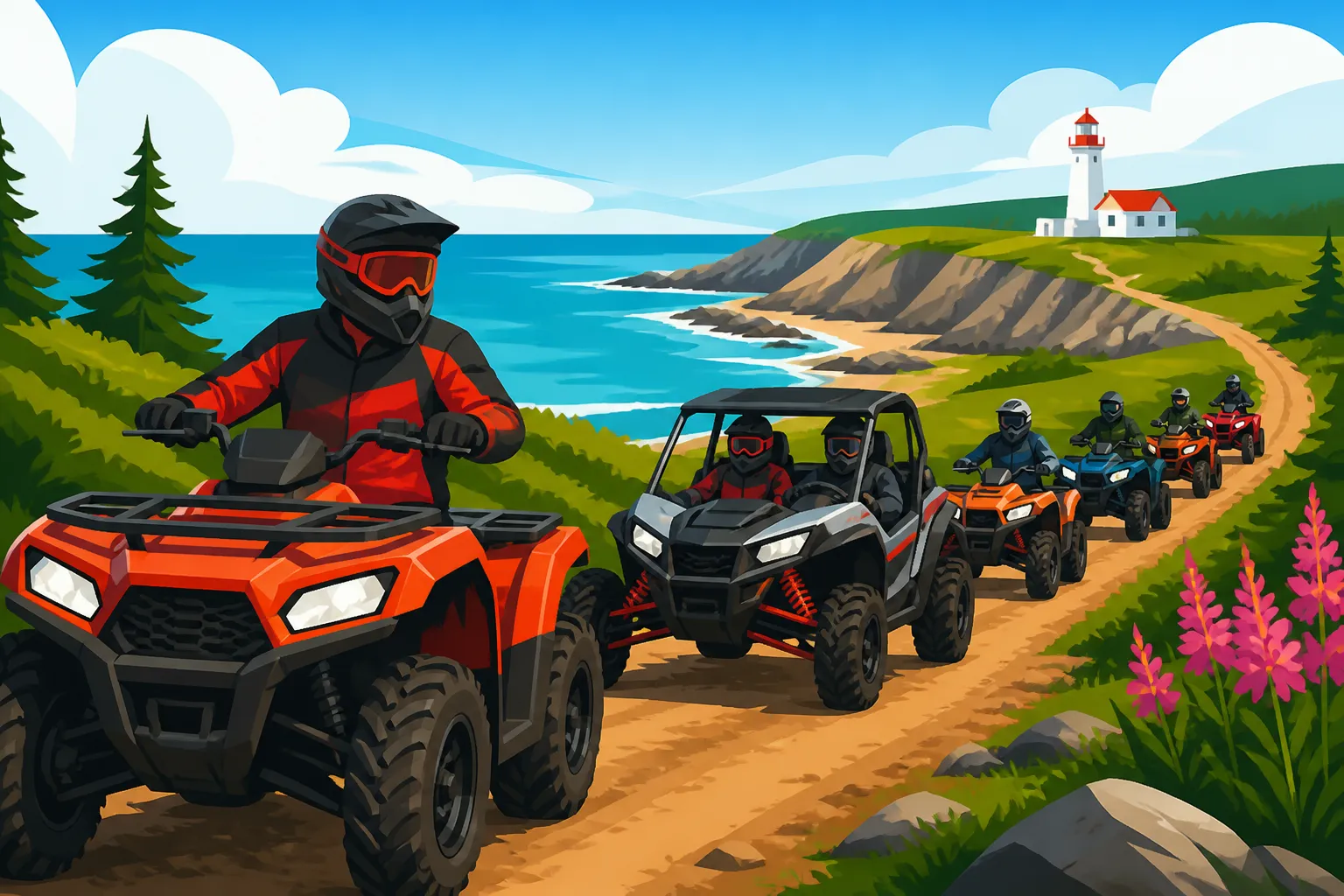
A ten-machine ride can feel organized at the trailhead and chaotic by the first narrow bridge, road crossing, or unexpected closure. In Nova Scotia, the route, land access, trail conditions, and riding rules all shape how a large group should travel. This guide explains how to plan a group of ten, keep riders together safely, and avoid creating problems for other trail users.
Start with the route, access, and group rules
Confirm that every segment allows your machines
A route that looks continuous on a map may include different kinds of land and trails. A club-maintained trail, a road trail, a woods road, and a private woodlot corridor can each have different access conditions. Before inviting everyone, trace the intended route segment by segment and confirm that the group is allowed to ride there. Do not assume that a route suitable for an ATV is automatically open to every UTV, or that permission for one section carries over to the next.
Use club information, local signage, and direct contact with the relevant trail organization or landowner to check access. A mapping app such as onX Offroad can help you orient yourself and review a route, but a map line is not proof that a trail is open, that you have permission to use it, or that a machine is permitted on it. Treat digital maps as planning aids, then confirm access through the people responsible for the trail.
This matters especially when a route crosses private woodlots or connects to public roads. A detour around a closed gate can lead the group onto land without permission, while a shortcut around a wet section can widen damage to the trail. Check [Nova Scotia Trail Conditions and Closures] before setting out, and stay on the marked route when access is permitted.
Ask about group limits before you ride
Do not assume there is one simple group-size rule that applies to every Nova Scotia trail. A club, event organizer, landowner, or narrow corridor may set limits or expectations of its own. Ask whether a group of ten machines is acceptable on your planned route, whether the group should be divided, and whether advance notice is needed. The guidance in [Nova Scotia Group Size on Club Trails] and [Group Limits on a Narrow Corridor] is especially relevant when the route uses managed trails or constricted sections.
A group of ten can also affect people who are not riding with you. A long line of machines may take time to clear a bridge, pass a trailhead, or move through a village. If the route includes public-road travel, use the applicable road-trail rules rather than assuming ordinary club-trail habits apply. For example, riders on road trails must travel single file; review [Nova Scotia Riders Travel Single File] before planning a road-trail section.
If a club or landowner says the group is too large for a particular segment, respect that direction and adjust the plan. Splitting into smaller groups may help, but only if the trail organization or landowner accepts that arrangement. Two batches passing through a sensitive area can still create more disturbance than the corridor can handle.
Plan the ride so ten machines can move smoothly
Choose a route with realistic stopping points
A route that is easy for two machines may be frustrating for ten. Consider how long the group will take to get fuel, regroup after a turn, clear a bridge, or handle a minor mechanical issue. Build in places where everyone can pull fully off the trail without blocking it. Avoid planning a tight schedule that leaves no room for the slowest rider, a muddy section, or a closure that requires a change of plan.
Before the ride, share a route overview and identify obvious decision points: the start, planned breaks, fuel options, turnaround points, and the end location. A map app such as onX Offroad can help members understand the planned line, but distribute a backup plan too. Screenshots or written directions can be useful if someone’s phone battery dies or the group loses cell service. Confirm that each rider understands where the group will stop and what to do if separated.
Trail information can change, so recheck it close to departure. If the route crosses multiple club areas, contact the relevant clubs rather than relying on one general map. [Nova Scotia Trail Maps Worth Downloading] can help you find planning resources, while [Finding a Member Club Near You in Nova Scotia] is a useful next step when you need local trail information or want to ask who maintains a particular corridor.
Give every rider a job
A group ride is easier to manage when responsibility is shared. Before leaving, name a lead rider who knows the route, a sweep rider who stays behind the last machine, and one or more helpers who can assist with regrouping or basic problems. Everyone should know who is leading and sweeping; otherwise, riders may mistake a temporary pause for a full stop or leave a junction before the group is together.
| Role | Main responsibility | Helpful habit |
|---|---|---|
| Lead rider | Sets a controlled pace and identifies turns or hazards | Stops at agreed decision points |
| Sweep rider | Confirms the last machine is accounted for | Carries the group contact details |
| Mid-group helper | Watches for gaps and helps at regroup points | Signals clearly without rushing |
| Each rider | Maintains space and follows the agreed route | Tells the group before stopping |
Do not make the lead rider responsible for everything. Before departure, agree on a simple communication method, such as a clear hand signal or stopping at every major junction. Decide what the group will do if a rider stops unexpectedly. A short, shared plan can prevent ten people from making ten different guesses.
Keep the riding pace appropriate for the least experienced rider and the conditions. A confident rider who pulls away can stretch the group until the last machines reach a junction after the lead has already turned. On a busy or narrow corridor, that gap can create confusion for both your group and other trail users. The etiquette advice in [Nova Scotia Trail Etiquette Locals Expect] is worth discussing before the engines start.
Keep the group safe and considerate on the trail
Use spacing and regroup points rather than a long, compressed line
Ten machines need room to react. Leave enough space to stop safely if the rider ahead slows for a rut, fallen branch, blind corner, or person on foot. Avoid bunching up at the bottom of a hill or around a turn. A tight pack can make it harder to see hazards and can create a cloud of dust that reduces visibility for the riders behind.
At the same time, do not let the group stretch so far that riders lose sight of one another at every turn. Agree to regroup after major junctions and at suitable pullouts. The lead should wait at those agreed points, not in a place that blocks the trail or hides a hazard from approaching riders. The sweep rider should confirm that the last machine has arrived before the group continues.
On a narrow section, pass other trail users carefully and only where there is room. Do not pressure walkers, cyclists, or another riding group to move faster than is safe. If the corridor cannot accommodate ten machines passing at once, wait in a safe place and let others through. A short delay is better than forcing a risky squeeze or damaging the trail edge.
Prepare for communication gaps and unexpected delays
Cell service can be unreliable in remote areas, so do not build a safety plan around every rider being able to call or message. Choose a regroup procedure that still works if phones have no signal. For example, agree that riders will wait at the next named junction rather than continuing to search for the group. Discuss what to do if someone takes a wrong turn, has a breakdown, or needs to leave early.
Let someone who is not riding know the route and expected return window. Share the plan in a way that is useful, not just a vague message such as “we’re going riding near the coast.” Include the starting point, intended route area, number of machines, and who to contact if the group is overdue. [Nova Scotia Cell Coverage on Remote Trails] can help set expectations when choosing a route in areas where connectivity may be limited.
Use onX Offroad or another navigation tool as one part of the plan, not as the only way to find the group. Before leaving, make sure riders know how to use their own map, have enough battery, and can identify the next regroup point. A route leader should also carry a practical backup, such as a paper map or saved route details. If conditions change or a trail is closed, stop somewhere safe, reassess, and confirm the new route with the responsible club or landowner where needed.
Make the day easier before the first machine moves
Hold a short pre-ride briefing
A quick briefing prevents the same avoidable confusion from happening repeatedly. Go over the route, the lead and sweep riders, regroup points, hand signals, planned breaks, and the procedure for a separation or mechanical issue. Confirm that each rider knows whether the ride includes public-road sections and understands the relevant requirements. Ask everyone to arrive with their machine ready, required documents, appropriate protective equipment, and enough fuel for the planned distance.
The briefing is also the time to make sure the group’s machines and riders suit the route. A large utility UTV may need more room to turn or pass than a smaller ATV. A newer rider may need a slower pace and extra space. If the route includes rough terrain, narrow bridges, or wet sections, explain those features in advance and give people the chance to opt out of a segment.
Use a checklist rather than relying on memory:
- Confirm trail access, closures, and any group-size conditions.
- Check that each machine is suitable for the planned route and permitted on its segments.
- Identify the lead, sweep, and regroup locations.
- Share the route and a backup plan with every rider.
- Check fuel, basic tools, first aid supplies, and communication arrangements.
- Tell an off-trail contact where the group is going and when it expects to return.
Make a change of plan feel normal
A successful group ride is not one that sticks to the original route at any cost. It is one that responds sensibly when the trail is washed out, a landowner closes access, weather worsens, or a rider is having trouble. Agree before departure that anyone can raise a safety concern without being mocked or pressured to keep up. If one machine needs attention, stop in a place that does not block the corridor and have the lead and sweep keep the rest of the group accounted for.
If conditions make the planned route unsuitable, turn around or use an alternative only after checking that it is open and appropriate. Do not follow an unmarked track just because it appears on a phone screen. A mapping tool such as onX Offroad may help you understand your location, but local confirmation still matters when access is uncertain. Keep the group together while the plan is being reviewed, and make sure every rider knows the revised route.
Finally, leave the trail as you found it. Close gates as directed, stay within the marked corridor, avoid spinning tires through wet ground, and keep noise and dust in mind near homes. With clear planning and a considerate pace, ten machines can share a ride without turning the group’s size into a burden for other riders, local residents, or the people who maintain the trail.
Disclaimer
This article is for general informational purposes only and does not constitute professional advice. Laws, prices and regulations vary by location and change over time. Consult a qualified professional for guidance on your specific situation.