Nova Scotia Youth Machine Size Rules
Choosing an ATV or UTV for a young rider is not just a matter of finding a low engine size. In Nova Scotia, age, supervision, training, machine classification and physical fit all matter. Here’s how to assess a youth machine without mistaking a manufacturer’s age recommendation—or a common engine-size chart—for the whole rule.
What Nova Scotia’s youth rules mean for machine size
A machine can be small and still be a poor or unsuitable choice for a particular rider. Conversely, a model with a modest engine is not automatically legal for every child. The key is to consider the rider’s age and the machine’s intended category alongside Nova Scotia’s operating requirements.
The province has a minimum riding age, and additional restrictions apply to young operators. The rules also address supervision and safety training. Those requirements are separate from choosing a machine that a child can control. Review Nova Scotia Rules for Riders Under 16 and Nova Scotia Youth Supervision Rules before making a purchase or arranging a ride.
A common source of confusion is the idea that one engine-size chart settles the question. Tables that pair age brackets with cubic centimetres can be useful as general buying guidance, but don’t assume a chart found online is a Nova Scotia legal limit. A machine’s manufacturer category, the rider’s physical ability and the rules for where the child will ride all need to be considered.
Age and supervision come first
Before comparing machines, establish whether the child can legally ride in the planned setting and what supervision is required. The details can differ depending on the rider’s age, the activity and the riding location. A child who may operate a machine under one set of conditions might not be allowed to use it on a road trail or other public route.
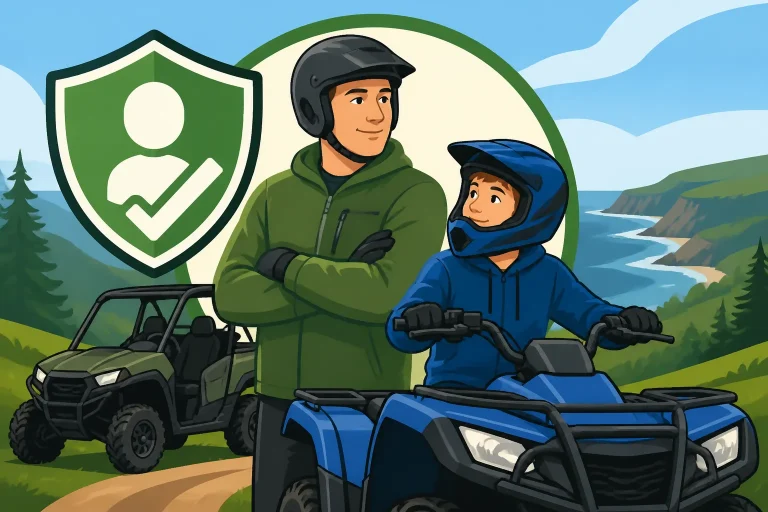
For younger riders, supervision is not a substitute for a properly sized machine. An adult nearby cannot reliably prevent a rollover or stop a child from losing control if the ATV is too heavy, too powerful or too large to manage. Check Nova Scotia Minimum Riding Age of 6 and Nova Scotia Closed Course Requirements for the relevant age and location rules.
Safety training is another separate issue. Don’t infer that a youth rider is exempt from every training or supervision requirement just because the machine is marketed for children. Check Nova Scotia Safety Training at 16 and confirm which requirements apply to the rider’s age and circumstances.
Machine classification matters
Look beyond the model name and engine displacement. Check the manufacturer’s label and manual for the machine’s intended age group, rider capacity and classification. If the paperwork uses a class such as Category B, confirm what that classification means for the exact model and how it affects the rider’s permitted use. Category B and Why It Matters can help explain why a label or class designation should not be replaced by a guess based on engine size.
A machine described as a youth ATV may still have different restrictions from another youth model. Two machines with similar engine sizes can differ in weight, power delivery, brakes, throttle response and intended rider age. Use the model’s own documentation rather than a retailer’s shorthand description.
UTVs need a separate assessment. Their enclosed or side-by-side design may make them seem more stable, but that does not automatically make one suitable for a child to drive. Check the manufacturer’s stated operator age and capacity, and confirm the applicable Nova Scotia rules for that machine and use.
How to judge whether a machine fits the rider
The best starting point is the manufacturer’s age and size guidance, followed by a physical fit check. A child who can reach the controls while parked may still struggle to steer, brake or shift their weight once the machine is moving. The test should be about control, not whether the rider can simply sit on the seat.
Use Choosing a Machine That Matches the Rider’s Size as a reminder that fit includes the rider’s reach, strength and ability to respond quickly—not only height or age.
Check reach, stance and control
With the machine off and on level ground, have the rider sit in the normal riding position. They should be able to:
- Reach the handlebars without stretching or leaning excessively.
- Operate the brake and throttle smoothly, without losing their grip or balance.
- Reach any required foot controls and keep their feet positioned as the manual specifies.
- Turn the handlebars through the full range without their arms being forced into an awkward position.
- Shift their weight as needed while remaining secure on the seat.
For a UTV, check that the young operator can reach and use the steering wheel and pedals while seated properly against the seat back. Seat position, restraints and the machine’s controls should fit the rider as designed. Never improvise with loose cushions or other changes that could interfere with restraint fit or control access.
A child’s ability to manage the machine while stationary is only the first check. They also need to understand the controls and be able to react appropriately. If they cannot operate the brakes confidently, turn without straining or maintain a stable riding position, the machine is too large or beyond their current ability.
Treat power and weight as separate issues
Engine displacement is only one indicator of how a machine behaves. Weight affects how difficult it is to stop, steer or recover from a lean. Power delivery affects how quickly it accelerates when the throttle is applied. A low-powered but heavy machine can still be difficult for a small rider to control; a lighter machine can still accelerate abruptly.
Consider these factors together:
| What to check | Why it matters | What to do |
|---|---|---|
| Manufacturer’s intended age or rider category | Indicates the kind of rider the machine was designed for | Read the manual and machine label; don’t rely on the product name alone |
| Weight and dimensions | Affects steering, balance and how manageable the machine feels | Compare the machine with the rider’s reach and strength |
| Throttle response and power | Affects acceleration and how easily a mistake can become a loss of control | Have a qualified dealer explain the controls and any manufacturer-approved settings |
| Brakes and controls | Must be reachable and usable without strain | Check operation while the machine is stationary |
| Passenger capacity | A second rider changes weight and handling | Follow the manufacturer’s seating and passenger instructions |
| Intended riding location | Rules can differ between private property, trails and road trails | Confirm local requirements before riding |
Avoid modifications intended to make a machine “grow with” a child unless the manufacturer permits them and they are adjusted as directed. A throttle limiter or similar feature does not change the machine’s weight, braking demands or legal classification. It also does not replace adult supervision or training.
Use age as a screening tool, not a guarantee
A manufacturer’s minimum age recommendation is a starting point, not proof that every child of that age is ready. Children the same age can differ substantially in size, coordination and judgment. The rider should understand how to stop, how to use the controls and what to do if the machine begins to tip or gets stuck.
For younger children, consult the age-specific guidance in Nova Scotia Rules for a 6-Year-Old Rider and [Nova Scotia Rules for a 10-Year-Old Rider]. Older children are not automatically ready for a full-size machine either; Nova Scotia Rules for a 14-Year-Old Rider can help you consider the rules that may apply at that age.
A practical way to choose a youth ATV or UTV
A careful decision is easier when you separate legal eligibility, machine fit and riding conditions. Work through the checks below before buying, borrowing or allowing a child to use a machine.
-
Confirm the rider’s age and legal conditions. Check the minimum age, supervision and training requirements that apply to the child. Confirm the rules for the exact place they will ride rather than assuming private property, a trail and a road trail have identical requirements.
-
Identify the machine correctly. Record the make, model and year. Read the manufacturer’s manual and labels for the intended age, rider category, seating capacity and operating instructions. If a seller cannot provide basic model information, pause before relying on their description.
-
Check the rider’s physical fit. Have the child sit on the machine with the engine off. Check reach to the controls, seating position and ability to move naturally. For a UTV, make sure the rider can use the controls from the seat while properly secured.
-
Assess weight and control, not just cc. Consider whether the child can manage the machine’s weight and power. Don’t choose a larger model simply because the child is expected to grow. A machine that is difficult to control today creates an immediate safety problem.
-
Match the machine to the riding area. A suitable machine for a supervised, controlled setting may not be appropriate for a more demanding trail. Check the machine’s capabilities, the child’s experience and the rules for the route. If the ride includes a road trail, confirm that the operator and machine meet the separate requirements for that use.
-
Plan for instruction and supervision. Explain the controls and basic stopping procedure before riding. An adult should supervise according to the applicable rules and remain close enough to respond. A child’s confidence is not the same as demonstrated control.
-
Recheck as the child grows. Fit can change quickly. Review reach, seating and control use regularly, and reassess whether the machine remains appropriate. Don’t assume a machine that fit last season still does.
If you’re comparing models, ask a dealer to demonstrate the controls and explain the manufacturer’s age guidance for the specific unit. For a used machine, ask for its manual and check that its controls have not been altered in a way that affects safe operation. If the documentation is missing or the machine’s classification is unclear, verify it before the child rides.
Common mistakes when sizing a youth machine
Buying by engine size alone. Displacement does not tell you whether the rider can reach the controls, manage the weight or handle the power delivery. Read the manufacturer’s guidance and assess fit directly.
Treating a youth label as automatic approval. A label or marketing description is not a substitute for checking age, supervision, training and location rules. Confirm that the specific model and planned use are permitted.
Choosing a machine to grow into. It may seem economical, but a child who cannot comfortably reach or operate the controls is not ready for that machine. Choose for the rider now and reassess later.
Assuming a UTV is easier because it has more than one seat. A side-by-side can still be heavy and powerful, and its operator needs to reach and control its pedals and steering. Passenger seating does not make a child fit to drive.
Assuming adult supervision cancels out poor fit. Supervision helps meet applicable requirements and supports safer riding, but it cannot make an oversized machine easier for a child to control.
Relying on an engine-size chart without checking its source. A chart may reflect another jurisdiction, a particular safety standard or general advice. Compare it with the manufacturer’s guidance and Nova Scotia’s current requirements rather than treating it as the final word.
When requirements are unclear, confirm the machine’s classification and the rider’s permitted use with the appropriate provincial service before riding. It is much easier to resolve a question before a child is on the machine than after a purchase or a trip to the trail.
Disclaimer
This article is for general informational purposes only and does not constitute professional advice. Laws, prices and regulations vary by location and change over time. Consult a qualified professional for guidance on your specific situation.