Nova Scotia Youth Supervision Rules
Youth supervision rules can be confusing when a child is old enough to operate a machine but not old enough to ride independently. In Nova Scotia, the rider’s age affects where they may ride and who must supervise them. Here’s how to understand the main requirements, plan a safer outing, and avoid assuming that an adult’s presence alone makes a ride legal.
How age changes the rules
Nova Scotia’s youth rules are not one blanket permission for every rider under 16. The rider’s age affects both the riding location and the supervision needed. As a practical starting point, the minimum riding age is six, but younger riders face tighter restrictions than teenagers. For the broader age framework, see Nova Scotia Rules for Riders Under 16 and Nova Scotia Minimum Riding Age of 6.
| Rider’s age | Main rule to keep in mind | What to check before riding |
|---|---|---|
| Under 6 | Too young to operate an OHV | Do not treat a parent’s permission as an exception |
| 6 to 13 | Riding is subject to closed-course restrictions and adult supervision | Confirm that the riding area qualifies as a closed course |
| 14 to 15 | Adult supervision still applies; age alone does not mean independent riding is allowed | Confirm the supervisor, location, machine and route meet the rules |
| 16 and older | Training and other requirements may apply; turning 16 does not remove every obligation | Check the rider’s training status and the rules for the place they plan to ride |
The ages in the table are a useful way to organize the rules, not a substitute for checking the specific riding situation. A private yard, farm lane, club corridor and public road trail are not interchangeable. Requirements can depend on the kind of machine, the type of land and whether the youth is riding on a closed course or a route open to other users.
Riders aged 6 to 13
A child in this age group may not simply join a family trail ride because an adult is nearby. The closed-course restriction is an important extra limit: riders from 6 through 13 must ride in a setting that meets the applicable closed-course requirements. Supervision does not turn a route that is not permitted for that age group into an acceptable riding location.
A closed course is a defined riding setting, not just any place where a parent can watch. A fenced paddock or quiet patch of private land may seem controlled, but appearance alone does not establish that it meets the legal definition. Before allowing a child to ride, confirm that the course and the activity qualify under Nova Scotia’s rules. Nova Scotia Closed Course Requirements explains why the location needs to be checked rather than guessed.
Riders aged 14 and 15
A 14- or 15-year-old is no longer in the 6-to-13 closed-course age group, but that does not mean they can ride without supervision. The adult supervisor requirement still matters. Nor does a teenager’s size or experience automatically change the legal requirements.
Check the actual route before setting out. A trail that is suitable for an adult may include public-road sections, traffic crossings, open land or other conditions that require separate permissions or qualifications. If the ride includes a road trail, the general road-trail rules still apply. A youth supervision arrangement cannot replace a required licence, registration, insurance or other condition of riding there.
Turning 16 is not a catch-all exemption
Age 16 is a point at which training requirements become especially important. Do not assume that a rider can switch from supervised to independent riding on their birthday without checking what training or documentation is required. Nova Scotia Safety Course for a 16-Year-Old covers the training question in more detail.
It also helps to distinguish a youth supervision rule from other rules. Being supervised does not automatically make an unregistered or uninsured machine legal to use on a route where those documents are required. Likewise, having a safety certificate does not necessarily let a rider ignore age-based limits or ride in a place that is closed to that machine.
Who can supervise and what supervision means
For a youth rider who must be supervised, the adult’s age and qualifications matter. The supervisor must be at least 19 and meet the applicable training requirement. A parent or guardian is not automatically qualified just because they own the machine or gave permission. Confirm that the person assigned to supervise meets the requirements before the ride begins. See [Nova Scotia Supervision Requirements] for a focused explanation.
Supervision should be treated as an active responsibility, not a name on a plan. The adult needs to know where the youth is, what route they are taking and how to respond if the machine stops or the rider needs help. A group ride can make this more complicated: if the supervisor is also riding, they may need to divide attention among the trail, traffic, other riders and the youth.
Keep the rider within sight
A useful practical standard is to keep the youth in sight rather than relying on a phone call, a meeting point or the assumption that the rider will catch up. Visual contact helps the supervisor notice a fall, a mechanical problem, a wrong turn or a risky interaction with other trail users.
Sight lines can disappear quickly on a wooded trail, around a bend, over a rise or in dust. If the adult cannot see the youth, the group should slow down, stop at a safe place or change the arrangement so the required supervision is maintained. “We’re on the same trail” is not a dependable substitute for being able to supervise the rider.
This does not mean the adult should ride so close that they create another hazard. The spacing needs to let the youth operate safely while keeping the supervisor close enough to observe and respond. On narrow or uneven trails, that may mean riding one at a time through a difficult section and regrouping immediately after it.
One adult cannot supervise an unlimited group
The number of young riders matters. Nova Scotia’s rules limit a supervisor to eight riders under 14 at a time. That limit is easy to overlook when several families meet for a group ride, especially if each family assumes its own adult will supervise. Nova Scotia Supervisors Limited to Eight Riders discusses the ratio.
Count the riders who are under 14, not just the number of machines or adults who happen to be present. If one adult is responsible for more than the permitted number, arrange another qualified supervisor or reduce the group. Do this before anyone starts riding; dividing the group on paper while everyone travels as one supervised group may not solve the problem.
The ratio is a maximum, not a target. Fewer young riders per adult may be sensible when the course is unfamiliar, the terrain is challenging or the children have different experience levels. A supervisor who is managing a larger group may struggle to keep every rider in view and respond quickly when something goes wrong.
A parent’s role is broader than signing permission
A parent or guardian can help choose an appropriate ride, but signing a form or giving verbal permission does not replace a required qualified supervisor. The adult who actually supervises should understand the rider’s ability, the route, the machine and the rules that apply.
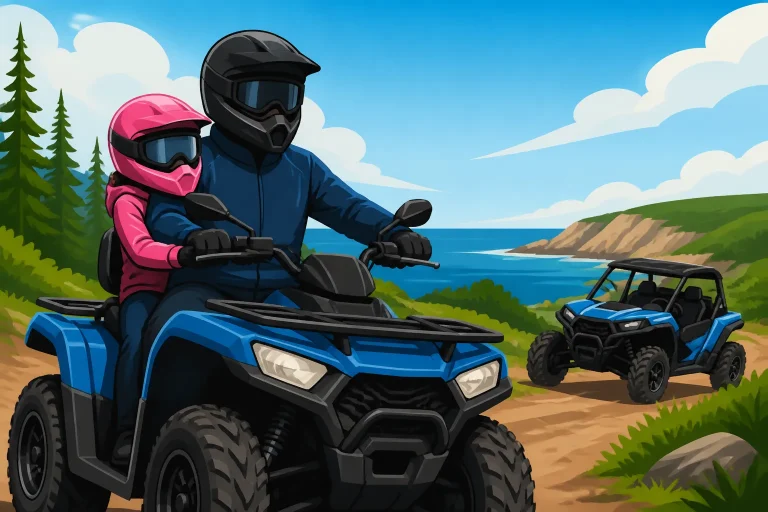
Before the ride, agree on simple instructions: where to stop, what to do if the group separates, how to signal a problem and who the youth should follow. A child should know not to continue alone if they lose sight of the supervisor. For more on the family side of planning, see Nova Scotia Parent Riding With a Child.
Choose the right place and machine
A legal supervision arrangement is only one part of a safe ride. The location and the machine must also suit the youth. A child riding with a qualified adult can still be in the wrong place or on a machine they cannot control.
For riders aged 6 to 13, confirm the closed-course restriction first. Do not assume that a familiar property or a quiet section of trail counts. For older youth, confirm the route is open to the machine and that the youth may use it under the applicable rules. Where a route crosses a road or connects with public roads, check the relevant road-trail requirements separately.
Match the machine to the rider
The machine should fit the rider’s physical size and demonstrated ability. The youth needs to reach and operate the controls, sit in a stable position, steer effectively and use the brakes without stretching or losing balance. A machine that is too large or powerful can overwhelm a young rider even on an easy-looking surface.
Do not use engine size as the only measure of suitability. A smaller machine can still be difficult to control if the seat is too tall, the throttle is abrupt, the brakes are hard to reach or the rider has not learned how to handle the terrain. Conversely, a youth who can physically sit on a machine may not yet have the judgement or coordination to operate it safely. Nova Scotia Youth Machine Size Rules is a useful companion when choosing a machine.
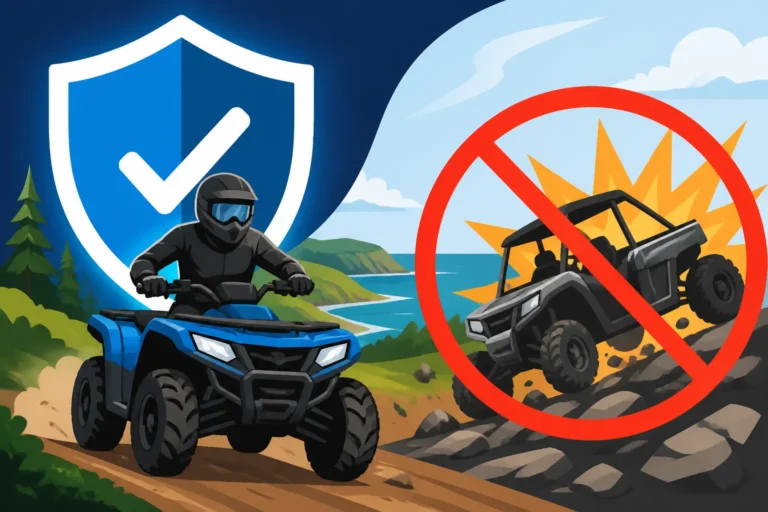
A side-by-side also requires its own assessment. Being seated beside an adult does not necessarily make a youth an approved driver, and a passenger’s age and seating position may be governed by separate rules. Do not treat an ATV and a UTV as interchangeable when checking requirements.
Keep the ride within the youth’s ability
A route that is easy for an adult may be a poor first ride for a child. Mud, steep grades, loose rock, deep water, narrow bridges, traffic and sudden changes in surface can all demand skills a new rider has not developed. Start with a controlled setting and a short, simple route. Add difficulty only as the youth shows consistent control and good judgement.
The adult should also be prepared to change plans. If conditions worsen, visibility drops, the machine develops a problem or the youth becomes tired, stop or turn back. A supervision plan is not successful simply because the group completed the route.
Separate riding permission from trail access
A machine may be legally owned and registered yet still lack permission to use a particular trail. A youth may meet the supervision conditions but still need to ride only on a route where that machine is allowed. Trail permits, landowner permission and local restrictions are separate questions.
Before a family ride, check whether the intended corridor is open to the machine type and whether a permit is needed. If the youth will travel on a club trail, review the applicable permit rules as well as the age and supervision rules. Do Nova Scotia Kids Need Their Own Permit? addresses the permit question for young riders.
A practical pre-ride supervision check
A short check before leaving can prevent the common mistake of focusing on the adult’s presence while overlooking age, route or machine requirements. Use this sequence whenever a youth will ride.
- Confirm the youth’s age. Identify which age group applies. For a rider aged 6 to 13, check the closed-course restriction before planning a route.
- Confirm the riding location. Make sure the course or route is suitable for the youth’s age and the type of machine. Do not rely on a property owner’s informal description of a location as “private” or “closed.”
- Name the supervisor. Confirm that the adult is at least 19 and has the required training. Make sure the person who qualifies is actually responsible for the youth during the ride.
- Count riders under 14. Check that the supervisor is not responsible for more than eight riders under 14. Add another qualified adult or split the group if needed.
- Check the machine. Make sure the youth can reach the controls, use the brakes and control the machine in the conditions planned. Consider ability as well as age and size.
- Review the route and conditions. Look for road crossings, changing trail surfaces, traffic, weather, closures and sections that may be beyond the youth’s skill.
- Set a simple group plan. Tell the youth who to follow, where the group will stop and what to do if they cannot see the supervisor.
- Check separate requirements. Confirm any registration, insurance, permit, land access or road-trail rules that apply to the machine and route.
Common situations that need a closer look
A parent follows behind on a trail. Being nearby is not enough if the location is prohibited for the youth’s age or the parent does not meet the supervisor requirements. Check both the route and the adult’s qualifications.
Several children ride together while one adult leads. Count the under-14 riders assigned to that supervisor. If the number is over the limit, add a qualified supervisor or divide the group. Also consider whether the adult can keep the riders in view on the route.
A youth rides around a farm or cottage property. Private land does not automatically remove age and supervision requirements. A child aged 6 to 13 still needs a qualifying closed-course setting. Confirm the rules for that location rather than assuming the property boundary is enough.
A teenager rides ahead and meets the group later. A meeting point does not provide continuous supervision. If the rider is required to be supervised, plan the ride so the qualified adult can supervise throughout the relevant section.
The adult has ridden for years but has never taken training. Experience is not necessarily a substitute for the required training. Confirm the supervisor’s eligibility before relying on them to meet the rule.
A child rides as a passenger in a UTV. Passenger rules are distinct from rules for operating a machine. Check the child’s age, seating and restraint requirements separately; a parent driving does not answer every passenger-related question.
Frequently Asked Questions
Can a six-year-old ride an ATV in Nova Scotia?
Six is the minimum riding age, but a rider aged 6 to 13 is subject to additional restrictions, including the closed-course requirement and adult supervision. Confirm that the specific course and machine meet the rules before the child rides.
Does the supervisor have to be the child’s parent?
The important questions are whether the supervisor meets the age and training requirements and whether they can supervise the rider properly. A parent’s permission by itself does not replace a qualified supervisor.
How many riders under 14 can one supervisor oversee?
The limit is eight riders under 14 per supervisor. That is a maximum, and fewer riders may be easier to supervise safely, particularly on unfamiliar or difficult terrain.
Can a youth ride alone on private land?
Do not assume that private land means a youth can ride without supervision. The youth’s age, the location and the applicable riding rules still matter. Riders aged 6 to 13 are also subject to the closed-course restriction.
Disclaimer
This article is for general informational purposes only and does not constitute professional advice. Laws, prices and regulations vary by location and change over time. Consult a qualified professional for guidance on your specific situation.