Nova Scotia’s Closed Course Rule for Ages 6 to 13
Nova Scotia’s closed-course rule can make it hard to know where a child may legally ride an ATV or UTV. For riders ages 6 to 13, the key issue is not just the machine or the adult nearby: it is whether the riding area qualifies as a closed course and whether supervision requirements are met. Here’s how to think through those questions before a young rider starts the engine.
What the closed-course rule means for riders ages 6 to 13
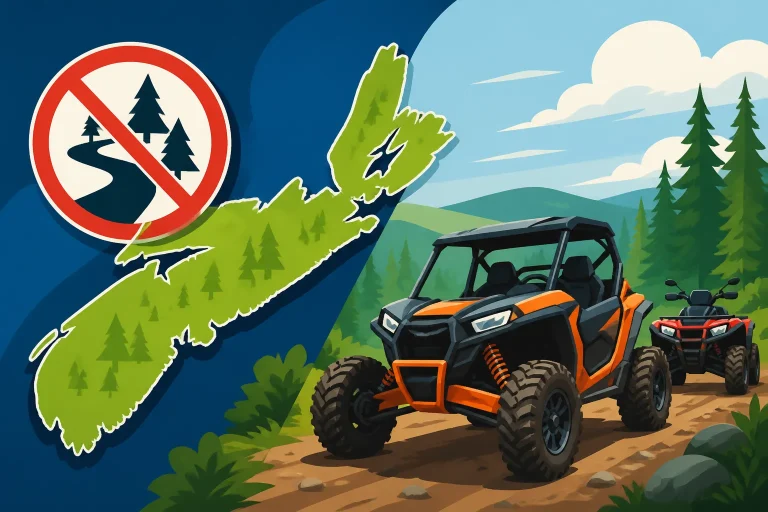
In Nova Scotia, children in this age group face restrictions on where they may operate an off-highway vehicle. A closed course is a limited setting for riding; it is not simply any route where a family feels safe or any place where the public is not currently riding.
That distinction matters because several places can look suitable to a parent without being legally recognized as a closed course. A private field, a backyard, an informal practice area, or a quiet section of trail does not qualify just because it is away from traffic. Likewise, an area being used for a club activity or an organized event does not, by itself, establish that it meets the legal requirements.
The practical starting point is to treat the rule as a restriction on the riding location, not just as a supervision rule. An adult watching closely does not necessarily make an otherwise restricted location legal. Before a child rides, find out whether the specific course is recognized for this purpose and whether it is open to the child’s type of machine and activity.
This is separate from the minimum-age rule. Six is the youngest age at which a child may ride under the relevant youth rules, but that does not mean every six-year-old can ride anywhere, or operate any machine. Age, course eligibility, adult supervision, the child’s physical ability, and the machine’s suitability all matter. For the broader age framework, see Nova Scotia Minimum Riding Age of 6 and Nova Scotia Rules for Riders Under 16.
The rule also needs to be kept separate from trail access. A club trail, road trail, or other riding corridor may be open to some riders and still not be a lawful place for a child in this age group to operate an OHV. A trail permit, registration, or insurance does not replace age-based operating requirements. Those documents address different obligations; they do not turn a regular trail into a closed course.
A useful way to frame the question is:
- Is the child old enough to ride at all?
- Is the child riding in a location permitted for their age?
- Does the location meet the applicable closed-course requirements?
- Is a qualified adult supervising in the required way?
- Is the machine suitable for that child and the course?
If one answer is unclear, pause and verify it before riding. Do not use a parent’s permission, a landowner’s permission, or the fact that other children ride there as proof that the activity complies with provincial rules.
What counts as a closed course
“Closed course” can sound like a plain-English description: a place closed off from general traffic. That can lead families to assume that a gate, a private-property line, or a temporary barrier is enough. It may not be. The legal meaning depends on the applicable rules and on whether the specific site meets them.
A closed course is best approached as a designated and controlled riding area, rather than an informal location that happens to be separated from a public road. The exact features that matter may include how the area is established, who controls it, what activities it is intended for, and whether it has the required approval or recognition. Confirm the current requirements for the particular course instead of relying on a general description.
Places that should not be assumed to qualify
These examples are not automatic proof of a qualifying course:
- A private yard or field where a child practises alone or with family
- A farm lane or woodlot road
- A club trail or a section of a multi-use trail
- A gravel pit or other open area where vehicles have ridden before
- A marked route on private land
- A temporary loop laid out for a birthday party or family gathering
- A fenced space that has not been confirmed as an eligible course
Some of these places may be used for riding by adults or by riders who meet different age requirements. That does not establish that they qualify for a rider ages 6 to 13. Nor does the owner’s permission settle the provincial age question. Land access and legal permission to operate are separate issues.
This is why a riding area’s name is not enough. A property owner might call an area a “track,” a club might advertise a “practice day,” or a family might call a fenced section a “closed course.” Those labels are not a substitute for checking the site’s status and the rules that apply to youth riders.
A trail permit is not a closed-course approval
Families sometimes mix up the paperwork for a trail ride with the conditions for a young person to operate an OHV. A permit may be necessary for certain trail access, but it does not certify that a place is a closed course. Similarly, a registered machine or an insured machine does not automatically qualify for use by a child in a restricted location.
If the intended ride is on a club trail, start with the age rules and the trail’s own access requirements. Do not conclude that a trail is allowed for a child because it has a permit system, a trailhead, or signage. Nova Scotia Closed Course Requirements covers the course question, while Nova Scotia Trail Permit Cost concerns a different part of riding access.
Get a clear answer about the specific site
When asking whether a course qualifies, describe the actual plan rather than asking only, “Is this a closed course?” Include the address or location, the operator or landowner, the type of machine, the child’s age, and whether the ride is practice, instruction, or an event. Ask who has confirmed the site’s status and whether that confirmation applies to a rider in the child’s age group.
If the answer is vague, such as “people ride there all the time,” “it’s private,” or “it should be fine,” that is not a reliable confirmation. Ask the course operator or relevant authority for the rule or approval that applies. Keep any written response with the ride plan, but remember that a message from a landowner may address permission to use the property without answering whether the youth-riding rules are satisfied.
Supervision and machine choice are separate requirements
A compliant location does not remove the need to follow supervision and machine-suitability rules. These are separate checks. A young rider may be in the right place but still be riding without the required adult oversight or on a machine that is not appropriate for their age and size.
Nova Scotia’s youth rules describe supervision requirements that can include the supervisor’s age, training, and ability to keep the child in sight. Confirm the current conditions for the child and activity rather than assuming that any adult present meets them. [Nova Scotia Supervision Requirements] and Why a Supervisor Must Be Nineteen and Trained address these points in more detail.
The supervisor’s role is active. Being somewhere on the property, waiting at a parked vehicle, or checking in occasionally may not meet a requirement that calls for direct oversight. The adult should be positioned to watch the rider, respond quickly, and keep the ride within the conditions that apply to the child. If the area’s layout makes that impossible, the setting may not be suitable even if the course itself is eligible.
It is also important not to confuse supervision with instruction. A trained adult may meet a qualification requirement, but that does not mean a child is ready to operate a particular machine. A responsible supervisor should first establish that the rider understands the controls, can stop and steer safely, and can follow directions without taking unnecessary risks.
Match the machine to the rider
A child’s legal eligibility does not mean every ATV or UTV is appropriate. Compare the machine with the child’s size, strength, reach, balance, experience, and ability to control it. The child should be able to use the controls properly and maintain a stable riding position without stretching or shifting awkwardly.
Follow the manufacturer’s age and operating guidance for the specific model. A machine that is available to borrow or already owned by the family may still be too large, powerful, or physically demanding for a child. A larger machine can also carry passengers or cargo, change how it handles, and create risks that a beginner may not be ready to manage.
For UTVs and side-by-sides, check the vehicle’s classification and the rules that apply to that machine. Do not assume that a child who is allowed to operate one type of youth quad can automatically operate a UTV. Nor should a child be placed in the driver’s seat simply because the vehicle has a steering wheel, seat belt, or passenger cab. The relevant rules apply to the vehicle and the child’s role, not just to how familiar the controls look.
The child should wear properly fitted protective equipment and use the machine only as intended. A helmet that does not fit, footwear that can slip off, or loose clothing near moving parts can turn a manageable mistake into a serious injury. Equipment does not make a prohibited ride legal, but it is still a basic part of reducing risk on a permitted ride.
A parent or supervisor can use the following checks before each session:
- Confirm the child’s age and the rules that apply to that age.
- Confirm that the specific site is eligible for the planned youth riding.
- Confirm the supervisor meets the applicable age and training requirements.
- Choose a machine that the child can control and that is allowed for the activity.
- Check the machine, protective equipment, course conditions, and weather.
- Set simple boundaries for speed, stopping, and where the child may ride.
- Stop the session if the rider becomes tired, distracted, or unable to follow instructions.
These steps do not replace the law or the course operator’s conditions. They help catch common problems before the child is underway.
If there is no suitable course nearby
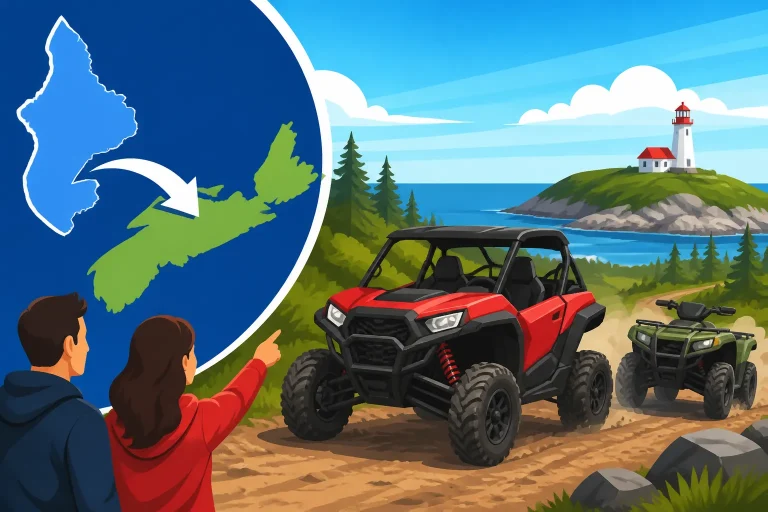
The absence of a convenient course can be frustrating, especially when a family has a youth-sized machine or a safe-looking private area. But distance and inconvenience do not change the legal meaning of a closed course. Do not treat a private property exemption, owner permission, or a lack of nearby facilities as an automatic alternative.
The safest response is to verify the available options before making plans. Nova Scotia has information on youth riding and course requirements, but families should confirm whether a particular site is recognized and what rules apply to the proposed ride. Nova Scotia Has No Accredited Closed Courses and What Happens When There Is No Closed Course Nearby explain why course availability can be a practical issue. Even where a site is described as unavailable or unaccredited, confirm the current status before relying on that description.
Questions to ask before travelling
Contact the course operator, the relevant provincial office, or another appropriate authority with a focused set of questions:
- Is this specific area approved or otherwise eligible as a closed course for youth riders?
- Does that status apply to a rider who is 6 to 13?
- Is the child’s type of OHV allowed there?
- Are there limits on course hours, supervision, instruction, or events?
- Does the supervisor need a particular certificate or other qualification?
- Does the course have additional rules for helmets, protective gear, or machine size?
- Is the course currently operating, and are there temporary closures or restrictions?
If a course operator can confirm their own site rules but cannot answer how provincial youth requirements apply, follow up with the appropriate authority. Try to get the answer in writing and retain the date and details of the response. If you receive conflicting advice, do not pick the answer that is most convenient; ask for clarification from the authority responsible for the rule.
Private land does not answer every question
Private land is often part of the discussion because families assume it provides greater freedom. It can matter for access and permission, but it does not automatically answer the age and location question. The landowner may allow riding while provincial rules still restrict who may operate there and under what conditions.
Before riding on private property, confirm two separate things: first, that the owner or lawful occupier has permitted the activity; second, that the child’s operation is allowed under the rules that apply to the location and course. Do not treat a signed permission note as a substitute for course status or supervision requirements.
A farm, woodlot, or large rural property can contain many different kinds of riding areas. A work road, a field, and a purpose-built track may not be treated alike. The fact that the property is used for agricultural or forestry activity does not automatically establish an exemption for a recreational ride. If the family is relying on a specific work-use or land-based exemption, verify the conditions and whether they apply to the child and machine. A separate discussion of youth rules appears in Nova Scotia Rules for Riders Under 16.
Don’t use a trail ride as a substitute
If the child cannot use a nearby course, taking them onto a trail or road trail is not a safe workaround unless the child is independently eligible to ride there under the rules for that location and activity. A quieter trail, an empty road, or a short trip between properties does not change the age restriction.
Road trails have their own requirements for riders and machines. Those can include licensing, registration, insurance, equipment, and operating rules. A child’s ability to ride on a closed course should not be treated as permission to ride on a road trail. Likewise, a qualified adult supervising from another machine does not remove other restrictions.
When no confirmed course is available, the practical choice may be to wait, arrange access to a suitable course, or choose a different activity. That can be disappointing, but it is better than relying on a casual interpretation that could put the child, family, or property owner in a difficult position.
A practical way to check before a young rider goes out
Use this process before the first ride, and repeat it when the location, machine, supervisor, or activity changes.
- Confirm the child’s age category. Check the rules for the rider’s exact age. Do not apply a rule for a 14- or 15-year-old to a younger child.
- Identify the machine. Record the type and model, and check the manufacturer’s guidance and any age or size conditions.
- Name the riding location. Use the precise site, not a general description like “the woods” or “our land.”
- Verify course status. Ask whether the site qualifies for youth operation and whether that answer covers this child, machine, and activity.
- Verify the adult’s qualifications. Confirm the supervisor’s age and required training or certificate. Also make sure the adult can maintain the required level of oversight.
- Check access and site rules. Get landowner permission where needed, and follow the operator’s conditions, signs, and instructions.
- Check equipment and conditions. Make sure the child’s helmet and other gear fit, the machine is in working order, and the riding area is suitable for the child’s current skill.
- Keep proof and contact details. Save written confirmation, course information, and the contact details of the operator or authority who answered the questions.
Do this check before telling the child that a ride is planned. It avoids the common situation where a family arrives at a property and only then discovers that the course is not appropriate for the child’s age or the intended activity.
If a child is moving from a closed course to another kind of riding area, check the rules again. Permission for one course does not create general riding permission. Similarly, completing a course session does not necessarily satisfy every training or certificate requirement that applies elsewhere. Nova Scotia Safety Certificates Are Mandatory and Nova Scotia Safety Training at 16 discuss training requirements that are separate from the closed-course question.
The main takeaway is straightforward: for a rider ages 6 to 13, do not rely on the setting’s appearance or an adult’s presence alone. Confirm that the course is eligible, supervision meets the applicable requirements, and the machine suits the child. When any of those points is uncertain, wait for a clear answer before riding.
Frequently Asked Questions
Can a 6-year-old ride an ATV anywhere in Nova Scotia?
No. Six is the minimum age under the youth framework, not blanket permission to ride anywhere. Location, supervision, and machine requirements still apply.
Does a private field automatically count as a closed course?
No. Private ownership or landowner permission does not by itself establish that a field qualifies. Confirm the status of the specific area before a child rides there.
Can a child ride a club trail if an adult is watching?
Adult supervision does not automatically make a trail eligible for a rider ages 6 to 13. Check the child’s age rules and the trail’s access conditions separately.
Does a trail permit replace the closed-course requirement?
No. A trail permit and the closed-course rule address different issues. A permit does not establish that a child may operate an OHV at a particular location.
Disclaimer
This article is for general informational purposes only and does not constitute professional advice. Laws, prices and regulations vary by location and change over time. Consult a qualified professional for guidance on your specific situation.