Nova Scotia Has No Accredited Closed Courses
A child may be old enough to ride an off-highway vehicle but still be restricted to a particular kind of riding area. In Nova Scotia, the lack of accredited closed courses makes that distinction especially important: a private field, club trail or safety course is not automatically a legal substitute. Here’s what families should check before a young rider starts.
What “no accredited closed courses” means for young riders
Nova Scotia’s rules distinguish between a rider’s age, the place they ride, supervision and safety training. For children aged 6 to 13, the closed-course restriction is a key part of that framework. The practical problem is that there are no accredited closed courses available in the province for families to rely on as a straightforward place to meet that requirement.
An accredited closed course is not simply any piece of land that looks enclosed or controlled. A field on private property, a fenced practice area or a marked section of trail does not become accredited just because an owner permits riding there. Accreditation is a formal status, so families should not treat informal permission or a club’s operating practices as proof that a location meets the legal requirement.
That distinction matters because a course and a trail serve different purposes. A trail is a route for travel, while a closed course is a designated riding area subject to the applicable requirements. A trail permit, club membership or a landowner’s permission does not, by itself, turn a trail or property into an accredited course.
The lack of an accredited course does not mean every young person is automatically prohibited from every kind of riding in every circumstance. Other rules may apply depending on the rider’s age, location, the machine and the circumstances. It does mean families should not assume that a child aged 6 to 13 can ride on a usual club trail or private practice area simply because an adult is nearby.
A useful way to understand the issue is to separate the questions:
- Is the child old enough to operate an OHV at all?
- Where is the child allowed to ride at that age?
- Does the rider need supervision or a safety certificate?
- Does the specific location meet any closed-course requirement?
- Are registration, insurance and trail-permit rules also met?
These are separate checks. Passing one does not automatically satisfy the others. For a broader overview of age and riding rules, see Nova Scotia ATV Age Requirements and Nova Scotia Rules for Riders Under 16.
Why a private field or club trail may not solve the problem
When there is no accredited course nearby, it is tempting to treat a familiar place as “close enough.” That can be an expensive assumption. A closed course is a legal category, not just a description of a place with a gate, fence or boundary.
A private field may be safe for practice and the landowner may agree to let a child ride there. But landowner permission addresses access to the property; it does not necessarily satisfy the rules for a rider’s age or the status of the course. The same applies to a club’s practice area. Ask whether the particular location has the required accreditation, rather than relying on the fact that it is private or used by a riding group.
A marked trail raises a different issue. Trails may run across private land, Crown land or other corridors, and the rules governing access can vary by location. A trail being open to riders does not automatically make it a closed course. Nor does buying a trail permit change the legal classification of the route. For details about riding access and landowner permission, see Nova Scotia Private Woodlot Permission and Nova Scotia Crown Land Riding Rules.
Do not assume that these arrangements solve the closed-course question:
| Place or arrangement | What it may establish | What it does not establish by itself |
|---|---|---|
| Private field with the owner’s permission | Permission to be on that property | That the site is an accredited closed course |
| Fenced riding area | A physical boundary or controlled access | That the area has the required legal status |
| Club trail | Access to an authorized trail, subject to its rules | That a trail is a closed course |
| Trail permit or club membership | Permission to use certain club trail networks | That the rider meets age, supervision or training rules |
| Safety course or training session | Instruction, if it meets the applicable requirements | That the training venue is an accredited riding course |
| Adult riding nearby | Possible supervision | That the location or the child’s activity is permitted |
The practical takeaway is to verify the legal status of the exact place where the child would ride. A general answer such as “kids ride there all the time” is not the same as confirmation that the location meets the rule. If a club, landowner or course operator says a site is accredited, ask which authority accredited it and whether that status applies to the area and activity you have in mind.
A family should also distinguish between riding on private property and using public or club trails. Permission from a property owner may be necessary, but it is not a universal exemption from OHV laws. If you are trying to understand what counts as riding on your own land, see Riding Your Own Land Without a Registration. That question is related to access, but it does not replace checking youth-specific requirements.
How age, supervision and safety training fit together
A child’s age is central, but it is not the only factor. Nova Scotia’s youth rules include different requirements for different age groups, and the closed-course issue is particularly relevant for riders aged 6 to 13. Do not apply the rule for one age group to a sibling who is younger or older.
For a young rider, verify the following before arranging a ride:
- Confirm the child’s age category. Check the rule that applies to the rider’s actual age, not just the age of the oldest child in the group.
- Identify the exact riding location. Record whether it is private property, an authorized trail, a club area or a course.
- Check the course status. If the rule requires an accredited closed course, ask whether the site is formally accredited. Do not infer accreditation from a fence, sign or club affiliation.
- Confirm supervision requirements. Ask who must supervise, what qualifications are required and whether the adult must remain in sight or within a specified distance.
- Check machine suitability. A machine that is too large or powerful for the rider can create a serious control risk, even when riding is otherwise allowed.
- Verify safety training and certificates. Find out whether the child needs a course or certificate for the specific age and situation.
- Check the remaining operating rules. Registration, insurance, trail access, protective equipment and local restrictions may still apply.
Supervision is not a blanket permission. An adult can reduce risk and may be required by law, but an adult’s presence does not automatically make a restricted location lawful. Likewise, completing a safety course is valuable preparation, but it does not necessarily authorize a child to operate an OHV wherever they choose.
The rules for a 6-year-old, a 10-year-old and a 14-year-old may not be interchangeable. A family with children in different age groups should check each rider separately. The details in Nova Scotia Rules for a 6-Year-Old Rider, Nova Scotia Rules for a 10-Year-Old Rider and Nova Scotia Rules for a 14-Year-Old Rider can help clarify which questions to ask.
Safety training also has its own rules. It is a mistake to assume that a child who has attended any ATV lesson has met every provincial training requirement. Ask whether the training is recognized for the rider’s age and circumstances, what certificate or record is issued, and whether the instructor or course must meet specific requirements. For the training rules that apply to older youth, see Nova Scotia Safety Training at 16.
Machine size deserves a separate check. A child should be able to reach and operate the controls, steer, brake and stop the machine without being stretched or relying on an adult to steady it. Engine size alone does not tell the whole story: fit, weight, balance and the rider’s experience all matter. A machine that seems manageable in a driveway may behave differently on loose ground, a slope or a wet trail.
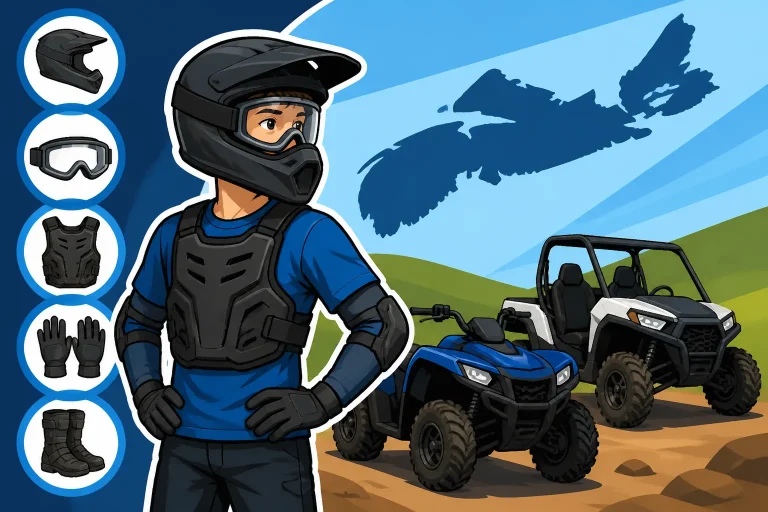
Protective equipment matters even when the location is legally suitable. Use a properly fitted helmet that meets an accepted standard, along with suitable clothing, gloves and boots. If shopping online through Amazon or another retailer, check the product’s certification markings and sizing details rather than choosing by appearance alone. Equipment lowers some risks; it does not make an unsuitable machine or unauthorized riding location acceptable.
What parents should do before arranging a ride
When no accredited closed course is available, the safest approach is to pause before treating a private property or trail as a workaround. The purpose is not to stop families from seeking answers; it is to avoid putting a child on a machine in a setting that may not meet the rule.
Start by describing the situation clearly when asking the provincial authority responsible for OHV rules. Include the child’s age, the machine type, where the ride would take place, who would supervise and whether the activity is practice, travel on a trail or a formal course. Vague questions often produce vague answers.
Ask direct questions, such as:
- Does the closed-course restriction apply to this child’s age and proposed activity?
- What qualifies as an accredited closed course under the current rules?
- Is the specific site accredited, and for which activities and age groups?
- If no accredited course is available, is there another legal option for this rider?
- What supervision, training or safety certificate is required?
- Does the answer differ for private property, a club trail or a public road trail?
- Are there separate registration, insurance or permit requirements?
If you speak with a club or property owner, ask for the answer in writing and confirm it with the authority responsible for the rule. A club can explain its own access conditions, but its permission does not necessarily answer a question about provincial law. The same is true of a retailer, instructor or other rider.
Keep a record of what you confirm: the date, the name or role of the person who answered, the child’s age, the proposed machine and the site discussed. If the answer depends on a course’s accreditation, ask how to verify that status. A response about one location or age group may not apply to another.
Before the ride, work through a basic readiness check:
- The child can comfortably reach the controls and stop the machine.
- The machine is appropriate for the rider’s size and ability.
- The helmet and other protective gear fit correctly.
- The supervisor understands the rider’s limits and can intervene.
- The location is confirmed as lawful for this rider and activity.
- Any required training, documents, registration, insurance and permits are in order.
- The route or riding area has no conditions that exceed the child’s skill.
If you cannot confirm that the proposed location meets the applicable requirement, do not treat uncertainty as permission. Wait for a clear answer or choose an activity that does not require the child to operate the OHV. That is especially important when the alternative being considered is an ordinary trail, a fenced field or a site described informally as a “closed course.”
Families planning trail use should also confirm that the child is eligible to ride on the specific trail network. Nova Scotia Trail Permit Cost explains the permit side, while Nova Scotia Youth Supervision Rules covers the separate question of supervision. A permit or a trained adult does not override an age or location restriction.
Common misunderstandings about closed courses
“The landowner gave permission, so it is allowed”
Permission matters for access, but it does not necessarily satisfy the OHV rules. Ask separately whether the child is allowed to operate the machine at that age and whether the property meets any closed-course requirement.
“It is fenced, so it must be a closed course”
A fence may control access, but it does not prove formal accreditation. Confirm the site’s status instead of relying on its physical layout.
“The club allows youth riders”
A club may set access rules for its trails or events. Those rules do not automatically answer whether a particular young rider meets provincial requirements, or whether a trail counts as an accredited closed course.
“The child has taken a safety course”
Training can be important and may be required in some circumstances. It does not necessarily satisfy a separate location restriction. Confirm both the training requirement and the permitted place to ride.
“A parent is supervising, so the location is fine”
Supervision and location are separate checks. Even close supervision does not necessarily make an otherwise restricted activity permissible.
“The child can ride a smaller machine anywhere”
A smaller machine may be more appropriate for the child, but machine size alone does not resolve age, course, supervision, registration, insurance or trail-access requirements. Check the full set of rules for that rider and location.
For broader questions about permits and operating requirements, see Nova Scotia Rules for Riders Under 16. Before making plans, confirm current details with the responsible provincial authority, since requirements and course availability can change.
Frequently Asked Questions
Can a child aged 6 to 13 ride on a private field?
Do not assume so based only on the owner’s permission. Confirm whether the age-specific rule applies and whether the field meets any required closed-course status.
Does a club trail count as an accredited closed course?
Not automatically. A trail and an accredited closed course are different things. Ask whether the exact site has formal accreditation for the intended activity and age group.
Does an ATV safety certificate make a closed course unnecessary?
Not necessarily. Training or a certificate may address one requirement, while the location rule addresses another. Check both.
What should parents do if no accredited course is available?
Ask the provincial authority responsible for OHV rules whether another legal option applies to the child’s age and circumstances. Until that is clear, do not rely on an informal substitute.
Disclaimer
This article is for general informational purposes only and does not constitute professional advice. Laws, prices and regulations vary by location and change over time. Consult a qualified professional for guidance on your specific situation.