Nova Scotia Permits Not Valid for Motorcycles
A Nova Scotia ATV trail permit can be useful for riding an eligible off-highway vehicle, but it does not turn a motorcycle into an ATV or grant it access to an ATV trail network. If you ride a dirt bike, dual-sport or other motorcycle, the important question is not just whether you have a permit. It is whether that particular machine is allowed on that particular trail.
What the rule means for a motorcycle rider
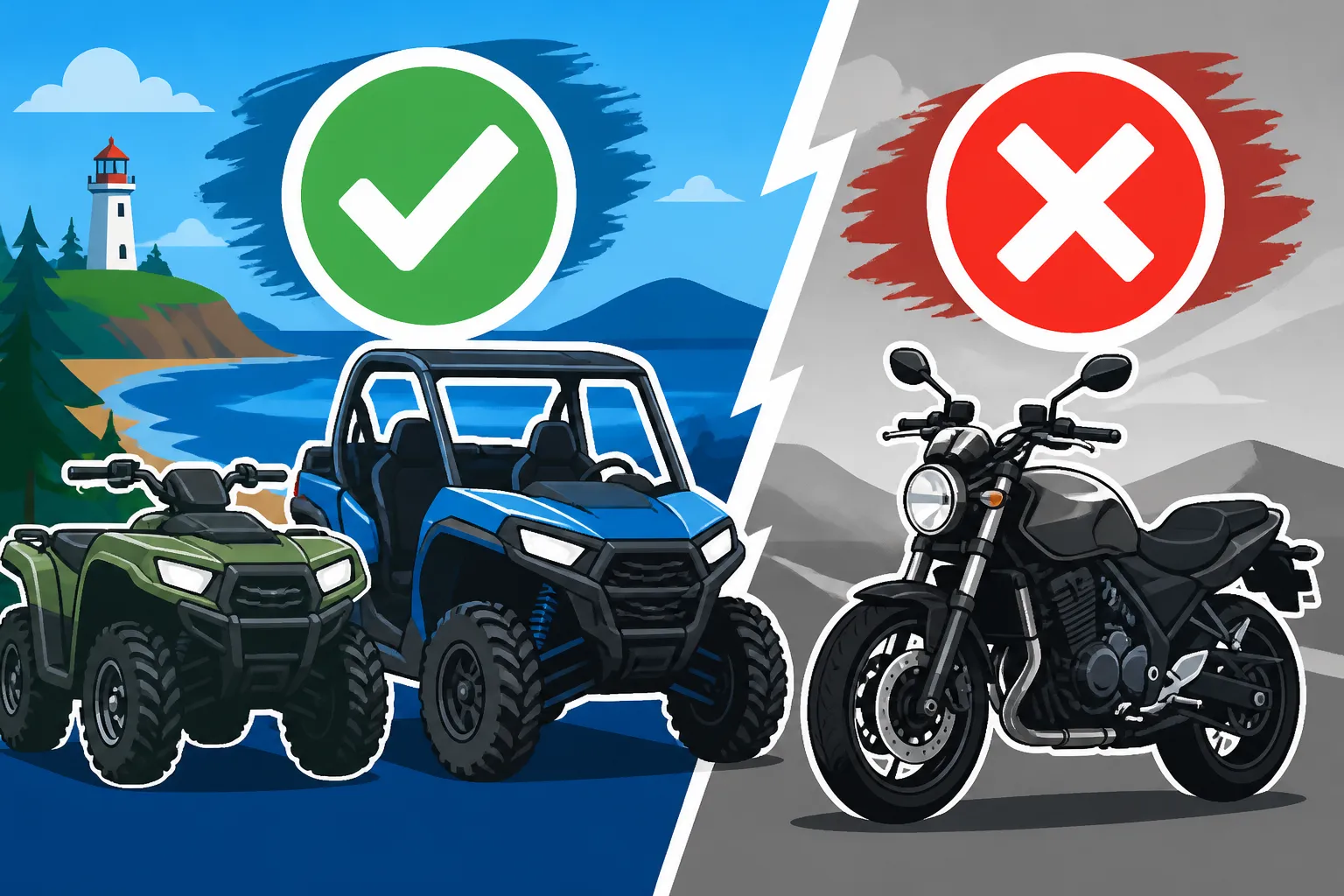
A trail permit is permission to use a defined trail system under the conditions set by the organization or land manager responsible for it. It is not a general pass for every motorized vehicle, and it does not override restrictions on vehicle type. In Nova Scotia, an ATVANS trail permit is not valid for motorcycles.
That distinction matters because motorcycles can look close enough to other off-highway machines that riders assume a permit should transfer. A dirt bike and an ATV may both be used off road, but they are different vehicle types. A side-by-side is not a motorcycle either. A permit issued for one class does not automatically cover another.
The same principle applies if you buy a permit that is otherwise valid for the ATV trail network. A permit does not change how the machine is classified, and it does not itself make a closed or restricted trail open to your bike. Before riding, check the trail manager’s current rules for the exact route and type of motorcycle you plan to use.
| Situation | What an ATV trail permit does | What it does not do |
|---|---|---|
| You ride an eligible ATV or UTV on a participating trail | May provide access subject to the permit’s conditions and trail rules | Does not guarantee every route is open |
| You ride a dirt bike or dual-sport motorcycle | Nothing for motorcycle access simply because you bought an ATV permit | Does not authorize the motorcycle on ATV trails |
| You have a motorcycle permit from another place | May be relevant under a specific reciprocity arrangement, if one applies | Does not automatically make the motorcycle eligible for Nova Scotia ATV trails |
| You have permission from a private landowner | May let you ride on that person’s land within the permission given | Does not grant access to neighbouring land or a club trail |
| Your motorcycle is road-registered | May matter for riding on roads where it is legally allowed | Does not make a trail open to motorcycles |
The permit system is easiest to understand when you separate the document from the machine. The permit applies to a particular type of use and trail system; the machine still has to be eligible. Read Nova Scotia Trail Permits From ATVANS for an overview of how that system works, and see Nova Scotia Permits Not Valid for Snowmobiles for another example of why a permit for one vehicle category does not carry across to another.
If a seller, riding partner or online post says, “You just need a permit,” ask what permit, for what vehicle and for which trail. Those details can change the answer completely. A valid permit for your ATV does not mean a motorcycle in your garage can use the same route.
ATV trail permits and motorcycle access are separate questions
It helps to treat the process as two separate checks:
- Does this permit apply to my vehicle type?
- Is this vehicle type allowed on the route I want to ride?
For a motorcycle on a Nova Scotia ATV trail network, an ATVANS permit does not satisfy the first check. That means you should not assume that paying for a permit, joining a club or riding with someone who has an ATV permit makes your motorcycle eligible.
A club membership permit does not change that. Membership may come with benefits for eligible riders and machines, but it is not a blanket access pass for every vehicle. Likewise, buying a permit without a club does not change the vehicle category. If you are comparing those options for a qualifying ATV or UTV, Nova Scotia’s Club Membership Trail Permit and Nova Scotia’s Trail Permit Without a Club explain the difference. Neither option should be treated as motorcycle authorization.
This is also why “I paid for a permit” is not a reliable answer if a club volunteer or trail representative asks whether your motorcycle is allowed. The relevant question is whether the permit is valid for that machine, and whether that route permits motorcycles at all. A permit receipt cannot substitute for permission that the permit does not provide.
A dirt bike and a road motorcycle are not interchangeable for access
People use “motorcycle” to mean several kinds of machine. A dirt bike may be designed primarily for off-road use. A dual-sport is set up for both road and off-road riding. A conventional road motorcycle may be street-oriented but could still be taken onto a private road or other surface with permission. These differences can affect registration, insurance and the way you may use public roads, but they do not make the ATV trail permit valid for any of them.
If you have a dirt bike and are trying to sort out its paperwork, Dirt Bikes and Nova Scotia Paperwork may help with the separate registration questions. Keep that paperwork question distinct from trail access. Having documents for a machine does not establish that a club corridor, private woodlot or other route is open to it.
A dual-sport rider should be especially careful not to infer access from road legality. A motorcycle that can legally travel on a public road does not automatically have permission to leave that road and enter an ATV trail. Conversely, a trail that appears to connect with a public road is not necessarily open to motorcycles. Check the rules for both the road and the trail segment.
A permit cannot change a trail’s vehicle restrictions
Trail access can depend on the organization maintaining the corridor, the landowner, a local agreement, posted restrictions and temporary closures. A trail may be part of a larger route while only some sections permit certain machines. A trail map that shows a continuous line is useful for planning, but the line alone does not prove motorcycle access.
That is why checking a permit’s general description is not always enough. Confirm the machine category and the specific segment. If the information is unclear, contact the club or trail manager before unloading the motorcycle. Nova Scotia Trail Conditions and Closures can help with the separate issue of whether a route is currently usable, but a trail being open does not necessarily mean it is open to motorcycles.
Visiting riders and reciprocity do not make an ATV permit work for a motorcycle
Visitors sometimes assume a pass or permit from their home province will be recognized in Nova Scotia. Reciprocity is a specific arrangement, not a general promise that every out-of-province credential works everywhere. It may apply to a defined kind of vehicle, permit or trail use. It does not automatically expand that credential to cover motorcycles.
The same caution applies in reverse: buying a Nova Scotia ATV trail permit does not make a motorcycle eligible just because you are visiting for a short time. A visitor permit is still tied to its stated purpose and vehicle category. If you are considering the temporary option for an eligible ATV, see Nova Scotia’s Thirty-Day Visitor Permit. If you are coming from New Brunswick, Nova Scotia Rules for a Visiting New Brunswick Rider covers the visitor question separately.
Before travelling, confirm these points with the organization responsible for the route:
- Is the machine category allowed on the trail?
- Is there a permit or pass required for that vehicle?
- Does any out-of-province permit or reciprocal arrangement apply to this type of machine?
- Are there sections with different rules or access agreements?
- Is the trail open on the day you intend to ride?
Do not rely on a friend’s experience from another province as proof. Their permit may cover an ATV, their route may be managed differently, or the rules may have changed since their last trip. A permit that is recognized for an ATV still does not necessarily apply to a motorcycle.
The safest approach is to identify the exact machine and exact trail before buying anything. Describe the motorcycle accurately: dirt bike, dual-sport or road motorcycle. Then ask the relevant club or trail manager for a direct answer. If you only ask whether “motorized vehicles” are allowed, you may get an answer that is too general to rely on.
Keep any reply or written guidance with your trip notes. It will not replace the trail’s posted signs or current instructions, but it helps prevent confusion about what you asked and what the organization told you. If you speak with someone by phone, note the date, the trail segment and the vehicle description. That is much more useful than remembering a vague “yes, bikes are fine.”
Where a motorcycle rider may be able to ride
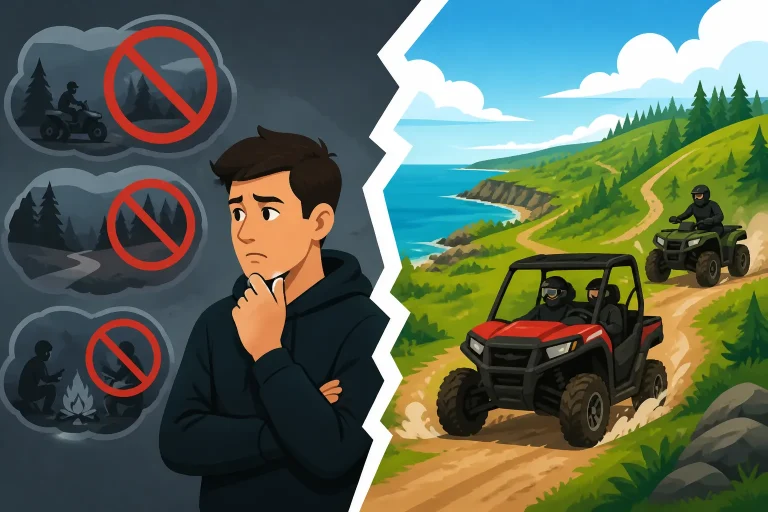
“No ATV permit” does not mean “no motorcycle riding anywhere.” It means you need to find a lawful place to ride that specifically permits motorcycles. The answer may be a private property arrangement, an authorized riding area or another route with rules that expressly allow your machine. Access has to come from the landowner or responsible organization, not from an ATV permit.
Private land requires permission
A landowner can give permission for use of their land, subject to the limits of that permission and any other rules that apply. Be clear about where you may ride, when you may ride, whether you can bring other riders and whether the permission includes access roads or connecting trails. Permission to use one property does not grant a right to cross the next property.
Do not assume that an unmarked woods road is public, or that a route used by ATVs is open to motorcycles. A gate, trail sign or existing tire tracks do not tell you that you have permission. For more on land access, see Nova Scotia Private Woodlot Permission and Nova Scotia Crown Land Riding Rules. These are separate questions from whether an ATV trail permit is valid.
When permission is given verbally, clarify the route and boundaries. Ask about logging or other work, seasonal restrictions, gates and any areas that must be avoided. Respecting those conditions matters: a rider who leaves the agreed route or damages wet ground can jeopardize access for others.
Road access and off-road access are not the same
A street-legal motorcycle may be allowed on particular public roads if it meets the applicable requirements. That does not automatically allow it onto an adjacent multi-use trail, ATV corridor or private road. A trail entrance beside a road is not an invitation to continue riding beyond the public roadway.
Likewise, a motorcycle’s road registration and insurance answer different questions from trail permission. Registration relates to the vehicle’s official status; insurance addresses financial protection under the policy; trail access depends on the rules for the land and route. None of these documents should be treated as a substitute for the others.
If you are planning a mixed ride that uses roads and trails, map each part separately. Identify where you will be on a public road, where you will enter a trail and who manages that trail. Make a detour plan in case a section is closed or does not allow motorcycles. Do not use an ATV permit as a workaround for an uncertain trail segment.
How to check before you load the motorcycle
A few minutes of checking can save a long drive, an argument at a trailhead or a ticket for riding where you do not have permission. Use this process whenever you are considering a new route or a trip from outside Nova Scotia.
- Describe the machine accurately. Note whether it is a dirt bike, dual-sport or road motorcycle. Do not call it an ATV simply because it is used off road.
- Name the exact trail or property. A county, region or broad trail network may include segments managed under different rules.
- Ask whether motorcycles are permitted. Ask directly about your kind of motorcycle rather than asking whether “OHVs” or “motorized vehicles” are allowed.
- Ask what credential is required. If the answer mentions a permit, confirm that the permit applies to motorcycles, not just eligible ATVs or UTVs.
- Confirm access for your dates. Closures, work, weather and seasonal restrictions can affect a route even when the vehicle type is normally allowed.
- Check signs and instructions on arrival. Follow current notices at the trailhead and any direction from the organization responsible for the land.
- Carry the relevant information. Keep permission details, any applicable registration or insurance documents, and route notes accessible without relying on a weak cell signal.
A small waterproof document pouch can keep paper permission, maps and other documents readable after rain or mud. You can find basic options at outdoor retailers or on Amazon. If you use your phone for route notes, a handlebar mount from Amazon may make it easier to consult the route while stopped; do not rely on handling a phone while riding. A compact power bank sold through Amazon can also be useful on a long trip, but it cannot replace a downloaded map or a plan for dead zones.
These are convenience items, not trail permissions. Do not let a map app’s route line persuade you that a trail is open to motorcycles. Digital maps can be incomplete, show a corridor without vehicle restrictions or lag behind a closure. Use them to orient yourself, then confirm access with the responsible source.
If a club or land manager cannot confirm motorcycle access, do not assume that silence means yes. Choose a route with clear permission or postpone that section until you have a definite answer. It is better to turn around before unloading than to discover the restriction after entering a trail.
Common mistakes to avoid
The most common mistake is treating every off-road machine as though it belongs to one permit category. An ATV, a UTV, a dirt bike and a snowmobile can all be used away from paved roads, but that does not make their permits interchangeable. Check the category named by the permit and the machine named in the access rules.
Another mistake is confusing a trail permit with registration or insurance. A trail permit is not a substitute for any paperwork that may be required for the motorcycle’s use. Registration does not grant access to a private trail, and insurance does not grant permission to ride across someone’s land. Handle each requirement separately.
Riders also sometimes assume that club membership settles the question. Membership can be valuable for eligible trail users, but it does not make every vehicle type eligible. Read the membership and permit information closely, and ask the club about motorcycles before buying a membership for the purpose of riding its trails.
A further risk is relying on old advice. Trail access can change when agreements change, a route is damaged, a landowner withdraws permission or an organization updates its rules. Ask about the route you will actually use, not just what a friend rode several seasons ago. If you see a sign that conflicts with information you were given, follow the posted direction and contact the trail manager.
Finally, avoid assuming that permission for one motorcycle applies to a group. A landowner may agree to one rider but not a large group, or may restrict riding to a particular time and route. Confirm how many machines are included, whether guests may come and whether any special conditions apply.
The practical takeaway is simple: an ATVANS permit is not a motorcycle permit. If you ride a dirt bike or another motorcycle, find a trail or property that specifically allows motorcycles, then confirm the access conditions directly. Treat the permit, machine classification, land permission and any registration or insurance requirements as separate checks.
Disclaimer
This article is for general informational purposes only and does not constitute professional advice. Laws, prices and regulations vary by location and change over time. Consult a qualified professional for guidance on your specific situation.