Nova Scotia Private Woodlot Permission
A trail on a map does not automatically give you permission to cross a private woodlot. In Nova Scotia, the practical first step is to identify who controls the land and ask before riding. This article explains how to seek permission, what to agree on, and why a trail permit or registration does not replace an owner’s consent.
Why private woodlot permission matters
A woodlot may look like open riding country, but it is still land someone owns or manages. A visible track, old logging road, or route used by other riders is not reliable proof that you can use it. Access might be limited to a particular group, season, or marked corridor, or it might have ended altogether.
Treat permission as something to confirm directly, not something to infer from tire marks, an unlocked gate, or a trail line on a map. If you cannot establish who controls the property or whether access is currently allowed, choose another route until you can check.
Private woodlot access is also different from permission to ride on a club trail. A club may maintain or manage a route under an arrangement with a landowner, but that arrangement can have limits. It may cover a specific corridor rather than the whole property, for example. The landowner can also close or restrict access. For background on how these routes work, see Nova Scotia Trails That Cross Private Woodlots and Staying on the Marked Corridor Through Private Woodlots.
| What you have | What it may allow | What it does not automatically allow |
|---|---|---|
| A landowner’s permission | Riding on the area and under the conditions the owner agrees to | Riding elsewhere, using a different route, or ignoring safety rules |
| A trail permit | Access to eligible trails under the permit’s terms | Entry onto every private property in Nova Scotia |
| Machine registration | Meeting registration requirements that apply to the machine | Permission to cross land you do not control |
| A club membership | Club-related benefits and any access included under its terms | Access to a separate woodlot without the necessary authorization |
| A route shown on a map | A useful starting point for planning | Proof that the route is open or that you may use it today |
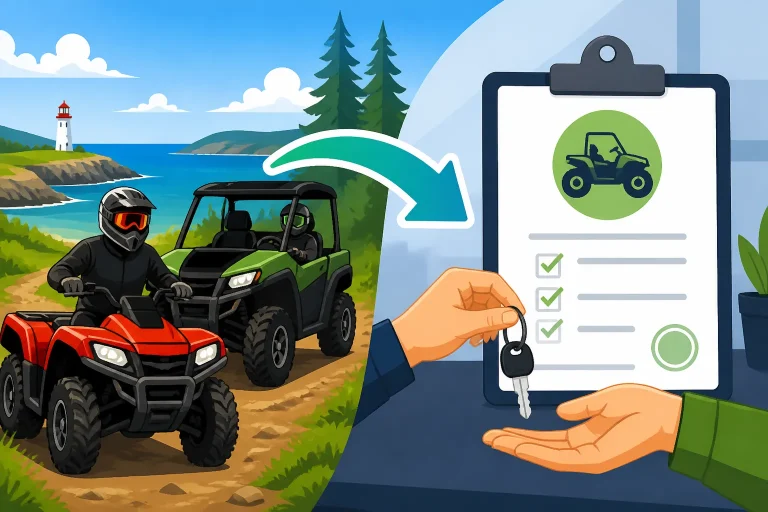
A landowner’s permission does not replace any registration, insurance, safety, or trail-permit requirements that apply to your machine and where you ride. In the same way, meeting those requirements does not give you the right to enter a private woodlot. Check each part separately. Nova Scotia Registration Before Your First Ride and Nova Scotia Insurance Requirements for Riders cover two requirements that are distinct from property access.
A route may cross several parcels, even if it looks like one continuous road. Permission from one owner covers only the land and route that person is authorized to approve. If a ride crosses a series of properties, confirm that the full route is open rather than assuming one conversation covers every section.
How to ask for permission
Start by identifying the owner or the person who manages access. If the route is part of a local club network, a nearby club may be able to tell you whether there is an established access arrangement or whether the section is closed. A club’s information is helpful, but if the arrangement is unclear, ask who is authorized to confirm access.
If you are approaching an owner directly, make the request specific and easy to answer. Explain who you are, what machine you intend to ride, how many people are coming, and the route or area you want to use. Include the date or time period and whether you expect to return regularly. A request to cross one known track for a single ride is clearer than a general request to ride “the woodlot.”
A short written message is useful because it lets both sides confirm the route and conditions. Written permission does not need to be complicated. The point is to avoid mismatched assumptions about where riding is allowed, who may come, and when access ends. If permission is given verbally, send a brief follow-up message summarizing what you understood and ask the owner to correct anything that is wrong.
Before the ride, confirm details such as:
- The exact entrance and route you may use.
- Whether permission applies to ATVs, side-by-sides, or both.
- How many machines or riders are allowed.
- Whether the permission is for one date, a season, or repeated visits.
- Whether passengers, guests, or a larger group are included.
- Whether you must avoid active forestry work or particular areas.
- What to do if a gate is locked or a sign says the route is closed.
- Whether the owner wants advance notice before each visit.
- How to contact the owner if conditions change or you find damage.
Do not assume that a friend’s permission transfers to you. Ask whether the owner has agreed to let additional riders use the property. Likewise, do not invite a larger group than the one the owner approved. If the conditions are not clear, pause and get clarification instead of trying to resolve the ambiguity at the gate.
For a route associated with a club, check with the club about current access and closures. Finding an ATVANS Club Near Your Trails can help you locate a club connected to the area. A club may also know whether a landowner has changed access conditions. If you hear conflicting information, avoid the route until someone with authority confirms it. A trail listing or an old message is not a substitute for current permission.
Follow the agreed conditions on every ride
Permission is not a general invitation to explore. Stay within the route and boundaries the owner approved, even if another track looks rideable. Taking a shortcut around a wet spot, exploring a side road, or widening a turn can take you beyond the agreed area and damage the property.
Respect gates and signs. If a gate is closed, do not assume you may open it because you have permission for the road beyond it. Contact the owner or follow the instruction you were given. If the owner has said you may open a gate, leave it exactly as you found it. That means checking whether it was open or closed and securing it accordingly. See Leaving Woodlot Gates Exactly as You Found Them for more on this small but important responsibility.
Conditions can change after a storm, during logging, or when a route becomes too wet to use safely. A track that was available on your last visit may be closed today. Ask about temporary closures before riding, and leave if you encounter a closure sign or an active operation. Check Nova Scotia Trail Conditions and Closures when your route uses a club trail, but still follow any separate instructions from the woodlot owner.
Forestry work deserves particular care. Logging trucks, equipment, loading areas, and newly cut sections can create hazards that are not obvious from the trailhead. Do not enter an active work area or assume the operator has seen you. If you encounter equipment or workers, stop at a safe distance and follow their instructions. If the route cannot be used safely, turn around rather than looking for an unapproved detour.
Keep the ride low-impact. Stay on the established track, avoid spinning tires, and do not make a new route around mud or standing water. Avoid disturbing timber, soil, water, gates, and other property. Carry out litter and secure any gear that could fall off. If you cause damage or find a hazard, tell the owner promptly rather than leaving them to discover it later.
Noise and group behaviour matter, too. Keep speeds controlled, avoid unnecessary revving, and make sure everyone in the group understands the access conditions. A guest who rides off-route or leaves a gate open can affect future access for everyone. If the owner has set a group-size limit, a quiet-hour condition, or a requirement to check in, treat it as part of the permission.
If an owner withdraws permission, stop using the route. Do not argue that it has been used for years or that other people still ride there. Access depends on current authorization. A closure may affect a club route or require a reroute, so report what you learned to the club if one manages or maintains the trail. Why a Woodlot Owner Closes a Trail explains why access can change even when a route has been popular.
Keep permission separate from permits and public access
A woodlot owner can authorize access to their property, but that does not settle every other requirement for the ride. Before heading out, check that your machine’s paperwork and insurance are in order and that any trail permit required for your route is valid. A trail permit’s coverage and access terms are separate from the owner’s permission. See Nova Scotia Trail Permit Cost for information about the permit side; check the permit provider for current requirements and details.
The reverse is just as important: having registration, insurance, and a trail permit does not authorize you to cross a private parcel that is not included in the access arrangement. If your planned route connects a public road or trail to a private woodlot, confirm that each section is open to you. Do not use a roadside entrance or another person’s driveway as a substitute for permission.
Private land and Crown land are not interchangeable. A route that leaves a woodlot may enter land with different access rules, and a permission agreement for one parcel does not carry over to another. Check the rules for each type of land before riding; Nova Scotia Crown Land Riding Rules provides a separate starting point for Crown land questions.
It can help to keep a copy of the owner’s written conditions with your ride plans, especially if permission is limited to certain dates or a particular group. That record is not a substitute for following the rules, but it can prevent confusion about the agreed route. Share the conditions with every rider before the group arrives, not after someone has gone through the gate.
When access is uncertain, the safest choice is straightforward: do not ride the property until the person authorized to grant access confirms that you can. Respectful requests and careful riding help preserve relationships between landowners and riders, but they cannot guarantee that access will always be available. The owner’s conditions, current closures, and the rules that apply to your machine all matter on every trip.
Disclaimer
This article is for general informational purposes only and does not constitute professional advice. Laws, prices and regulations vary by location and change over time. Consult a qualified professional for guidance on your specific situation.