What a Blue Plate Means on a Club Trail
A blue plate on an ATV or side-by-side can look like official proof that the machine is allowed on a Nova Scotia club trail. The important distinction is that a visible plate or marker is not, by itself, a reliable check of every requirement. Here’s what it may signify, what it cannot prove, and how to check your own trail access before riding.
What a blue plate may indicate
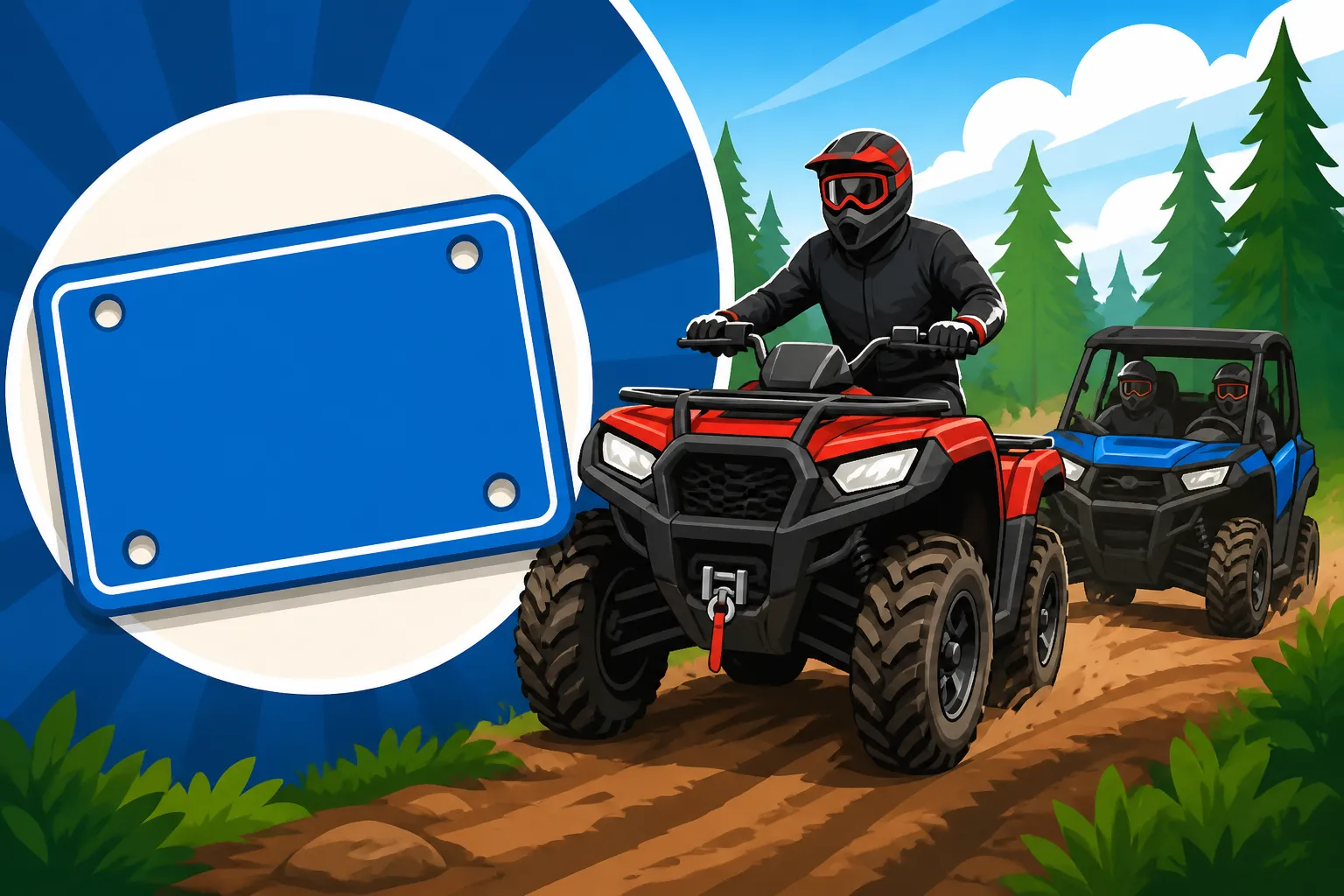
On a Nova Scotia club trail, riders may use “blue plate” informally to refer to a visible marker associated with trail access. It can suggest that the machine has a trail permit, but the colour alone does not tell you which permit was purchased, whether it is current, or whether the rider has met other requirements.
It also is not the same as a provincial road-vehicle licence plate. Off-highway vehicle registration and trail access are separate matters, and a marker on the machine should not be treated as a substitute for the relevant documents.
The clearest way to think about it is to separate three things:
| Item | What it is for | What a blue marker alone tells you |
|---|---|---|
| Provincial OHV registration | Identifies the registered machine and its owner under the provincial registration system | It does not reliably confirm registration |
| ATVANS trail permit | Provides trail access under the permit’s conditions | It may signal a permit, but does not establish that it is current |
| Insurance and rider requirements | Address separate legal and safety obligations | It does not prove coverage, training, or rider eligibility |
A club trail permit is not the same as a vehicle permit issued through the provincial registration system. If you’re unsure about the registration side, see Nova Scotia Registration and the Trail Permit. For the permit itself, Nova Scotia’s Club Membership Trail Permit explains the membership-linked option, while Nova Scotia’s Trail Permit Without a Club covers the alternative.
A visible marker can be useful for quick identification on a trail, but it is not a complete compliance check. A rider should be prepared to show whatever current permit or other proof is required, rather than assume the colour or appearance of a marker settles the question.
What the blue plate does not prove
Even if a marker is connected with a trail permit, it does not establish that every rule has been met. A permit is one part of riding legally; it does not replace registration, insurance, safety requirements, or permission to use a particular route.
It does not replace provincial registration
Nova Scotia’s provincial registration system is separate from the trail permit system. A machine may need the appropriate registration even if it has a club-trail marker. Conversely, having provincial registration does not automatically provide access to ATVANS club trails.
For a broad overview, see Do You Need to Register an ATV in Nova Scotia?. If you’re dealing with the paperwork for a machine you’ve just bought, Nova Scotia Registration Paperwork Checklist can help you identify what to have ready.
Registration also should not be confused with a road-trail permit or a licence plate for public roads. The rules depend on where you ride and what type of route you’re using. A marker that appears to show trail access does not authorize use of a road, shoulder, beach, woodlot, or other area where riding may be restricted.
It does not prove that the permit is current
Trail permits have terms and conditions, and riders should check the permit information rather than infer validity from a colour. If a marker remains on a machine after a permit expires or changes, its appearance may not reflect the rider’s current status.
Check the current permit details through the issuing organization or a member club. The information should clarify the permit period, which machine it applies to, and what proof the rider should carry or display. Nova Scotia Permit Expiry Date is useful if you’re trying to understand when a permit stops being valid.
Do not rely on another rider’s plate as a guide to your own obligations. They may have a different permit type, may be riding under different circumstances, or may not be complying with the rules.
It does not prove insurance or training
A trail permit does not automatically confirm that a rider has appropriate insurance or any required safety training. Those requirements are separate. If you’re checking insurance, Nova Scotia Insurance Requirements for Riders explains the distinction between trail access and insurance obligations. For training, see Nova Scotia Safety Certificates Are Mandatory.
This matters especially when riding with family or a group. A parent or experienced rider accompanying someone does not make every age, supervision, or training requirement disappear. Check the rules that apply to each rider and machine before setting out.
It does not grant access to every trail
A club trail permit is not blanket permission to ride anywhere in Nova Scotia. Club trails use defined corridors and may cross private property or connect with areas that have different access rules. Routes can also be closed or changed.
Before a ride, check the current route information and any closure notices. Keep to the signed corridor, respect gates and landowner conditions, and don’t assume a road or informal track is part of the club network just because it connects to one. Nova Scotia Trail Conditions and Closures and Nova Scotia Trails That Cross Private Woodlots offer more detail on these practical limits.
How to check what you need before riding
If you’re looking at a blue plate on someone else’s machine, you usually do not need to identify its exact meaning to plan your own ride. Confirm your own permit and paperwork instead. If you’re buying a machine or trying to work out whether it can enter a club trail, use this checklist.
- Confirm the route is a club trail open to your machine. Check current trail maps, local club updates, and posted signs. A trail’s name or apparent connection to the network is not enough to confirm access.
- Choose the correct trail permit. Determine whether you want a permit linked to club membership or a permit without club membership. Compare what each option provides in Nova Scotia Club Permit vs Standalone Permit.
- Check which machine the permit covers. Don’t assume one permit covers every ATV or side-by-side you own. If you plan to ride a second machine, see Nova Scotia Permit for a Second Machine.
- Confirm provincial registration separately. Check the registration status and required documents for the machine. Trail-permit proof does not take the place of provincial paperwork.
- Check insurance and rider requirements. Make sure the machine and rider meet the requirements that apply to the route and activity.
- Keep the required proof available. Follow the permit issuer’s instructions about proof of purchase, display, or documents to carry. A coloured plate or marker is not a substitute if the rules call for other evidence.
- Recheck before a later ride. Permit status, trail conditions, and closures can change. A marker that appeared valid on an earlier outing is no guarantee of current access.
If you already have a blue marker and aren’t sure what it represents, contact the club or organization that issued the permit, if known. If you don’t know who issued it, don’t use the marker as proof that the permit is valid. Ask the relevant club or ATVANS what current documentation they accept and whether the marker is still used.
For riders new to the province, the distinction can be particularly confusing: buying or registering a machine does not necessarily provide the trail access you expect. Visitors also need to check whether their permit from another province is accepted and what conditions apply. Nova Scotia Registration for a Visiting Rider addresses provincial registration questions, while Nova Scotia Permit for a Visitor focuses on trail-permit access.
The practical takeaway is simple: treat a blue plate as a possible visual clue, not as proof of every requirement. Your own current permit details, provincial registration, insurance, rider eligibility, and the trail’s access conditions are what matter. When in doubt, confirm with the club or permit issuer before riding.
Disclaimer
This article is for general informational purposes only and does not constitute professional advice. Laws, prices and regulations vary by location and change over time. Consult a qualified professional for guidance on your specific situation.