Nova Scotia Engine Size Guidance for Youth
Choosing an ATV or UTV for a young rider is not as simple as picking an engine size from an age chart. A machine that looks small can still be too heavy, fast or difficult to control. This guide explains how to use engine size as one clue, check Nova Scotia’s separate youth rules, and judge whether a machine genuinely fits the rider.
What engine size guidance can and cannot tell you
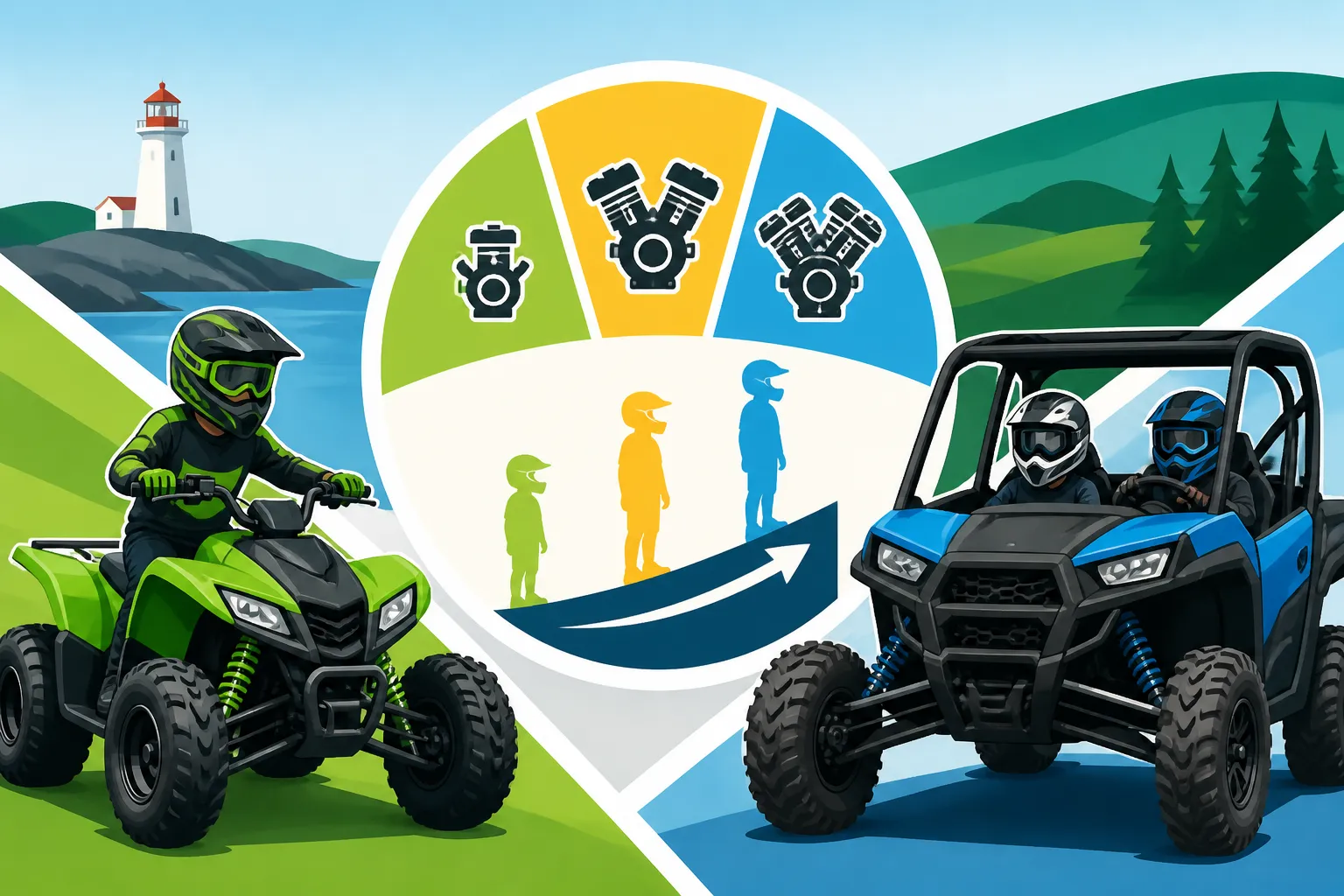
Engine displacement, usually shown in cubic centimetres (cc), describes the approximate size of an engine. It can help compare machines, but it does not tell you by itself how powerful, fast or manageable a particular ATV will be. Two machines with similar displacement can behave differently because of their gearing, weight, throttle response, speed limiter, design and condition.
That makes a simple rule such as “this many cc for this age” a poor way to choose. Age can help narrow the options, but it cannot account for a young rider’s height, strength, coordination, experience or ability to respond calmly when something unexpected happens. A child who can reach the controls while sitting still may still struggle to steer, brake or shift their weight on uneven ground.
Engine size guidance is best treated as a starting point for comparing models, not a legal permission slip or a guarantee of safety. Before buying or lending a machine, use several checks together:
- Read the owner’s manual and any manufacturer age or rider-size recommendations.
- Check the machine’s weight, seat height, control layout and speed-limiting options.
- Confirm that the rider can operate the controls and keep a secure riding position.
- Check Nova Scotia’s rules that apply to the rider, machine and place of use.
- Consider whether the young rider has the training and maturity to ride safely.
The distinctions between engine displacement, speed and control matter. A small-engine machine can still be too heavy for a child to stop or redirect. A machine with adjustable speed may still be difficult to handle if its brakes, steering or throttle take more strength than the rider has. Conversely, a machine with a larger engine is not automatically suitable for every adult; the rider’s skill and the machine’s setup matter too.
If you are comparing youth models, look at the whole machine rather than treating the number on the spec sheet as the answer. Check the listed dry or curb weight, seat height, recommended age range, speed controls and the instructions for supervising young riders. Model labels and seller descriptions are not substitutes for reading the manufacturer’s manual.
Nova Scotia’s age-related requirements are a separate issue from engine-size guidance. A machine that seems appropriately sized does not automatically mean a young person is allowed to operate it in a particular setting. Start with Nova Scotia Rules for Riders Under 16 and confirm the current requirements that apply before riding.
Check the rules before choosing a machine
Youth rules and machine specifications answer different questions. The rules determine whether a person may ride under particular conditions. The manufacturer’s guidance helps you judge whether a specific machine is designed for that rider. Neither replaces the other.
Nova Scotia has age-specific requirements for young OHV riders, including rules about supervision and protective equipment. The details can depend on the rider’s age, the type of machine and where it will be operated. Do not assume that a parent’s permission, riding on private property or choosing a small engine automatically removes those requirements.
Before a young person rides, confirm the applicable rules through an official source. In particular, check:
- The minimum age and any conditions attached to riding at that age.
- Whether direct supervision is required and who qualifies as a supervisor.
- Whether the permitted riding location is limited by age or other conditions.
- What safety training or certificate is required for the rider.
- Which helmet and other protective equipment must be worn.
- Whether the machine may be used on a road trail or only in another permitted setting.
You can also review [Nova Scotia Supervision Requirements] and Nova Scotia Closed Course Requirements. These are important to check because engine displacement does not create an exception to age, supervision or location rules. If information from a dealer, seller or online post conflicts with official requirements, rely on the current official rule and ask the relevant authority for clarification.
A parent or guardian should also separate legal eligibility from readiness. A young rider may meet the legal conditions and still need more practice before riding a particular machine. Legal permission does not mean that every machine, trail or riding situation is suitable for that child.
ATV and UTV are not interchangeable
An ATV is generally designed for one rider, though some models are built to carry a passenger. A UTV is a side-by-side machine with a seat and controls more like those in a small vehicle. The different layout does not automatically make a UTV a better choice for youth.
A UTV can be heavy, wide and powerful. Its steering, braking, seat belts and passenger arrangement require riders to follow the model’s instructions. Do not assume a child may drive a UTV simply because they can reach the pedals or fit in the seat. Check the manual and Nova Scotia’s rules for the specific machine and rider.
Likewise, do not carry a child as a passenger unless the machine is designed for passengers and the manufacturer permits the arrangement. A seat that looks large enough is not proof that it is a proper passenger seat. Check the vehicle’s seating capacity, restraints and passenger instructions.
Judge the rider and the machine as a complete match
The most useful question is not “How many cc should a child ride?” It is “Can this rider operate this machine safely, in the conditions where it will be used?” That requires looking beyond engine size.
Start with fit and control
Have the young rider sit on the stationary machine with the engine off. They should be able to reach the handlebars and controls without stretching or leaning so far that they lose balance. Their hands should operate the brake and throttle as intended, and their feet should reach the footrests securely. For a UTV, check whether the rider can use the steering wheel and pedals while remaining properly seated and restrained.
A good fit also means the rider can move naturally. If their knees are cramped, feet dangle, arms are overextended or body position is unstable, the machine may not fit, even if it is sold as a youth model. A young person should not have to stand on tiptoe to reach a control or shift their whole body awkwardly just to steer.
Consider strength and weight
The machine must be manageable when it is stopped, turning or on uneven ground. A rider needs enough strength to use the controls consistently and maintain a stable position. Machine weight matters because a child may have difficulty correcting a tip, moving the ATV or keeping it under control on a slope.
Weight and balance can also change with passengers, cargo or accessories. A machine that feels controllable on flat ground may become harder to manage with a load or in mud. Follow the manufacturer’s limits for passengers and cargo, and do not use extra weight as a way to make a machine “more stable” for a child.
Look closely at speed and throttle response
Displacement does not directly tell you the maximum speed or how quickly the machine accelerates. A speed limiter or adjustable throttle may help set a lower maximum, but it does not make the machine harmless. A young rider still needs to control the throttle smoothly, stop reliably and respond to changing terrain.
If the machine has an adjustment feature, use it only as described in the owner’s manual. A parent should understand how the setting works, confirm it is secured properly and check it again before riding. Do not rely on a casual adjustment or a verbal instruction to keep the speed down.
Match the machine to the purpose
A machine used for short, supervised practice on an appropriate area has different demands from one used on a long trail ride, a steep property or a work site. Consider the terrain, distance, likely weather, visibility and whether the rider will encounter other people or vehicles. For a young beginner, a challenging route can make an otherwise manageable machine unsuitable.
If a young person will be riding with family, plan for the least experienced rider. Choose a route and pace that allow supervision without pressure. A machine that is appropriate for a child to practise on is not necessarily the right choice for every group ride.
The province’s youth-machine guidance is worth checking alongside the individual model’s manual. See Nova Scotia Youth Machine Size Rules for related information, and use Choosing a Machine That Matches the Rider’s Size when comparing fit factors.
A practical pre-purchase and pre-ride check
A careful assessment is more useful than relying on an age label alone. Use the same basic process whether you are buying a new machine, considering a used one or deciding whether a child is ready to ride a machine already in the family.
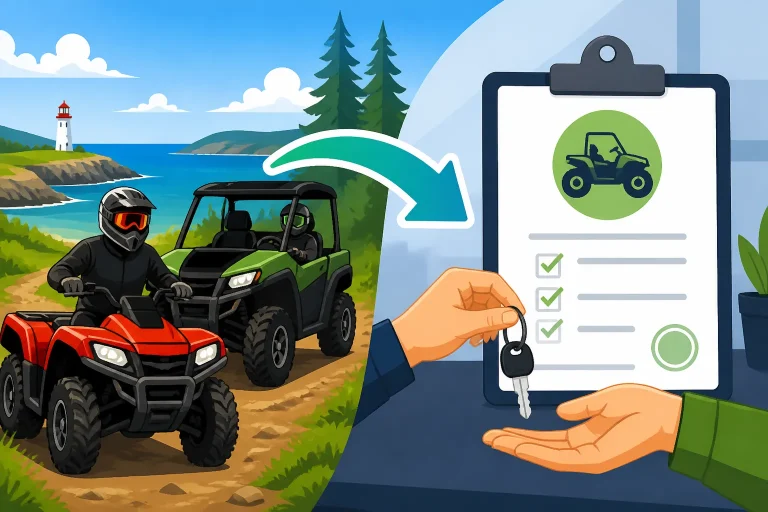
- Confirm the rider’s legal eligibility. Check current Nova Scotia requirements for the rider’s age, supervision, training, equipment and intended location. Do this before comparing engine sizes.
- Read the exact model’s manual. Look for age guidance, rider-size recommendations, passenger limits, speed controls and operating instructions. Make sure the manual matches the model and year.
- Inspect the controls and fit. With the machine off, check reach, posture, foot placement and whether the rider can use the controls without strain.
- Assess the rider’s ability. Consider experience, attention, judgment and ability to follow instructions. A child who is easily distracted or uncomfortable with the controls may not be ready.
- Check the machine’s condition. For a used ATV, inspect steering, brakes, throttle return, tires, suspension and any speed-limiting equipment. A poorly maintained small machine can be more dangerous than a properly maintained one that fits the rider.
- Plan the first practice session. Use a suitable, permitted area, keep conditions simple and supervise as required. Do not start with a group ride, rough trail or steep slope.
- Reassess as the rider develops. Growth, experience and confidence can change the fit, but they do not eliminate the need to recheck the machine and the rules.
When shopping, ask the seller for the owner’s manual and the model’s full specifications. If a listing gives only a broad age range or engine size, ask for the exact model number and verify the manufacturer’s recommendations. Online listings, including Amazon, can help compare product details, but a seller description should not be treated as proof that a particular machine is legally suitable for a Nova Scotia youth rider.
For a used machine, do not base the decision on appearance or a seller’s assurance that “kids ride these all the time.” Confirm that the throttle and brakes work as intended, that any speed-control feature is present and functional, and that the machine has not been modified in a way that changes its performance. If the seller cannot provide reliable model information, pause the purchase until you can identify the machine and check its manual.
A short test sitting on the machine is not a substitute for training or supervision. The rider should practise starting, stopping and controlling the machine in an appropriate setting, with an adult who understands both the machine and the applicable rules. Keep the first session focused on basic control rather than distance or speed.
Common mistakes when using engine size as a shortcut
Treating a chart as a legal rule
A chart that assigns an engine size to each age may be a general shopping aid, a manufacturer’s recommendation or a retailer’s shorthand. It is not automatically a Nova Scotia law. Check the province’s current requirements separately, and do not assume that a machine is permitted because a chart says it is suitable for a certain age.
Assuming a smaller engine always means safer
A small engine can still move a heavy machine quickly, and a rider may still lose control on a slope or loose surface. Engine size alone does not measure braking distance, stability, rider fit or the effect of a passenger. Look at the complete model and how it will be used.
Buying for the rider the child may become
It can be tempting to buy a larger machine so the young rider can “grow into it.” That approach creates a period when the child may be too small or inexperienced to manage the machine safely. Buy for the rider’s current size and abilities, not for an imagined future use.
Equating confidence with readiness
A child may be eager to ride and still lack the coordination or judgment required to manage a machine. Confidence is not the same as skill. Watch whether the rider can follow instructions, control speed, stop promptly and maintain attention. If any of those are inconsistent, slow the process down.
Using a speed limiter as a substitute for supervision
A limiter can help manage speed when it is designed for that purpose and set according to the manual. It cannot keep a young rider from turning abruptly, entering unsuitable terrain or failing to notice another trail user. Continue to supervise and choose an appropriate riding area.
For age-specific questions, Nova Scotia Rules for a 10-Year-Old Rider can help you identify issues to confirm for that stage. Riders approaching their later teens should also check Nova Scotia Safety Training at 16, since training requirements are not determined by engine displacement.
Frequently Asked Questions
Is there one engine size that is right for every young rider in Nova Scotia?
No. Engine size is only one comparison point. Consider the rider’s fit, strength, maturity and experience, along with the specific machine’s weight, speed controls and manufacturer guidance. Check Nova Scotia’s youth rules separately.
Does a small engine mean a child can ride without supervision?
No. A smaller engine does not remove age, supervision, training or location requirements. Confirm the current rules that apply to the rider and the intended riding area.
Can a child ride a UTV because it has seats and seat belts?
Not automatically. Check the exact UTV’s manual, its passenger and driver instructions, and the rules that apply to the child. Being able to reach the controls or sit in a seat does not establish that the child may operate it.
Should a young rider use a speed-limited machine?
A manufacturer-designed speed control may be one useful feature, but it is not a replacement for choosing the right fit, following the manual, supervising the rider and meeting Nova Scotia’s requirements. Check how the control works and ensure it is set correctly.
Disclaimer
This article is for general informational purposes only and does not constitute professional advice. Laws, prices and regulations vary by location and change over time. Consult a qualified professional for guidance on your specific situation.