Group Limits on a Narrow Corridor
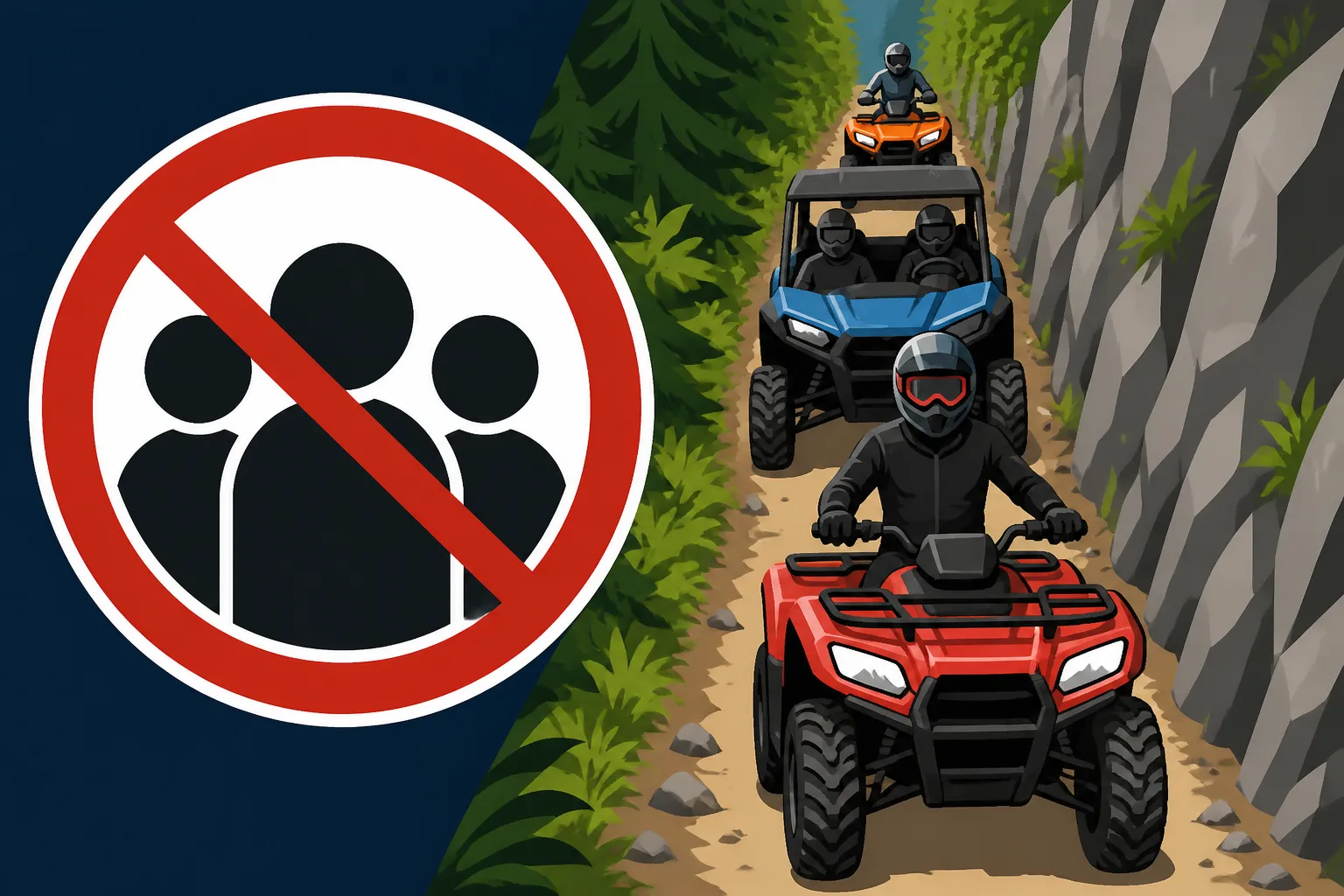
A large ATV or UTV group can turn a narrow Nova Scotia trail into a bottleneck, especially where there is no room to pass or pull over. The practical answer is not simply to pick a smaller number: check the route’s rules, split the ride when needed, and agree on how the group will handle tight sections before anyone sets off.
Is there a group limit on a narrow trail?
There is no safe assumption that one group-size limit applies to every ATV route in Nova Scotia. The rules may depend on whether you are on a club trail, a road trail, a private corridor, or a route used under a specific event or land-use arrangement. A club, landowner, municipality, or ride organizer may set additional conditions. Check the route’s current rules rather than treating a number heard elsewhere as a province-wide limit.
That distinction matters because “narrow corridor” describes a physical condition, not necessarily a legal category. A tight cut through woods may be a club trail; a section along a public road may be a designated road trail with different operating rules. A permit that gives access to some club trails does not override a closure, a landowner’s conditions, or a separate rule that applies on a road trail.
On a road trail, riders must travel single file and must not pass. Those requirements make a long line harder to manage, so a group should keep its formation orderly and avoid stopping where it blocks other traffic. For a fuller explanation of the rules applying to that kind of route, see Nova Scotia Road Trail Rules Explained. Do not assume that the same road-trail rules automatically describe every club trail.
On a club trail, use the posted signs and the trail operator’s directions. If the trail is part of a club network, the club may be the best source for current access information and any group conditions. Nova Scotia Clubs and What They Maintain explains why route access and upkeep can involve local clubs rather than a single province-wide standard. If you are planning an organized outing, ask the club or event organizer whether there is a participant cap, a booking requirement, or a route-specific restriction.
A permit is also not a blanket guarantee that a whole group may ride anywhere. Confirm that each machine and rider has the required documents and that the permit applies to the intended route. Nova Scotia Trail Permits From ATVANS can help clarify the role of a trail permit; Nova Scotia Registration and the Trail Permit explains why registration and trail access are separate matters.
A useful rule for planning is to treat the lowest limit that applies as the one to follow. That may be a posted restriction, a club or event condition, or a practical limit imposed by a route too narrow for a large convoy to use safely. If you cannot confirm the rules, contact the organization responsible for that section before riding it.
How to choose a workable group size
Even where no fixed number is posted, group size affects how quickly riders can respond to a stop, hazard, or change in trail conditions. A narrow route leaves fewer places to pull over, turn around, or pass another group. The same number of machines that works on a wide, open trail may be awkward on a single-track cut, a steep approach, or a corridor with poor visibility.
Think about the route, not only the number of people. Relevant factors include:
- Width and visibility: Can riders see far enough ahead to react, and is there room for a machine to move aside?
- Passing and pull-off space: Are there safe places to let another group through without leaving the marked corridor?
- Terrain: Tight turns, slopes, soft ground, rocks, and water crossings can stretch out a group and make it harder to regroup.
- Rider experience: New riders may need more time and space, particularly on unfamiliar or difficult sections.
- Machine mix: ATVs, side-by-sides, and different machine widths may not fit or manoeuvre alike in a constrained section.
- Conditions: Rain, thaw, washouts, or a temporary reroute can make a familiar trail much narrower or more difficult.
- Other users: A trail may be shared with walkers, cyclists, or other riders, depending on the route.
There is no need to force every participant into one continuous line if the corridor cannot handle it comfortably. Divide a large group into smaller riding units with enough space between them that the first unit can clear a difficult section before the next arrives. Set a regrouping point beyond the pinch point, where everyone can stop without blocking the trail. The ideal spacing depends on visibility and terrain; the goal is to avoid bunching, not to create a gap so large that riders lose contact or become unsure of the route.
For planned group rides, ask about local expectations before choosing a route. The article [Nova Scotia Group Size on Club Trails] is relevant when you need to assess club-trail group conditions. If the club does not give a numerical cap, ask what it considers a manageable group for that particular corridor, whether advance notice is needed, and whether a different route would suit your numbers better.
A trail permit or club membership should not be mistaken for permission to reserve a trail for your group. Other trail users may be approaching from either direction, and access can be affected by current closures or landowner requirements. Check Nova Scotia Trail Conditions and Closures before you leave, and review Nova Scotia Trail Etiquette Locals Expect for practical ways to share the route.
What to do when the corridor narrows
The safest response to a pinch point is to slow down and make a plan before the first machine enters it. A group leader should brief riders on where to stop, who will go first, and how the last rider will know the whole group has cleared the section. Avoid making those decisions at the narrowest point, where a machine may have nowhere safe to wait.
- Pause in a suitable place. Stop before the constriction only if there is room to get fully clear of the riding line. Keep the entrance and any nearby junction unobstructed.
- Check for oncoming users. Do not assume that the corridor is clear because the lead rider has passed through. A bend, rise, or vegetation can hide another group.
- Send riders through in a controlled order. Leave enough space for each machine to negotiate the section without pushing the one ahead. Follow any signage or direction from a trail marshal.
- Keep the line moving where it is safe. Avoid stopping midway through a narrow or steep section unless a hazard makes stopping necessary.
- Regroup beyond the pinch point. Use a wide, safe pull-off or another agreed place, not the middle of the trail.
- Confirm the last rider is through. The lead rider should not set off again until the group is together and everyone knows the route forward.
If two groups meet, courtesy and judgment matter. Neither group should assume that the other must back up; the safest option depends on the terrain and available pull-offs. Talk calmly, identify the nearest safe passing place, and move only when the route is clear. On a narrow coastal cut or similar constrained stretch, backing a machine around a blind corner can be riskier than waiting for the other group to reach open ground. Passing Safely on a Narrow Coastal Cut covers the practical considerations for a tight passing situation.
Do not create a new passing lane by riding around a muddy or wet section. That can widen the corridor, damage the ground, and put riders outside the authorized route. Stay on the marked line and wait for a safe opportunity. This is especially important where a trail crosses private woodlots: access depends on respecting the corridor and the conditions attached to it. See Nova Scotia Trails That Cross Private Woodlots and Staying on the Marked Corridor Through Private Woodlots.
If the passage is blocked or appears unsafe, do not pressure riders to squeeze past. Turn back only where it is safe to do so, or use an approved alternative route. A trail closure, damaged bridge, fallen tree, or washed-out section can change the situation after a ride is planned. Report significant damage to the responsible club or trail contact, and do not assume a visible side path is an authorized detour.
Permits, events, and responsibility for the group
Before organizing a ride, confirm the route and the conditions that apply to each part of it. A trip may combine club trails with road trails or other land, and the rules can change along the way. Check current access information, read posted signs, and make sure participants understand where the group is going. If a route includes an event or organized activity, ask the organizer whether it has separate participant limits or procedures.
A good pre-ride check should cover:
- the route’s current status and any temporary closures;
- whether each participant has the documents and permits required for the route;
- whether any club, landowner, municipality, or event condition limits group size;
- where the group will split, stop, and regroup;
- what to do if a rider is delayed, has a breakdown, or needs to turn back; and
- who will contact the relevant trail authority if conditions are unsafe.
A permit does not remove the need to ride within the corridor or follow its posted conditions. Nor does one rider’s paperwork necessarily cover everyone else’s machine. Confirm each participant’s requirements, including registration and insurance where applicable. The distinction between a trail permit and other operating requirements is explained in Nova Scotia Registration and the Trail Permit.
For an organized ride, assign clear roles. A lead rider can manage pace and warn the group about hazards; a sweep rider can check that no one is left behind. Neither role makes it safe to stretch a group beyond the route’s capacity. Agree on a communication method that works in the area, and do not rely on cell service where coverage may be poor. Riders should know the regroup point and what to do if they become separated.
If there is a collision or another serious incident, prioritize safety and get appropriate help. Do not block a trail junction or narrow passage while managing the situation if there is a safer place nearby. Nova Scotia’s reporting duties can depend on the circumstances; Nova Scotia Accident Reporting Rules is a useful place to check what may be required.
The simplest way to avoid trouble on a narrow corridor is to choose a route suited to your group, verify the conditions with the responsible club or organizer, and split a large convoy when the trail cannot comfortably accommodate it. A posted limit is binding, but even without one, the corridor’s width, visibility, terrain, and other users should determine how many machines travel together at a time.
Disclaimer
This article is for general informational purposes only and does not constitute professional advice. Laws, prices and regulations vary by location and change over time. Consult a qualified professional for guidance on your specific situation.