Nova Scotia Trail Etiquette Locals Expect
A ride can feel relaxing until you meet a hiker around a blind corner, find a gate left open, or discover that a muddy shortcut has widened into a mess. In Nova Scotia, good ATV and UTV trail manners help protect access, wildlife, and relationships with nearby communities. This guide explains how to share trails thoughtfully, handle common situations, and leave the route in good shape.
Know whose trail you are riding
Treat a marked route as permission with boundaries
A trail that looks rideable is not automatically open to ATVs or UTVs. In Nova Scotia, routes may cross land managed by clubs, private woodlots, or other property owners, and access can depend on the specific corridor and its signs. Stay on the marked route and follow posted instructions, even when an unmarked track looks like an easy alternative.
This matters especially where a trail passes close to homes, farms, businesses, or active forestry work. A short detour may seem harmless, but it can take you onto land where access has not been granted. If the sign is missing, unclear, or seems to conflict with your map, stop somewhere safe and check before continuing. The guide to [Nova Scotia Trails That Cross Private Woodlots] offers useful context for understanding why landowner access deserves care.
Mapping tools can help you plan, but a route on a screen is not permission to ride every line it displays. A rider using onX Offroad, for example, should still compare the planned route with current trail signs and local access information. Treat mapping as a planning aid—not as a substitute for the posted rules or permission on the ground.
Follow signs and closures even when the route looks open
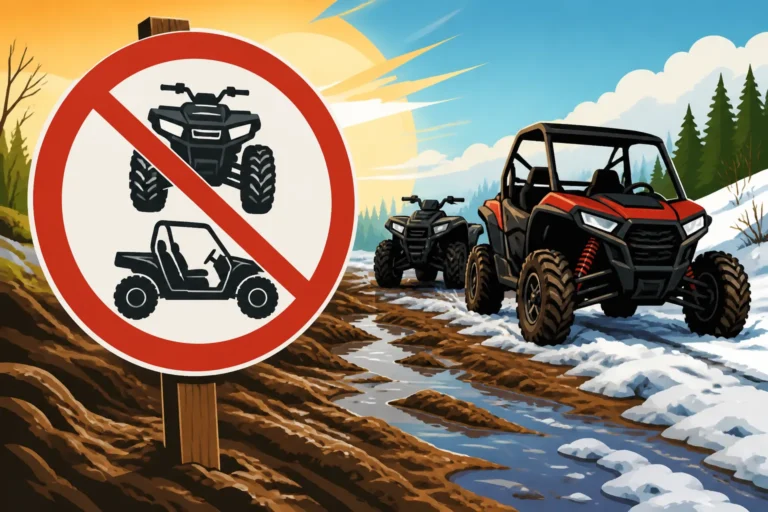
A trail can be closed for reasons that are not obvious from the seat of a machine. A washout may be around the next bend, a bridge may be damaged, or a corridor may be temporarily closed during sensitive ground conditions. A barrier or closure sign is not an invitation to squeeze around the edge. Turn back and use a route that is confirmed open.
When signage is missing or damaged, do not assume that the route is open simply because tire tracks continue past the spot. Tracks may be old, unauthorized, or left before a closure took effect. If the trail network has an official local update or club contact, check it before setting out. [Nova Scotia Trail Conditions and Closures] is a helpful related topic when you are planning around changing access.
Trail signs also help riders understand how to behave at a junction, crossing, or shared-use section. Give yourself time to read them rather than rushing through an intersection. If you ride with a group, tell the riders behind you what the sign says and wait until everyone has understood the instruction before moving on.
Share the corridor with patience and care
Slow down early around people and animals
On a narrow trail, a person walking, cycling, riding a horse, or working nearby may not hear an ATV or UTV until it is close. Reduce speed as soon as you see another trail user, and approach in a controlled way. A sudden throttle burst, hard braking, or loud rev can be startling even when you believe you have plenty of room.
Give other users space and time to decide what feels safe. Slow to a crawl or stop if the corridor is tight, visibility is limited, or someone appears uncertain. Keep your machine steady and avoid crowding the edge of the trail; a person on foot may need a stable place to step aside. A quiet greeting and a clear indication that you are waiting can ease an awkward encounter.
Do not assume that every trail user knows how an ATV or UTV handles. A cyclist may be worried about loose gravel, a walker may be keeping a dog close, and a horse may react to a sudden engine sound. Be predictable: ease off the throttle, avoid sudden movements, and wait for a clear signal or enough room to pass safely. For more on shared corridors, see [Yielding on a Multi-Use Corridor] and [Sharing a Rail Trail With Cyclists].
Make passing and group riding predictable
Before passing another rider or group, make sure you can see far enough ahead and have space to pass without forcing anyone off the trail. Never pass on a blind rise, around a bend, or where the surface narrows. If you are unsure whether the other group has seen you, wait until you can communicate clearly and pass without rushing.
When you meet another machine, slow down and leave room. On a narrow section, one rider may need to stop in a safe, visible place so the other can pass. Avoid driving through a soft shoulder or vegetation to make room; that can damage the edge and create a wider, less stable corridor. Follow local signs and any club guidance about right-of-way rather than relying on assumptions.
Group leaders can prevent a lot of confusion by setting expectations before the ride. Agree on a pace, a regrouping point, and how riders will signal a stop or hazard. Keep enough distance to react to the machine ahead, but close enough that the group does not become scattered at junctions. [Nova Scotia Group Ride Planning] has more on organizing a ride that is manageable for everyone.
| Trail situation | Considerate response | Avoid |
|---|---|---|
| Hiker or cyclist ahead | Slow early, give space, and pass only when safe | Revving, crowding, or passing on a blind section |
| Horse or dog on the trail | Stop or move slowly and wait for a clear path | Assuming the animal will stay calm |
| Another machine approaching | Reduce speed and make room on a stable surface | Forcing someone onto a soft shoulder |
| Closure or barrier | Turn around and use a confirmed open route | Going around or moving the barrier |
| Muddy or damaged section | Use the marked line or turn back if necessary | Creating a new track beside it |
Protect the surface, land, and access
Stay on the established line through mud and wet ground
A muddy patch can tempt riders to go around it, but repeated bypasses can turn one narrow trail into several damaged tracks. The new line may cut into vegetation, expose soil, or widen the corridor until it becomes difficult for clubs and landowners to maintain. If a marked route is open and passable, stay on the established track rather than making a fresh path.
Use good judgment about whether conditions are suitable for your machine and skill level. If the trail is deeply rutted, the ground is saturated, or getting through would require aggressive wheelspin, stopping and turning back may be the more responsible choice. Spinning tires can dig into the surface and make the section harder for the next rider. It can also leave an unpleasant surprise for a person walking or cycling through later.
A machine that can power through a difficult patch does not necessarily mean it should. Consider the impact on the route and on the people who maintain it. If a wet or damaged section has become unsafe or is being bypassed by riders, report it through the relevant club or trail contact rather than widening the route yourself. The related guide [Reporting Trail Damage to a Nova Scotia Club] can help you think through what details are useful to share.
Leave gates, barriers, and trailheads as you found them
If you pass through a gate, follow the sign or local instruction exactly. When a gate is meant to remain closed, close it behind you. An open gate can allow livestock to wander, create a safety problem, or undermine the trust that makes access possible in the first place. Do not climb over a barrier, shift a marker, or move a closure sign to get through.
At a trailhead, park only where the space allows and leave room for other vehicles, trailers, and emergency access. Keep ramps, straps, and gear contained rather than spreading them across the entrance. If the area is busy, unload efficiently and move your vehicle once your machine is ready. A clear trailhead makes it easier for other riders to arrive and easier for local residents to use nearby roads.
Keep the area tidy even if a bin is not available. Pack out food wrappers, cans, broken straps, and anything else you brought in. A small piece of litter can quickly become a reason for landowners or neighbours to feel that riders are careless. For more on access points, see [Nova Scotia Trailheads With Parking]. For gate etiquette, [Leaving Woodlot Gates Exactly as You Found Them] covers a simple practice with a real impact.
Respect nearby homes and working land
A trail can pass close to a home even when it feels remote from the machine. Reduce speed near buildings, driveways, livestock, and work areas, and avoid unnecessary throttle or repeated engine revving. If you stop, keep the group and machines off private driveways and out of places where residents need to move equipment or vehicles.
Trail access often depends on neighbours seeing riders behave responsibly over time. Dust, noise, litter, and machines leaving the marked route can affect people who do not use the trail themselves. A considerate rider treats nearby residents as part of the landscape, not as an obstacle to get past. If someone approaches you with a concern, listen calmly, avoid arguing on the spot, and pass the concern to the relevant club or authority if needed.
Do not assume that a woods road, field entrance, or connecting track is available just because it appears to lead somewhere useful. A route that looks like a shortcut may serve a property owner or active work site. Stay on the marked corridor and respect any gates or notices. The guide to [Nova Scotia Private Woodlot Permission] is relevant when you are unsure how access across private land works.
Ride quietly and leave room for everyone
Keep noise under control
Noise travels farther than many riders expect, particularly in quiet rural areas or near water. Avoid revving while stopped, accelerating hard near homes, or riding in a way that keeps the engine loud for longer than necessary. A steady, controlled pace is usually less intrusive and often makes it easier to respond to changing trail conditions.
A loud machine can change how a nearby resident feels about the entire trail network. One rider may think a quick burst of throttle is no big deal, while someone at home hears a repeated disturbance. That difference in perspective is worth remembering when you pass a house, campsite, or quiet section of trail. [Nova Scotia Sound Limits on Trails] covers the rules and considerations related to machine noise.
Groups should be especially mindful of noise because several machines can create a much larger impact than one. Avoid bunching up and revving together at a stop, and do not let a long line of riders accelerate hard through a settled area. If someone in the group is consistently loud or disruptive, address it privately and calmly rather than letting the behaviour become the group’s reputation.
Give wildlife and other users room
If you encounter wildlife, slow down and give it space to move away. Do not chase, crowd, feed, or deliberately approach animals for a closer look. A machine can make an animal feel trapped, especially where the corridor is narrow or vegetation blocks an escape route. Wait if needed, and continue only when the animal has moved clear.
The same patience applies to people who may need a little extra room. A family with children, an older walker, or someone managing a dog may not move aside quickly. Stop at a safe distance rather than expecting them to react at your pace. If you need to speak, use a calm voice and give them time to answer.
Keep your attention on the corridor instead of focusing on a phone or map while moving. If you need to check directions, pull off only where it is safe and permitted, then take the time to confirm your route. Tools such as onX Offroad can help with pre-ride planning, but checking a route while riding can distract you from people, signs, and changing trail surfaces. A short stop is better than an abrupt correction at a junction.
Prepare before you ride and respond well when things go wrong
Plan for the route, not just the destination
Before leaving home, check that the route is suitable for your machine, that the access is open, and that you know where the trail begins and ends. A map can make distances and connections look simple, but junctions, closures, private access, and surface conditions can change what is practical on the ground. Build in extra time so you do not feel pressured to rush or take an unmarked shortcut.
Bring the essentials for the length and remoteness of the ride, and make sure the group knows what to do if someone falls behind or a machine develops a problem. Share the planned route with someone who is not riding with you, particularly for a longer outing. If the group has mixed experience, choose a pace and route that allow less experienced riders to stay comfortable.
Use onX Offroad or another planning resource as one part of preparation, then check signs and local information when you arrive. If the route on your screen does not match a posted closure or marked trail, follow the on-the-ground direction and stop to clarify rather than trying to reconcile it while moving. A little preparation can prevent a stressful disagreement at a junction miles from the trailhead.
Handle mistakes and conflicts without making them worse
Even careful riders can miss a turn, encounter a damaged section, or realize they have stopped in an inconvenient place. The best response is to pause safely, assess what happened, and avoid compounding the problem. Do not push through a barrier, create a new route around damage, or leave equipment where it blocks the corridor.
If you have an uncomfortable interaction with another trail user or a nearby resident, stay calm and give the other person space to explain the issue. A defensive response can turn a small misunderstanding into a larger conflict. If you made a mistake, acknowledge it and move to a safe place. If the issue involves access or a damaged sign, note the location and report it through the appropriate trail contact rather than confronting someone or changing the signage yourself.
A useful report is factual and specific: describe the trail section, what you observed, and whether there is an immediate safety concern. Avoid sharing private details about other people or posting unverified claims as though they are confirmed. When riders communicate respectfully and fix problems through the right channels, it is easier for clubs and landowners to keep routes usable.
Make courtesy part of the ride
Etiquette is not only about avoiding complaints. It is also about making a ride more enjoyable for everyone using the corridor. A patient pass, a closed gate, a quiet approach near homes, and a decision not to churn up wet ground may seem small on their own. Together, those choices help build a pattern of responsible riding.
Before setting out, agree that the group will follow signs, stay on the route, and stop rather than force a risky pass or muddy shortcut. During the ride, notice how your choices affect the next person—not just the machine behind you. At the end, leave the trailhead clean, share any useful information about damage, and thank volunteers or landowners when you have a natural opportunity.
Local expectations can vary by trail and community, so use posted instructions and club guidance as your reference point. The simplest rule is also the one that travels well: ride predictably, make room, protect the route, and leave the place as welcoming as you found it.
Disclaimer
This article is for general informational purposes only and does not constitute professional advice. Laws, prices and regulations vary by location and change over time. Consult a qualified professional for guidance on your specific situation.