First Aid on a Remote Coastal Loop
A remote coastal ATV ride can turn stressful quickly when someone is injured, soaked by spray, or stranded beyond reliable cell service. First aid on a Nova Scotia coastal loop starts before anyone gets hurt: prepare a kit, know how to share your location, and agree on what the group will do if a rider cannot continue. This guide covers practical steps for common trail emergencies.
Prepare Before a Remote Coastal ATV Ride
Check the route and plan for weak signal
A route that looks straightforward on a screen can include long stretches with no dependable phone service, difficult access for emergency vehicles, or trail conditions that have changed since your last visit. Before leaving, check for closures and recent damage, and tell someone who is not riding where you expect to travel and when you plan to return. Nova Scotia Trail Conditions and Closures and Nova Scotia Trail Closures After a Storm are useful reminders to check the route rather than relying on an old plan.
Save your route and key details for offline use, including the trailhead, major junctions, planned fuel stops, and likely exit points. onX Offroad can help riders prepare an offline map and follow a planned route, but it is not a substitute for an emergency communication device or local trail information. Download maps before you lose service, and make sure everyone in the group knows how to use the same location references.
Set a firm check-in time with your contact person. Agree on what they should do if you miss it, such as calling you first and then contacting emergency services if they cannot confirm your safety. A vague plan like “we’ll be back this afternoon” is harder to act on than a specific return window and a clear route description.
Pack a first aid kit that matches the ride
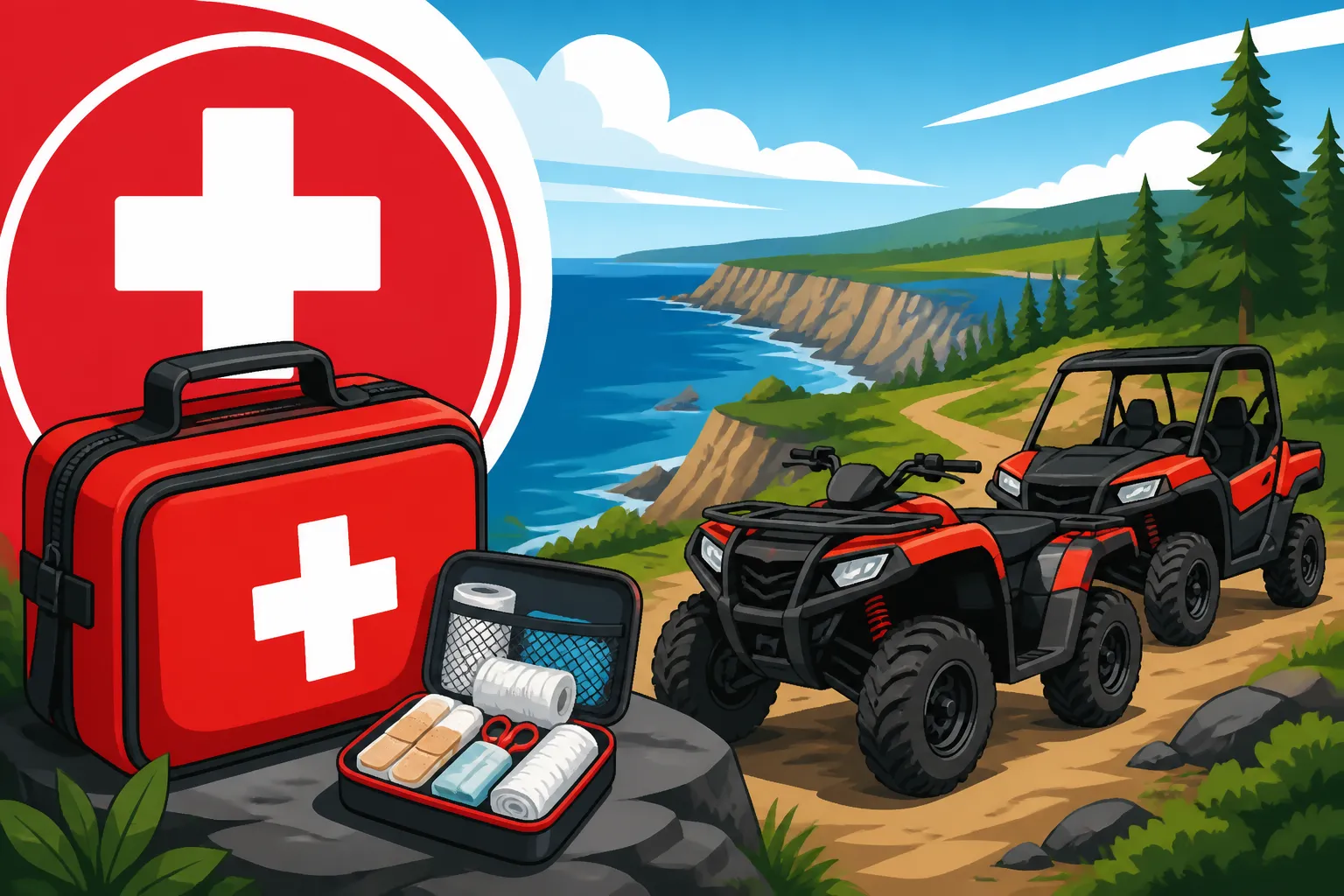
A compact kit is more useful when riders know where it is and can reach it without unloading the machine. Store it in a dry, accessible bag, and protect dressings and medication from rain, mud, and salt spray. Check it before the season and after every use; a kit is not ready if its supplies are wet, used up, or difficult to find.
For a remote ride, consider packing disposable gloves, sterile gauze, absorbent dressings, medical tape, bandages, an elastic wrap, antiseptic wipes, tweezers, trauma shears, a triangular bandage, and a thermal blanket. Bring any personal medication a rider may need, kept in its original packaging where practical. A first-aid manual or offline reference can help someone remember steps under pressure, but it does not replace training.
A kit should suit the people riding and the route. A group with a rider who has a known allergy, for example, should discuss that in advance and make sure the person carries their prescribed medication. For a long loop, also think about water, warm layers, a headlamp, and a way to keep supplies dry. Packing for a Full Day on a Coastal Trail can help with the broader “what else belongs in the machine” question.
Agree on roles before anyone is hurt
In an emergency, several people trying to help at once can create confusion. Before starting, agree that one person will take charge, one will contact emergency services or use the group’s communication device, and another will watch for approaching riders or help direct responders. If there are only two riders, the uninjured person may need to handle more than one task, so keep the plan simple.
Share key information before the ride: who has first-aid training, where the kit is, which machine carries the satellite messenger, and what the group will do if someone is separated. If a rider has a relevant medical condition, they can choose what the group needs to know to respond safely. Do not assume that the person who “usually leads” will be able to coordinate after an accident.
| Before the ride | What to confirm | Why it helps |
|---|---|---|
| Route | Planned trail, junctions, exit points, and closures | Makes it easier to explain where help is needed |
| Communication | Cell coverage expectations and backup device | Reduces reliance on a phone that may have no signal |
| First aid | Kit location, contents, and trained riders | Avoids searching through bags during an emergency |
| Check-in | Return time and missed-check-in plan | Gives someone a clear reason to follow up |
| Group roles | Who calls, leads care, and guides responders | Keeps tasks organized when people are shaken |
Responding to an Injury on a Remote Coastal Loop
Make the scene safer before treating the rider
The first impulse may be to rush toward an injured friend, but first check for immediate hazards. Look for moving machines, unstable ground, traffic, loose rocks, water, fire, or poor visibility. Shut off engines where safe, keep other riders from crowding the scene, and use lights or a visible marker if the trail setting makes it hard for others to see you.
Do not put yourself in danger trying to move a machine or reach someone on unstable terrain. If there is an immediate threat, such as fire or rising water, move the injured rider only as far as needed to get away from that danger, if you can do so safely. Otherwise, avoid unnecessary movement, especially if there may be a head, neck, back, or serious limb injury.
Once the area is safer, ask the person what happened and whether they can hear and answer you. Check whether they are breathing normally and look for severe bleeding. If the rider is unresponsive, is having trouble breathing, has a major injury, or is getting worse, contact emergency services as soon as possible. In Nova Scotia, call 911 when you have a connection. If the phone has no service, use your satellite communication device according to its instructions or send a capable rider to a known location where they can call for help.
Handle serious bleeding and suspected fractures carefully
For significant bleeding, use gloves if available and apply firm, steady pressure with a clean dressing. If blood soaks through, add more material on top rather than repeatedly lifting the first dressing to check. Follow the instructions on any commercial first-aid product you carry. A tourniquet is intended for severe limb bleeding and should be used only if someone is trained or can follow the device’s instructions.
If a limb looks badly bent, is extremely painful, or cannot be used, treat it as a possible fracture. Keep the rider as still and comfortable as possible, support the injured area in the position found, and avoid trying to straighten it. Do not give food or drink to someone who is drowsy, vomiting, or may need urgent medical treatment. Reassure the person and watch for changes while help is being arranged.
A rider may say they are “fine” because they are embarrassed or want to continue. Pay attention to what you observe, not only what they say. Confusion, faintness, worsening pain, unusual sleepiness, or difficulty breathing are reasons to take the situation seriously and seek professional help rather than pressing on with the ride.
Prevent cold stress and shock
Coastal conditions can become uncomfortable even on a day that began mild. Wind, wet clothing, spray, and waiting in one place can quickly make an injured rider colder. Move them out of wind and rain if it is safe, insulate them from cold ground, remove wet outer layers when practical, and cover them with dry clothing or a thermal blanket. Keep checking whether they are alert and whether their condition is changing.
Do not assume that a warm day rules out cold stress. A rider who is injured and stationary may lose heat faster than someone who is moving. Shivering, clumsiness, confusion, or unusual fatigue can signal that the person needs prompt attention. Avoid aggressive attempts to warm someone or giving them alcohol. If their condition is serious or uncertain, contact emergency services and follow the dispatcher’s instructions.
Get Help When the Trail Is Far From the Road
Share a location rescuers can use
“Somewhere near the coast” is not a useful location report. When calling for help, describe the trail or access point, the direction of travel, the nearest named junction or landmark, and any visible signs or trail markers. Give coordinates from your phone or GPS if available, and read them carefully. A saved offline map can help identify a location even when it cannot send a call.
If you use onX Offroad or another mapping tool, make sure the people in your group know how to display the current position and communicate it clearly. A map app can make location details easier to interpret, but its position reading should be paired with a plain-language description. Tell responders what kind of machine you are riding and whether the trail can be reached by a truck or only on foot or by off-road vehicle.
If you have a satellite messenger, learn how to send an emergency alert before you leave home. Keep it charged, accessible, and attached to a person or a machine that will stay with the group. A device buried under gear is difficult to use in a hurry. Carrying a Satellite Messenger Into the Highlands and Cell Dead Zones in the Highlands cover two important parts of planning for limited service.
Decide whether to wait or send someone for help
When a rider is seriously injured, do not leave them alone unless staying creates a greater danger or you need to get help. If you must send someone, keep the group together as much as possible and make sure the person going for help has a clear route, a working communication plan, and the details responders need. If the injured rider is stable and emergency services advise you to wait, follow their directions.
Do not send an unprepared rider racing down an unfamiliar trail. A second accident can turn one emergency into two. Choose the person most able to navigate safely and make decisions under pressure. If the group has a satellite messenger or reliable two-way communication, use it to coordinate rather than splitting up without a plan.
Once a call or alert has been sent, keep the line open if requested and follow the dispatcher’s instructions. Make the location easier to find by moving other machines away from the access route, keeping a rider where they can safely signal responders, and using lights or reflective gear when visibility is poor. Do not assume rescuers can see a machine from the main road.
Know when to stop the ride
A minor scrape may not require ending the trip, but any injury that affects a rider’s balance, judgment, vision, grip, or ability to control a machine makes continuing unsafe. A rider who is dizzy, confused, significantly cold, or in worsening pain should not drive themselves out. Even if they insist they can manage, make a conservative decision and arrange help or a safe way to return.
If the group decides to leave the route, use the safest known exit rather than improvising across private land, a watercourse, or an unmarked access road. Respect gates and posted restrictions. Nova Scotia Trail Etiquette Locals Expect and Crown Land Access Questions in Nova Scotia are useful context for making route decisions without creating a new access problem.
Reduce the Chances of a First Aid Emergency
Ride within the group’s ability and conditions
Fatigue, speed, poor visibility, and pressure to keep up can turn a manageable trail into a risky one. Set a pace that works for the least experienced rider, stop before people are exhausted, and leave extra space between machines so riders have time to react to a sudden stop. On narrow or unfamiliar sections, ride predictably and watch for changing surfaces, washouts, loose gravel, and trail users on foot.
Coastal fog can reduce visibility quickly, while wet clay and slick rock can make familiar ground feel different. If conditions are deteriorating, turn around before the group is committed to a longer stretch. Nova Scotia Coastal Fog and Riding and Frost Heaves on a Spring Cape Breton Trail offer more on conditions that can change how a route feels beneath the tires.
Protect your energy and prepare for the wait
A first-aid plan has to cover the time before help arrives, not just the first few minutes. Carry enough water and food for delays, wear layers that can handle changing weather, and keep a light and spare warm clothing where it can be reached. If the group is planning a long route, identify fuel options in advance rather than assuming the next community is close. Planning Fuel Stops Along the Eastern Shore can help make that part of the plan more deliberate.
Before departing, check that every rider understands the route and knows what to do if separated. Confirm that phones and communication devices are charged, and carry a backup power source if appropriate. If a machine problem, weather change, or injury makes the planned loop unsafe, turning back is a sound decision—not a failed ride. A little preparation gives everyone a better chance of handling the unexpected calmly.
Disclaimer
This article is for general informational purposes only and does not constitute professional advice. Laws, prices and regulations vary by location and change over time. Consult a qualified professional for guidance on your specific situation.