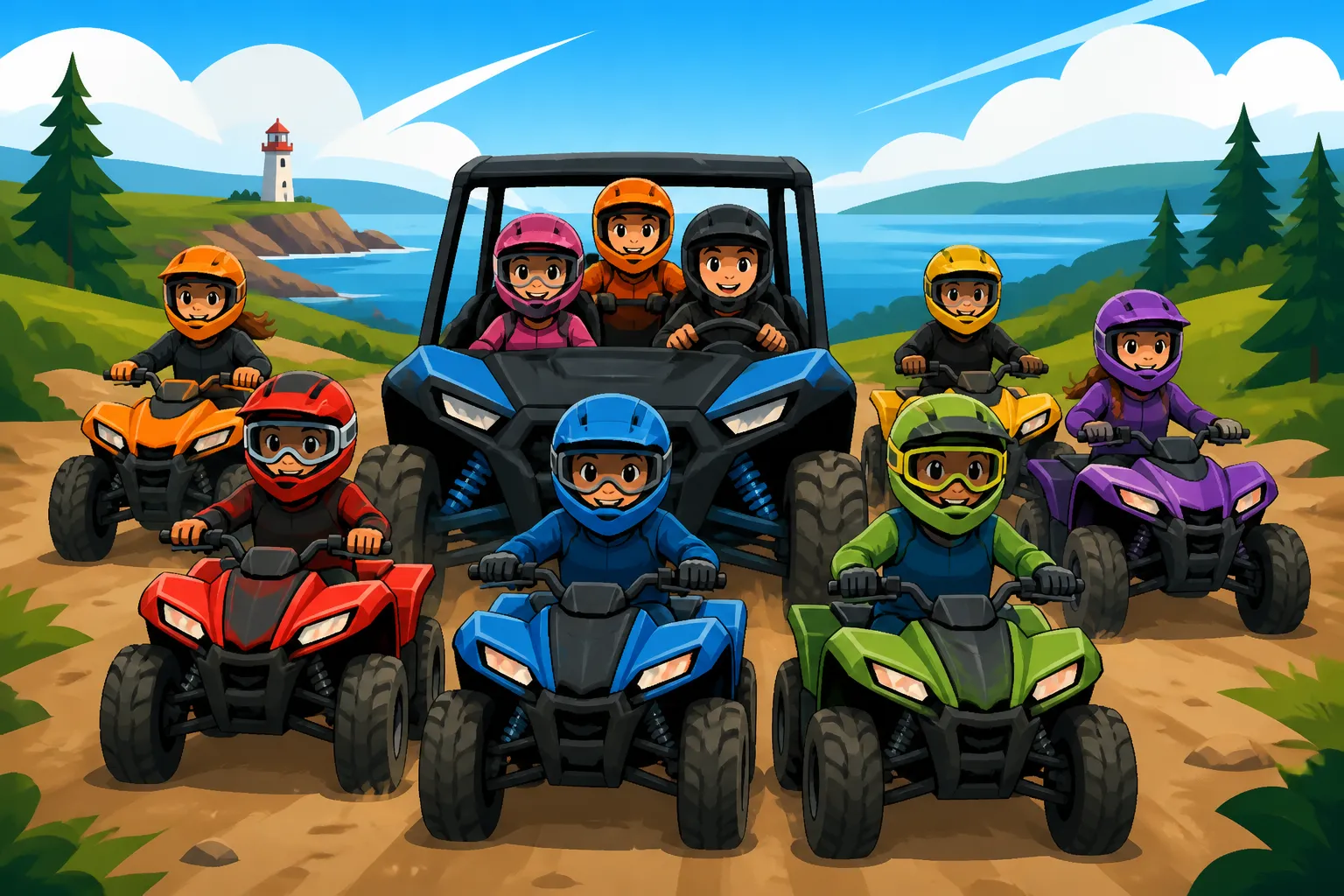
Eight Riders Under Fourteen at Once
Nova Scotia allows one qualified supervisor to oversee no more than eight riders under 14 at a time. That cap is easy to miss when planning a family ride or youth event, and meeting it does not automatically make every rider or trail eligible. Here’s how to count the group, choose supervisors and check the other requirements before setting out.
What the eight-rider limit means
The limit is a supervision cap: one supervisor may oversee at most eight riders under 14 at a time. If your group has more than eight riders in that age range, arrange another eligible supervisor rather than assuming one adult can cover everyone.
Count the riders under 14 who will be under that supervisor’s care, not simply the total number of people at the trailhead. Riders who are 14 or older do not count toward this specific under-14 limit, but that does not mean they are exempt from every other age, training or riding rule. The rules for youth are broader than a single headcount; Nova Scotia Rules for Riders Under 16 and Nova Scotia Supervision Requirements are useful starting points.
| Riders under 14 in the group | Minimum supervisors needed for this cap |
|---|---|
| 1 to 8 | 1 |
| 9 to 16 | 2 |
| 17 to 24 | 3 |
| 25 to 32 | 4 |
This is a planning guide for the eight-rider cap, not a complete checklist of legal requirements. Each supervisor must qualify, and the riders must meet the rules that apply to their ages and riding location. For example, a group of nine young riders needs at least two supervisors to stay within the cap, but splitting the group on paper is not enough if one supervisor cannot actually supervise the riders assigned to them.
It also matters what “at a time” means in practice. A supervisor should be responsible for no more than eight riders under 14 while they are riding, not just when the group starts together. If riders become separated, one adult leaves, or the group divides, check that each subgroup still has an eligible supervisor and remains within the limit.
The supervisor’s age matters. Nova Scotia’s youth supervision rules require a supervisor to be at least 19; an older sibling or teen may be a capable rider but does not meet that age threshold. Review Nova Scotia Requires a Supervisor Nineteen or Older before relying on a particular adult to supervise.
The cap does not create a general permission for younger riders to go anywhere an adult goes. Age-related restrictions, course or location requirements, machine suitability, safety training and other rules still apply. A supervisor is one part of the arrangement, not a substitute for checking whether each child is allowed to ride in that setting.
How to organize supervisors and riders
Start with the age list, then assign riders to supervisors. This is more reliable than counting heads casually at the staging area, especially when a group includes children of different ages or families arrive separately.
- Confirm each rider’s age. Identify everyone who is under 14. Keep a clear count for each group rather than relying on the total number of machines.
- Choose eligible supervisors. Confirm that each person responsible for a group meets the age and other applicable requirements. Read Nova Scotia Supervision Requirements if there is any doubt about who qualifies.
- Assign no more than eight under-14 riders to each supervisor. If a ninth young rider joins, add another qualified supervisor or reorganize the group before riding.
- Make the assignments clear. Each child and supervisor should know who is responsible for whom. Avoid an informal arrangement where everyone assumes another adult is watching a particular rider.
- Keep supervision workable on the route. Plan a pace and route that let the supervisor monitor the assigned riders. A group that stretches out of sight can be difficult to supervise effectively, even if its original headcount was within the cap.
- Recount after changes. If a child joins, a supervisor leaves, or the group splits, reassess the numbers before continuing.
A group leader can help with logistics, but do not assume that being the leader automatically makes someone a qualified supervisor. Likewise, a parent who attends the outing should not be counted as covering children outside their actual group unless the arrangement is clear and the person meets the applicable requirements.
If you are organizing a club outing, communicate the limit before people arrive. Ask families to confirm the ages of participating riders and identify which adults will supervise. That makes it easier to arrange additional qualified adults if the group is too large, rather than trying to solve the problem after everyone is ready to ride.
Think about distance and visibility as well as the number of riders. A supervisor who has eight children spread across several machines may have a harder time keeping track of them on a narrow, winding trail than in a controlled riding area. Keep the group together, choose terrain suited to the least experienced rider, and stop somewhere safe to regroup if riders become separated.
For younger riders, machine fit is another practical issue. A child needs a machine they can control, with controls they can reach and a riding position that allows them to respond safely. An adult’s presence does not make an oversized or unfamiliar machine suitable. Nova Scotia Youth Machine Size Rules can help with the separate question of age and machine suitability.
Age, location and permit checks still apply
The eight-rider maximum is only one part of youth riding rules. Before taking children out, confirm the requirements for their ages and the place where they will ride. The rules can differ depending on the rider’s age, the type of riding area and whether the route is a club trail or another setting.
In particular, do not treat a supervisor’s presence as permission for an under-14 rider to use any trail. The provincial rules include age-related course or location restrictions for younger children. Review Nova Scotia Closed Course Requirements and verify that the specific riding area qualifies. A private field or woodlot should not be assumed to meet a formal closed-course requirement simply because it is away from public traffic. The situation is especially worth checking for children aged 6 to 13; Nova Scotia Has No Accredited Closed Courses addresses an important practical complication.
Training is another separate check. Supervision and a safety certificate are not interchangeable: an adult watching a child does not automatically satisfy a training requirement that applies to that rider. Confirm what applies to each child’s age and circumstances through Nova Scotia Safety Training at 16. If a rider’s status depends on an exemption or earlier ownership, check the details rather than inferring eligibility from age alone.
The group also needs the right permission to use the route. A trail permit does not replace supervision requirements, and a supervisor does not replace a permit where one is required. Riders should check whether the trail is open to their type of machine and whether the permit they hold gives access to that trail. For a child riding their own machine, confirm whether that machine needs its own permit; Do Nova Scotia Kids Need Their Own Permit? covers that question.
Registration and insurance are separate from trail access, too. Make sure the machine’s paperwork and coverage are in order before riding, and carry any proof required for the trip. A family should not assume that a parent’s paperwork or permit automatically covers every child’s machine.
Use this quick check before the group leaves:
- Count riders under 14 and assign no more than eight to each eligible supervisor.
- Confirm that every supervisor meets the applicable age and qualification rules.
- Check each rider’s age-related training and location requirements.
- Confirm the trail or riding area allows the planned use.
- Check registration, insurance and trail-permit requirements for each machine.
- Agree on a route, pace, regrouping points and a plan if someone falls behind.
If you cannot verify that an area meets the relevant requirements for a young rider, choose a location whose status you can confirm before the outing. It is better to change the plan than to rely on a broad assumption about what “supervised” allows.
Common planning mistakes to avoid
Counting adults instead of assigning supervisors. Several adults may be present, but the limit is about how many under-14 riders each supervisor is responsible for. Make the assignments explicit and ensure the numbers work for every subgroup.
Treating the cap as a target. Eight is the maximum under this supervision rule, not a recommended group size. A smaller group can be easier to monitor, especially for beginners, on unfamiliar terrain or where the trail is narrow.
Assuming a parent can cover an unlimited number of children. A parent’s relationship to the riders does not remove the cap. If one parent is supervising more than eight riders under 14, the group needs another eligible supervisor or a different arrangement.
Leaving a child without a clear supervisor. If adults rotate, stop riding, or split up, make sure responsibility is handed over clearly. A child should know which adult to stay with, and the receiving adult should know the child has joined their group.
Relying on a supervisor to fix a location problem. An adult’s presence does not waive a closed-course or other age-related restriction. Confirm that the place is appropriate before planning the ride.
Assuming the permit covers the rider and machine automatically. Trail access rules and permit arrangements can depend on the machine and rider. Check the requirements for each child rather than assuming one adult’s permit covers a family group.
Making the group too difficult to manage. The legal maximum does not guarantee that a route is manageable for eight young riders. Use conservative spacing, set regrouping points, and keep the supervisor close enough to monitor their assigned riders. If a child is new to riding, a smaller group and a familiar area may be the safer choice.
Not recalculating after a change. A supervisor may need to leave early, or another family may join at the trailhead. Recount and reassign before continuing; a plan that met the cap at the start can stop meeting it after the group changes.
For organizers, a simple written roster can prevent confusion. Record each young rider’s age, assigned supervisor and machine, then confirm the assignments before departure. This is not a replacement for official paperwork or legal advice, but it helps adults spot a group that exceeds the limit before anyone starts riding.
If you are unsure whether a particular adult qualifies, a child meets the conditions for a riding area, or a machine needs its own permit, confirm the point with the relevant provincial office or trail organization before the trip. The safest plan is one where the headcount, supervisor assignments, riding location and paperwork are all settled in advance.
Disclaimer
This article is for general informational purposes only and does not constitute professional advice. Laws, prices and regulations vary by location and change over time. Consult a qualified professional for guidance on your specific situation.