Why a Supervisor Must Be Nineteen and Trained
When a young person rides an ATV in Nova Scotia, an adult’s presence is not enough by itself: the supervisor must meet the age and training rules, and the rider must remain within the permitted setting. Knowing what “supervision” means helps families plan a ride without mistaking experience, a nearby adult or a parent’s permission for legal compliance.
What Nova Scotia requires of a youth rider’s supervisor
Nova Scotia’s off-highway vehicle rules set a minimum age and training requirement for an adult supervising a young rider. The supervisor must be at least 19 and have the required safety training. A parent or guardian who does not meet those requirements should not assume they can supervise simply because they own the machine or have years of riding experience.
The rule is part of a broader framework for young riders. Six is the minimum age for operating an off-highway vehicle, but that does not mean a six-year-old can ride anywhere or on any machine. Age, supervision, the riding area and the vehicle all matter. See Nova Scotia Rules for Riders Under 16 and Nova Scotia Rules for a 6-Year-Old Rider for related age-specific requirements.
A supervisor’s job is also more than being somewhere on the same property or trail system. The young rider must remain in the supervisor’s sight where the rule requires it. A supervisor who has gone ahead around a bend, is riding far enough away to lose sight of the child, or is distracted by another task may not be providing effective supervision.
| Question | What to plan for |
|---|---|
| How old must the supervisor be? | At least 19 |
| Does the supervisor need training? | Yes; confirm that the training or certificate meets the applicable requirement |
| Can the supervisor simply be nearby? | No. Plan to keep the young rider in sight as required |
| Does adult supervision make any location legal? | No. Age, course, trail and road rules still apply |
| Can one adult supervise a large group? | There is a limit for supervising riders under 14; confirm the current rule and keep the group manageable |
The number of riders an adult can supervise matters in group settings. Nova Scotia’s rules include a limit on how many riders under 14 one supervisor can oversee. The linked explainer, Nova Scotia Supervisors Limited to Eight Riders, covers that limit. Even when a group is within the legal maximum, a smaller group can be easier to watch, especially on unfamiliar trails or in changing conditions.
Supervision requirements should not be treated as a substitute for other requirements. A supervisor’s training does not automatically qualify the child to ride on a road trail, and it does not make an unsuitable route or machine safe. Registration, insurance, trail access and equipment rules may apply separately. For example, road-trail use has its own driver-licence requirement; an adult riding alongside a youth does not replace it. See Nova Scotia Requires a Full Driver’s Licence and Nova Scotia Requires Registration and Insurance before planning that kind of ride.
Why the supervisor must be an adult with training
A young rider can be quick to react, but may not yet have the judgment or experience needed to recognize hazards early. A trained adult is expected to understand safe operation and know how to respond when a rider, machine or trail condition becomes a problem. The age requirement sets a clear threshold; the training requirement adds knowledge beyond simply being older or more familiar with ATVs.
Training is useful because off-highway riding presents decisions that are not always obvious to a beginner. A rider may need help judging a slope, choosing a safe speed, managing an obstacle, avoiding a collision or knowing when to stop. An adult who has learned safe operating practices is better positioned to give clear instructions and notice risky behaviour before it escalates.
The supervisor should be able to focus on the young rider. That means avoiding a plan where the adult is expected to lead a fast group, manage several children spread across a route, or watch from a location where the rider can disappear from view. A legal headcount limit is not a guarantee that every group size or terrain is manageable.
Training is a qualification, not a casual claim
A statement such as “I’ve been riding for years” does not establish that a person has completed the required training. Nor should a family assume that a course from another activity, a general first-aid course or a child’s riding lesson is equivalent to the safety training required for OHV supervision.
Before setting out, confirm what counts as acceptable training for the supervisor and what documentation may be needed. The requirements and recognized certificates can depend on the applicable rules and a person’s circumstances. The background on Nova Scotia Safety Training at 16 can help explain how training fits into the wider system, but check the current official guidance if you are unsure whether a particular certificate qualifies.
Keep the supervisor’s proof of training accessible, along with any documents required for the machine or ride. The point is not to carry paperwork instead of behaving safely; it is to avoid arriving at a trail or event without being able to establish that the responsible adult meets the qualification.
Supervision is active, not symbolic
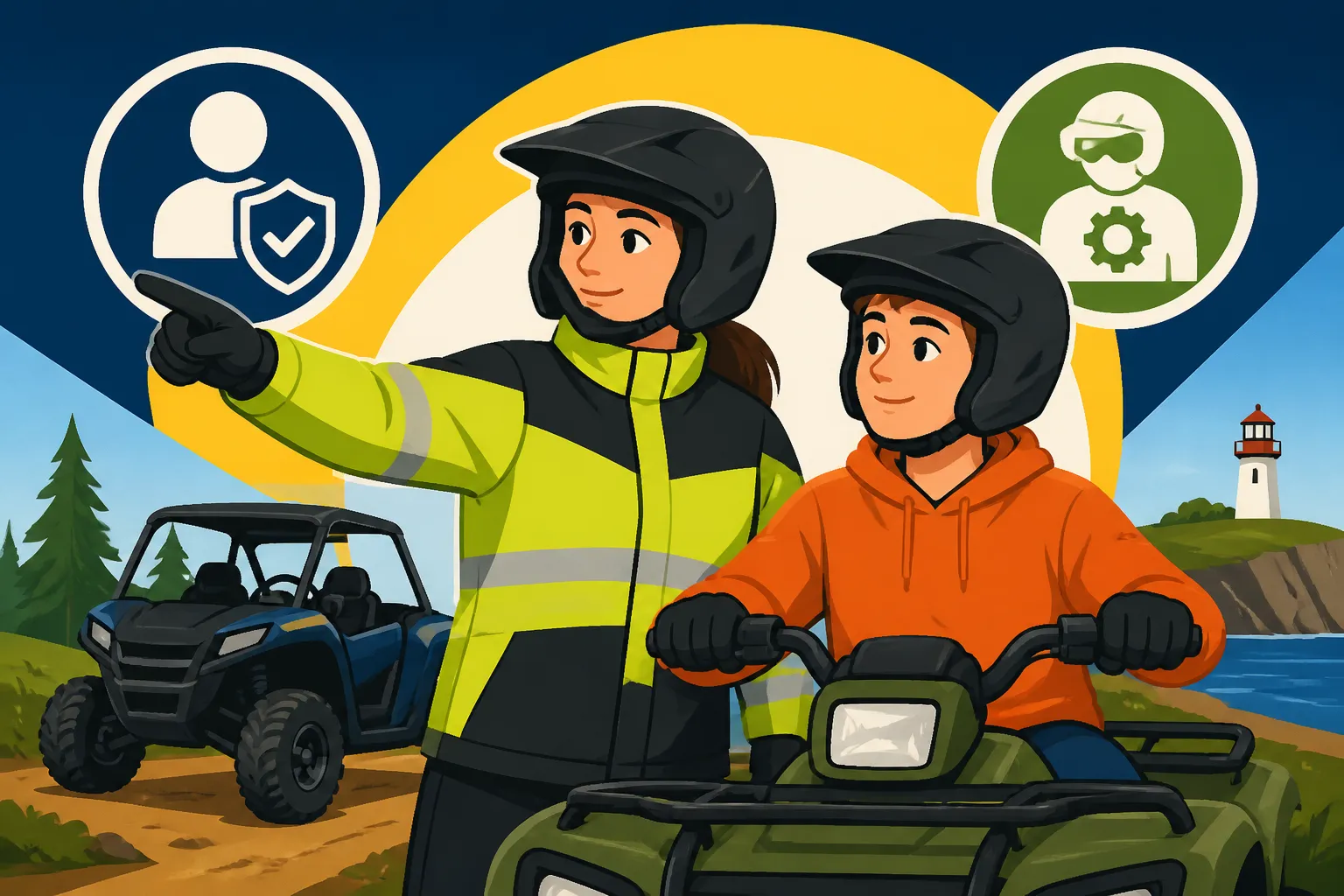
A supervisor should be close and attentive enough to recognize when the child is having trouble. That does not necessarily mean the adult must ride the same machine, but families should not assume that merely sharing a trail is sufficient. The practical test is whether the adult can keep the rider in sight and respond promptly if something changes.
A rider may move out of view because of trees, bends, hills, dust or the distance between machines. If that happens regularly, change the route, spacing or riding arrangement. A slower pace, frequent stops and a simple rule to wait at junctions can help the group stay together, but they do not replace the requirement to maintain the required supervision.
Supervision also includes setting limits. The adult should choose a pace the child can control, stop the ride when the child is tired or upset, and avoid asking a young rider to follow an adult through terrain the child cannot safely handle. Young riders may be reluctant to admit they feel overwhelmed, so make stopping or turning back an ordinary option rather than a sign of failure.
Where the young rider can ride, and what supervision does not allow
A supervisor cannot make every location permissible just by being present. Youth rules may distinguish between riders of different ages and between ordinary riding and riding on a qualifying closed course. For younger riders, the closed-course rules are especially important. Review Nova Scotia Closed Course Requirements rather than treating an empty field, private driveway or quiet trail as automatically qualifying.
The distinction matters because “private property” and “closed course” do not necessarily mean the same thing under the applicable rules. Get clear confirmation that the proposed area meets the relevant definition before taking a child there. Do not rely on an assumption that a landowner’s permission alone settles the question.
For riders aged 6 to 13, the rules can be more restrictive than families expect. The linked page Nova Scotia’s Closed Course Rule for Ages 6 to 13 focuses on that issue. Check the specific requirements for the child’s age and the course before riding. An adult’s training and supervision do not erase a restriction on where a child may operate a machine.
The same principle applies to road trails. Adult supervision does not override the road-trail rules, including driver licensing, registration, insurance, equipment and operating requirements. If the youth rider is not legally eligible to use a road trail, following behind a licensed adult does not make the ride legal. A planned route should stay within the settings the young rider is allowed to use.
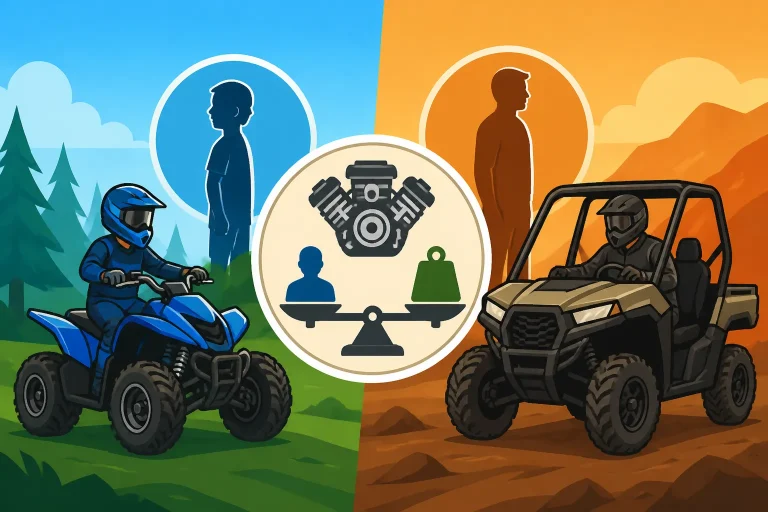
Machine choice is another separate safety issue. An adult can be fully qualified and still be supervising a child on a machine that is too large, heavy or powerful for that rider to control. The vehicle should match the rider’s size and ability, with controls the child can reach and use confidently. Review Nova Scotia Youth Machine Size Rules before choosing a machine. Manufacturer guidance is useful, but it does not replace the province’s rules.
Equipment and riding conditions also deserve attention. A properly fitted helmet, suitable clothing and working controls are basic parts of a safer ride. The supervisor should check the machine before departure and explain what the child should do if it stalls, tips or becomes separated from the group. A brief conversation about stopping points, hand signals and what to do at a junction can prevent confusion once engines are running.
A practical pre-ride check for families
A short check before each outing helps turn the rules into a workable plan. It also gives the adult a chance to notice when a ride should be postponed because the route, group or conditions have changed.
- Confirm the rider’s age and permitted riding setting. Check whether the child may ride on the planned course and whether special closed-course conditions apply.
- Confirm the supervisor’s qualifications. Make sure the adult is at least 19 and holds training or a certificate that meets the applicable requirement. Do not rely on informal experience alone.
- Choose a suitable machine. Check the fit, controls and condition, and make sure the rider can manage the vehicle without stretching or struggling.
- Plan for visibility. Choose a route where the adult can keep the child in sight. Avoid terrain, spacing or group arrangements that make the rider disappear from view.
- Keep the group manageable. Check the applicable supervision limit for riders under 14. Consider reducing the group below the maximum if conditions are difficult or the children have different abilities.
- Review separate riding rules. Confirm that registration, insurance, trail access and any road-trail requirements are met. Supervision is only one part of compliance.
- Agree on simple safety instructions. Tell the child where to stop, what to do if the adult is out of sight and how to signal that they need help.
- Be prepared to end the ride. Fatigue, poor visibility, mechanical trouble or a child who is losing control are reasons to stop, regardless of how much riding was planned.
If a family is uncertain about whether a particular adult’s certificate qualifies, whether a location counts as a closed course or how a rule applies to a child’s age, confirm the details with the relevant Nova Scotia authority before riding. Rules can depend on the situation, and an answer based on a different age group or type of land may not fit the planned outing.
The safest approach is to treat the 19-and-trained requirement as a minimum, not the whole safety plan. The adult must be qualified, able to watch the young rider, and prepared to keep the ride within the child’s legal and practical limits. When any part of that plan is unclear, pause and verify it before starting the machine.
Disclaimer
This article is for general informational purposes only and does not constitute professional advice. Laws, prices and regulations vary by location and change over time. Consult a qualified professional for guidance on your specific situation.