Engine Size for Age and Weight
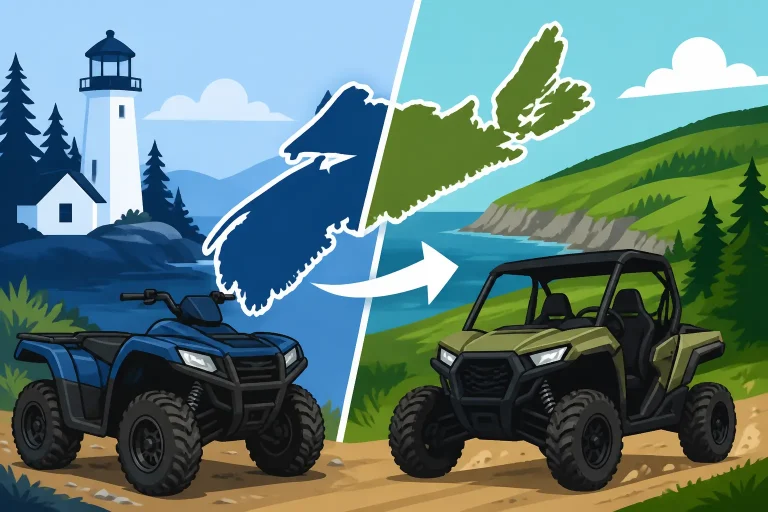
Choosing an ATV or UTV for a young rider is not just a matter of picking a low engine size. In Nova Scotia, age-related rules, the machine’s fit, the rider’s ability and where they plan to ride all matter. Here’s how to weigh those factors, what engine displacement can and can’t tell you, and what to check before a first ride.
Engine size is only one part of the decision
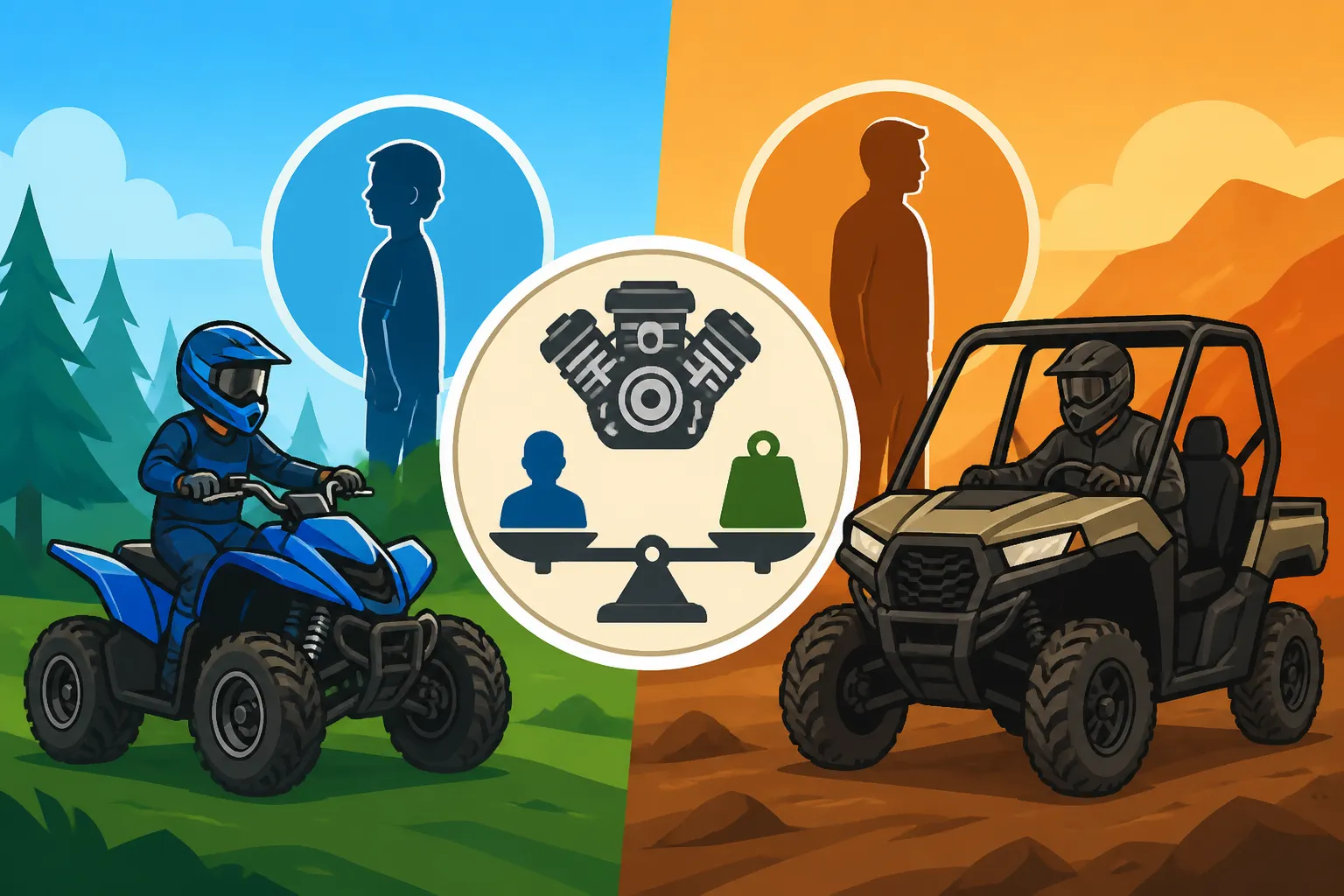
Engine displacement, usually stated in cubic centimetres (cc), describes the engine’s size. It can help you compare machines, but it does not tell you on its own how quickly a machine will accelerate, how heavy it is, how easy it is to control or whether it is suitable for a particular child.
Two machines with similar engine sizes can feel very different. Their weight, throttle response, gearing, brakes, suspension and overall dimensions all affect how they behave. A youth model may be designed to deliver power differently from a larger machine, but the word “youth” on a listing is not proof that it fits a particular rider.
Engine size is most useful as an initial screening tool. The owner’s manual and manufacturer’s age and size guidance are more useful for deciding who should operate a specific machine. Those recommendations are not a substitute for Nova Scotia’s rules or for a careful assessment of the rider.
| What to check | Why it matters | What to do |
|---|---|---|
| Engine displacement | Offers a rough comparison, but not a complete measure of performance | Compare it with the model’s manual and specifications |
| Manufacturer’s age guidance | Gives the intended age range for that model | Follow the guidance; do not assume a child can safely use a larger model |
| Rider’s size and strength | Affects reach, balance and ability to control the machine | Have the rider demonstrate the controls while the machine is off |
| Machine weight and dimensions | A heavier or larger machine can be hard to manage, even at modest speed | Check that the rider can mount, dismount and maintain a stable position |
| Throttle and brakes | A rider must be able to use them smoothly and reliably | Check reach and control before riding |
| Riding location | Rules and hazards vary between a controlled private area and a trail | Confirm the legal requirements for the location before setting out |
A machine that seems appropriately sized while parked may become difficult to control on a slope, in mud or when the rider needs to stop quickly. That is why a child’s age or the machine’s engine size should never be the only test.
If the rider cannot comfortably reach and operate the controls, keep their feet where the design intends, and hold a stable riding position, the machine is not a good fit. A smaller engine does not make an oversized or unsuitable machine safe.
Match the machine to the rider, not just their age
Age can provide a starting point, but children of the same age can differ substantially in height, strength, coordination and experience. A rider who is still growing may also outgrow a machine quickly. That does not mean they should move up to a larger one before they can reliably control it.
Check fit with the machine turned off
Before a ride, have the child sit in the normal riding position with the engine off and the machine secured. Check whether they can reach the handlebars and operate the throttle and brakes without leaning, stretching or losing their balance. They should be able to shift their weight as the machine’s design requires and get on and off without help that would be unavailable during a ride.
On a youth ATV, the rider’s posture should look controlled rather than strained. If the child has to stand on their toes to stabilize themselves, stretch to reach a lever or twist awkwardly to steer, consider a smaller machine or a different model. A child who cannot use a control confidently while stationary is unlikely to manage it better once the machine is moving.
For a UTV, check that the rider can sit properly, reach the steering wheel and controls, and remain securely positioned. A passenger seat does not make a UTV appropriate for a child to drive. The operator must be capable of handling the vehicle and must meet the rules for the place where it is being used.
Think about control, not just speed
Parents often focus on top speed, but control is the more useful question. Can the rider accelerate gently, release the throttle, brake smoothly and steer without abrupt movements? Can they understand and respond to instructions? Can they stop when asked, even when excited or distracted?
A speed limiter or adjustable setting may help limit performance, if the specific machine is equipped for it and the manufacturer allows the adjustment. It does not correct poor fit, replace supervision or make an unsuitable machine appropriate. Check the manual for how the feature works, and test any setting in a controlled area before a ride.
Avoid using an adult-sized machine with the idea that the child will “grow into it.” A heavy machine can be difficult to stop or redirect if the rider loses control. Power delivery may also be harder to manage than the engine-size figure suggests. When comparing options, look at the complete machine, not only the cc number.
For broader age and supervision considerations, see Nova Scotia Rules for Riders Under 16 and Nova Scotia Supervision Requirements. The machine must fit the rider, but fit alone does not satisfy the legal requirements.
Understand Nova Scotia’s youth rules before choosing a machine
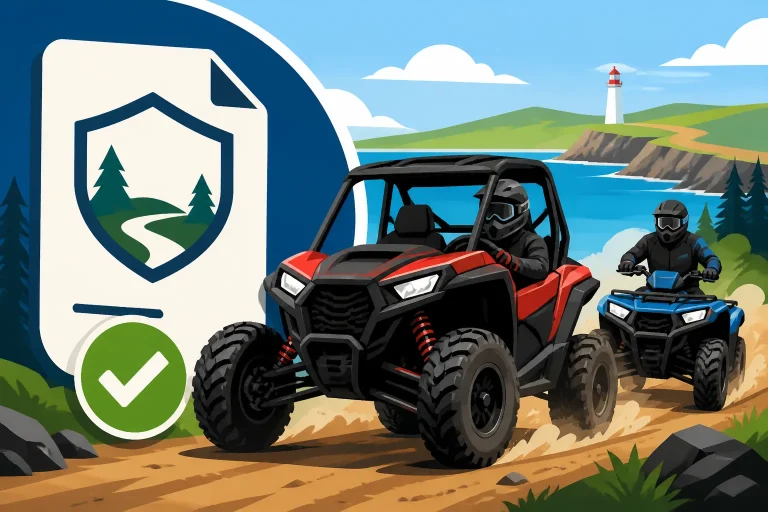
A suitable machine does not automatically make a ride legal. Nova Scotia has requirements concerning young riders, supervision, training and where a machine may be operated. Those requirements are separate from the manufacturer’s engine-size or age recommendations.
The rules can depend on the rider’s age, the type of use and the riding location. In particular, do not assume that a child who can physically operate a machine is therefore permitted to ride it on a trail or other land. Check the applicable requirements before buying a machine based on plans for trail riding.
Age and training are separate from engine size
Nova Scotia’s youth riding rules include a minimum riding age, supervision requirements and training provisions. The details that apply can differ by age. For instance, rules for a young child should not be treated as interchangeable with those for a teenager. Review Nova Scotia’s Minimum Riding Age of 6, Nova Scotia Safety Training at 16 and Nova Scotia’s Closed Course Rule for Ages 6 to 13 for the issues to confirm.
Do not treat engine displacement as a shortcut around those rules. A small engine does not by itself establish that the rider meets age, supervision, training or location requirements. Likewise, choosing a larger machine does not make a rider eligible for a different kind of use.
Some youth-related requirements may be difficult to apply in practice if the required training or riding setting is not available nearby. That is a reason to confirm the current rule and practical options with the relevant authority or safety program before purchasing a machine, not a reason to assume the requirement does not apply. For more on the training category and how it relates to youth riders, see Category B and Why It Matters.
Confirm where the rider will use the machine
A family may plan to use a youth ATV only on private property, but later decide to join friends on a club trail. Those settings can have different access rules and safety requirements. Private land does not necessarily remove every legal obligation, and permission to use land is not the same as permission to ride on a trail.
Before purchasing, identify the intended riding locations and check what is required for each. If the plan includes organized or maintained trails, review the trail-access requirements as well as the youth rules. Do Nova Scotia Kids Need Their Own Permit? and Nova Scotia Youth Supervision Rules can help frame the questions to ask.
For each location, confirm who may operate the machine, what supervision is required, whether a permit or other documentation is needed, and whether the rider must have completed training. Rules and access conditions can change, so verify current details with the appropriate official source or trail organization.
A practical way to choose and prepare
Use a staged decision rather than choosing by age or engine size alone. This approach helps separate legal eligibility from physical fit and riding skill.
- Identify the intended rider and riding location. Note the rider’s age, experience and size, along with whether the machine will be used on private land, a club trail or another location.
- Check the current rules for that age and location. Confirm supervision, training, permit and access requirements before you shop. If the planned use is not permitted for the rider, a different engine size will not solve the problem.
- Read the manual for each machine under consideration. Check the manufacturer’s age guidance, weight recommendations, controls, safety features and instructions for limiting performance. Use the guidance for the exact model rather than relying on a listing that simply calls it a youth machine.
- Assess the rider’s fit. With the machine off and secured, check posture, reach, balance, mounting and dismounting. The rider should be able to operate every relevant control without strain.
- Start with controlled practice. Use an appropriate, permitted area with clear boundaries and close supervision. Begin at a pace that lets the rider demonstrate smooth steering, throttle control and braking before considering more challenging conditions.
- Reassess as skills and size change. A rider who has grown or gained experience may need a new assessment, but progress should be based on demonstrated control and legal eligibility, not age alone.
Keep the manufacturer’s instructions available and make sure the supervising adult understands the machine’s controls and safety features. Explain how to stop, where the rider may go and what to do if they feel unsure. Supervision is most useful when the adult can watch closely and intervene promptly, not when the rider is out of sight or beyond easy communication.
Protective equipment matters, but it cannot make an ill-fitting machine suitable. Use equipment appropriate to the ride and ensure it fits the rider. If buying a helmet online through Amazon or another retailer, check the safety certification markings, sizing information and return terms before relying on it. A helmet that is too loose, too tight or not properly secured is not a dependable substitute for a correct fit.
Finally, be cautious with second-hand machines and online listings. Ask for the exact make, model and year, then compare the machine with its manual and manufacturer information. Do not rely on a seller’s estimate of the engine size or a vague description such as “good for kids.” Check that safety-related parts work, and arrange a proper inspection if the machine’s condition or history is unclear.
The safest choice is the machine the rider is legally allowed to use, can physically control and can operate responsibly in the intended setting. Engine size can help narrow the options, but it cannot answer all three questions.
Disclaimer
This article is for general informational purposes only and does not constitute professional advice. Laws, prices and regulations vary by location and change over time. Consult a qualified professional for guidance on your specific situation.