Keeping a Rider 6 to 15 in Sight
Riding with a young ATV or UTV operator takes more than following along behind. In Nova Scotia, riders aged 6 to 15 have supervision requirements, and the younger ages also face limits on where they can ride. Knowing what “in sight” means in practice helps adults choose a suitable route, stay close enough to intervene and avoid confusing trail permits with permission to ride.
What “in sight” means when supervising a young rider
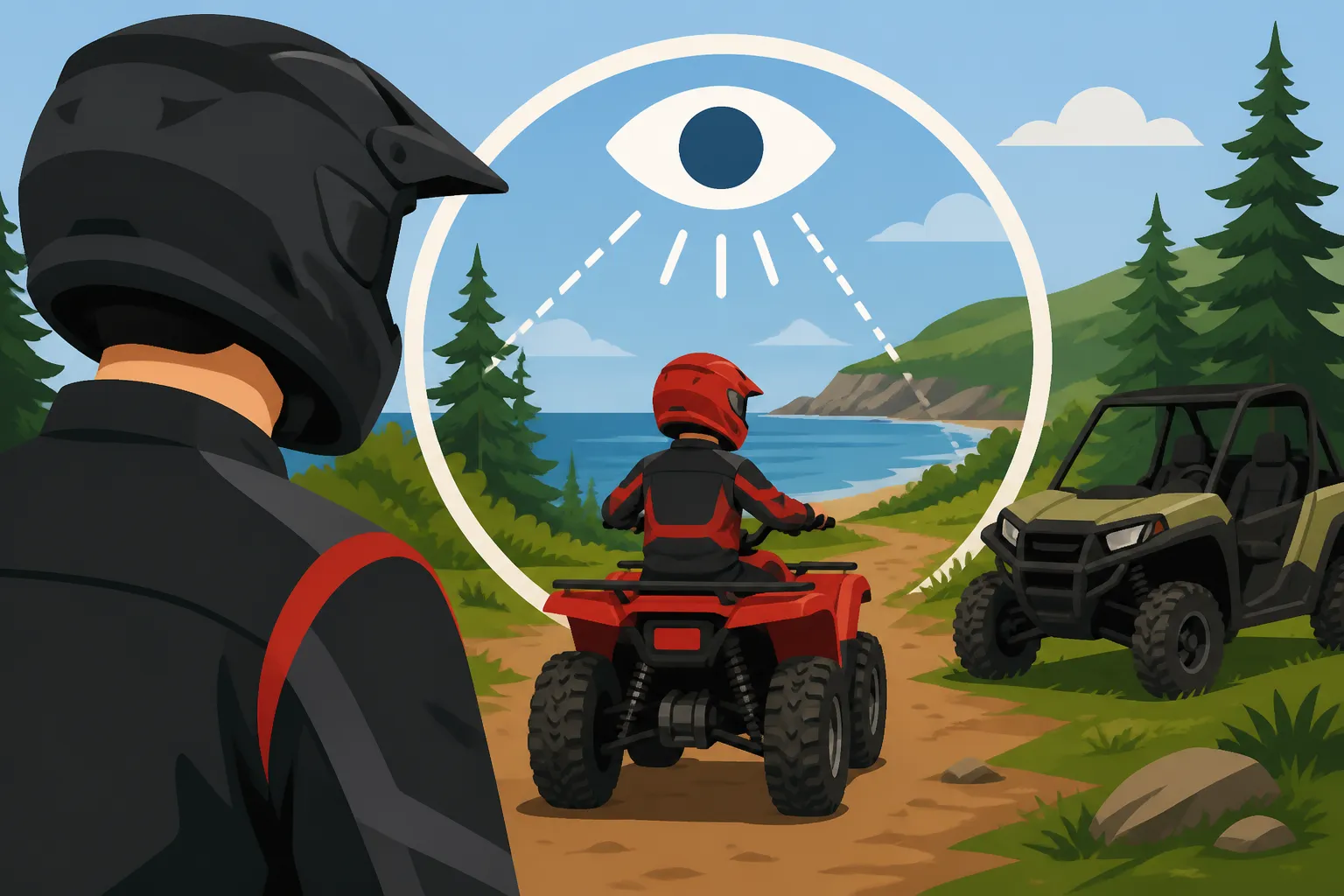
For a rider aged 6 to 15, supervision is an active responsibility. The supervising adult needs to keep the rider in view, pay attention to what is happening and be close enough to respond if the machine stalls, tips or approaches a hazard. Riding somewhere behind the child and checking in by phone does not provide that kind of supervision.
A useful practical test is whether the adult can see the young rider and machine without relying on a signal from someone else. A bend, rise, thick stand of trees or long gap between machines can break that view. If the route makes it impossible to maintain visual contact, change the order, slow down or choose another route.
“Keeping in sight” is not the same as keeping the child within hearing distance. Engine noise, wind, terrain and other riders can make a shouted warning ineffective. The adult should be positioned to notice a problem and act, not simply to hear that one has happened.
The supervisor needs to be responsible for the ride
Nova Scotia’s youth supervision requirements call for a supervisor who is at least 19 and has the required safety training, subject to any applicable exemption. Check the current requirements before a ride, especially if relying on an older certificate or an exemption. Nova Scotia Requires a Supervisor Nineteen or Older and Why a Supervisor Must Be Nineteen and Trained explain those conditions in more detail.
A parent or guardian is not automatically an eligible supervisor just because they are the child’s parent. The adult should confirm that they meet the age and training requirements, understand the route and are prepared to focus on the young rider. An adult who is also operating a machine may have less ability to watch a child than someone riding nearby at a controlled pace.
Supervision works best when the adult sets expectations before starting. Agree on where the child should ride in the group, what signal means “stop,” and what the child should do if they lose sight of the adult. Make clear that the child should stop in a safe place rather than continue alone or try to catch up at speed.
Visual contact has to survive the terrain
On an open area, keeping a child in view may be straightforward. On a wooded trail, the adult may lose sight of the rider at every turn. A route that is manageable for experienced adults can be a poor choice for supervising a new or young operator.
To maintain visibility:
- Keep the young rider close enough to see clearly, with a safe following distance.
- Put the child where the adult can observe them, rather than several machines back.
- Reduce speed before bends, crests, crossings and narrow sections.
- Stop at places where the group might otherwise stretch out of view.
- Choose routes with sightlines and surfaces that match the child’s ability.
- Stop the ride if dust, fog, darkness or poor visibility makes it hard to keep visual contact.
Do not treat a whistle, radio or phone as a substitute for seeing the rider. Those tools can help a group communicate, but they cannot make an out-of-sight rider supervised in the practical sense. If the adult cannot see the child, the safest response is to stop and re-establish contact.
Age and location matter as much as supervision
The supervision rule is only one part of the requirements for young operators. In Nova Scotia, ages 6 to 15 are not one uniform category: age affects where a rider may operate and what other conditions apply. Nova Scotia Rules for Riders Under 16 gives the broader picture, while Nova Scotia Minimum Riding Age of 6 covers the minimum age.
In particular, riders aged 6 to 13 are subject to a closed-course requirement. Do not assume that a regular trail, a quiet woods road or a section of private property qualifies as a closed course. Confirm that the location meets the current rules before taking a young rider there. The requirements for Nova Scotia Closed Course Requirements are separate from the requirement to keep the rider in sight.
For ages 14 and 15, do not assume that being old enough to ride beyond a closed course means the young operator can use any trail or road. The route must still be legal for that machine and rider, and supervision remains important. Nova Scotia Supervision Requirements can help clarify how supervision fits into the rules for young riders.
| Rider’s age | Supervision consideration | Location consideration |
|---|---|---|
| 6 to 13 | Keep the rider in view and use an eligible supervisor | A closed course is required; confirm the location qualifies |
| 14 to 15 | Keep the rider in view and use an eligible supervisor | Check the rules for the route, machine and type of land |
| 16 and older | Different youth supervision rules may apply | Check age-related training, access and operating requirements |
This table is a planning aid, not a substitute for checking the rules that apply to a particular ride. Age is only one factor. The machine type, location, permission to use the land and any trail or road requirements also matter.
A club trail permit, vehicle registration or insurance policy does not by itself make a location suitable for a rider under 14. A permit may provide access under its own conditions, but it cannot override an age-based operating restriction. Likewise, permission from a landowner does not replace a legal requirement for a closed course. Treat each question separately: who may operate, where they may operate, what paperwork applies and who must supervise.
Match the machine to the rider
A young operator needs a machine they can control, not simply one that is available. Consider whether the rider can reach and use the controls, steer without strain, stop reliably and understand how the machine responds on the intended surface. A larger or more powerful machine can be difficult to manage even when the rider is keen and the adult is close.
The supervisor should also choose a route that allows the child to stop without being pressured by traffic, a group of faster riders or challenging terrain. If the young rider cannot comfortably control the machine on the route, supervision alone does not make the ride safe or permitted. Nova Scotia Youth Machine Size Rules is a useful next read when comparing a machine with a young operator’s size and ability.
How to keep a child in view on a group ride
A group can make supervision harder. Riders spread out, adults may focus on their own machines, and a child can disappear around a bend while the group continues. Plan the group around the young rider instead of expecting the child to keep pace with experienced adults.
- Choose a suitable route first. Confirm that the child’s age allows them to ride there and that the land or trail is open to the machine. For a rider aged 6 to 13, confirm the closed-course requirement before leaving.
- Name the supervising adult. Make sure that adult meets the current age and training requirements and knows they are responsible for maintaining visual contact.
- Place the young rider where they can be watched. Avoid putting the child at the rear of a long group, where dust and distance can block the view. The supervisor should ride close enough to observe without crowding the child.
- Set a conservative pace. The group’s speed should suit the young operator and leave room to stop before hazards. Do not let the child feel they must accelerate to avoid being left behind.
- Agree on stop points and signals. Decide in advance what everyone should do at a junction, when the rider loses sight of the supervisor, or when someone needs help. A young rider should know not to continue alone.
- Regroup whenever the view is lost. If the trail bends out of sight or a rider falls behind, stop in a safe location and re-establish contact before continuing.
- End or change the ride when conditions worsen. Poor light, fog, heavy dust, fatigue or a difficult surface can make it harder to supervise effectively.
Some groups use a front-and-back arrangement, with an adult leading and another adult following. That can help keep a group together, but it does not automatically satisfy the supervision responsibility for a particular child. Be clear about which eligible adult is watching that rider, and make sure the child remains in that adult’s view. If a group has several children, one adult’s attention may not be enough to manage the terrain and keep each one in sight.
Nova Scotia also has a limit related to supervising riders under 14. Check the current rule before organizing a group with several young operators; do not assume one adult can supervise any number of children. Eight Riders Under Fourteen at Once covers that specific group-size consideration.
Use short rides while a young operator is learning. A brief loop gives the adult a chance to assess attention, control and fatigue without committing the group to a long route. If the rider is tired, frustrated or struggling to follow instructions, stop. Continuing because the destination is close can turn a manageable problem into a risky one.
Check the whole ride, not just the supervision rule
Before setting out, confirm the legal and practical conditions for the child, machine and location. Young riders’ supervision requirements sit alongside other rules; they do not replace registration, insurance, land access or applicable trail permits. Do You Need to Register an ATV in Nova Scotia? and Nova Scotia Trail Permit Cost can help with separate paperwork questions.
Use a simple pre-ride check:
- Age and eligibility: Confirm the rider’s age-related rules, including any applicable training or closed-course condition.
- Supervisor: Confirm that the adult meets the current age and training requirements and can give the child their attention.
- Location: Check that the route is open to that machine and that the rider’s age allows them to ride there.
- Permission and access: Confirm permission where required. A route that appears open may cross private land or have access conditions.
- Machine fit and condition: Check the controls, brakes, tires and other basic safety items, and make sure the rider can operate the machine comfortably.
- Protective equipment: Make sure the child has the required helmet and suitable clothing for the conditions.
- Group plan: Set the order, pace, stop points and response if the child loses sight of the supervisor.
- Visibility: Consider light, weather, dust and terrain. Postpone or change the route if the adult cannot maintain visual contact.
Keep the plan simple enough that the child can remember it. A young rider should know who their supervisor is, what to do at a stop and what to do if they become separated. They should also know that stopping to wait is safer than trying to catch up.
If there is uncertainty about whether a rider’s age permits a particular location, or whether a supervisor meets the requirements, check with the relevant Nova Scotia authority before riding. Do not rely on a trail map, another rider’s interpretation or a permit alone to answer an age-related legal question. Rules and access conditions can change, so confirm the details that apply to the planned ride.
Keeping a rider aged 6 to 15 in sight is both a practical safety measure and part of understanding the supervision rules. The adult’s job is to remain attentive, choose a lawful setting and make the ride fit the child—not to expect the child to manage adult-sized distances, speeds or decisions.
Disclaimer
This article is for general informational purposes only and does not constitute professional advice. Laws, prices and regulations vary by location and change over time. Consult a qualified professional for guidance on your specific situation.