Nova Scotia Clubs and What They Maintain
A trail can look open on a map and still be muddy, washed out, temporarily closed, or unavailable to ATVs on a particular section. In Nova Scotia, local clubs help maintain many riding corridors, coordinate access, and share trail information. This guide explains what that work involves, what riders can reasonably expect from a club, and how to help keep trails usable.
How Nova Scotia ATV clubs fit into trail riding
Clubs connect riders with local trail networks
An ATV club is often the local, hands-on part of a much larger trail system. Clubs may organize volunteer work, communicate with landowners, help riders understand local access, and work with other groups responsible for a corridor. Their role is not necessarily the same from one area to the next: a club may maintain a section directly, coordinate work with another organization, or help manage a route that crosses different kinds of land.
That distinction matters when you’re planning a ride. A route that appears continuous on a map may pass through a stretch maintained by a different club, a municipality, a landowner, or a public agency. A local club can often help explain who looks after a section and where to check for updates. For a broader look at how clubs fit into the province-wide network, see [Nova Scotia Clubs and What They Maintain] and [Nova Scotia's 48 Member Clubs].
Clubs also give riders a local point of contact. If you’re unfamiliar with an area, asking a nearby club about trailheads, closures, parking, or sensitive sections can prevent a frustrating start to the day. Someone local may know that a route has a temporary detour, that a gate must remain closed, or that a trail entrance is easy to miss even when it is shown on a map.
A club does not own every trail it helps maintain
“Club trail” is a useful everyday phrase, but it does not automatically mean the club owns the land or has unlimited control over the route. Trails may cross private woodlots, Crown land, municipal property, former rail corridors, or land managed by other organizations. Access arrangements and maintenance responsibilities can vary along the same ride.
That means a club may have permission to mark or maintain a corridor without being able to promise that it will remain open indefinitely. A landowner may need to restrict access, a storm may damage a bridge, or a municipality may close a section while repairs are made. Clubs often have to balance riders’ needs with landowner concerns, environmental conditions, and public safety.
For riders, the practical takeaway is to follow posted signs and current local guidance rather than treating a line on a map as blanket permission. [Nova Scotia Trails That Cross Private Woodlots] and [Nova Scotia Trails That Cross Crown Land] explain why access can differ from one section to another. If a route crosses private land, stay on the marked corridor and respect the landowner’s instructions.
What trail maintenance actually involves
Routine work keeps a corridor rideable
Trail maintenance is a mix of small, recurring jobs and larger repairs. Volunteers may cut back brush, clear branches, improve drainage, refresh signs, remove litter, or check that a route remains passable after routine wear. A few hours of clearing can make a narrow trail easier to see and reduce the temptation for riders to create new paths around overgrowth.
Drainage is another important part of keeping a trail usable. Water can pool in low spots, carve channels down a slope, or soften a section until repeated traffic causes damage. A club may need to identify where water is crossing the corridor, keep a ditch clear, or report a problem that needs equipment and expertise beyond a volunteer crew’s capacity.
Maintenance does not always look dramatic from the seat of a machine. A ride might pass over a section that seems ordinary because someone has already trimmed the brush, replaced a marker, or cleared a blocked culvert. That behind-the-scenes work can make a route safer and easier to follow, especially for visitors who don’t know the area.
Larger repairs take coordination and time
Some problems require more than a volunteer with hand tools. A washed-out trail, damaged bridge, unstable bank, or failing culvert may need an assessment, materials, machinery, funding, or approvals before repairs can begin. The club may help report the issue, coordinate with the landowner or managing organization, and communicate a closure or detour to riders.
A repair can also involve several parties. For example, a club might identify damage on a rail trail, while another organization controls the structure or the land around it. In that case, the club may not be able to fix the problem on its own, even if members are the first to notice it. [Nova Scotia Washouts and Reroutes] and [Nova Scotia Bridges on Club Trails] offer useful context for why a simple-looking obstruction can take time to resolve.
When a section is closed, riding around the problem is rarely a harmless shortcut. Detours through vegetation or around a muddy spot can widen the corridor, damage the land, or create an unofficial route that lacks permission. If you encounter an obstruction, turn around where it is safe, follow a signed detour, and tell the club or responsible organization what you found.
Who may maintain a trail and how responsibilities differ
Clubs, landowners, and public agencies may share the work
A trail can involve several different responsibilities: permission to use the land, routine upkeep, major infrastructure repairs, signage, and decisions about temporary closures. These duties may be shared between a club, a private landowner, a municipality, a provincial agency, or another organization. The arrangement depends on the corridor, so it is better not to assume that one group handles everything.
A club’s volunteer crew may be responsible for brushing a section while a landowner decides whether access can continue. A municipality might control a road connection, while the club maintains a nearby trail segment. On a former rail corridor, one organization may manage the trail surface and another may have a say over a bridge or crossing. The details can change from one part of the route to the next.
| Trail responsibility | What it can involve | What riders should do |
|---|---|---|
| Club maintenance | Clearing brush, checking signs, reporting damage, organizing volunteers | Follow club notices and report problems |
| Land access | Permission, gates, seasonal restrictions, or landowner conditions | Stay on the marked route and respect signs |
| Municipal or agency work | Road connections, public structures, approvals, or major repairs | Obey closures and posted directions |
| Rider responsibility | Safe operation, staying on the corridor, and avoiding damage | Don’t create a detour or ride around a closure |
This shared arrangement is one reason a club may know about a problem but not be able to solve it immediately. A responsible club may need to confirm who controls the site, get permission, or wait for a qualified crew. Asking a club for an update is reasonable; expecting volunteers to reopen every damaged section on demand is not.
Trail access depends on permission, not just maintenance
A groomed or signed route is not necessarily open to every type of vehicle, in every season, or under every condition. A corridor may have different rules for different users, and a segment can be closed while work is underway or while the ground is especially vulnerable. Maintenance and access are related, but they are not the same thing.
This is particularly important when a route passes through a private woodlot. The landowner’s permission and any posted conditions matter, even if the route has been used by riders for years. Gates, signs, and barriers should be treated as instructions, not inconveniences. [Why a Woodlot Owner Closes a Trail] and [Leaving Woodlot Gates Exactly as You Found Them] cover common situations riders may encounter.
When you’re unsure whether a segment allows machines, check with the local club or the organization responsible for that corridor before setting out. Trail maps and apps can help with orientation, but they do not replace permission or current closure information. A careful check is especially worthwhile if you’re planning a long ride that crosses several communities or land types.
Seasonal conditions and why clubs sometimes close trails
Spring thaw and heavy rain can make riding damaging
Nova Scotia’s wet weather and changing ground conditions can turn a firm trail into a fragile one. During spring thaw, the surface may be soft even when it looks mostly dry. A machine can leave deep ruts, push mud into drainage areas, or widen the corridor as riders try to find a firmer line around the damaged section.
Heavy rain can create similar problems at other times of year. Water may run over a trail, loosen material on a slope, fill a low spot, or wash out part of a crossing. Clubs may post a closure or advise riders to avoid a section because continued traffic would make repairs more difficult. Respecting a temporary closure can help a trail recover sooner.
If you’re deciding whether to ride after rain, don’t rely only on what the trail looks like at the entrance. Conditions can change significantly between a high, well-drained section and a low area farther along the route. Check local updates, watch for signs, and turn around if the surface is deteriorating. [Nova Scotia Spring Thaw and Trails] and [Nova Scotia Trail Closures in Thaw] discuss why a short wait can prevent a season’s worth of avoidable damage.
Storms, frost, and seasonal work all affect trail availability
Storms can drop trees across a corridor, damage signs, wash out approaches, or leave debris that makes a route unsafe. In coastal areas, weather can also affect exposed sections quickly. Clubs and local volunteers may inspect known trouble spots and organize clearing, but a large fallen tree or damaged structure may need specialized equipment or permission before work can begin.
Winter and freeze-thaw conditions bring their own challenges. A frozen surface may be firm one day and soft the next, while frost heaves can make a route rough or unstable. Some corridors are shared with other trail users or have seasonal arrangements. Even if a trail appears passable, riders should check whether machines are permitted and whether the route has been closed for conditions or maintenance.
A closure is not proof that a club has forgotten about a trail. It may mean volunteers are waiting for safer working conditions, arranging materials, or protecting a vulnerable surface. [Nova Scotia Trails After a Hurricane] and [Nova Scotia Trail Closures After a Storm] can help riders understand why reports and repairs may take time after severe weather.
Finding trail information before you ride
Start with the local club and its current updates
If you’re riding somewhere new, start with the club connected to the area whenever possible. Look for information about access, trailheads, parking, closures, and any special local conditions. A club may share updates through its own channels or direct riders to another organization that manages the corridor.
Try to be specific when you ask a question. “Is the trail open?” may be difficult to answer if your planned ride crosses several sections. Instead, name the trail, road crossing, community, or trailhead you’re asking about. If you’re planning to ride from one area to another, ask whether the entire route is open to your machine rather than assuming that one open section means the whole route is available.
Keep in mind that trail conditions can change after an update is posted. A storm, logging activity, repair, or new closure can affect the route. Check close to your departure, especially if you’re traveling a long way or have a group relying on the plan. [Nova Scotia Trail Conditions and Closures] and [Finding a Member Club Near You in Nova Scotia] are useful starting points for learning where to look.
Use maps and apps as planning aids, not permission
A map is helpful for understanding distance, finding connections, and planning fuel or rest stops. A GPS app such as onX Offroad can be useful for following a route and seeing your position in the field, particularly when cell service is weak. It can also help you compare your planned route with the signs and landmarks you encounter.
But digital mapping cannot guarantee that a trail is open, legal for your machine, or in good condition on the day you ride. Map data may not reflect a newly posted closure, a landowner’s restriction, a washed-out crossing, or a local detour. Use the map alongside club updates and signs on the ground. If they disagree, do not treat the app as permission to continue.
Before leaving, download or otherwise prepare the information you’ll need if your phone loses service. Tell someone your general route and expected return, carry the essentials for the conditions, and avoid depending on a single navigation device. [Nova Scotia Trail Maps Worth Downloading] and [Nova Scotia Cell Coverage on Remote Trails] explore the practical side of planning beyond the screen.
How riders can support clubs and protect the trails
Ride in a way that reduces maintenance pressure
The simplest way to support trail maintenance is to avoid creating extra work. Stay on the marked corridor, don’t cut around puddles through brush, and resist widening a trail to pass another machine. A wet spot may be frustrating, but riding around it can create two damaged tracks instead of one.
Follow posted speed, access, and direction instructions, and leave gates as you found them. If you come across a crew working, slow down, follow their directions, and give them space. If a sign or barrier tells you to stop, don’t move it or assume the closure is only for someone else. These small decisions help preserve landowner relationships and make it easier for clubs to keep routes open.
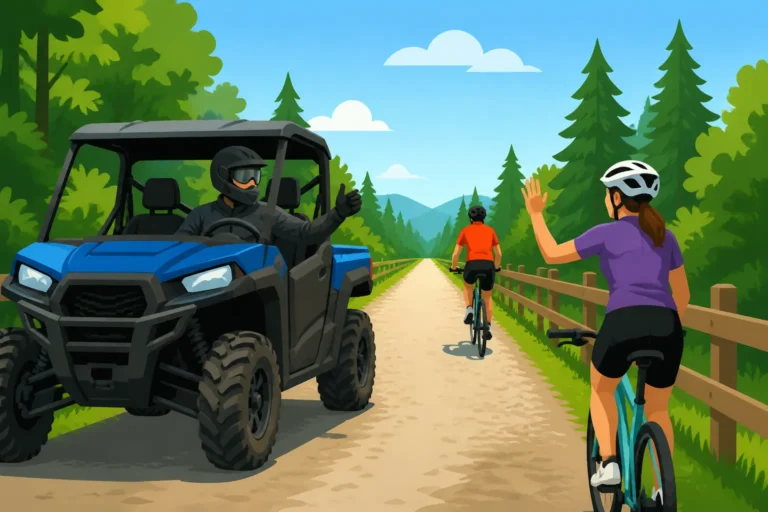
Noise and respectful behaviour matter too, particularly where trails pass near homes or shared-use areas. A group that rides quietly through a community and yields appropriately is less likely to generate complaints that can threaten access. For more on trail etiquette, see [Nova Scotia Trail Etiquette Locals Expect] and [Riding Quietly Past Coastal Homes].
Report damage clearly and volunteer where you can
A useful trail report tells the responsible group what happened and where. If it is safe to do so, note the nearest trail marker, road crossing, or recognizable landmark. Describe the issue plainly: a fallen tree, a washed-out approach, a missing sign, or water crossing the trail. A photo can help, but don’t put yourself or others at risk to take one.
Avoid trying to repair a serious problem without permission or the right tools. Moving a branch may be straightforward, but work on a bridge, culvert, unstable slope, or protected area can be unsafe or require approval. Reporting the issue gives the club or managing organization a chance to decide what response is appropriate. [Reporting Trail Damage to a Nova Scotia Club] explains how a concise, location-specific report can be more useful than a general complaint.
If you want to contribute more directly, ask a local club about volunteer days, membership, or other ways to help. The work may include brushing, sign checks, cleanup, event support, or administrative tasks. Not everyone needs to run heavy equipment to make a difference; reliable help with planning and communication can also keep a club’s work moving.
Planning rides through Nova Scotia’s trail areas
Expect different riding experiences from one region to another
Nova Scotia’s trail experiences vary with landscape, access, and local maintenance. On Cape Breton, routes such as the Celtic Shores Coastal Trail are associated with a very different setting from wooded corridors inland. In the Annapolis Valley, the Harvest Moon Trailway offers another kind of landscape and riding context. On the Northumberland Shore, the Pugwash Salt Express Trail is a separate route with its own access and conditions.
Those names are useful for trip planning, but they should not be read as a promise that every section is open to ATVs or UTVs. Trail use can vary by segment, and a route may be shared with other users. Verify which sections allow your machine, where access begins and ends, and whether there are restrictions or current closures before you load up.
For a closer look at specific regions, explore [Celtic Shores Coastal Trail in Nova Scotia], [Nova Scotia's Harvest Moon Trailway], and [Nova Scotia's Pugwash Salt Express Trail]. Use local guidance to confirm the details for the ride you actually plan to take, rather than relying on a trail name alone.
Build a flexible plan with safe alternatives
A good ride plan leaves room for a change of route. If your preferred trail is closed, you may need to shorten the ride, use another confirmed route, or save the trip for another day. Don’t improvise by crossing private land or taking an unmarked road just to keep the planned mileage.
Think through the practical details before setting out: where you’ll park, how far you can travel between fuel stops, whether you’ll have cell service, and what the group will do if a machine breaks down. If you’re riding with others, agree on a meeting point and a simple way to regroup if someone falls behind. A route that is comfortable for one experienced rider may not suit a mixed group or a newer operator.
Finally, leave enough time to turn around without rushing. A closure or slow section can change the day’s schedule, and pressure to reach a destination is not a good reason to ignore signs. The best rides are not always the longest ones; they’re the ones where everyone gets home safely and the trail is left in good shape for the next group.
What to expect from a local club
Clubs provide useful local knowledge, not a guarantee of perfect trails
A club can help you understand local routes, access arrangements, trail etiquette, and where to look for updates. Members may know which sections tend to be wet, where a detour is currently marked, or which trailhead is easiest for a group to use. That local context can make a big difference, especially if you’re visiting from outside the area.
At the same time, clubs are often working with volunteers and limited time. A trail may still have rough patches, temporary signs, or an unfinished repair. Maintenance is ongoing, and weather can undo work quickly. A club’s involvement does not mean every kilometre has been inspected immediately before your ride.
Approach a club as a valuable source of guidance and a partner in keeping access responsible. Be patient if a volunteer cannot answer right away, and share clear information when you report an issue. A respectful exchange is more likely to help than assuming someone has ignored a problem.
Good trail access depends on cooperation
Maintained trails rely on more than equipment and volunteer hours. They depend on landowners continuing to allow access, organizations coordinating repairs, and riders behaving in ways that respect the corridor and its neighbours. When one part of that relationship breaks down, a closure can affect everyone who uses the route.
That is why everyday choices matter. Keep to the designated trail, obey closures, avoid creating new tracks, and be courteous around homes and other trail users. These habits reduce avoidable wear and help reassure landowners that riders can use a corridor responsibly.
When you join a local club, volunteer, or simply follow its guidance, you’re supporting more than a trail surface. You’re helping maintain the trust and cooperation that make riding possible in the first place. A well-used trail is not just one that is open today; it is one cared for well enough to remain a welcome route in the future.
Disclaimer
This article is for general informational purposes only and does not constitute professional advice. Laws, prices and regulations vary by location and change over time. Consult a qualified professional for guidance on your specific situation.