Passing Safely on a Narrow Coastal Cut
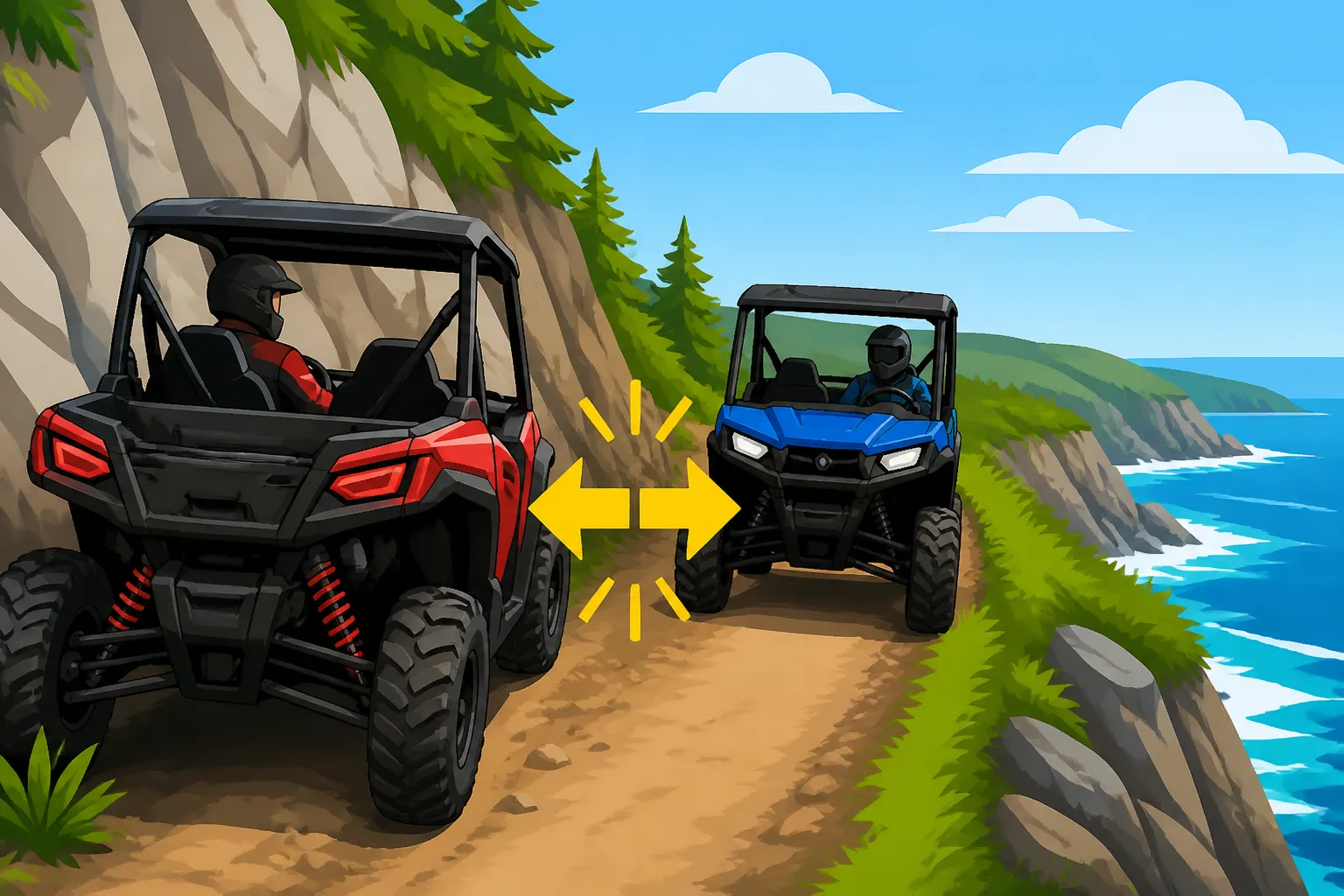
A narrow coastal cut can feel manageable until another ATV or side-by-side appears around a bend, with soft ground or a steep edge leaving little room to move. This guide explains how to approach, communicate, yield, and pass safely on Nova Scotia’s tight trails without widening the route, damaging the corridor, or turning a cautious encounter into a collision.
Read the Trail Before You Meet Another Rider
Expect blind corners and changing conditions
A coastal cut is often narrower than it looks from the seat. Brush can hide the edge of the trail, a bend may block your view, and rain can make the usable surface much smaller than it was earlier in the day. On some routes, washouts, exposed roots, soft shoulders, or a sudden change in elevation leave only one safe line for a machine.
Ride at a speed that lets you stop within the visible distance ahead. That matters especially when climbing a rise, entering a shaded bend, or travelling through coastal fog. If you cannot see around a corner, assume someone may be coming toward you. Slow down before the blind spot rather than braking hard once you spot another machine.
Conditions can change over a single ride. A dry section may be firm, while a nearby low spot stays slick after rain. Fog can settle quickly near the coast, and salt air, loose gravel, and damp leaves can all affect traction. Check local updates before setting out, and look for reports about Nova Scotia Trail Conditions and Closures and Nova Scotia Coastal Fog and Riding when planning a route.
Choose a pace that leaves room to react
Your speed should reflect the trail, not the machine’s capability. A side-by-side may feel steady on an open road, but its width can make a tight cut difficult to clear. A quad may be narrower, but it still needs space to stop, turn, and avoid a soft edge. Extra caution is useful when riding with a passenger, carrying gear, or towing anything.
Keep enough distance from the rider ahead that you can stop without being forced into a sudden move. If the lead machine brakes at a blind corner, the rest of the group should not have to swerve around it. On a narrow section, close following also makes it harder for an oncoming rider to see how many machines are behind the first one.
A useful habit is to ease off the throttle as the trail narrows, then scan for a safe place to pull in before you reach the tightest point. Do not wait until you are already nose-to-nose with another machine to decide where you can stop. A little patience early can prevent a stressful squeeze later.
Use maps as a planning aid, not a guarantee
A trail map can help you understand where a route goes and identify likely connections, but it cannot tell you exactly how wide a cut is today or whether a section has become soft or obstructed. onX Offroad can be one tool for reviewing a planned route and keeping track of your position. Pair any digital map with local trail information and posted signs, rather than treating a line on a screen as proof that a maneuver is safe.
Before leaving a trailhead, check that your phone or navigation device is charged and that you know how to use it offline if service drops. In remote areas, cell coverage can be unreliable. Download or save what you need ahead of time, and let someone know your route and expected return. For additional planning, compare Nova Scotia Trail Maps Worth Downloading with Nova Scotia ATV Trail Map Downloads.
A map is most useful when it helps you make a conservative choice. If a route appears to narrow, runs close to a shoreline, or crosses a less-maintained area, plan for the possibility that you will need to turn around or wait for another machine to pass. Do not let a route suggestion pressure you into taking a line that is visibly unsafe.
How to Handle an Oncoming Machine
Slow down, stop, and make yourself visible
When you see another rider, reduce speed smoothly and stop where you can be seen. Avoid stopping right at the apex of a bend, on a steep slope, or in a spot where a following rider may run into you. If you can safely move back to a wider, stable part of the trail, do so before the encounter becomes a squeeze.
Make eye contact where possible and use a clear, simple signal. A wave, a hand gesture toward a pullout, or a brief verbal exchange can help establish who will move and where. If you use a radio, keep the message short and specific. For example: “I’m stopped just past the bend; I’ll wait here while you come through.” Do not assume the other rider has heard you just because you have a radio.
Visibility equipment matters, too. Keep lights in working order and use them appropriately for the conditions. In fog, shade, or late-day light, a machine can appear suddenly against brush or dark terrain. The goal is not to glare at the oncoming rider; it is to make your presence easier to notice.
Decide who should yield based on the actual space
There is no single maneuver that suits every narrow cut. Look at the width, surface, slope, edge condition, and the position of both machines. One rider may have a stable pullout nearby, while the other may be beside a steep bank or on a soft shoulder. The safest choice is usually the one that keeps both machines on firm, visible ground and avoids a rushed reverse or sharp turn.
Communicate before moving. If one rider backs up, the other should remain stopped and give them room. Reverse slowly, checking behind for rocks, roots, branches, or a drop-off. A rider should never be expected to back toward an edge simply because the other person has already started moving forward.
Where the trail offers a clear, firm passing area, use it rather than trying to squeeze past in a section that is only marginally wide enough. If neither machine can pass safely, one rider may need to back to the nearest suitable turnout. That can feel inconvenient, especially after a long climb, but waiting is better than risking a rollover, collision, or damaged trail edge. The principles in Yielding on a Multi-Use Corridor and Nova Scotia Trail Etiquette Locals Expect are useful reminders to treat other trail users with patience and courtesy.
Keep the whole group accounted for
When you are riding with friends, do not let the lead machine handle the encounter alone. Stop the group in a safe place and make sure everyone knows whether the group is waiting or moving. A trailing rider who arrives quickly may not see the oncoming machine until they are already committed to the narrow section.
If there is room to pass in a designated wider spot, move through in a controlled order and leave enough space between machines to avoid crowding the other rider. Do not send one machine through and then assume the remaining group can follow. Check that the other party is ready before continuing, and thank them when the encounter is over.
A group leader can reduce confusion by agreeing on simple signals before the ride. Decide how you will indicate “stop,” “come ahead,” and “wait.” This is especially helpful when engines are loud, helmets make speech difficult, or riders are separated by brush and bends. If you are riding with children or newer operators, keep them close enough to follow instructions without pressuring them to make a quick decision.
Passing at a Wider Spot Without Leaving the Trail
Use a proper pullout, not the soft shoulder
A safe passing place should be broad enough for both machines, reasonably level, and firm under the tires. The shoulder may look like extra room but can be loose, waterlogged, undercut, or covered in vegetation. On a coastal route, the edge may also be close to a ditch, bank, or sensitive shoreline. A tire slipping off the packed trail can lead to a rollover or force the machine into the brush.
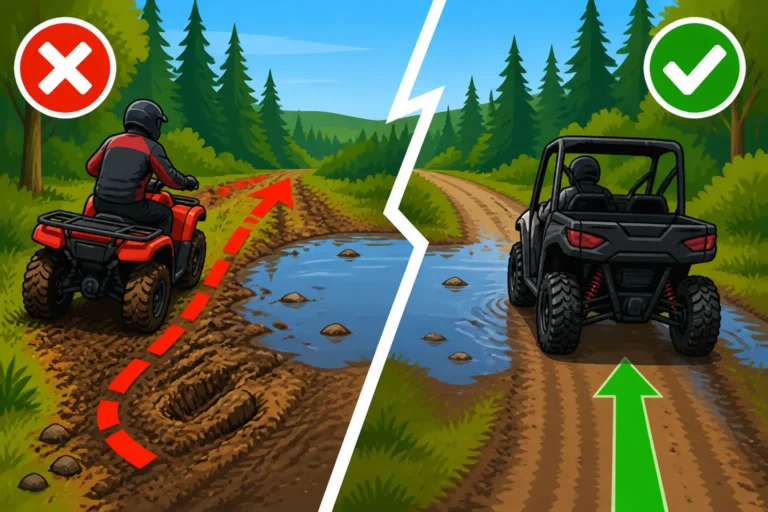
Stay within the established trail corridor. Do not widen the route by driving around a stopped machine, cutting through vegetation, or making a new track beside a muddy spot. Repeated detours can turn one narrow section into a broader damaged area, particularly on soft ground. If a marked route crosses private land, respect its boundaries and leave gates as you found them. See Nova Scotia Trails That Cross Private Woodlots for more on riding through these corridors responsibly.
Once you reach a suitable passing area, stop and look at the ground before committing. Check for a slope, loose rocks, a hidden rut, or a place where one machine’s tires could slide toward the other. If the space does not look safe from the seat, dismount only when it is safe to do so and assess it from a stable position. Do not walk into the path of a moving machine.
Pass slowly and leave room between machines
When both riders agree that the space is suitable, pass at a walking pace or another very low speed appropriate to the terrain. Keep a steady line and avoid sudden throttle inputs. Do not accelerate sharply to “get it over with,” especially if the surface is loose or the machines are close together.
Give the other machine as much clearance as the trail allows. Account for the full width of a side-by-side, including mirrors and accessories. A rider on a quad may be able to move slightly within the trail, but should not be expected to put a tire onto an unstable edge to accommodate a wider vehicle.
If you are uncertain about the clearance, stop and reassess rather than continuing because the machines have already started moving. A brief pause lets both riders choose a better position. It is also reasonable to agree that one machine will back up to a wider spot if the current turnout is too tight.
| Trail situation | Safer response | Avoid |
|---|---|---|
| Blind bend with no view beyond it | Reduce speed before the bend and be ready to stop | Accelerating through the corner |
| Firm, wide turnout | Stop, communicate, and pass slowly when both riders are ready | Rushing through without agreement |
| Soft or sloped shoulder | Stay on the firm trail and find another passing place | Dropping a tire into loose ground or vegetation |
| Neither machine has room to pass | Back carefully to a suitable wider section | Squeezing between machines or forcing a pass |
| Group meets a single rider | Stop the group and coordinate the full pass | Letting riders stream through one at a time without checking |
| Fog or poor visibility | Slow further, use working lights, and listen for other machines | Assuming a quiet trail is an empty trail |
Know when turning around is the safest option
Sometimes the trail is simply too narrow to pass safely. A fallen branch, washout, parked machine, or damaged edge may leave no stable turnout. In that situation, one rider may need to reverse a short distance or, if there is a safe place to turn, head back to a wider section. The choice should be made calmly and communicated clearly.
Do not attempt a multi-point turn on a steep, loose, or exposed edge just to avoid reversing. If you need to turn around, look for a broad, level area with stable footing. Make sure the space is not being used by the other rider, and check for traffic approaching from either direction before moving.
Turning back is not a failure or an overreaction. Trail conditions can change, and a route that was manageable on the way out may be more challenging when wet, foggy, or busy. When a section looks unsafe, choosing another route protects the riders and helps prevent avoidable damage to the trail.
Common Mistakes That Make a Narrow Pass Riskier
Assuming the other rider knows what you intend
A person who sees you stopped may not know whether you plan to reverse, move forward, or wait. This uncertainty can lead both riders to move at once. Make your intention clear with a signal or a short conversation, then wait for an acknowledgement before acting.
Avoid using a wave that could mean several different things. Point clearly toward the safe turnout, or use a simple “you go first” signal after you have confirmed there is room. If the other rider looks unsure, pause and clarify instead of relying on a gesture they may not have understood.
Do not treat silence as agreement. An engine, wind, helmet, or distance can make speech difficult to hear. A visible nod or hand signal gives both riders more confidence that the plan is understood.
Trying to pass at speed or on the wrong side of the trail
Passing quickly does not make a tight encounter safer. It gives both riders less time to correct a mistake and increases the chance that a tire will slide on gravel, mud, or wet leaves. Move slowly enough to stop if the other machine shifts or the ground gives way.
Do not assume there is a safe side to pass on. The open-looking side may be soft, steep, or outside the established corridor. Follow any posted signs and use the visible, stable space available. If the route does not provide enough room, wait or back up rather than inventing a shortcut.
Trail signage can help clarify where to ride and which areas are restricted, but signs do not replace a direct assessment of the ground. Review Nova Scotia Trail Signage Explained before heading out, and pay attention to local markings when you arrive.
Pressuring someone who is already in a difficult position
A rider facing an oncoming machine may be new, riding a wider vehicle, or dealing with a mechanical issue. Honking repeatedly, revving, or moving close to their machine can make an already tense situation worse. Give them time to assess the ground and choose a safe move.
If another rider needs help backing up, offer assistance only after asking and agreeing on what you will do. Do not push, pull, or touch their machine without permission. A tow strap or winch is not a substitute for a clear plan, especially near a drop-off or unstable shoulder.
After the pass, continue at a controlled pace until the trail opens up. The next bend may be just as narrow, and another rider could be approaching behind the first one. Stay alert, leave enough following distance, and keep the group together without crowding.
A Practical Routine for Every Narrow Section
Before entering a tight cut, reduce speed, scan the visible trail, and identify a place where you could stop. If you meet another machine, stop where you are visible and stable. Communicate, decide who will move, and use a firm, wide turnout if one is available. If the space is not safe, back up or turn around only where the terrain allows it.
A little preparation makes these encounters much less stressful. Check trail conditions, carry a dependable navigation option, and discuss hand signals with your group before leaving the trailhead. Use onX Offroad as a planning reference if it fits your setup, but combine it with local club information and what you can see on the ground. If conditions are foggy or the trail has changed, slow down and be willing to choose a different route.
The most important rule is simple: nobody needs to win a narrow pass. Take the time to protect the riders, the machines, and the trail corridor. A courteous wait at a safe turnout is far better than a rushed maneuver that leaves someone stuck, injured, or repairing a damaged machine.
Disclaimer
This article is for general informational purposes only and does not constitute professional advice. Laws, prices and regulations vary by location and change over time. Consult a qualified professional for guidance on your specific situation.