Filming With a Drone Over a Coastal Trail
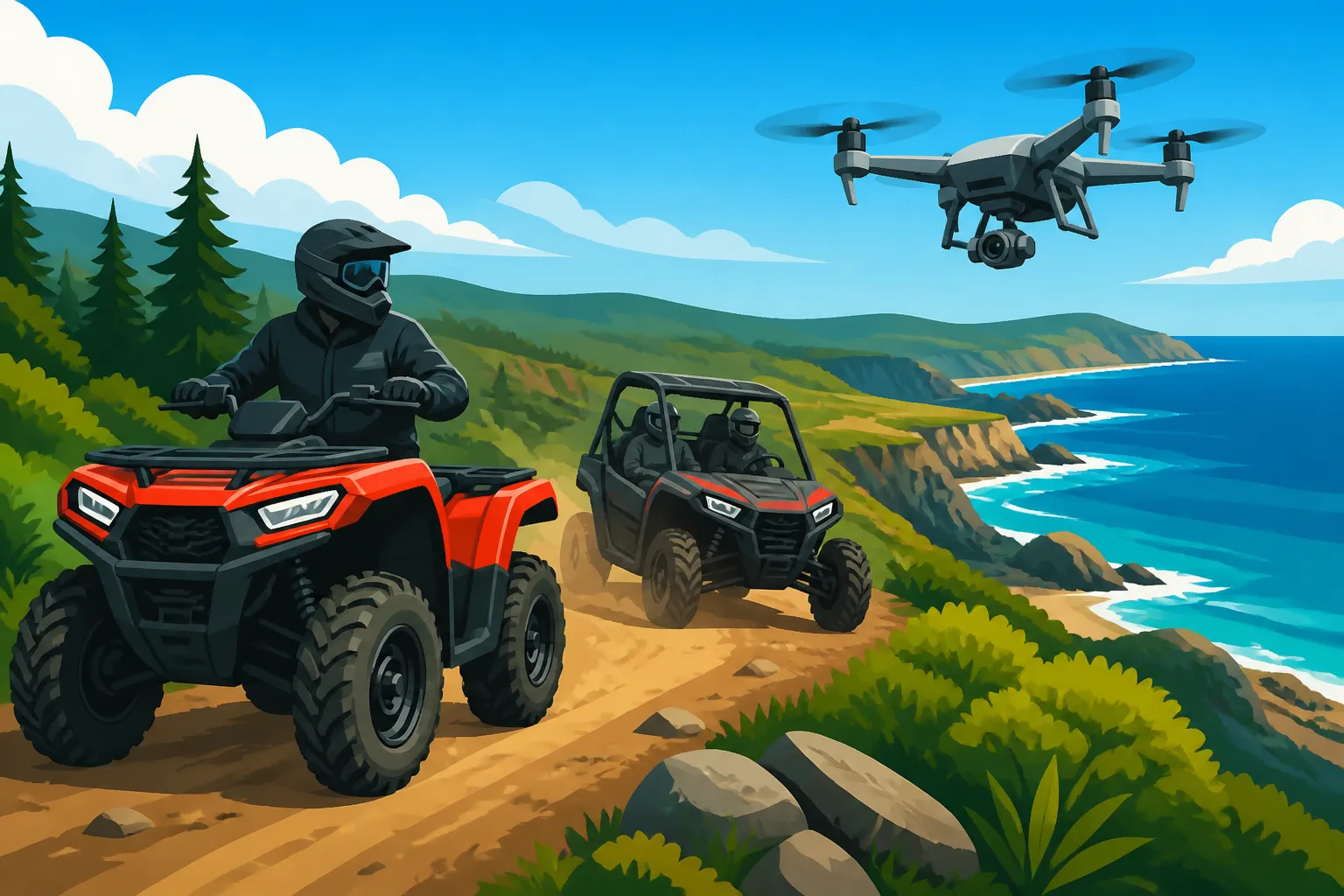
A drone can capture a coastal ATV ride beautifully, but a trail permit is not permission to fly or film. The practical challenge is coordinating aviation rules with trail access, landowner consent, privacy and coastal conditions. Before you pack a drone for a Nova Scotia ride, sort out who controls the launch site, where the machine can travel and what to check before takeoff.
A trail permit does not authorize a drone flight
A trail permit and permission to operate a drone cover different things. A permit may allow a machine to use particular ATVANS club trails, subject to the permit’s terms, club rules and any closures. It does not automatically grant permission to launch a drone, film people or property, or fly over every part of a connected route.
The same distinction applies when a trail crosses private woodlots, Crown land or other managed property. Access for trail riding does not necessarily include permission to conduct a separate filming activity. Start by identifying the trail segment and the land or organization responsible for it, then ask about drone use and filming before setting up.
| Question | What to check |
|---|---|
| Can your ATV or UTV use the route? | Confirm that the segment is open and that your trail permit and machine meet access requirements. |
| Can you launch from the trail? | Ask the club, land manager or landowner responsible for the launch spot. |
| Can you fly and record there? | Check current Canadian drone rules, local restrictions and any site-specific conditions. |
| Are other riders or visitors in the footage? | Avoid filming identifiable people without their agreement, especially for public or commercial use. |
| Is the route near sensitive coastal habitat? | Check for wildlife, protected areas, seasonal restrictions and temporary closures. |
Before travelling, check Nova Scotia Trail Conditions and Closures and Nova Scotia Trail Signage Explained. A route that appears on a map may have a closure, detour or access condition that changes where you can safely stop. If a segment crosses a private woodlot, Nova Scotia Private Woodlot Permission is a useful reminder to confirm the landowner’s terms rather than assume trail access covers filming.
For Crown land, establish whether the proposed launch site and activity are allowed there; a public-looking shoreline or woods road does not by itself confirm access. See Nova Scotia Crown Land With No Club Trail for the distinction between Crown land access and a maintained club trail. If the route passes through a park or another managed site, check its own rules too. Nova Scotia Park Rules for Machines addresses machine access, but drone restrictions may need to be confirmed separately with the site manager.
Check flight rules and filming permissions separately
Drone operations in Canada are subject to federal aviation requirements. Before flying, check Transport Canada’s current guidance for the drone’s weight, the type of operation and the place where you intend to fly. Requirements can differ by aircraft and operation, and airspace restrictions or temporary restrictions can affect a specific location. Do not rely on an old social post, a trail map or the fact that another rider has flown there.
A route being remote does not mean the airspace is unrestricted. Check for nearby airports, heliports, emergency activity and other restrictions. Coastal areas can also bring unexpected aircraft activity, including helicopters. If you cannot confirm that a flight is allowed, do not launch until you have reliable, current information.
Permission to fly is also different from permission to use the land. A drone operation may meet aviation requirements and still conflict with a club’s rules, a landowner’s conditions, a park restriction or a wildlife concern. Ask the relevant club or property manager whether they allow drone launches and filming on or beside the corridor, and whether they require advance notice or proof of insurance.
Be precise when you ask. Share the trail segment, launch and landing locations, the date or time window, whether the flight is recreational or for a client, and whether other riders will appear in the footage. Ask whether the route has a no-drone rule, whether launching from the corridor is allowed, and whether an alternate location would be more appropriate. Permission for one trail section should not be treated as permission for the whole route.
Privacy deserves separate attention. A camera can capture riders, homes, camps, vehicles and people who are not part of your outing. Keep the camera aimed at the route rather than nearby private areas, and do not assume that a public trail means everyone on it has agreed to be filmed. If another rider will be recognizable, get their agreement before filming or sharing the footage. For commercial, promotional or otherwise public use, get clear permission from anyone whose image will be featured and check whether additional land or event approvals apply.
A drone can also create risk even when the operator is following aviation rules. Rotor noise and a low pass may startle riders, hikers or wildlife. Do not fly over a group that has not agreed to the operation, and do not make a rider follow or race the drone. Keep the flight separate from active trail traffic: the operator should be stopped in a safe location, with the machine parked out of the way and the drone kept under the pilot’s control.
Plan for coastal weather, terrain and trail traffic
Coastal conditions can change quickly. Wind that feels manageable at a sheltered trailhead may be stronger on an exposed shoreline or ridge. Salt spray, fog, rain and blowing sand can also make flying or recovering a small aircraft less predictable. Check conditions at the actual filming location, not only the nearest town, and be prepared to cancel when visibility, wind or precipitation makes the flight unsafe.
Scout the launch and landing area before you set up. Look for uneven ground, loose sand, vegetation, overhead wires, people and a clear route to move away from trail traffic. Avoid launching from narrow trail sections, bridges, road crossings and busy trailheads. Do not block a gate or emergency access point. If the site has no safe area to stand and monitor the flight without interfering with riders, choose another location.
Coastal wildlife is another reason to keep distance and avoid repeated passes. Do not chase, circle or drive animals away from nesting or resting areas to get footage. If wildlife changes its behaviour because of the drone, leave the area and do not continue filming there. Follow site-specific restrictions and seasonal closures, which may apply even when the trail itself remains open.
The safest filming plan separates riding and piloting. One person should operate the drone from a stationary, safe position while another person manages the ATV or UTV, if a machine is needed at all. Never try to steer a machine while watching a live drone feed or handling controls. Do not launch or land from a moving machine, and do not ask a rider to watch the drone while navigating a rough or narrow section.
If you are travelling with a club or a group, tell everyone about the filming plan before the ride. Agree on where the operator will stand, how riders will pass that location and what happens if the drone needs to land unexpectedly. Keep the flight short enough that it does not delay the group or create pressure to hurry. Trail users who are not part of your group may still be approaching, so pause the flight if people enter the area or conditions change.
For a remote route, make a contingency plan before takeoff. Know where you can safely land if the weather shifts, where the nearest accessible road or trailhead is, and who can help if equipment fails. Do not fly beyond the point where you can safely maintain control and respond to hazards. Nova Scotia Cell Coverage on Remote Trails can help with trip planning, but a phone signal should not be your only safety plan.
Use a simple pre-flight and permission checklist
A short checklist helps prevent the common mistake of treating a scenic location as automatically available for filming. Work through these steps before loading the machine:
- Confirm the trail segment. Check that the route is open, identify any detours and confirm your machine and trail permit are valid for the intended access. The Nova Scotia Trail Permit Without a Club and Nova Scotia Club Membership Trail Permit explain permit options; neither is a substitute for a drone approval.
- Identify who controls the launch area. It may be a club, private landowner, park or other land manager. Ask that party directly about launching and filming.
- Check current Canadian drone requirements. Confirm the rules for your aircraft and operation, airspace restrictions and any current notices that could affect the flight.
- Decide who may appear in the footage. Get consent from people you plan to feature. Avoid recording nearby homes or private activities, and plan to leave uninvolved trail users out of the shot.
- Assess the site and weather. Check wind, visibility, precipitation, wildlife and trail traffic. Choose a safe place to stand and a clear emergency landing area.
- Brief the riding group. Tell riders where the drone will operate and make clear that nobody should chase it, pass under it or change their riding to keep it in frame.
- Cancel when the plan no longer works. A gust, new trail traffic, wildlife disturbance or uncertain permission is enough reason to stop.
Equipment should support a safe flight, not encourage a riskier one. Spare batteries, a protective case and a landing surface can help with practical handling, but accessories do not make a restricted flight permissible. If buying a landing pad or replacement parts, Amazon is one place to compare listings; check that any item is compatible with your exact drone model.
If the footage is for a business, client, tourism promotion or organized event, contact the trail organization and land manager well in advance. Explain how the footage will be used and whether you expect to record participants or visitors. Ask about required permissions, insurance and any limits on commercial use. Do not assume that a recreational flight approval, trail permit or informal verbal okay covers every part of a paid production.
The least disruptive option may be to film from an approved location outside the active trail corridor, or to use a ground camera instead. If you cannot confirm both lawful flight conditions and land permission, leave the drone packed. A good coastal shot is not worth putting riders, wildlife, property access or the trail relationship at risk.
Disclaimer
This article is for general informational purposes only and does not constitute professional advice. Laws, prices and regulations vary by location and change over time. Consult a qualified professional for guidance on your specific situation.