Nova Scotia Rules for Riders Under 16
Nova Scotia’s rules for riders under 16 are more than an age limit: supervision, training, the type of place you ride, machine size and protective gear all matter. This guide explains how those requirements fit together, what a responsible adult needs to do, and why a trail permit or a parent’s permission does not automatically make every ride legal.
Start with age, supervision and where the ride will happen
Nova Scotia sets a minimum age for operating an off-highway vehicle, but being old enough to ride does not mean a young person can ride anywhere or without conditions. The rules depend on the rider’s age and the setting. A private property ride, a club trail and a public road trail are not interchangeable.
The practical starting point is to treat riders under 16 as a group with extra requirements. A young rider may need an adult supervisor, and riders under 14 face additional restrictions. Protective equipment and a machine that fits the rider are also essential parts of a safe, lawful setup.
| Rider’s age | What to pay particular attention to |
|---|---|
| Under 6 | Do not assume that an adult’s permission makes operating an OHV lawful. Nova Scotia has a minimum riding age. |
| 6 to 13 | Check the closed-course restriction, supervision requirements and machine suitability before riding. |
| 14 to 15 | Supervision and youth safety requirements still matter. A road-trail route is not an option for a rider who does not hold the required full driver’s licence. |
| 16 and older | Safety-training and certificate requirements become especially important. Check the current rules before riding. |
Nova Scotia’s minimum riding age is six. That is a floor, not a guarantee that every six-year-old can safely manage a quad. A child must be physically able to reach and use the controls, understand directions, and stop or steer when needed. Age alone does not tell you whether a particular machine is appropriate.
For ages six through 13, the rules include a closed-course restriction. Do not assume that an ordinary woods road, a trail through a neighbour’s property, or a quiet stretch of club trail counts as an approved closed course. If you are relying on a course exception or trying to establish whether a location qualifies, get a clear answer from the responsible authority before the ride. A course should not be treated as lawful just because it is private or fenced.
Supervision is another key part of the rules. A young rider may need to be accompanied by a supervisor who is at least 19 and has the required safety training. The supervisor must be close enough to keep the rider in sight and respond if something goes wrong. Watching from a distant parking area, following behind in a truck, or assuming that a child can manage alone because they have ridden before may not meet the intent or requirements of supervision.
There are also limits on how many young riders one supervisor can oversee at once. In particular, the number of riders under 14 assigned to one supervisor is limited. A parent planning a group ride should confirm the current limit rather than assuming that one adult can supervise any number of children. Even where a group is within the legal limit, fewer riders may be the sensible choice when children are inexperienced, the trail is narrow or conditions are difficult.
The age bands and rules can be easy to mix up. Before riding, ask four separate questions:
- Is the rider old enough to operate this type of OHV?
- Does the rider need a supervisor in this location?
- Is this location allowed for a rider of this age?
- Is the machine, including its size and controls, suitable for that rider?
A “yes” to one does not answer the others. For example, parental permission does not remove a closed-course restriction. A trail permit does not replace supervision. And a small-looking quad is not automatically safe or suitable for a particular child.
For an overview of the minimum age and how it differs from the licence rules for older riders, see Nova Scotia Rules for a 6-Year-Old Rider, Nova Scotia Rules for a 10-Year-Old Rider and Nova Scotia Rules for a 14-Year-Old Rider. The details can change, so use those age guides as a starting point and verify the applicable rules before a ride.
What a supervisor is responsible for
A supervisor is not simply an adult who happens to be riding in the same area. The role is an active one: help the young operator ride within their ability, keep them in view when required and intervene before a small mistake becomes a collision or rollover.
For youth supervision, Nova Scotia’s rules set a minimum age for the supervisor and require relevant training. Do not assume that any adult relative, neighbour or older sibling qualifies. Check the current requirements for the supervisor’s age and safety certificate, especially if the adult has not supervised a young rider before. The rules for riders under 16 and the requirements for an adult supervisor are separate questions.
A supervisor should be able to see the young rider clearly and stay close enough to respond. That may mean choosing a simple route, riding at the child’s pace and stopping when visibility is lost. A child disappearing around a bend or dropping out of sight in thick woods is a reason to pause and regroup, not to keep moving and hope they catch up.
The supervisor also has to judge whether conditions have changed. A route that feels manageable on a dry, open section can become unsuitable when it narrows, turns muddy, meets traffic or crosses uneven ground. If the young rider is tiring, struggling to control the machine or no longer following instructions, end the ride or choose a safer route.
When a group includes children, plan the adult-to-rider arrangement before starting. Keep the group small enough that the supervisor can maintain effective oversight, and confirm any legal cap on the number of under-14 riders per supervisor. Do not count on a second adult who is several kilometres ahead or behind to provide meaningful supervision.
Before setting out, agree on simple rules the child can remember:
- Stay where the supervisor can see you.
- Stop when the supervisor signals.
- Do not pass or leave the group.
- Slow down before bends, hills, crossings and unfamiliar ground.
- Do not follow another rider onto an unapproved route.
- Tell the supervisor immediately if the machine feels wrong or the rider is tired.
A responsible supervisor also checks the machine before the ride. Make sure the controls work, the brakes respond, the tires are in suitable condition and the lights are functioning if they are needed. Adjust the handlebars, seat or other equipment where possible so the young rider can operate the machine without stretching or shifting their weight awkwardly.
Training matters even when a young rider is below the age at which a certificate is required. A child who has been shown how to start, stop and steer on a flat surface still needs practice handling turns, slopes and changing ground. An adult should not treat basic familiarity as proof that the rider is prepared for a long trail ride.
For more on the adult’s role and the rider-to-supervisor rules, see [Nova Scotia Supervision Requirements] and Why a Supervisor Must Be Nineteen and Trained. If you are planning a formal course or a training activity, confirm the applicable course requirements and notice rules in advance rather than assuming that an informal practice session counts as certified training.
Closed courses, trails and public road trails
The riding location is one of the easiest parts of the rules to misunderstand. People often use “trail,” “woods road,” “private land” and “closed course” as if they mean the same thing. They do not necessarily mean the same thing under the rules.
For riders aged six to 13, Nova Scotia has a closed-course restriction. Before a young rider in that age group operates an OHV, confirm that the location and activity satisfy the legal definition and any applicable requirements. A piece of private land is not automatically a closed course. Nor should a family assume that a club trail, a logging road or a loop on a large property qualifies.
This matters because families may have limited access to a suitable course. Do not solve that problem by quietly treating a regular trail as an exception. If you cannot confirm that the course is compliant, hold off and ask the appropriate provincial authority or an organization familiar with the current rules. A local club can help explain its own access rules, but a club’s permission to use a trail does not override provincial age restrictions.
A trail can also have rules of its own. A club may require a trail permit, restrict access to particular vehicle types or close a section for maintenance, landowner concerns or unsafe conditions. Those requirements apply separately from youth supervision. For example, having a supervising adult does not make an unauthorized route open to a child, and a permit does not make a closed segment available.
A Nova Scotia Trail Permit Cost guide can help explain what a trail permit covers, while Nova Scotia Club Permit vs Standalone Permit can help you understand the different ways riders access club trails. Neither should be read as permission to disregard the operating rules for a young rider.
Public road trails have an additional barrier for children. Nova Scotia’s road-trail rules require a full driver’s licence to operate on these routes. A rider under 16 who does not hold that licence cannot ride on a public road trail just because a supervising adult is present. An adult following alongside, or giving a child permission to ride, does not replace the required licence.
That restriction is easy to miss when a road trail connects two familiar places, such as a trailhead and a community stop. It still counts as a road-trail route. Do not use one as a shortcut to reach fuel, a restaurant or another section of trail with an underage rider. Check Nova Scotia Requires a Full Driver’s Licence and Can You Ride an ATV on the Road in Nova Scotia? for the broader road-trail rules.
A child’s age may also affect what kind of route is appropriate even where the route is otherwise legal for OHVs. A beginner should not be placed on a difficult trail simply because an adult can supervise. Consider the width of the path, visibility, surface, traffic, steep sections, water crossings and the availability of a safe place to stop. If a young rider cannot comfortably manage the route, choose another activity.
When checking access, use more than one source if the route passes through several kinds of land. Confirm the club or land manager’s access information, check for current closures, and clarify whether the route is a road trail or a regular off-highway trail. For a general guide to route access and legal riding areas, see Nova Scotia Road Trail Rules Explained and Nova Scotia Trail Conditions and Closures.
Choosing a machine and protecting a young rider
A machine can be technically operable and still be a poor fit. The rider must be able to reach the controls, keep a stable position, steer without fighting the handlebars and use the brakes confidently. A child who cannot reach the controls properly may react too slowly or lose control when the ground changes.
Choose a machine for the rider’s current size and ability, not for the size they may grow into. An oversized machine can be difficult to control even at low speed. A youth machine should not be modified or operated in a way that defeats its safety features. Follow the manufacturer’s instructions, and seek qualified advice if you are unsure whether the vehicle is suitable.
Nova Scotia has youth machine-size guidance. Treat engine size as one part of the decision rather than a safety guarantee. Two machines with similar engine capacity can feel very different because of their weight, power delivery, braking, seat height and handling. A child’s strength, judgment, coordination and experience matter too. Review Nova Scotia Youth Machine Size Rules and Choosing a Machine That Matches the Rider’s Size before buying or borrowing a machine for a young operator.
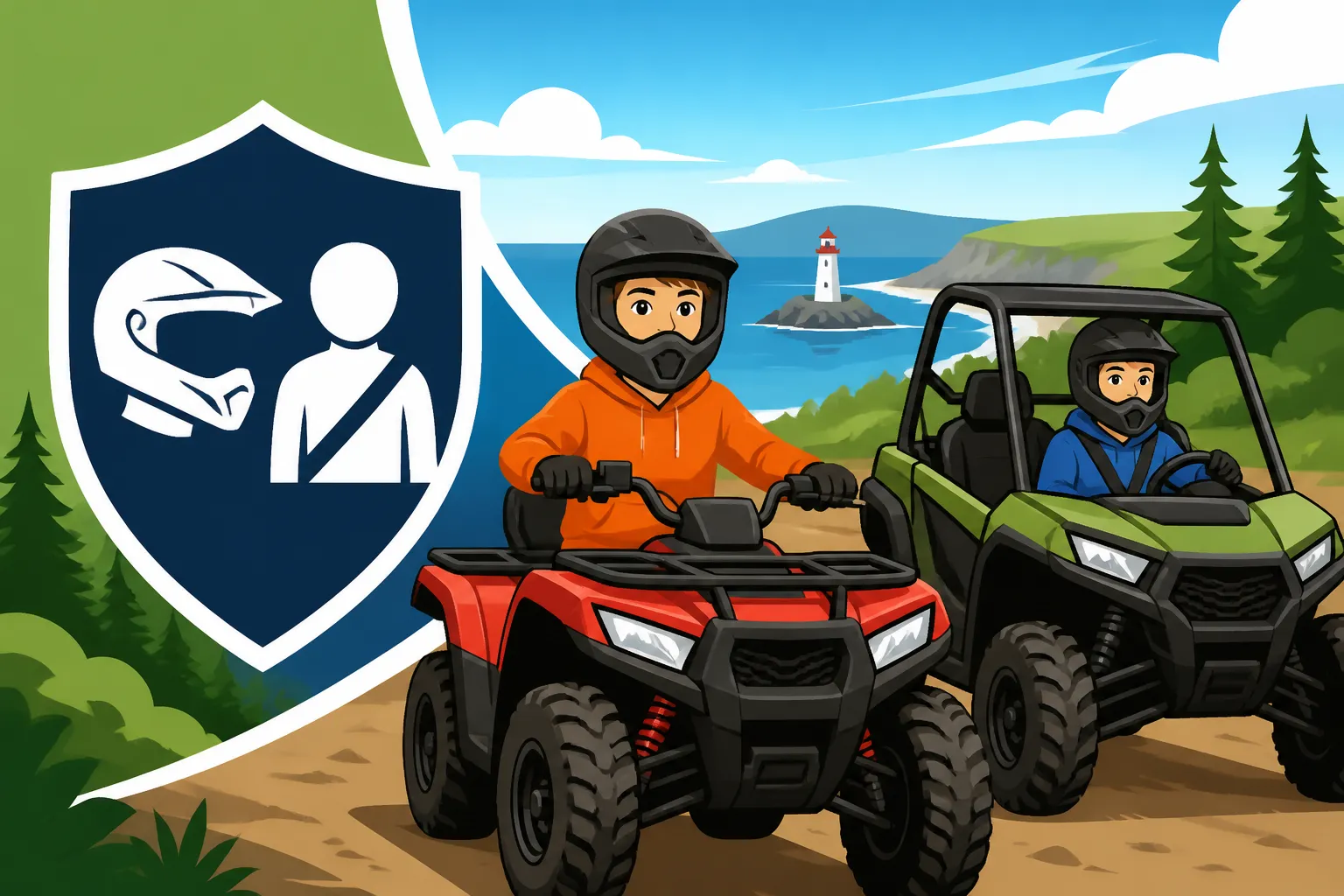
Protective equipment is not optional simply because the ride is short or the child is on private land. Riders need a properly fitted helmet that meets an accepted standard, and riders under 16 have additional clothing and eye-protection requirements. Check the current rules for the exact equipment required and accepted markings. A helmet that is too loose, damaged or not intended for motorized riding is not a sound substitute.
For a young rider, check the complete setup before every outing:
- A properly fitted, approved helmet.
- Eye protection that stays in place and gives a clear view.
- Long sleeves and gloves.
- Long pants and sturdy boots that protect the feet and ankles.
- Clothing that fits closely enough not to catch on controls or moving parts.
- Any other protective equipment required for the rider’s age and type of ride.
Fit is as important as the shopping list. A helmet that moves around when the child shakes their head, goggles that fog immediately, or boots that prevent the rider from reaching a control can make riding less safe. Let the child try the equipment while seated on the machine with the engine off. Check that the helmet fastens correctly and that the rider can turn their head, see clearly and reach the controls.
Amazon can be useful for comparing helmet models, gloves and protective clothing, but do not choose solely by a product title or a customer photo. Confirm the helmet’s safety marking, size, fit and intended use, and check the seller’s return process before ordering. For safety-critical gear, a local shop can be valuable because a knowledgeable fitter can help assess fit in person.
Amazon listings may also make it easy to compare youth sizes, but children’s sizing is inconsistent across brands. Measure the rider and follow the manufacturer’s own sizing guide. If the helmet does not fit correctly when it arrives, exchange it rather than hoping the child will grow into it. The same applies to boots: a secure fit and reliable grip matter more than buying a size with lots of extra room.
Amazon can help with accessories such as protective eyewear or gloves, but make sure each item is suited to riding and compatible with the helmet. A fashion visor or ordinary sunglasses may not meet the requirements for riding. If the rule calls for a specific standard or type of protection, confirm that the item actually meets it instead of relying on vague marketing language.
For more detail, see What a Rider Under 16 Must Wear and Nova Scotia Helmet Standards Accepted. The general helmet rules also apply to supervised rides: an adult’s helmet does not satisfy the child’s requirement, and a passenger’s equipment rules do not replace the operator’s.
Safety training, certificates and permits are separate requirements
A frequent source of confusion is treating training, vehicle registration, insurance and a trail permit as one package. They are different things, and meeting one requirement does not necessarily meet the others.
For young riders, the age at which safety training or a certificate becomes mandatory is a separate issue from the minimum age to ride. Nova Scotia’s safety-certificate rules apply from age 16, subject to the specific requirements and any recognized exemptions. That does not mean a child under 16 should ride without instruction. Practical training is a good safety measure at every age, but do not assume that an informal lesson is the same as a required course or certificate.
If a youth is approaching 16, check the certificate requirement before planning a ride. Make sure the certificate is valid for the kind of riding involved and that any exemption relied on is genuinely applicable. The details of training, recognized credentials and grandfather provisions can be specific. See Nova Scotia Safety Certificates Are Mandatory, Nova Scotia Safety Training at 16 and Nova Scotia’s Exemption for Riders Who Owned Before 2006 for related information.
A trail permit is about access to certain organized trail networks. It is not a driver’s licence, an age waiver or a safety certificate. A parent cannot buy a permit and use it to bypass a youth restriction. Likewise, a child who is allowed to ride in one setting should not assume that the same permission carries over to every club corridor or public road trail.
Vehicle registration and insurance are also distinct from the rider’s age. A machine may need registration and insurance even when it is operated by a young person, and the person responsible for the machine may need to ensure that the documents are in order. Check the vehicle’s status and the rules for the place you intend to ride. For background, see Do You Need to Register an ATV in Nova Scotia? and Nova Scotia Insurance Requirements for Riders.
Before a youth ride, think of the checks as separate boxes:
| Requirement | What it addresses | What it does not replace |
|---|---|---|
| Age and supervision rules | Whether the young person may operate in the intended setting and with what oversight | A trail permit, registration or insurance |
| Safety training or certificate | Required training or proof of training for riders who fall under the certificate rules | Supervision or permission to use a particular route |
| Registration and insurance | The machine’s paperwork and required coverage | The operator’s age, licence or training |
| Trail permit or club access | Access to a participating trail network, where applicable | Provincial operating restrictions or road-trail licensing |
| Landowner or route permission | Permission to use a particular property or corridor | Any of the requirements above |
This distinction is useful when a family buys a used quad, borrows a machine from a relative or joins a club ride. Ask about every requirement rather than relying on one piece of paper. A club permit does not prove that the vehicle is registered. A registration document does not show that a child can ride on a public road trail. And adult supervision does not cancel a trail closure.
If you are unsure which requirements apply to a particular ride, explain the details when asking for guidance: the rider’s age, the machine type, where the ride will take place, whether the route is a road trail, who will supervise and what training the rider has completed. A clear description is more useful than asking only, “Can my child ride?”
Planning a legal and manageable ride
The safest way to plan is to check the route and the rider together. Do not pick a destination first and then try to make the rules fit. Start with the child’s age and ability, confirm the allowed location, and choose a machine and route that the rider can manage.
Before you leave
Use this checklist before starting the engine:
- Confirm the rider’s age category. Check the current minimum-age and under-16 rules, including any closed-course restriction for riders aged six to 13.
- Confirm the location. Establish whether it is a closed course, a regular trail, private property or a public road trail. Do not guess.
- Check the route’s access status. Look for club rules, landowner permission, permit requirements and temporary closures.
- Arrange a qualified supervisor. Confirm the adult meets the age and training requirements, can keep the young rider in sight and is not supervising more children than permitted.
- Assess the machine. Make sure the rider fits it, can operate every control and can stop safely.
- Inspect protective gear. Check the helmet, eye protection, clothing, gloves and boots, including fit and condition.
- Check the machine’s paperwork. Confirm registration, insurance and any relevant trail permit or access documents.
- Choose a short, suitable route. Avoid difficult crossings, steep terrain and places where the adult cannot remain close.
- Agree on signals and stopping rules. The child should know what to do if they lose sight of the supervisor or the machine develops a problem.
- Recheck conditions. Weather, trail conditions and visibility can change. Be prepared to turn around.
A first ride should be brief and predictable. A child’s concentration can fade before they are physically tired, particularly on a noisy, bumpy route. Stop regularly and ask whether the rider feels comfortable, can still reach the controls easily and understands the next section.
Do not use a ride as the time to teach every basic skill at once. Practice starting, stopping, turning and using the controls in an appropriate safe setting before attempting a longer outing. Then add difficulty gradually, with the supervisor close by. If the child is hesitant, overwhelmed or having trouble controlling the machine, stop. Pressuring a young rider to keep up is a poor substitute for experience.
Common mistakes to avoid
Assuming private land means no rules apply. Private land may change which permissions are needed, but it does not automatically erase age, supervision, equipment or vehicle requirements.
Calling any trail a closed course. The terms are not interchangeable. Confirm that the location actually qualifies for the age group and activity.
Letting the adult ride out of sight. Supervision needs to be meaningful. Choose a route where the adult can observe and respond.
Using an adult-size machine because it is already available. A machine that the child cannot control confidently is not made suitable by limiting the throttle or riding slowly.
Treating a permit as an age exemption. A permit may grant access to a trail network, but it does not make a prohibited route legal for a young rider.
Taking a child onto a road trail as a shortcut. The full-driver’s-licence requirement applies to road-trail operation. Adult accompaniment does not replace the licence.
Waiting until the trailhead to sort out paperwork. Check the machine documents, route status and required permits before leaving home. A group ride is not the time to discover that a route is closed or the youth rider cannot use it.
Assuming all children of the same age have the same ability. Physical size, judgment, coordination and experience vary. Select the machine and route for the individual rider.
For a family’s first trail outing, a local club may be able to clarify which trails it maintains and what permits or access rules apply. But confirm the provincial youth requirements separately. The club can explain its own corridor; it cannot grant an exception to a provincial rule.
What to do when the rule is unclear
When the answer depends on the precise location, course status, rider age or type of machine, do not rely on a guess or a neighbour’s recollection. Rules and guidance can change, and informal terms such as “private trail” may not settle the question.
Write down the facts before contacting the relevant provincial office or organization:
- The rider’s exact age.
- Whether the rider is operating or riding as a passenger.
- The type of OHV.
- The location and who controls it.
- Whether the route is a road trail, club trail, private property or closed course.
- The supervisor’s age and training.
- The number of young riders in the group.
- Any certificate, registration, insurance or permit already in place.
Ask specific questions. For example: “Can a 12-year-old operate this machine on this named route with this supervisor?” is more useful than “Can kids ride ATVs?” If you are relying on an exception, ask what conditions must be met and how to confirm them. Keep a record of the guidance, especially if it affects a planned event or repeated use of the same location.
If you are organizing a group ride, make the youth rules part of the sign-up process. Ask parents to confirm riders’ ages, required equipment and supervision arrangements in advance. Do not assume that another adult’s presence covers a child who has been dropped off. Set a clear plan for who is responsible for each young rider and what happens if the group becomes separated.
The goal is not to make youth riding unnecessarily complicated. It is to keep the child, the supervising adult and other trail users safe while avoiding a situation where a family discovers too late that a route or machine was not appropriate. A short check before the ride is easier than dealing with an injury, a citation or an argument about what someone thought was allowed.
Nova Scotia’s youth rules work best when you treat age, supervision, location, training, machine fit and access as separate checks. If one part is uncertain, pause and confirm it before riding. That approach gives young riders a better chance to learn in a controlled setting and helps adults make decisions based on the actual ride, not assumptions.
Disclaimer
This article is for general informational purposes only and does not constitute professional advice. Laws, prices and regulations vary by location and change over time. Consult a qualified professional for guidance on your specific situation.