Nova Scotia Commercial Guiding Rules
If you plan to take paying customers on ATV or UTV rides in Nova Scotia, a trail permit alone may not be enough. Commercial guiding can bring separate certification, land-access, insurance and safety obligations. The key is to treat the guide’s qualification and the business’s permission to operate as different requirements, then confirm both before advertising a trip.
What counts as commercial guiding
A ride may be commercial guiding when someone is paid to lead or guide other people using off-highway vehicles. Payment need not necessarily be described as a “guiding fee”: it could be part of a package that includes a machine rental, accommodation, transportation or another service. If customers are paying for someone to lead the ride, ask whether the activity falls under Nova Scotia’s guide-certification rules.
That is different from an informal ride with friends, where nobody is being paid to guide. It is also different from simply renting a machine to a customer without leading the customer on a route. Those distinctions can affect which rules apply, but a business should not rely on the wording of its invoice or advertisement to decide. Describe the actual service to the appropriate provincial office and ask for a clear answer.
The starting point is the requirement for a paid guide to be certified. Review Why a Paid Trail Guide Must Be Certified and Guide Certification Rules for the guide-specific issue. A guide certificate relates to the individual leading rides. It should not be assumed to act as a general business licence, confirm access to every trail, or satisfy every insurance requirement.
| Issue | What it relates to | What to confirm before a trip |
|---|---|---|
| Guide certification | The person leading a paid ride | Whether the activity requires certification and whether the guide’s certificate is current |
| Trail access | The route and land used | Whether commercial groups are permitted on each segment |
| Vehicle registration and permits | Each machine | Which registration and trail permits are required for the machines and riders |
| Insurance | The business, guide, machines and activity | Whether the policy covers paid guided rides and the planned route |
| Rider safety | The group and trip plan | Age, training, supervision, equipment and emergency arrangements |
A guide certificate and a trail permit solve different problems. A permit is not proof that a guide is certified, and a guide certificate is not permission to use a trail. Likewise, general permission to ride a corridor does not automatically authorize a commercial operation there.
If you are unsure whether your planned service counts as guiding, explain the details rather than asking a broad question. Include whether customers pay, who supplies the machines, who chooses the route, who leads, and whether the ride uses club trails, private land, Crown land or roads designated for off-highway vehicles. Keep the response you receive with your business records.
Certification, qualifications and records
Before taking a paid group out, confirm the certification requirement with the provincial authority responsible for off-highway vehicles. Requirements and administrative processes can change, so verify what applies to the type of ride you offer rather than relying on an old webpage, a certificate held by another operator or an informal interpretation.
Ask specifically:
- Whether the planned activity is considered commercial guiding.
- Which qualifications or training a guide must hold.
- How to apply for or renew a guide certificate.
- Whether the guide must carry proof of certification while leading a trip.
- Whether any certificate or qualification must be reported to the minister or another authority.
- Whether other rules apply to employees, substitute guides or contractors.
The certificate process is a separate question from a rider’s general training requirements. Nova Scotia also has safety-certificate rules for riders in relevant circumstances; Nova Scotia Safety Certificates Are Mandatory explains that separate issue. Do not assume a customer’s rider training qualifies the person leading the commercial trip as a guide, or that a guide’s certificate replaces riders’ own obligations.
If a certificate has to be reported or filed, follow the current instructions and keep evidence that the step was completed. Notifying the Minister of a Certificate covers this record-keeping question. Make a simple file for each guide with the certificate details, any required supporting documents, renewal dates and records of submissions. If you hire a new guide, check their qualifications before assigning them a paid trip; do not assume a prior employer’s records settle the matter.
Keep copies of the answers you receive from officials and any written approvals from landowners, clubs or trail managers. Record the date, the person or office contacted, what activity you described and what they advised. This is useful if the service changes later—for example, if you add rentals, change routes or start taking larger groups.
Certification is only one layer of preparation. A qualified guide can still lead a ride on a route where commercial access is not allowed, take an inadequately insured group out, or overlook a participant’s age or equipment requirements. Treat qualification as the beginning of the compliance check, not the finish.
Trail access, permits and insurance
A commercial ride needs a lawful and suitable route. Before advertising a destination, identify who manages each part of it and ask whether paid guided groups are allowed. A route that is open to individual recreational riders may have different conditions for a business, a large group, a special event or a ride involving rented machines.
For club-managed routes, contact the relevant club or trail authority directly. Ask whether the route is open, whether a commercial operator needs written approval, whether group-size limits apply, and whether there are seasonal closures or operating conditions. A trail permit may support access under the permit’s terms, but it should not be treated as permission to conduct a business on every corridor. See Nova Scotia Trail Permits From ATVANS and [Nova Scotia Group Size on Club Trails] for related permit and group-access considerations. For an organized event, check whether Nova Scotia Event Permits for a Ride applies to the planned format.
Land status matters. Some corridors cross private woodlots or Crown land, and permission to pass recreationally may not cover commercial use. Confirm the route segment by segment and get any required approval in writing. Nova Scotia Private Woodlot Permission and Nova Scotia Crown Land Riding Rules cover two common access questions. Avoid relying on an old map or another operator’s past use as proof that a route is currently open.
Each machine also needs the required registration and permits for the intended use. Make a list of the machines the business owns, rents or uses, then check what must be carried or displayed and who is responsible for renewing it. A customer’s personal permit should not be assumed to cover a company machine, another rider or a different trail system. If the trip crosses onto a route managed by a club, confirm the club’s current conditions as well.
Insurance deserves an explicit conversation with a broker. Explain that the business will lead paid ATV or UTV rides, whether customers use company-owned or rented machines, the routes involved, group sizes and who supervises participants. Ask the broker to confirm in writing that the policy covers commercial guiding and the actual activities offered. A standard personal policy or a general business policy may not cover a guided ride simply because it mentions off-road vehicles. Nova Scotia Association Insurance Explained discusses association-related coverage, which should not be mistaken for a substitute for the operator’s own commercial insurance.
Also ask about liability coverage, damage to rented or company machines, participant injuries, employees and contractors, and any conditions that must be met for coverage to apply. Disclose the way the business operates accurately. A policy arranged for recreational use may not respond as expected if the machine is being used to provide a paid service.
A practical pre-trip compliance check
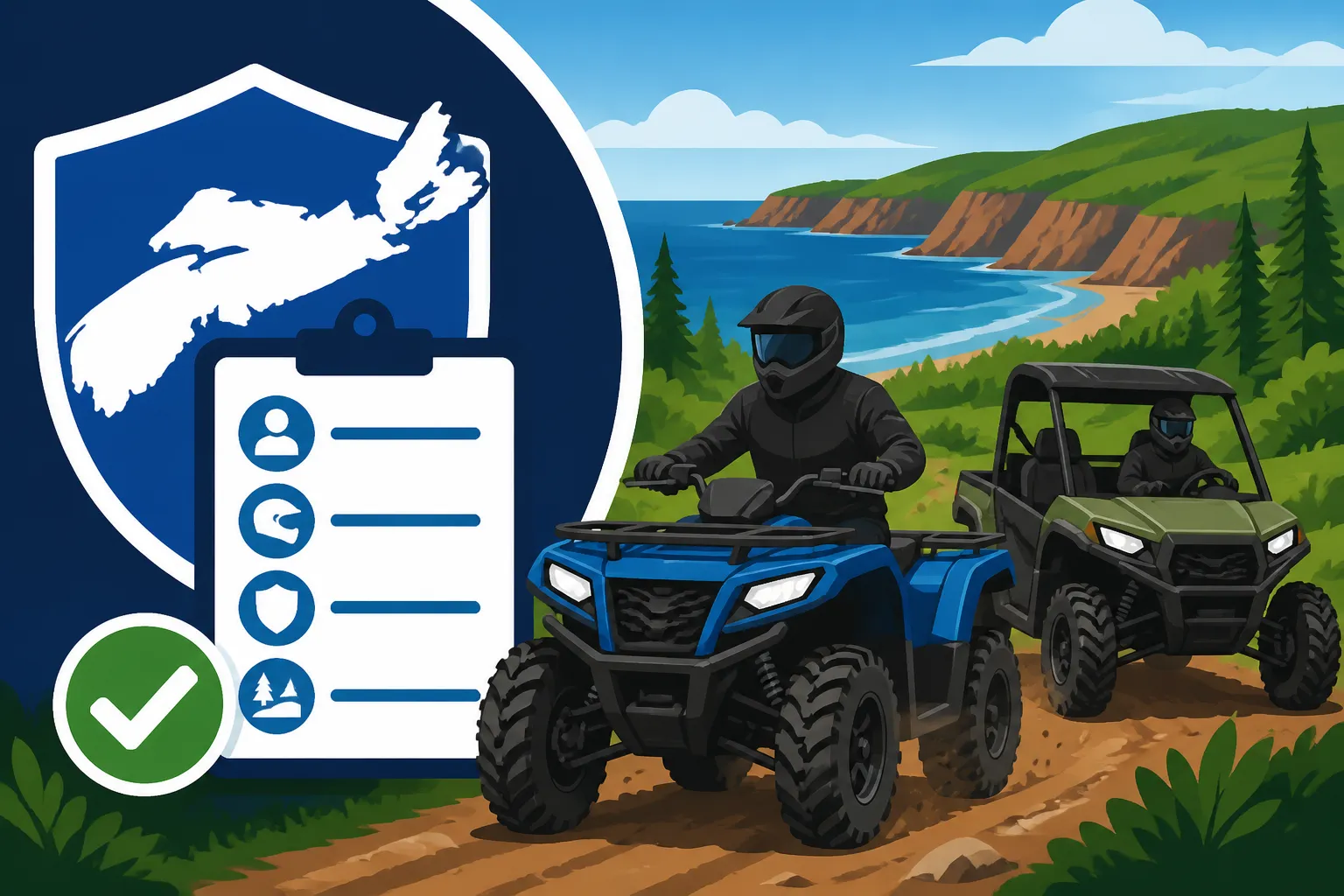
Create a written checklist and use it before each season, when routes change and when the business adds a new service. The purpose is not to turn every ride into paperwork; it is to catch the gaps that are easy to miss when an operator assumes one approval covers everything.
- Describe the service. Record who pays, what the customer receives, who supplies the machine and who leads the ride. Confirm whether the activity requires guide certification.
- Check every guide. Verify current qualifications, any required certificate or filing, and what proof the guide must carry. Keep the relevant records available to the business.
- Confirm the route. Identify each trail manager and landowner, check current closures, and get written approval where commercial use requires it. Do not promise a route until access is confirmed.
- Check machines and permits. Confirm that each machine is properly registered and that the required trail permits and documents match the intended use.
- Confirm insurance in writing. Tell the broker the activity is paid guiding, not private recreation. Keep the policy documents and any conditions accessible to the person responsible for the trip.
- Screen the group. Confirm participants meet the applicable age, training, supervision and equipment requirements. Set a clear process for handling someone who is not eligible or prepared to ride.
- Plan the ride. Set a realistic route, group size, turnaround point and communication plan. Consider weather, daylight, fuel range, remote sections and a vehicle breakdown or injury.
- Brief customers before departure. Explain the route, riding order, stopping procedure, signals, separation plan, required protective equipment and what to do if someone has a problem.
- Keep trip records. Note the guide, route, group, machines and any incident or change of plan. Use the records to improve procedures and support insurance or access questions.
The safety brief should match the actual ride. A short beginner loop and a remote day trip do not have the same risks. Make sure customers understand that they must follow the guide’s instructions, stay on the authorized route and avoid riding beyond their ability. If a participant cannot safely operate the machine or does not have the required equipment, postponing or declining their ride is safer than trying to solve the problem on the trail.
Build in a way to contact help, but do not assume mobile service will be available throughout a route. Tell someone outside the group where the trip is going and when it is expected to return. Carry suitable first aid and recovery equipment, and assign a clear role for responding to an incident. These precautions are practical planning, not substitutes for the legal and insurance checks.
Commercial guiding can be a workable service, but the obligations sit in several places: the guide, each machine, the route, the business and the customer group. Confirming those pieces separately is more reliable than treating a guide certificate or a trail permit as an all-purpose authorization.
Disclaimer
This article is for general informational purposes only and does not constitute professional advice. Laws, prices and regulations vary by location and change over time. Consult a qualified professional for guidance on your specific situation.