Nova Scotia Dealer Paperwork at Delivery
The moment you decide to bring home a new ATV or UTV from a Nova Scotia dealer, the excitement is usually through the roof. You're picturing yourself hitting the trails, exploring the rugged coastline, or maybe tackling some serious work on your property. But then, as you sit down with the salesperson, a towering stack of paperwork often appears, and suddenly, that excitement can get a little bogged down in confusion and anxiety. This guide is here to cut through that clutter, walking you through every essential document you'll encounter during your Nova Scotia dealer delivery, so you can sign with confidence and get to the fun part faster.
The Initial Mountain of Forms: What to Expect from a Nova Scotia Dealer
When you're buying a brand-new off-highway vehicle (OHV) from a reputable dealer here in Nova Scotia, there's quite a bit of administrative heavy lifting that goes on behind the scenes. They're not just handing you the keys; they're ensuring a legal and smooth transfer of ownership, which means a stack of documents will come your way. It can feel a bit overwhelming, but each piece serves a critical purpose in protecting both you and the dealership. Understanding these initial documents is the first step in a transparent purchase process.
Sales Agreements and Purchase Orders
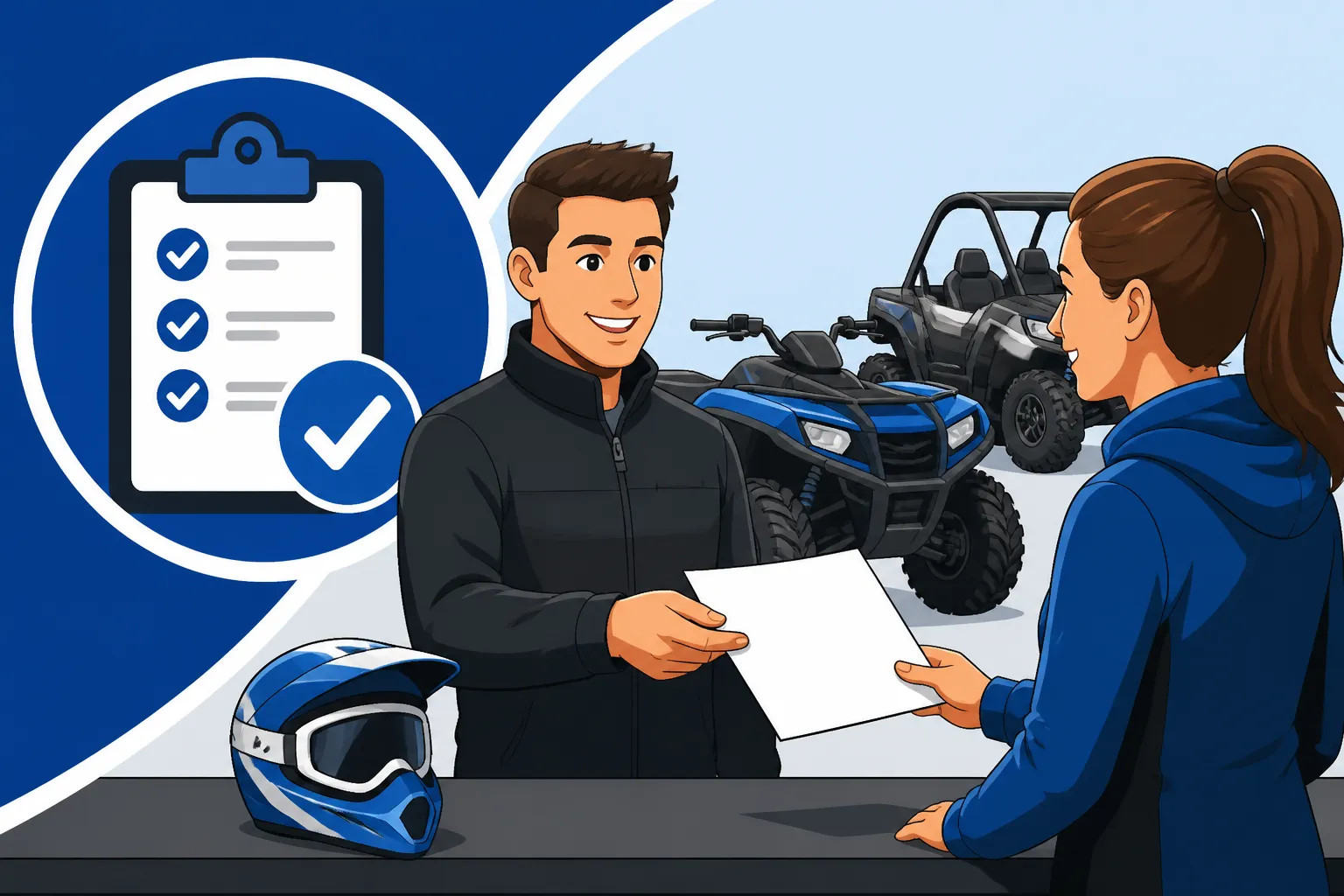
The sales agreement or purchase order is arguably the most critical document you'll sign at the outset. Think of it as the foundational contract outlining the entire deal between you and the dealership. It's where all the nitty-gritty details of your purchase are formally recorded and agreed upon.
This document will meticulously detail the specific ATV or UTV you're buying, including its make, model, year, colour, and most importantly, its Vehicle Identification Number (VIN). It will also clearly lay out the agreed-upon purchase price, any trade-in value if you're exchanging an old machine, and a line-by-line breakdown of any accessories, protection plans, or additional services you've opted for. It's your responsibility to carefully review every figure, ensuring it aligns perfectly with what was discussed and agreed to verbally. Discrepancies, no matter how small, should be clarified and corrected before you put pen to paper.
Beyond the machine itself, the sales agreement will also specify payment terms, whether you're paying cash, using a bank draft, or financing the purchase. It might outline delivery expectations, such as when the machine will be ready for pickup or if there's a specific date for any customization work. This agreement is legally binding, so take your time. It’s the roadmap for your purchase, and ensuring its accuracy can save a lot of headaches down the line. It's your opportunity to ask any last-minute questions about the final price or any charges you don't fully understand.
Financing Documents and Loan Agreements
If you're not paying cash outright for your new machine, the stack of paperwork will grow considerably with financing documents. Dealers often have relationships with various lenders, simplifying the loan application process, but it introduces a whole new set of legal obligations you need to comprehend.
The primary document here will be the loan agreement or promissory note. This is where you legally promise to repay the borrowed amount, plus interest, over a specified period. It will detail the interest rate, the number of payments, the total amount to be repaid, and any penalties for late payments. Another crucial piece is the security agreement, which essentially states that your new ATV or UTV serves as collateral for the loan. This means that if you fail to make payments as agreed, the lender has the right to repossess the machine. It's a standard part of secured lending, but understanding its implications is vital.
Lenders are also required to provide disclosure statements, which outline all the terms and conditions of your loan in a clear, transparent manner. While the dealer facilitates this, the financing agreement is directly between you and the lending institution. Make sure you understand all the terms before signing, including any options for early repayment or provisions for deferring payments in certain circumstances. It’s always a good idea to take these documents home and review them if you can, rather than feeling pressured to sign on the spot. Remember, these are long-term commitments that impact your budget for years to come.
Essential Paperwork for Ownership and Registration in Nova Scotia
Once the purchase details are ironed out and any financing is approved, the next set of documents focuses on officially transferring ownership to you and preparing your machine for legal use in Nova Scotia. This is where the machine truly becomes "yours" in the eyes of the law and the province.
The Manufacturer's Certificate of Origin (MCO/MSO): Your Machine's Birth Certificate
The Manufacturer's Certificate of Origin (MCO), sometimes called a Manufacturer's Statement of Origin (MSO), is perhaps the single most important document you’ll receive for a brand-new machine. This is literally your ATV or UTV’s birth certificate. It’s issued by the manufacturer when the machine rolls off the assembly line, and it proves that the vehicle is new and has never been registered before.
The MCO is your initial proof of ownership. It travels from the factory to the dealership, and then, crucially, from the dealership to you. Without this document, you cannot register your off-highway vehicle with Access Nova Scotia. It contains vital information like the VIN, make, model, year, and engine size, all of which will be transferred to your provincial registration documents. It's a single, unique document, so treat it with extreme care. Dealers will usually provide this to you to take to the registry, or in many cases, they will handle the initial submission on your behalf, which is a significant convenience.
Ensuring you receive the original MCO (or that the dealer submits it directly) is paramount. If it's lost or delayed, it can create significant headaches and prevent you from getting your machine legally registered. Always double-check that the VIN on the MCO matches the VIN on your machine and on your sales agreement. This cross-referencing is a simple but critical step to prevent future problems. It’s the ultimate validation that you are taking possession of the exact machine you intended to buy.
Bill of Sale and Tax Collection
An official bill of sale from the dealership is another cornerstone document. While the sales agreement sets the terms, the bill of sale formally records the transaction and the transfer of ownership from the dealer to you. It's a simpler document than the full sales agreement, focusing specifically on the machine, the purchase price, and the taxes collected.
In Nova Scotia, dealers are required by law to collect Harmonized Sales Tax (HST) directly from you at the point of sale. This is a significant convenience, as it means you don't have to worry about paying this tax separately when you go to register your machine, unlike with many private sales where you pay the tax at Access Nova Scotia. The bill of sale will clearly show the total purchase price of the machine and the exact amount of HST collected. This figure is crucial for your own records and as proof that the tax obligation has been met. For more details, you might want to review [Nova Scotia HST on an ATV Purchase].
This is also where the dealer simplifies things compared to a private transaction. If you were buying a used machine from a private seller, you might use a service like LawDepot to draft a legally sound bill of sale and then you'd be responsible for declaring the purchase price and paying the tax directly to the registry. With a dealer, they handle both the robust documentation and the tax remittance, streamlining your path to ownership. The bill of sale serves as your definitive proof of purchase, and it's essential for any future resale or insurance claims. This document is a key piece of the puzzle for [Nova Scotia Tax Collected at Registration].
Beyond the Sale: Additional Dealer Paperwork and Considerations
The paperwork doesn't always stop once the sale is finalized and the MCO is in hand. Dealers often provide additional documentation that's crucial for the long-term enjoyment, maintenance, and legal operation of your new Nova Scotia ATV or UTV. These extra layers of information are just as important as the initial sales contracts.
Warranty Information and Service Agreements
New off-highway vehicles invariably come with a manufacturer's warranty, and the dealer will provide you with all the details for this. This warranty is your protection against defects in materials or workmanship for a specified period or mileage. It's vital to understand what components are covered, what is excluded (like normal wear and tear or damage from misuse), and the procedures for making a warranty claim.
Beyond the standard manufacturer's warranty, dealers often offer extended warranty plans or service agreements. These are optional but can provide additional peace of mind, covering repairs beyond the factory warranty period. You’ll receive separate contracts for these, detailing their specific terms, costs, and coverage. Read these carefully to determine if the additional protection aligns with your needs and budget. Keeping all warranty documentation in a safe place is critical, as it will be your reference point if your machine ever needs unexpected repairs within the coverage period. Understanding these documents can save you from significant out-of-pocket expenses down the line.
Dealer-Assisted Registration and Permitting
One of the biggest conveniences a Nova Scotia dealer often provides is assistance with the initial registration of your new ATV or UTV. While you could take your MCO and bill of sale directly to Access Nova Scotia yourself, many dealers offer to handle this step for you, sending the necessary documents to the provincial registry on your behalf. This can save you a trip and ensure everything is processed correctly.
When a dealer assists with registration, they are typically ensuring that you obtain your [Nova Scotia Certificate of Registration at $39.80] (the one-time fee) and your initial [Nova Scotia Vehicle Permit at $13.20] (the annual fee). They'll guide you through any forms required by Access Nova Scotia, ensuring all information is accurate, especially regarding the machine's details and your personal information. This process is a common benefit of [Nova Scotia Dealers Registering New Machines]. You'll still need to carry proof of insurance, often referred to as your "pink card," as [Nova Scotia Insurance Requirements for Riders] are mandatory, and officers may ask for your [Nova Scotia Pink Card Rules] if you’re pulled over on a road trail.
Some dealers may even go a step further and help you apply for your annual trail permit from ATVANS, though this is often a separate process and cost. While this assistance is invaluable, always confirm with the dealer exactly what they are doing on your behalf and what documents you will receive back from Access Nova Scotia. Understanding the [Nova Scotia OHV Registration Cost] in its entirety, including the initial registration fees and the recurring permit costs, is important for your budget. For other legal forms outside of these specific vehicle transactions, you might find templates on platforms like LawDepot helpful for various personal or business needs.
Pre-Delivery Inspection (PDI) Checklist and Delivery Receipt
Before you drive your shiny new machine off the lot, the dealership should have performed a comprehensive Pre-Delivery Inspection (PDI). This is a multi-point check to ensure that the ATV or UTV is assembled correctly, all fluids are at proper levels, all systems are functioning as they should, and there are no cosmetic damages. You should receive a PDI checklist, which often has signatures from the technicians who performed the inspection.
Reviewing this checklist confirms that the dealer has prepared your machine according to the manufacturer's specifications and industry standards. It’s also your opportunity to do your own walk-around inspection. Look for any visible damage, check tire pressure, test the lights, and ensure everything appears to be in order before you accept delivery. If you notice anything amiss, now is the time to point it out and have it rectified by the dealer.
Finally, you’ll typically sign a delivery receipt. This document simply confirms that you have taken possession of the machine in satisfactory condition. It acts as a final timestamp for the transfer of the physical machine. Once you sign this, the machine is officially in your care, and responsibility for its condition generally shifts to you. This is why a thorough PDI and your own careful inspection are so crucial. Don't rush this final step, as it's your last chance to ensure your new purchase is perfect before you head out on your first adventure.
Here’s a quick overview of the key documents you'll encounter:
| Document Category | Specific Document | Purpose | Your Role |
|---|---|---|---|
| Purchase & Financing | Sales Agreement / Purchase Order | Outlines the full terms of sale, price, and machine details. | Review, verify all figures, understand terms, sign if accurate. |
| Loan Agreement / Promissory Note | Legal promise to repay borrowed funds with interest. | Understand interest rates, payment schedule, terms, sign if acceptable. | |
| Security Agreement | States the machine is collateral for the loan. | Understand implications of collateral, sign. | |
| Ownership & Registration | Manufacturer's Certificate of Origin (MCO) | Proves the machine is new and legally recognized; essential for registration. | Keep safe, verify VIN matches, provide to registry (or dealer for submission). |
| Bill of Sale | Official record of sale and proof of HST collection. | Keep for records, verify tax amount. | |
| Post-Sale & Delivery | Warranty Information | Details manufacturer's coverage against defects. | Understand terms, coverage, exclusions, keep for reference. |
| Extended Warranty/Service Agreement | Optional additional coverage beyond factory warranty. | Review, understand costs and benefits, decide if desired, sign contract. | |
| PDI Checklist | Confirms dealer has inspected and prepared the machine. | Review, perform your own walk-around inspection. | |
| Delivery Receipt | Acknowledges you have taken possession of the machine. | Sign after verifying machine is in satisfactory condition. |
Disclaimer
This article is for general informational purposes only and does not constitute professional advice. Laws, prices and regulations vary by location and change over time. Consult a qualified professional for guidance on your specific situation.