Nova Scotia Visitors From Quebec
Visitors from Quebec can bring an ATV or UTV to Nova Scotia, but should not assume a Quebec trail pass works on Nova Scotia club trails. The key is to separate a trail permit from vehicle registration and insurance, then confirm which documents and permit fit the trip before setting out.
Does a Quebec permit let you ride Nova Scotia club trails?
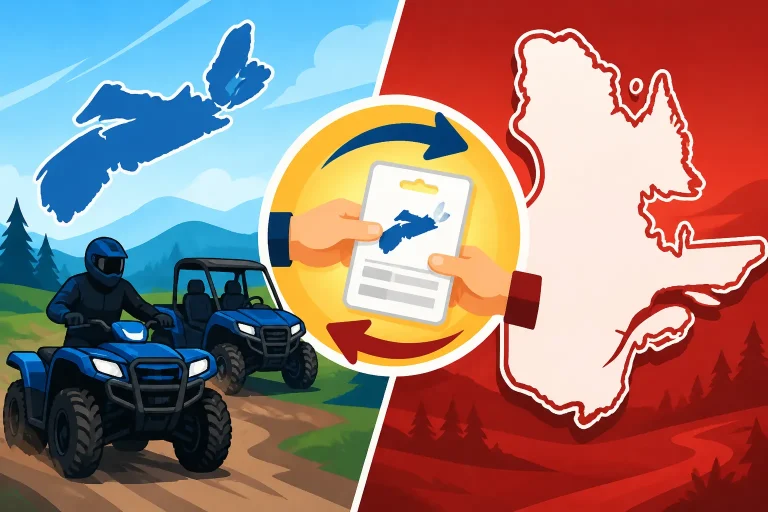
In general, a Quebec trail permit should not be treated as a Nova Scotia trail permit. Trail access arrangements are not automatically reciprocal across provinces. Nova Scotia’s recognition of some out-of-province permits is specific, so a Quebec rider should arrange the appropriate Nova Scotia permit unless ATVANS confirms otherwise for their situation. Nova Scotia Honours Ontario Permits
That permit is for access to participating trails in the Nova Scotia ATV network. It is not a replacement for your machine’s registration, insurance, or any other documents required for lawful operation. Nor does it grant permission to ride on every road, private woodlot, Crown land area, or other property. Trail access depends on the route, landowner permission, and local rules.
A simple way to keep the paperwork straight is to treat these as separate questions:
| Requirement | What it covers | What a Quebec visitor should check |
|---|---|---|
| Nova Scotia trail permit | Access to participating club trails | Whether a visitor permit or another permit fits the length of the trip |
| Vehicle registration | The machine’s registration status | Whether the Quebec registration documents are valid and should be carried in Nova Scotia |
| Insurance | Required coverage for the type of riding | Whether the policy covers the machine in Nova Scotia and what proof to carry |
| Land or route permission | Permission to use a particular trail, road, or property | Whether the route is open and authorized for ATVs or UTVs |
If you are planning to use club trails, arrange the trail permit before riding. For a visit lasting about a month, check the terms of Nova Scotia’s Thirty-Day Visitor Permit. For a longer stay or frequent trips, compare the visitor option with other permit choices rather than assuming one permit type is best. Nova Scotia Permit for a Visitor
The permit rules and sales arrangements can change. Confirm the current terms with ATVANS or the relevant trail club before travelling, especially if you have a Quebec pass and are unsure whether it has any recognition in Nova Scotia.
Choose a permit that fits the length of your visit
The practical choice often comes down to how long you plan to ride and whether you want a club membership as well as trail access. A short visit and a full riding season are different situations. Check the permitted dates, eligible trails, and proof-of-permit instructions before paying.
A visitor permit is intended for a limited stay. Do not assume it covers a whole calendar year just because it is issued during that year. Conversely, do not assume a full-season permit is necessary for a brief visit. Compare the current options with your planned arrival and departure dates. Nova Scotia Trail Permit Cost
| Your plan | What to look into | Why it matters |
|---|---|---|
| A short holiday or visit | The visitor permit and its exact validity period | A time-limited permit may better match the trip |
| Several visits during the season | A full-season permit and any membership option | Repeated visits can make a different permit more practical |
| Riding with a local club | Whether club membership includes a trail permit | Membership and trail access may be bundled, but check the current terms |
| Riding only on private property with permission | Whether a trail permit applies to the intended riding | A trail permit does not create permission to use property or routes |
Some Nova Scotia permits run on a calendar-year basis, while a visitor option may be tied to a defined period instead. Check the dates on the permit you actually buy, not just the date you make the purchase. Nova Scotia Permits Run a Calendar Year
Also check what form of proof you will receive. A permit may not arrive as a conventional sticker, so follow the instructions provided with it. Keep the confirmation or permit details accessible during the ride, and make sure every rider in the group understands which machine the permit applies to. How to Buy a Nova Scotia Trail Permit
A permit is not permission to use a closed route. Trail status can change because of weather, damage, landowner decisions, or maintenance work. Check current trail conditions before departure and again if your route crosses multiple areas. Nova Scotia Trail Conditions and Closures
Keep trail access separate from registration and insurance
A Nova Scotia trail permit does not register your ATV or UTV and does not provide insurance. Visitors need to consider the machine’s legal paperwork and insurance separately from club-trail access.
Carry the registration documents for the machine and confirm that your Quebec registration remains valid for the trip. Bring proof of insurance, and check with your insurer that the policy applies to the planned riding in Nova Scotia. Ask specifically about trail use, road-trail use if relevant, and any limits on who may operate the machine. Requirements and coverage can depend on the policy and where you ride. Nova Scotia Insurance Requirements for Riders
Before departure, make a small document set for each machine:
- Registration documents showing the machine’s identifying information and registered owner.
- Proof of insurance that can be produced during the trip.
- The Nova Scotia trail permit or its confirmation, following the issuer’s instructions about proof.
- Contact details for the insurer and anyone who needs to be reached in an emergency.
If the registration is in someone else’s name, or the machine is borrowed, make sure you have the owner’s permission and any documents needed to explain your authority to use it. If you are moving to Nova Scotia rather than visiting, do not assume visitor arrangements apply indefinitely. Review the requirements for a person establishing residence in the province. Nova Scotia Registration for a New Resident
For riding on a designated road trail, check the road-trail rules as well as the trail permit. Registration and insurance do not make every road legal for ATV use, and a trail permit does not replace the operating rules. Riders may need to meet additional requirements, including rules about licensing, equipment, hours, speed, and passenger age. Check the route and the rules that apply before including road trails in your itinerary.
Private land needs separate attention. A trail permit is not a landowner’s permission, and a route that appears on a map may cross private property or have restrictions. Stay on the authorized corridor and confirm permission where required. Nova Scotia Private Woodlot Permission If your plan includes Crown land rather than a marked club trail, check the applicable access rules instead of assuming the club permit covers it. Nova Scotia Crown Land Riding Rules
Plan the trip before crossing into Nova Scotia
The easiest way to avoid a wasted permit or an unusable route is to sort out the basics before loading the machine. You do not need to plan every stop in detail, but you should know which trails are open, what permit applies, and whether your documents cover the riding you intend to do.
Use this checklist:
- Define the riding area. Identify the club trails and any road-trail sections you expect to use. Do not assume all ATV-friendly-looking routes are open to machines.
- Choose the permit by trip length. Compare the visitor permit with other options, and verify its start date, end date, eligible machines, and proof requirements.
- Confirm the Quebec permit question. Unless ATVANS confirms recognition for your specific pass, plan to obtain a Nova Scotia permit for club trails.
- Check registration and insurance. Confirm the machine’s paperwork is valid for the trip and that the policy covers riding in Nova Scotia.
- Check current conditions. Look for closures, detours, damaged bridges, and other restrictions shortly before departure.
- Pack proof where it can be reached. Keep documents protected from weather but available to the operator, rather than buried in luggage or left at camp.
- Review the rules for each type of route. Club trails, private property, Crown land, and designated road trails may have different access and operating requirements.
If the trip is only a few days, a time-limited visitor permit may be the straightforward option, provided it covers the planned dates and routes. If you expect to return several times, compare the full-season and club-related options. The most suitable choice depends on the current terms, not simply on where you live or which provincial pass you already own.
If you are travelling with several machines, confirm the permit requirements for each one. Do not assume one permit covers an entire group or multiple ATVs and UTVs. Keep track of which proof belongs to which machine, especially when family members or friends are sharing transport and riding arrangements.
Common mistakes Quebec visitors can avoid
The most common misunderstanding is treating “permit” as one universal document. In Nova Scotia, a trail permit, registration, and insurance do different jobs. Having one does not automatically satisfy the others.
Other avoidable mistakes include:
- Assuming Quebec and Nova Scotia have automatic reciprocity. Verify recognition before travelling; otherwise, arrange a Nova Scotia trail permit for club-trail riding.
- Buying the wrong permit period. Match its validity dates to your visit and check whether it covers the locations you plan to ride.
- Assuming a permit opens every route. Trail access still depends on closures, landowner permission, and route-specific rules.
- Leaving registration or insurance proof at home. Carry the documents required for the machine and confirm the insurance territory with your provider.
- Planning a road-trail ride based only on the trail permit. Road-trail use has separate operating requirements. Check those before adding a road section to your route.
- Relying on old information. Reciprocity arrangements, permit terms, and trail conditions can change. Recheck with ATVANS and the relevant club before each trip.
A little preparation can prevent a frustrating first day in Nova Scotia. For a Quebec visitor, the safest planning assumption is that the Quebec pass and the Nova Scotia trail permit are separate unless the permit issuer confirms otherwise. Then check registration, insurance, and route access independently. That gives you a clear set of requirements to meet before the machine comes off the trailer.
Disclaimer
This article is for general informational purposes only and does not constitute professional advice. Laws, prices and regulations vary by location and change over time. Consult a qualified professional for guidance on your specific situation.