Nova Scotia Honours Ontario Permits
Nova Scotia Honours Ontario Permits
An Ontario permit can help an ATV or UTV visitor ride in Nova Scotia without buying a separate provincial trail permit, but it does not make every trail or road legal to use. The key is knowing what the Ontario permit covers, what it does not replace, and which documents and local rules still apply. This guide helps you check those details before loading up.
What Nova Scotia’s recognition of Ontario permits means
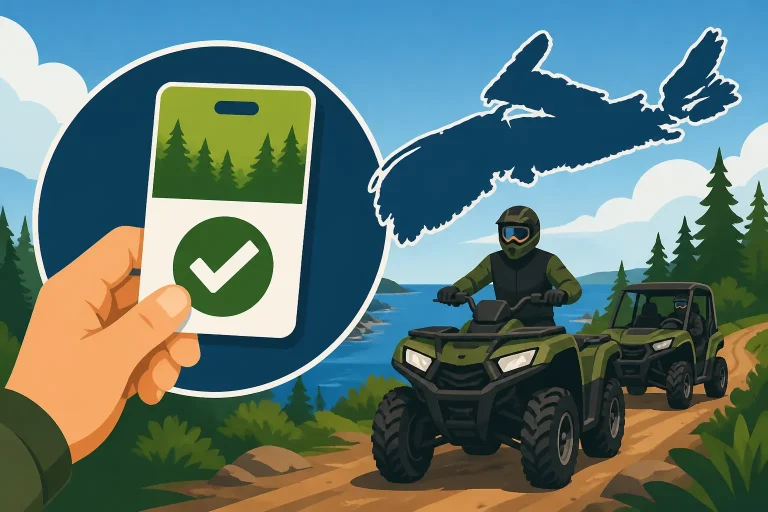
Nova Scotia recognizes valid Ontario permits for visiting off-highway vehicle riders in circumstances where a trail permit is required. In practical terms, that recognition can let an Ontario rider use eligible Nova Scotia trails without purchasing a second provincial trail permit for the same machine.
The important word is “trail.” A trail permit is about access to a trail system. It is not the same thing as registering a machine, proving ownership, carrying insurance, or meeting the rules for riding on a road trail. Ontario documents may have names or functions that differ from Nova Scotia’s, so don’t assume that one permit covers every legal requirement.
A permit also doesn’t grant permission to ride anywhere you can reach. It does not open a closed corridor, override a landowner’s restrictions, or make an unmarked woods road a public trail. A recognized permit is one part of a lawful ride, not a substitute for checking where you are going.
| What you’re checking | What an Ontario permit may do | What you still need to check |
|---|---|---|
| Access to eligible Nova Scotia trails | May be recognized in place of a separate Nova Scotia trail permit | Whether the permit is valid, applies to the machine and is accepted for the trail you plan to use |
| Registration or proof of ownership | Does not automatically replace Nova Scotia’s registration and ownership requirements | The machine’s registration or permit papers, ownership documents and any documents required for a visitor |
| Insurance | Does not prove that the machine has the required insurance | Your policy’s coverage, exclusions and proof-of-insurance document |
| Road-trail use | Does not authorize riding on a road or road trail | The road-trail rules, route, rider qualifications, equipment and documents |
| Private property or closed trails | Does not grant land access | Trail status, landowner permission, signs, gates and closures |
For a useful visitor overview, see Nova Scotia Visitors From Ontario. If you are planning specifically around trail access, compare your situation with Nova Scotia Trail Permits From ATVANS.
Confirm that your Ontario permit is the kind Nova Scotia recognizes
“Permit” can refer to different paperwork depending on the province and the task. A document connected to an Ontario off-road vehicle may establish that the machine is registered or permitted in Ontario, while a recreational trail pass may relate to use of a particular trail network. Those are not automatically interchangeable.
Before travelling, identify the exact document you have. Check its issuing authority, the machine it applies to, whether it remains valid, and whether it is meant to travel with the machine or rider. If you have more than one ATV or UTV, confirm that the paperwork covers each one you intend to bring. Do not assume that a permit for one machine extends to another just because they have the same owner.
It is sensible to keep a clear digital copy as a backup, but carry the original or other required proof as well. A screenshot can be handy if paper gets wet, yet it may not satisfy every document check. Keep paperwork protected from rain and mud, and make sure it is readable before you head out.
Ask about the specific trail, not just the province
Recognition at the provincial level does not guarantee that every trail operator handles out-of-province permits identically. A club-managed corridor, a multi-use route and a road trail can have different access conditions. A local club or trail operator can confirm what it accepts for the exact route you plan to ride.
Check the permit terms before departure, particularly if your plans include several trail networks. Ask whether the Ontario permit is accepted for that corridor, whether any additional club requirement applies, and whether the route is open to your machine type. If you are unsure, ask the operator or association directly rather than relying on a friend’s experience from a previous trip.
That last point matters because reciprocity arrangements can change. A province may recognize a permit from one jurisdiction while ending or changing arrangements with another. The fact that an Ontario permit is recognized does not mean a permit from every neighbouring province is treated the same way. For comparison, see Nova Scotia Visitors From New Brunswick.
Keep the Ontario permit valid for the visit
Check the expiry date and any conditions before you travel. If the permit is close to expiring, renew it before leaving home and bring evidence that the renewal is complete. If a renewal is still processing, do not assume that a payment receipt alone will be accepted as proof of a valid permit.
Also check that the permit details match the machine. A serial number or vehicle identification number that is hard to read, or that does not match the paperwork, can turn a simple roadside or trailhead check into a longer problem. If there is a discrepancy, resolve it with the issuing authority before the trip.
What an Ontario permit does not replace
The easiest way to avoid a paperwork surprise is to treat trail access, vehicle registration, insurance and route permission as separate checks. A recognized Ontario permit may satisfy one part of the trail-access question. It does not automatically answer the others.
Registration and proof of ownership
Registration requirements concern the machine’s legal identification and the person recorded as its owner. A trail permit concerns access to a trail. The two may be represented by different documents and may be issued by different organizations.
An Ontario rider should carry the registration and ownership documents that apply to the machine in Ontario, along with any other papers Nova Scotia requires from a visiting vehicle. If you are bringing a borrowed, company-owned or newly purchased machine, make sure you have permission and supporting documents that explain who owns it and who is authorized to use it.
For Nova Scotia’s separate requirements, see Nova Scotia Requires Registration and Insurance. That article is especially useful if your trip includes public roads or road trails, or if you are unsure whether the machine’s home-province registration is enough for the activity you have planned.
Insurance
A trail permit is not an insurance policy. Confirm that your policy covers the machine while it is being operated in Nova Scotia and that it provides the coverage required for the kind of riding you intend to do. Do not rely only on the fact that the machine is insured at home: review the policy for geographic limits, permitted uses, riders, passengers and exclusions.
Carry proof of insurance in the format your insurer provides, and make sure the document is legible. If the machine is borrowed or insured under another person’s name, ask the insurer whether you are covered as a rider. A quick call before departure is easier than trying to resolve a coverage question after a collision.
Road-trail rules
A recognized trail permit does not grant permission to operate on a public road. Nova Scotia’s road-trail network has its own route and operating rules, and a route may be open to authorized off-highway vehicles only under specified conditions. A permitted machine can still be illegal to ride on a road that is not designated for that use.
Road-trail riding may also require qualifications, equipment, registration and insurance beyond what you need on a private or club trail. Do not infer that your Ontario licence, permit or equipment automatically satisfies Nova Scotia requirements. Read Nova Scotia’s Road Trail Rules Explained before planning to connect trail sections by road.
Land access and closures
A permit does not override a posted closure, a gate, a landowner’s conditions or a temporary reroute. Nova Scotia trails often cross land where access depends on agreements and responsible use. A corridor can be closed because of damage, weather, forestry activity or a landowner’s decision, even if your permit is valid.
Stay on the marked route and respect signs. Do not ride around a barrier or bypass a wet section through the woods. If a route appears open on an old map but is closed on the ground, follow the current closure and check with the local club about an alternate route. See Nova Scotia Trail Conditions and Closures for practical ways to check before setting out.
A pre-trip checklist for Ontario riders
Do the checks while there is still time to fix a problem. A quick review a few days before departure can prevent a wasted trip or an uncomfortable discussion at a trailhead.
- Identify the permit. Confirm which Ontario document you hold and what it authorizes. Do not treat proof of registration as proof of every trail-access requirement.
- Check validity. Confirm the permit is current for the dates of your visit and applies to the machine you are bringing.
- Verify acceptance. Ask the relevant trail operator or association whether the Ontario permit is accepted on your planned route. Check each separate trail network if your itinerary crosses between them.
- Confirm vehicle paperwork. Bring the registration, ownership documents and any permission required for a borrowed or business-owned machine.
- Review insurance. Make sure your policy applies in Nova Scotia and covers the planned use. Carry proof and confirm that every intended rider is covered.
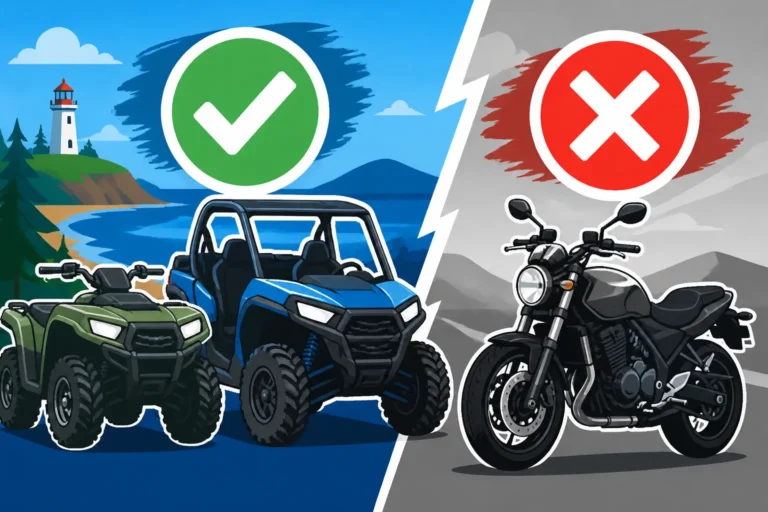
- Check the machine category. Make sure the route permits your type of vehicle. Rules for ATVs, side-by-sides, dirt bikes and snowmobiles are not necessarily the same.
- Separate trail riding from road riding. If you intend to use a road trail, read the road-trail rules and check the route separately. Do not assume that trail-permit recognition authorizes road use.
- Check conditions and closures. Review current trail information close to departure, then follow signs and barriers on site.
- Plan for documents on the ride. Keep required papers protected and accessible. Share copies of the itinerary and emergency contact information with someone not on the ride.
- Ask before crossing onto a new network. A permit accepted on one managed trail may not answer the requirements of a different corridor or event.
A good rule is to have three separate answers before riding: “Is the machine properly documented?”, “Am I allowed on this trail?”, and “Am I allowed to use this particular road or access route?” If any answer is uncertain, pause and confirm it.
Choosing the right Nova Scotia trail permit option
Ontario riders often ask whether they should buy a Nova Scotia trail permit anyway, even when their Ontario permit may be recognized. There is no one answer for every trip. It depends on where you plan to ride, how long you will stay, what your Ontario permit covers and what the local trail operator accepts.
If you plan to ride only in places that confirm Ontario permit recognition, another permit may not be necessary for that trail-access purpose. If you plan to join a local club, attend an event, or ride across networks with different arrangements, ask whether the club or event has additional requirements. A club membership may include benefits beyond access, while a standalone permit can be a more straightforward option for some visitors.
For the distinction between these options, read Nova Scotia’s Club Membership Trail Permit. If you are making a short visit and want to compare visitor-specific arrangements, check Nova Scotia’s Thirty-Day Visitor Permit. Do not purchase a permit simply because you assume every visitor needs one, but do not rely on assumed reciprocity without checking the route.
| Your situation | A practical next step |
|---|---|
| You have a current Ontario permit and will ride one confirmed trail network | Ask that network whether the permit is accepted for your machine and visit |
| Your route crosses several club-managed areas | Contact the clubs or association and confirm acceptance across the whole route |
| You are joining an organized ride | Ask the organizer whether it requires a particular permit, membership or proof of insurance |
| You are staying for an extended period or riding regularly | Compare the visitor option with a local permit or membership and check any residency or eligibility conditions |
| Your Ontario document is expired or does not clearly identify the machine | Resolve the issue with the issuing authority before travelling |
| You are bringing a borrowed machine | Confirm registration, owner permission and insurance, then ask the trail operator what documents it expects |
Do not buy a Nova Scotia permit to solve a registration or insurance problem. Likewise, do not rely on your Ontario permit to satisfy an event’s separate participation terms. Each document has a job; make sure you are using it for the right one.
Riding responsibly once you arrive
Paperwork can get you to the trail, but good local habits help keep access available. Nova Scotia routes can cross private land, working forests and multi-use corridors. A visitor who stays on the marked route and treats the community respectfully helps protect access for the next rider.
Before each ride, check the trail status, weather and any notices from the local club. Rain can make a corridor vulnerable to rutting, and a route that was open earlier in the week may be temporarily closed. If a trail is posted as closed, choose another route rather than trying to find a way around the sign.
On the trail:
- Follow posted speed limits and directional signs.
- Keep to the marked corridor; avoid widening the trail to bypass mud, water or obstacles.
- Close gates as you found them, unless a sign gives different instructions.
- Yield appropriately to other trail users and slow down near homes, trailheads and road crossings.
- Keep noise under control, particularly in communities and near properties.
- Pack out litter and secure anything carried on a rack or in a cargo bed.
- Stop safely if you encounter logging equipment, maintenance work or an emergency.
- Do not assume a visible track is an authorized trail.
If you are buying or replacing riding gear before the trip, a marketplace such as Amazon can be convenient for comparing helmets, gloves, rain layers and document pouches. Check the relevant safety standard and product details carefully rather than relying on a listing title or photo. A helmet that looks similar to an approved model may not meet the standard required for your ride.
The same caution applies to navigation. A downloaded map can help when cell service is weak, but a map is not permission to ride a route. Use current trail information and signs, and carry a backup plan for getting back to your vehicle if a segment is closed or blocked.
If you want to use your phone for documents or navigation, protect it from water and vibration and make sure it has power for the day. A paper copy of essential information is a useful backup. You can find simple waterproof pouches on Amazon, but test that your documents remain readable and that the pouch can be secured safely before relying on it outdoors.
Common mistakes Ontario visitors can avoid
Assuming every Ontario document is a trail pass
A registration document may be important, but it may not be the document a trail operator means when it asks about a permit. Check the exact document name and purpose. If the operator asks whether your Ontario permit is valid, be ready to say which permit you have and what machine it covers.
Assuming recognition means unrestricted access
Permit recognition does not create a right to ride every trail in the province. Trail status, land access, machine restrictions and local conditions still matter. Confirm each part of your route, especially where a planned ride crosses between club areas or uses a road trail.
Treating a previous trip as current guidance
A friend’s experience is useful, but permit arrangements and trail conditions can change. A permit accepted on one route last season may not answer the requirements for a different route today. Check with the trail operator shortly before travelling.
Forgetting insurance and machine papers
A trail permit is not proof of insurance or ownership. Keep the relevant documents together and confirm that the policy covers your trip. If the machine is financed, borrowed or registered to someone else, make sure you have the documents and permission needed to use it.
Buying a separate pass without checking
Some riders purchase another permit “just in case,” then discover it was unnecessary for their planned route. Others assume reciprocity covers everything and arrive without a document the trail operator requires. The sensible middle ground is to verify the route and permit before paying for anything. When comparing options, confirm the current terms directly with the provider; costs and availability can change.
Confusing a trail with a road trail
A connector that appears on a map may be a road trail with additional requirements, or it may not be open to off-highway vehicles at all. Check the route’s legal status rather than relying on the map line. The rules for an ATV trail do not automatically carry over to a public road.
If you are unsure which part of your paperwork is being requested, ask the trail operator a direct question: “Does this current Ontario permit cover trail access for this machine on this route, or do I need another trail permit?” Then ask separately about registration, insurance and road-trail use. Clear questions tend to get more useful answers than asking simply whether an Ontario permit is “good in Nova Scotia.”
A simple decision process before you leave
Use this sequence for a practical answer:
- Write down your planned trail network and route. Include any road-trail sections, trail crossings and organized events.
- Match the Ontario permit to the machine. Confirm it is current and identifies the vehicle you are taking.
- Ask the trail operator about reciprocity. Get confirmation for the planned corridor, not just a general answer about the province.
- Check the other legal requirements separately. Confirm registration, ownership documents, insurance and any road-trail qualifications or equipment.
- Review current closures and access notices. Check again close to departure and obey signs on the ground.
- Decide whether another permit is useful or required. If the route accepts your Ontario permit, you may not need a second pass for that purpose. If the route or event requires a different option, arrange it before riding.
- Carry the documents you may be asked to show. Keep them dry, legible and accessible without putting yourself at risk while riding.
The short version: Nova Scotia’s recognition of Ontario permits can make a visitor’s trail-access planning simpler, but it is not a blanket exemption from local requirements. Confirm the permit, the machine, the route and the separate rules for registration, insurance and road-trail use. That bit of checking is far easier than discovering at the trailhead that your paperwork answers a different question.
Disclaimer
This article is for general informational purposes only and does not constitute professional advice. Laws, prices and regulations vary by location and change over time. Consult a qualified professional for guidance on your specific situation.