A Certificate From 1991 Onward
An old ATV safety certificate can be hard to assess: the card may be faded, the course provider may have changed, or you may not know whether the date still matters. In Nova Scotia, a certificate issued from 1991 onward may be relevant proof of training, but the issuing organization and the separate ownership-based exemption matter too.
What a certificate from 1991 onward means
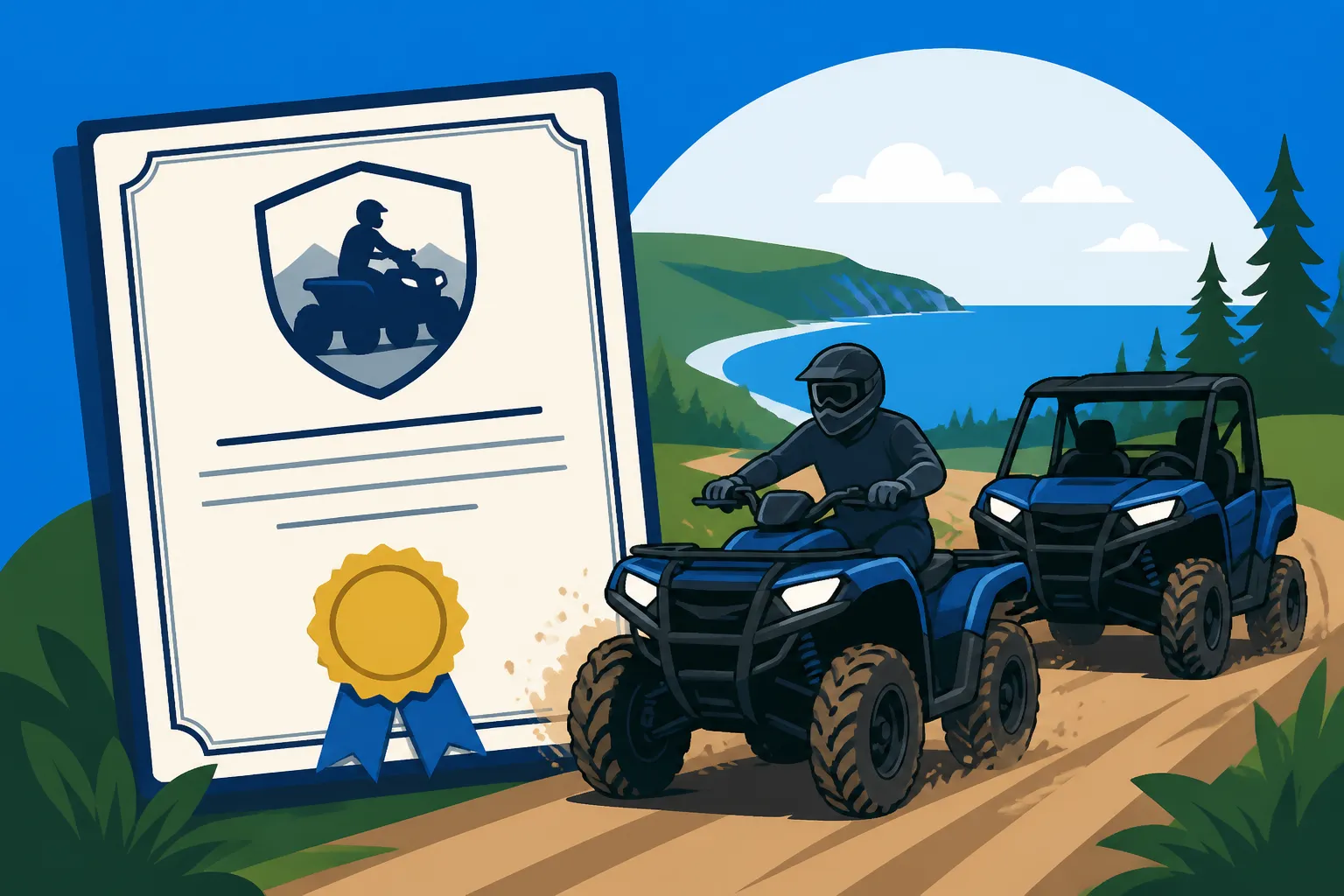
Nova Scotia has safety-training requirements for off-highway vehicle riders. A certificate issued in or after 1991 may meet the requirement if it is from an accepted course or issuing organization. The year is a useful starting point, not the only thing to check: a date on a card does not, by itself, prove that the course qualifies.
A certificate is evidence that a particular person completed training. It is not a permit for a machine, proof of registration, or permission to ride wherever an off-highway vehicle is restricted. Nor should you assume that an old certificate belongs to a machine rather than to the person who took the course.
The simplest way to think about it is:
| Question | What to check |
|---|---|
| Is the certificate old enough to be relevant? | Look for an issue date in or after 1991. |
| Was the course accepted? | Check the issuing organization and course details against current Nova Scotia requirements. |
| Can you prove who completed it? | Make sure the name and identifying details are readable and match the rider. |
| Does it settle every rule? | No. Training, ownership exemptions, registration, insurance and trail access are separate matters. |
If your certificate clearly shows your name, course, issuer and date, keep the original in a safe place and make a legible copy. If it is damaged or missing information, do not fill in gaps from memory and assume that will be enough. Ask the course provider, if it still maintains records, or contact the appropriate provincial office to find out what proof it will accept.
The key distinction is between a qualifying certificate and a separate grandfather exemption. Riders sometimes use “grandfathered” to mean anyone who has been riding for years or has an old card. Those are not necessarily the same thing. The training certificate is evidence of course completion; the ownership-based exemption depends on its own criteria. For the broader rules, see Nova Scotia Safety Certificates Are Mandatory and Nova Scotia’s Grandfather Exemption.
What information to check on an older certificate
Before relying on an old document, review it as if you were helping someone else verify it. A clear date and name are useful, but the issuer and the type of course are just as important. The rules may recognize certificates from specific providers or programs, and a document that looks like a safety card may not establish that the rider completed the required training.
Check the rider’s name and identity
The certificate should belong to the person who will ride. If the name has changed, keep supporting documentation that connects the certificate to the rider, such as a legal name-change document. If the name is misspelled or incomplete, ask the issuer or the relevant office whether it can confirm the record or what alternative evidence is acceptable.
Do not rely on another family member’s card, even if the rider learned on the same machine or attended the same session. Training proof is personal. A parent’s certificate does not automatically cover a teenager, and a certificate held by one machine owner does not automatically cover other people who use the machine.
Identify who issued it
Look for the name of the organization, course provider or instructor, as well as any course number or certificate number. If the card only shows a logo or abbreviation, search your own files for a course receipt, completion letter or email that gives the full name. Do not assume that every safety course—whether it was for a motorcycle, workplace equipment or another activity—counts as an ATV or off-highway vehicle course.
When the issuer is unclear, ask the provincial office responsible for off-highway vehicle requirements what it recognizes. Give the staff the exact details printed on the certificate rather than asking only whether “an old card” is valid. The more specific the information, the easier it is to get a useful answer. For a record that may no longer be in your possession, Nova Scotia Safety Certificate Lookup explains the issue of confirming an older certificate.
Confirm the course date and type
A certificate dated 1991 or later may be relevant, but the date does not tell you whether the course covered the required subject or met the accepted standard. Check that it is a completion certificate rather than an attendance slip, registration confirmation or course booking. If the document does not name the course, supporting records from the provider may help establish what was completed.
Keep the original document dry and protected from fading. Store a digital scan or clear photograph separately, and make sure all text is readable. A quick phone photo can be useful as a backup, but avoid glare, shadows and cropped edges. Retain any related correspondence, especially a written confirmation from a provider or government office.
How this differs from the pre-2006 ownership exemption
The most common mix-up is treating an older safety certificate and the pre-2006 ownership exemption as interchangeable. They are different routes that address different facts. A course certificate documents training. The exemption is associated with a qualifying history of owning a machine before the relevant cutoff and may also involve registration requirements. Having one does not automatically prove the other.
The pre-2006 exemption is not simply a reward for being an experienced rider. Being old enough to have ridden for decades, having bought an ATV long ago, or having a registration paper with an old date may not establish eligibility on its own. The exact conditions and the records needed to show them should be checked before relying on an exemption.
| Your situation | What it may show | What it does not automatically show |
|---|---|---|
| You hold a qualifying safety certificate from 1991 onward | You completed a course that may satisfy the training requirement | That you meet a separate ownership exemption |
| You owned a machine before the relevant cutoff | You may have a basis to ask about the ownership exemption | That your old certificate is accepted or that every current rule is met |
| You have ridden for many years | Relevant background, but not necessarily formal proof | Course completion or exemption eligibility |
| You have old registration paperwork | Evidence to discuss with the registry | That the document satisfies every exemption condition |
If you are relying on ownership history rather than a course certificate, gather documents that show the machine, owner and timing as clearly as possible. Old registration records, purchase documents or other official records may be useful, but the office reviewing the claim decides what evidence it will accept. See Nova Scotia’s Pre-2006 Grandfather Rule and Nova Scotia’s Exemption for Riders Who Owned Before 2006 for the separate ownership question.
A rider may have both kinds of evidence. For example, you might have completed an accepted course years ago and also have records showing that you owned an off-highway vehicle before the cutoff. Keep the documents separate and explain which one you are relying on. That avoids the common problem of presenting an old certificate as though it proves ownership, or presenting old ownership papers as though they prove course completion.
The related cutoff and registration history can also matter. If you believe an exemption applies, confirm the applicable conditions with the province rather than relying on a friend’s interpretation or on paperwork that was accepted for someone else. The answer may depend on what the records show and how the rule applies to your circumstances.
What to do if your certificate is accepted, missing or unclear
If you have a clear certificate, keep it available and confirm that the course and issuer meet the current requirement before you ride. If the document is uncertain, take a few practical steps before making plans around it.
- Photograph or scan the complete document. Include both sides if the card has information on the back. Keep the file in a place you can access if the original is lost.
- Write down the details. Note the rider’s name at the time, the date, the course title and the issuing organization. Avoid adding details you cannot verify.
- Contact the issuer if possible. Ask whether it can confirm completion or provide a replacement record. Older course providers may have changed names or no longer hold all records, so ask what other verification is available.
- Ask the provincial office a precise question. Provide the certificate date, issuer and course name. Ask whether that exact document satisfies the training requirement and what to do if part of the record is missing.
- Get the answer in writing where practical. Save an email or note the date, office and instructions from a phone call. Written confirmation is particularly useful when an old card is hard to read.
- Take an accepted course if the record cannot be verified. If you cannot establish that the old certificate qualifies, completing a currently accepted course may be the clearest solution. Confirm the approved options before registering.
Do not treat an unclear certificate as a reason to skip training requirements. Nor should you assume that a new training course fixes unrelated issues. A rider may still need to meet age and supervision rules, and the machine may still require registration, insurance or a trail permit depending on where and how it is used. These are separate obligations, covered in Nova Scotia’s Pre-2006 Grandfather Rule and Nova Scotia Safety Certificates Are Mandatory.
For youth riders, be especially careful not to use an adult’s old certificate as a substitute for the young rider’s own training or supervision requirements. Check the age-specific rules that apply to the rider and the type of riding planned. A certificate may address training, but it does not automatically authorize a child to ride alone or on a particular trail.
Before heading out, also check the rules for the route itself. Provincial safety training does not grant permission to use private land or open a closed trail, and it does not replace a trail permit where one is required. Confirm current access and permit requirements separately, especially if you are crossing club trails, private woodlots or roads.
If staff cannot confirm the old certificate and you choose to take a course, ask whether the certificate you receive will be recognized for the riding you plan to do. Keep the new record with your other machine documents. A simple file containing training proof, registration information, insurance details and any relevant exemption records makes later checks much easier.
Disclaimer
This article is for general informational purposes only and does not constitute professional advice. Laws, prices and regulations vary by location and change over time. Consult a qualified professional for guidance on your specific situation.