Is an Ontario Permit Honoured in Nova Scotia?
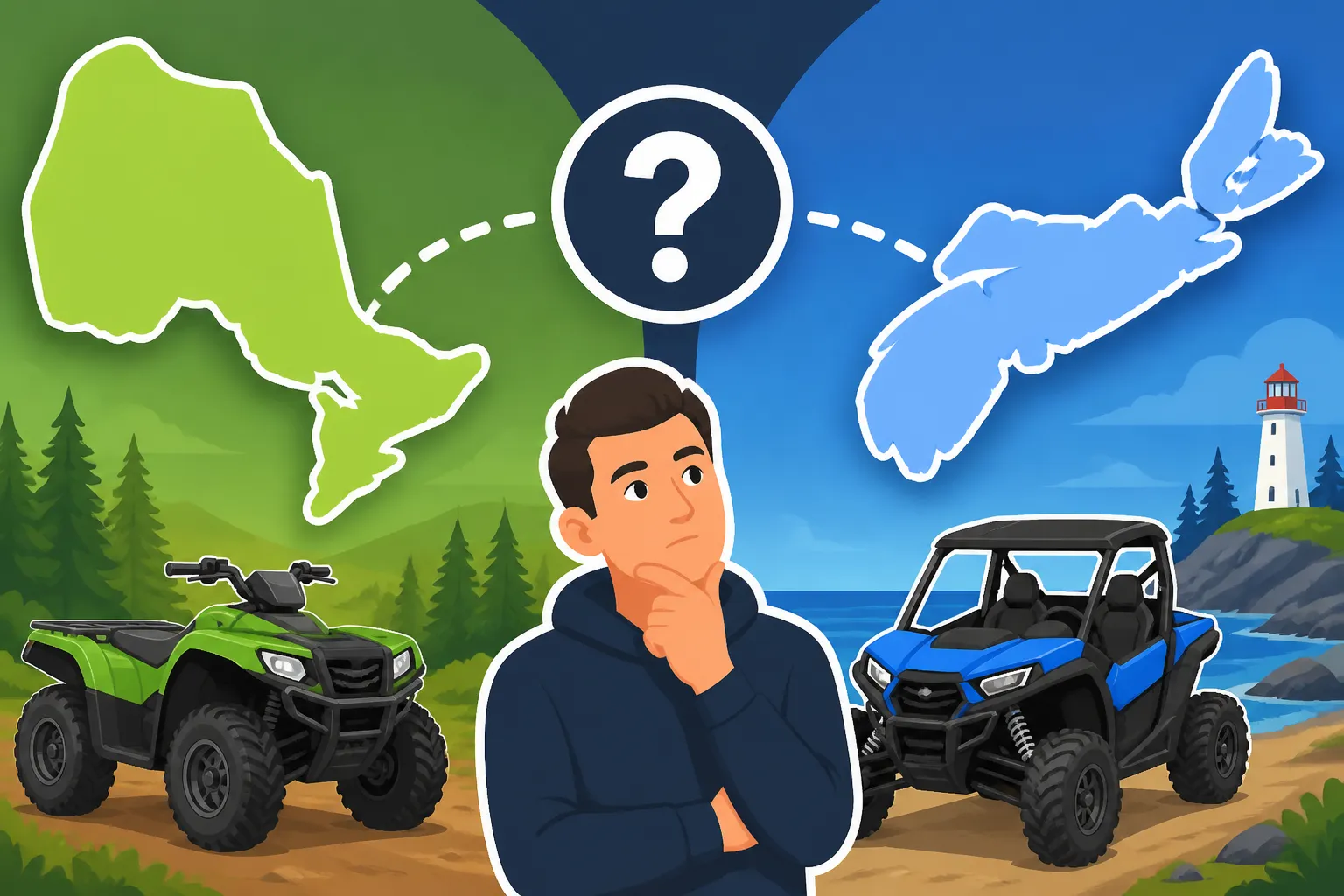
If you’re bringing an ATV or UTV from Ontario, you may be wondering whether you need to buy another trail permit before riding in Nova Scotia. In general, Nova Scotia honours eligible Ontario ATV trail permits through reciprocity. The important catch is that a trail permit is only one part of the picture: your machine, insurance and route must also meet Nova Scotia’s requirements.
The short answer: generally yes, for trail access
Nova Scotia honours eligible Ontario ATV trail permits, so a visiting rider may not need to buy a separate Nova Scotia trail permit for the same machine. Reciprocity is intended to let riders travel between participating jurisdictions without paying twice for trail access.
That does not mean every document called a “permit” in Ontario automatically works in Nova Scotia. Riders use the word to mean different things: a trail-access pass, vehicle registration, a permit issued by a club, or paperwork tied to a machine. The reciprocity question is about an ATV trail permit—not a blanket exchange of all vehicle documents.
Before you travel, check that your Ontario permit is the type accepted under Nova Scotia’s reciprocity arrangement and that it is valid for the machine you plan to ride. If you have a membership card but are unsure whether it includes trail access, confirm that detail with the issuer. A membership and a trail permit are related in some systems, but they are not necessarily the same thing.
The clearest practical answer is: an eligible, current Ontario ATV trail permit is generally honoured on participating Nova Scotia trails, but it does not give you unrestricted permission to ride anywhere in the province. It also does not replace registration, insurance, safety requirements, landowner permission or local trail rules.
Nova Scotia’s arrangement is covered in more detail in Nova Scotia Honours Ontario Permits. If you are planning a trip, use that as a starting point, then verify your particular permit and route before loading your machine.
What the Ontario permit covers—and what it doesn’t
A trail permit is about access to trails that require a permit. It is not the same as vehicle registration. Registration identifies the machine and establishes that it is authorized for use under applicable vehicle rules. A trail permit supports access to a trail system. A machine may need both, even when its rider has a permit recognized through reciprocity.
| What you have | What it generally relates to | Does an Ontario trail permit replace it? |
|---|---|---|
| Ontario ATV trail permit | Access to eligible trails under the permit system | It may satisfy Nova Scotia trail-permit requirements on participating trails |
| Vehicle registration or permit | The machine’s registration status | No |
| Insurance | Financial protection and required coverage | No |
| Club membership | Membership benefits and, sometimes, trail-permit eligibility | Not necessarily; check what the membership includes |
| Landowner permission | Permission to use private land or an access route | No |
| Local trail or road rules | Where and how you may ride | No |
Do not assume the reciprocal permit covers a machine that is not included in the Ontario permit, or that it transfers automatically if you switch machines during the trip. Read the permit terms and ask the issuing organization what is covered. Keep proof available while riding, and check whether the permit must be displayed on the machine or presented in another way.
Nova Scotia also has its own trail permit options, including Nova Scotia’s Club Membership Trail Permit and Nova Scotia’s Trail Permit Without a Club. Those can help explain how local permits work, but a visiting Ontario rider should first find out whether their existing permit qualifies. Buying another permit before checking could mean paying for access you already have.
Even when the Ontario permit is accepted, the trail itself must be open to ATV or UTV use. A permit does not turn a closed route into an open one, authorize riding on an unmarked corridor, or grant permission to cross private property outside an authorized trail. Trail access can vary by segment, landowner, club and current conditions. Check Nova Scotia Trail Conditions and Closures before heading out, especially after storms, during spring thaw, or when a route crosses working or privately managed land.
Other Nova Scotia requirements still apply
An Ontario trail permit does not make an Ontario machine automatically compliant with every Nova Scotia rule. Visitors need to consider registration, insurance, age and training requirements, equipment, and rules for the particular type of route they plan to use.
Registration and insurance
Trail access and vehicle registration are separate issues. An out-of-province visitor should check what registration documents they need to carry and whether their current registration is sufficient for the kind of riding planned. Start with Nova Scotia Registration for a Visiting Rider and Nova Scotia Requires Registration and Insurance.
Insurance is another separate requirement. Do not treat a trail permit, membership card or registration document as proof that your machine has the coverage required for riding in Nova Scotia. Ask your insurer whether your policy applies in the province and whether it covers your planned use. Carry proof of insurance in a form you can produce if asked.
Training and rider eligibility
Rider age, supervision and safety-certificate rules may also matter. An Ontario permit does not waive Nova Scotia’s rider requirements. This is particularly important when travelling with a young rider: check who may operate the machine, what supervision is required and whether the rider needs a safety certificate. See Nova Scotia Safety Certificates Are Mandatory for the local certificate rules.
Do not rely only on the rules you follow at home. Requirements can differ between provinces, and a rider who is allowed to operate a machine in one place may not meet the conditions for riding in another.
Road trails are a separate question
A trail permit does not, by itself, authorize riding on a public road or a designated road trail. Road-trail access has its own rules, including requirements for riders, machines and operation. If your route connects to roads, or you plan to ride on a road trail, review Nova Scotia Road Trail Rules Explained before setting out.
This distinction matters when mapping a trip. A route may include club trails, private access roads, municipal roads or designated road trails, each with different access conditions. Having an Ontario permit does not settle every part of that route.
How to check your permit before travelling
A little checking before departure can prevent a wasted permit purchase or an unexpected stop at a trail entrance. Use this process:
- Identify exactly what you have. Find the permit document, receipt or account record and confirm that it is an ATV trail permit, not only vehicle registration or a club membership card.
- Check that it is valid for your trip. Confirm the expiry date and whether the permit covers the specific machine you intend to bring.
- Ask whether that permit qualifies for Nova Scotia reciprocity. If the wording is unclear, contact the organization that issued it or ATVANS before you travel. Give them the permit’s name and type rather than asking only whether “an Ontario permit” is accepted.
- Confirm the route’s access rules. Check with the local trail organization or club about the segments you want to ride, closures, landowner restrictions and any local permit conditions.
- Pack separate vehicle documents. Bring registration and insurance proof, and make sure you can access your trail-permit confirmation while riding. Keep the documents together, but remember that each serves a different purpose.
- Check rules for every rider. Make sure each operator meets Nova Scotia’s age, supervision and training requirements. Review extra rules if children will ride or if the route includes road trails.
- Ask before buying an additional Nova Scotia permit. If your Ontario permit qualifies, another trail permit may not be needed for the same access. If it does not qualify, ask which Nova Scotia option applies. The Nova Scotia Trail Permit Cost page explains the local cost categories; check the provider for current figures.
If your Ontario document is lost, damaged or hard to verify, replace or confirm it with the issuing organization before travelling. A vague recollection that you paid for a permit is less useful at a trailhead than a clear record showing what was purchased and which machine it covers.
For visitors who are staying longer, planning repeated rides or bringing more than one machine, ask specifically whether the reciprocity applies to each machine and for the full period of the visit. Do not assume that a permit valid for one vehicle or one riding season covers a second vehicle, a replacement machine or a later trip.
The practical takeaway is straightforward: you can generally use an eligible Ontario ATV trail permit on participating Nova Scotia trails, but check the exact permit and route first. Keep registration and insurance separate, follow Nova Scotia’s rider and road-trail rules, and do not treat reciprocity as permission to ride on every trail or piece of land.
Disclaimer
This article is for general informational purposes only and does not constitute professional advice. Laws, prices and regulations vary by location and change over time. Consult a qualified professional for guidance on your specific situation.