Buying a Pass Before You Cross
Crossing into Nova Scotia with an ATV or UTV does not automatically give you permission to use its club trail network. A trail pass, vehicle registration, insurance and access permission are separate things. The easiest way to avoid a problem at the trailhead is to check which pass applies to your home province, buy it before you travel and confirm that your planned trails are open to your machine.
What to arrange before you cross
A trail pass is permission to use a participating trail network under its rules. It is not the same as registering your ATV or UTV, carrying insurance, or getting permission to ride on private land. Each requirement serves a different purpose, so having one does not replace the others.
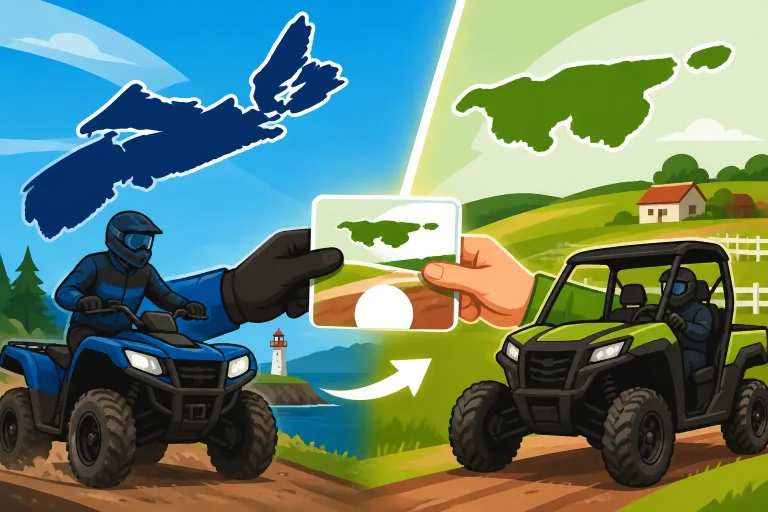
For many visitors, the first question is whether Nova Scotia recognizes the trail permit they already have. The answer depends on where the permit was issued and on the current reciprocal arrangements. Nova Scotia recognizes some out-of-province permits, but visitors should not assume that a permit from a neighbouring province automatically works here. The rules have changed, and arrangements can differ between provinces.
| What to check | What it allows or confirms | What it does not replace |
|---|---|---|
| Trail permit or pass | Access to eligible trails covered by that permit | Vehicle registration, insurance or permission to use every trail |
| Registration | Identifies the machine and its registered owner under applicable rules | A trail permit or proof of insurance |
| Insurance | Meets the applicable insurance requirements for riding | Trail access or registration |
| Trail status and access | Confirms that a particular trail is open and permits your machine | Any required pass, registration or insurance |
If you are coming from Ontario, start by checking the current terms for Nova Scotia Honours Ontario Permits. If you are travelling from New Brunswick, do not rely on an old reciprocity arrangement; read Nova Scotia Riders Visiting New Brunswick and confirm what applies to your trip. Visitors from Prince Edward Island should check Nova Scotia Riders Visiting PEI as well as Nova Scotia and PEI Reciprocity Ended in 2026. When an arrangement has ended or changed, carrying a valid pass from home may not be enough.
A local or provincial vehicle registration from your home jurisdiction may help establish that your machine is registered, but it is not automatically a trail pass. Likewise, an insurance card does not provide trail access. Before departure, check each item separately and make sure the name, machine and coverage details match the vehicle you plan to bring.
It is also worth checking your destination, not just your province of origin. A trail permit may cover access to a network while a particular segment is temporarily closed, restricted to another type of vehicle, or subject to landowner conditions. A road trail and a club trail are not necessarily the same corridor, either. Read Nova Scotia Trail Conditions and Closures and confirm that the route you want to ride is currently open to your machine.
Decide whether you need a Nova Scotia pass
If your home permit is not recognized for the trip, you may need a Nova Scotia trail permit. ATVANS offers a visitor option intended for short stays, but the permit type, eligibility, validity period and purchase method should be checked with the association before you travel. The reference title Nova Scotia’s Thirty-Day Visitor Permit points to the short-visit option; confirm its current conditions rather than assuming it suits every visiting rider or every itinerary.
A visitor pass can be a practical fit if you are coming for a brief trip and do not need the benefits of joining a local club. If you plan to ride regularly, are staying longer, or want access associated with a local club, compare the visitor option with Nova Scotia Club Permit vs Standalone Permit. Club membership and a permit-only purchase are not identical arrangements, and the choice can affect more than the length of your visit.
The permit calendar can also matter. Some Nova Scotia trail permits run for a calendar year, rather than for a full year from the date you buy them. If your trip falls late in the year, check the permit’s actual expiry date before paying. The details in Nova Scotia Permit Expiry Date and Why a Trail Permit Runs January to December can help explain why a pass bought near the end of the season may not cover the next riding season.
Before buying, compare the permit’s terms with your actual plans:
- How long will you ride in Nova Scotia? A short visit may suit a visitor pass, while repeated trips may make another permit option more appropriate.
- Where do you plan to ride? Confirm that the trails you want are within the network covered by the permit and open to your machine.
- How many machines will you bring? Do not assume one pass covers several ATVs or UTVs. Check whether each machine needs its own permit.
- Are you travelling with children or other riders? Confirm what each rider needs, including any age-related safety requirements.
- Will you use road trails as well as club trails? A trail pass does not grant permission to ride on every public road. Check the separate requirements in Nova Scotia Road Trail Rules Explained.
If you are unsure which pass applies, ask before crossing. ATVANS or a member club may be able to clarify what is required for the trail network you intend to use. For questions about a visitor permit, Nova Scotia Permit Questions Clubs Hear is a useful related topic. Keep a record of the answer and the permit purchase details, especially if you are travelling with a group.
Buy the right pass, then check the conditions
Buying before you travel is sensible because it gives you time to resolve an eligibility or payment issue before you arrive at a trailhead. It also lets you confirm how the permit is delivered. A pass may be provided as a letter or other proof rather than as a conventional sticker, so do not assume that a missing decal means a purchase did not go through. Check Why Your Permit Arrives as a Letter, Not a Sticker for the format, and follow the current instructions on what proof to carry.
Use this process before departure:
- Confirm your home province’s status. Check whether Nova Scotia recognizes the permit you already hold. If the answer is unclear, ask the relevant association or permit provider directly.
- Choose the permit that matches the visit. If your existing permit is not valid for Nova Scotia, compare the visitor, standalone and club-related options.
- Check the terms for each machine. Verify whether a separate permit is needed for every ATV or UTV in your group and whether there are different requirements for passengers or youth riders.
- Complete the purchase through the current provider. Use the association’s official purchase information rather than relying on an old social post, saved screenshot or third-party listing.
- Save the proof. Keep the confirmation or permit document somewhere you can access without a mobile connection. Bring any required original or printed proof if the provider’s instructions call for it.
- Check the route shortly before riding. Look for closures, washouts, detours, landowner restrictions and machine-specific limits. A valid pass cannot make a closed trail open.
- Carry the other required documents. Have registration and insurance proof available as required for your machine and route.
Pay close attention to what the pass does not cover. A visitor permit is not a general licence to ride wherever you can see a track. Some corridors cross private woodlots, and access depends on the landowner’s permission and the conditions of the trail. Staying on the marked route and respecting gates and closure signs helps keep access available. See Nova Scotia Trails That Cross Private Woodlots for more on shared access.
The same caution applies to insurance. A trail permit does not insure your machine or pay for damage if you crash. Confirm that your policy is valid for riding in Nova Scotia and that you have the required proof with you. If you are unsure what protection your policy provides away from home, ask your insurer before setting out. The related topic Nova Scotia Association Insurance Explained can help distinguish association-related coverage from the insurance you need for your machine.
A practical pre-trip checklist
A few minutes of checking can prevent a wasted trip. Before you load the machine, make sure the pass, paperwork and route line up.
Permit and reciprocity
- Confirm whether Nova Scotia recognizes the permit from your home province.
- If not, check whether a Nova Scotia visitor permit is available and suitable for your trip.
- Verify the permit’s validity dates, machine coverage and proof-of-purchase requirements.
- Do not assume a permit for one machine covers every machine in your trailer.
- Save the permit confirmation and the current provider’s contact information.
Machine and rider paperwork
- Confirm the machine’s registration is valid and that its details match the vehicle.
- Check that your insurance applies to the planned riding and that you can show proof.
- Review the rules that apply to everyone in your group, including age, supervision and equipment requirements.
- Keep documents accessible during the ride, not packed where they cannot be reached.
Route and trail access
- Check that each planned segment is open and permits your type of machine.
- Confirm where the route crosses private land and follow posted access conditions.
- Plan for fuel, weather, limited cell coverage and possible detours.
- Carry a current map or offline route information instead of relying only on a phone signal.
If you are planning several days of riding, build a backup route into the trip. A storm, a damaged bridge or a landowner closure can change which segments are available. A permit gives you no guarantee that every trail will be passable on the day you arrive. Check local club updates and be prepared to turn around rather than detour around a closure.
The most reliable approach is to treat the pass as one item in a larger checklist: verify reciprocity, buy the right permit if needed, keep registration and insurance current, and check trail access close to the ride. That way, you can cross the border knowing what your permit covers—and what it does not.
Disclaimer
This article is for general informational purposes only and does not constitute professional advice. Laws, prices and regulations vary by location and change over time. Consult a qualified professional for guidance on your specific situation.