Nova Scotia Night Riding Equipment Rules
Ah, there's nothing quite like extending a beautiful Nova Scotian riding day into the evening, watching the stars pop out over the trees, or seeing the faint glow of a coastal village in the distance. But as much as we love those peaceful night rides, the thought of being out there in the dark without the right gear, or worse, getting stopped for not meeting legal requirements, can put a real damper on the adventure. This guide is all about cutting through that confusion and helping you understand exactly what equipment you need to ride safely and legally after dark on your ATV or UTV here in Nova Scotia.
The Unique Challenges of Night Riding in Nova Scotia
Riding after sunset isn't just a matter of flipping on your headlights; it introduces a whole new set of considerations that can drastically change your experience and your safety. Nova Scotia's varied terrain, from dense forests to rocky coastal trails, combined with our often unpredictable weather, makes night riding a unique beast.
Reduced Visibility and Increased Hazards
When the sun dips below the horizon, the world transforms, and not always for the better when you're on an off-highway vehicle. Shadows become deeper, obscuring terrain features that are obvious in daylight. A seemingly innocent puddle can hide a deep rut, and that small rock you'd easily navigate around can become a tire-shredding obstacle. Nova Scotia’s trails are known for their natural beauty, but also for their raw, untamed nature. Imagine cruising along a familiar path, only to have a fallen tree branch, previously invisible in the deep shadows, suddenly loom into your limited headlight beam. It’s a jarring moment that could easily lead to a spill if you’re not prepared.
Then there's the wildlife. Our forests are teeming with deer, moose, coyotes, and smaller critters that are far more active at dusk and after dark. A deer darting across your path in broad daylight gives you time to react, but at night, with reduced peripheral vision, it’s a much more dangerous encounter. Coastal fogs can roll in quickly, especially in the evening, further reducing visibility to mere feet. The very air can feel heavier, dampening sounds and making it harder to anticipate what's around the next bend. It's not just about seeing; it's about being able to react quickly and safely to an environment that has suddenly become far less forgiving.
Legal Obligations and Why They Matter
It's easy to dismiss equipment regulations as just another set of rules, but when it comes to night riding, these laws are truly the backbone of your safety and the safety of everyone else on the trails. In Nova Scotia, the rules for off-highway vehicles, including what's required for night operation, are in place for very good reasons. They're designed to ensure that you can see where you're going and, just as importantly, that others can see you. An officer isn't pulling you over for an out-of-spec headlight just to be difficult; they're doing it because an inadequate light system dramatically increases the risk of an accident, not only for you but for other riders, hikers, or even local traffic if you're near a road trail.
Many riders might feel like their stock lights are "good enough" for short forays into the dark, but there's a significant difference between "getting by" and "being genuinely safe and legal." The legal minimums are exactly that: minimums. They might prevent a fine, but they might not prevent you from hitting that hidden rock or being unseen by a fellow rider. Understanding and adhering to these legal obligations means more than just avoiding a ticket; it means taking responsibility for your safety and the safety of the riding community. It's about ensuring your machine is a beacon of safety, not a potential hazard, when the sun goes down.
Understanding Nova Scotia's Core Lighting Requirements
When it comes to riding your ATV or UTV in Nova Scotia after sunset, proper lighting isn't just a recommendation; it's a legal necessity. The provincial regulations are clear about what your machine needs to be equipped with to ensure visibility and safety in low-light conditions.
Headlights: Illuminating Your Path Forward
Your headlight is, quite literally, your guide in the dark. Nova Scotia regulations stipulate that your off-highway vehicle must be equipped with at least one headlight that emits a white or amber light, visible from a distance of at least 300 feet (approximately 90 meters) in front of the machine. This isn't just about illuminating the trail directly in front of you; it's also about signaling your presence to anyone else who might be on or near the trail. However, many riders quickly discover that the stock headlights on their ATVs or UTVs, while meeting these minimum legal requirements, often feel incredibly inadequate for actual trail riding after dark.
You're trying to navigate a challenging, rocky incline, perhaps along the Cape Breton coastline, with only dim, yellow-ish light barely reaching twenty feet ahead. Every shadow looks like a monster, and your eyes are constantly straining. This is a common frustration, and it's why many experienced riders choose to upgrade. Moving to brighter LED bulbs or installing auxiliary light bars can dramatically improve your visibility. Options from reputable brands, like SuperATV, can provide a much wider and brighter beam, turning those terrifying shadows into navigable terrain. When you can clearly see the trail ahead, spot hazards much earlier, and confidently assess the terrain, your night riding experience becomes far safer and more enjoyable. Remember, the clearer your path, the quicker your reaction time. [Nova Scotia Headlight and Tail Light Rules] detail these requirements specifically.
Tail Lights: Ensuring You're Seen From Behind
While seeing where you're going is paramount, it's equally important that others can see you, especially when riding in a group or on shared trails. Nova Scotia law requires your ATV or UTV to have at least one tail light that emits a red light, visible from a distance of at least 200 feet (approximately 60 meters) to the rear of the machine. If your machine is equipped with brake lights, they must also be functional and clearly visible when activated. This is particularly crucial for UTVs, which often feature more car-like controls.
Imagine you're part of a group ride, traversing a dusty trail in the Annapolis Valley after dark. The rider behind you is relying almost entirely on the red glow of your tail light to maintain a safe following distance and anticipate your movements. If your tail light is dim, flickering, or simply out, you become a phantom, a serious hazard to those following. This risk is amplified if you suddenly slow down or stop and your brake lights aren't working. Regularly checking your tail light and brake light functionality, ensuring lenses are clean and bulbs are bright, is a simple but vital part of your pre-ride routine. It ensures that everyone in your riding party can confidently share the trail, and that you're in compliance with [Nova Scotia Lighting Requirements].
Beyond Basic Lights: Enhancing Night Riding Safety
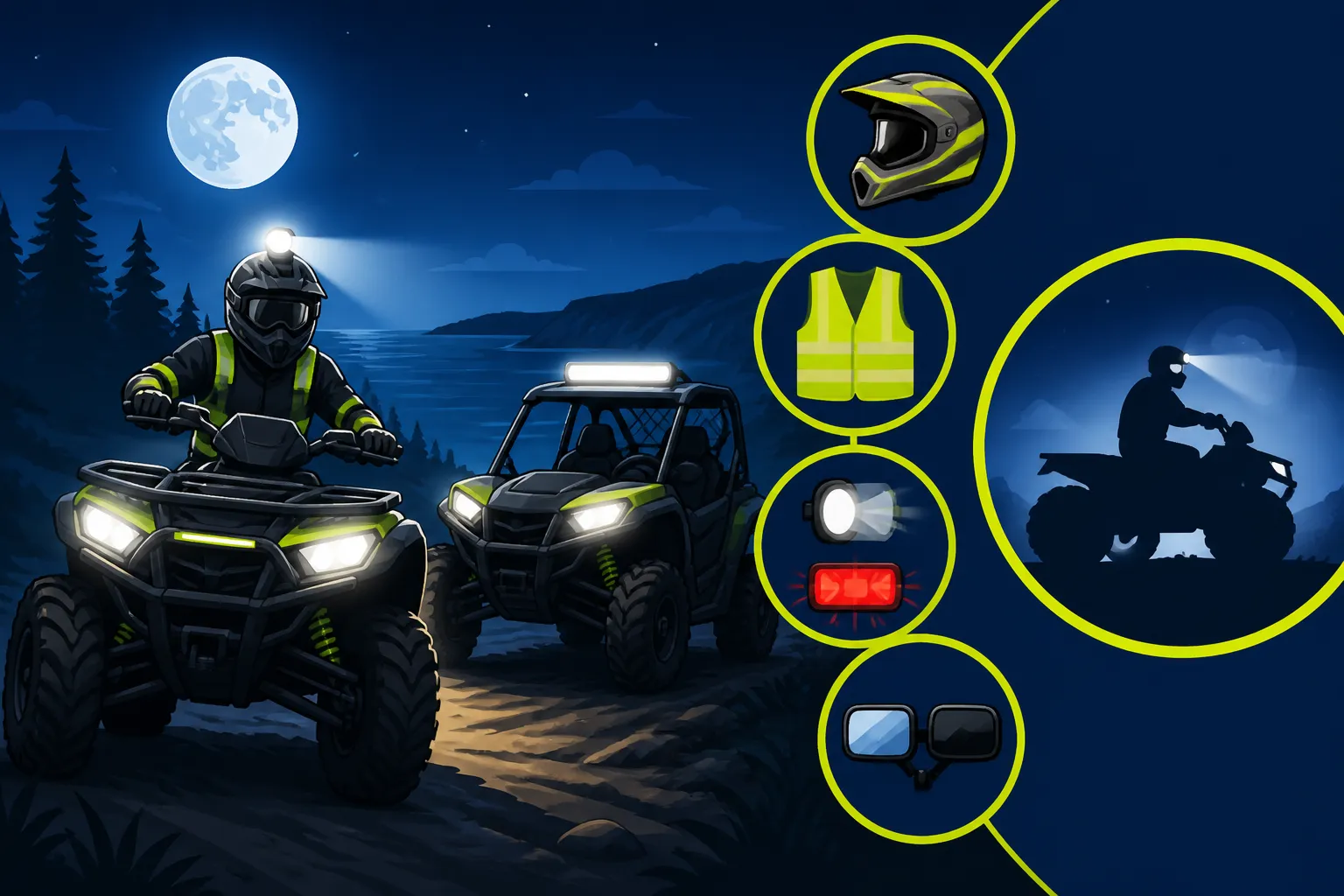
Meeting the minimum legal requirements for headlights and tail lights is a good start, but for true peace of mind and enhanced safety when riding at night in Nova Scotia, you'll want to think beyond the basics. The dark can play tricks on your eyes, and adding extra layers of visibility can make all the difference.
Reflective Gear for Rider and Machine
Even with the brightest headlights and tail lights, there's always the chance of an electrical issue, a bulb burning out, or simply being caught at an awkward angle where your primary lights aren't fully visible. This is where reflective gear becomes an absolute lifesaver. Think of reflective materials as a passive safety system, always working to catch any ambient light and bounce it back, making you visible even if your machine's lights aren't active.
Applying reflective tape to strategic points on your helmet, the sides and rear of your machine, and even on your riding gear can dramatically increase your profile. A bright, reflective vest, especially if you're the type to dismount often to check trails or help a buddy, makes you stand out immediately. Imagine you're on a remote trail near Guysborough, and your machine breaks down after dark. Without power, your lights are out. If another rider comes along, or even a search and rescue team, that reflective tape on your helmet and jacket, or a vest, could be the first thing they see, allowing them to spot you from a much greater distance. It's a small investment that provides a huge boost to your overall safety. Also, remember to always wear an approved helmet, as detailed in [Nova Scotia Helmet Law for Riders].
Auxiliary Lighting: When More is Better
For many serious night riders, the stock lighting system simply doesn't cut it. This is where auxiliary lighting steps in, transforming your machine from merely "visible" to "illuminated." Light bars, ditch lights, and even dedicated reverse lights can dramatically improve your field of vision, helping you see things the stock headlight might miss.
Imagine you're navigating a winding, tight section of trail deep in the woods near Kejimkujik. Your main headlight casts a beam forward, but the immediate sides of the trail are shrouded in darkness, making it hard to judge obstacles or the sharpness of a turn. Ditch lights, mounted to illuminate the areas directly to your left and right, can fill in those crucial blind spots, giving you a complete picture of the trail ahead. A robust LED light bar mounted on your roof or front bumper can turn night into a semblance of day, projecting a far wider and longer beam than any stock headlight. Many riders also add dedicated reverse lights, which are incredibly useful for backing up in tight spots, especially with a UTV, ensuring you don't inadvertently back into a ditch or obstacle.
When considering auxiliary lighting, it's wise to invest in quality. You want durable, weather-resistant options that can withstand Nova Scotia's rugged conditions, from coastal salt spray to muddy inland trails. Brands like SuperATV offer a range of robust LED light bars and pods that are designed to take a beating and keep shining, ensuring your investment enhances your safety for many seasons to come. Just be mindful of how you use these powerful lights; dim them or turn them off when approaching other riders or residential areas to avoid blinding them, as courtesy and safety go hand in hand on the trail.
Pre-Ride Checks and Maintenance for Night Operations
Riding at night places extra demands on your machine and its electrical system. A light that's barely functional in daylight might completely fail in the dark, leaving you in a very vulnerable position. That's why a meticulous pre-ride inspection, with a special focus on your lighting and power, is absolutely non-negotiable before heading out after sunset.
A Thorough Pre-Ride Inspection Checklist
Before every night ride, even a short one, you need to go beyond the usual once-over. Start by physically inspecting all your lights: headlights, tail lights, brake lights, and any auxiliary lights you have installed. Are the lenses clean and free of mud, dust, or condensation? A dirty lens can drastically reduce light output. Then, test each light individually. Turn your machine on and systematically check every bulb. Have someone stand behind your machine to confirm the tail light and brake lights are working. Wiggle the wiring harnesses gently to check for intermittent connections.
Don't forget the electrical basics. Check your fuses – are there any signs of corrosion or looseness? Carry a spare set of common fuses for your machine; they're small, cheap, and can save you a long, dark walk. Also, consider the battery. Is it securely mounted? Are the terminals clean and tight? A loose connection or corroded terminal can cause power drops, leading to dimming or flickering lights. Imagine you’re deep in the woods, far from any cell service, and suddenly your headlight dies because of a loose fuse. Having a spare on hand, or having checked it beforehand, changes a potential crisis into a minor inconvenience. This detailed inspection is more than just maintenance; it’s a crucial safety ritual for any night rider.
Battery Health and Charging Systems
All those extra lights and accessories—your GPS, winch, heated grips, and especially those bright auxiliary lights—draw significant power from your machine's electrical system. This means your battery and charging system are going to be working overtime. A battery that's perfectly adequate for daytime riding might quickly be drained when tasked with powering a full complement of night lighting.
Before a night ride, it's a good idea to check your battery's charge level. If it's not a maintenance-free battery, check the fluid levels. Ensure your battery terminals are clean and tight; corrosion or a loose connection can lead to voltage drops that cause your lights to dim or fail. More importantly, verify that your machine's charging system (alternator or stator) is functioning correctly. This system is responsible for recharging your battery as you ride. If it's not putting out enough power, your battery will slowly drain, eventually leaving you stranded with no lights and a dead engine. Test the output with a multimeter if you're able, or have your dealer do a check if you suspect issues. The last thing you want is to be miles down a dark trail, trying to make your way back to your trailer because your battery gave up the ghost. Investing a little time in battery and charging system health before you head out can prevent a truly miserable and potentially dangerous night.
Night Riding on Nova Scotia's Road Trails
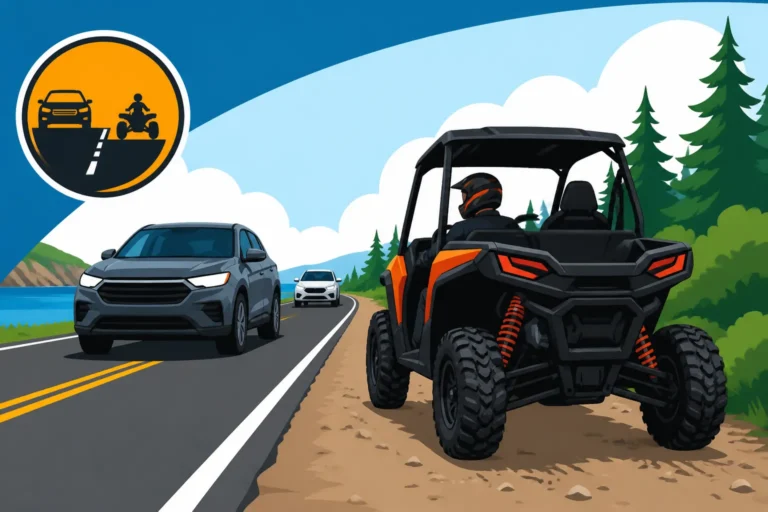
Nova Scotia has been making great strides in opening up more [Nova Scotia Road Trails: Where You Can Ride], offering exciting new routes for OHV enthusiasts. However, riding on these designated road trails, especially at night, comes with an even stricter set of rules and considerations than purely off-road trails. You're sharing the space, even if only partially, with traditional road traffic, and that demands heightened awareness and compliance.
Specific Rules for Mixed-Use Roads
The fundamental difference when riding on a Nova Scotia road trail at night is that you're no longer in the exclusive domain of off-roaders. You are in a mixed-use environment, and that carries greater responsibility. The Nova Scotia Off-highway Vehicles Act and associated regulations, particularly those governing road trails, often specify particular operating hours. Generally, off-highway vehicles are restricted to operating on road trails during daylight hours, specifically from half an hour before sunrise to half an hour after sunset. This restriction is primarily due to safety concerns given the reduced visibility at night and the presence of other road users.
If, for any reason, you find yourself on a road trail during those darker hours (perhaps returning from an earlier permitted ride), the onus is heavily on you to be as visible as possible and to adhere strictly to all road trail rules. This includes lower speed limits, often [Nova Scotia's 25 km/h Road Trail Limit], and diligently yielding to all other traffic. A vehicle approaching quickly on a dimly lit rural road near Chester or Annapolis Royal presents a far greater hazard than on a remote dirt path. Your machine needs to be clearly visible, and your riding actions predictable. Understanding and respecting these specific regulations is paramount to a safe experience and to ensure the continued access to these valuable riding corridors. [Nova Scotia Road Trails Act Explained] provides extensive detail on these specific conditions.
Headlights, Tail Lights, and Turn Signals (If Applicable)
When riding on a road trail, your machine's lighting must not only meet the basic OHV requirements but also effectively function within a road-traffic context. This means your headlights must be robust enough to project clearly and consistently, illuminating your path while also making your presence known to oncoming vehicles. Your tail lights must be bright and unmistakable, especially when dust is stirred up or in foggy conditions. Any integrated brake lights become absolutely critical here, as they are a primary signal of your intentions to vehicles behind you.
Furthermore, if your ATV or UTV is equipped with turn signals, or if the type of off-highway vehicle requires them for road-trail use (which is often the case for UTVs that are closer to side-by-sides), they must be in perfect working order. Imagine attempting to make a left turn across a rural road in Pictou County after dark without functional turn signals—it's an invitation for a collision. Riders must be extra cautious and assume that other road users may not immediately register your presence. It's about signalling your every move with maximum clarity. Ensuring your machine is in top shape regarding all its lighting components is an absolute must. Whether you are riding on a designated road shoulder or briefly crossing a highway, as per [Nova Scotia Rules for Crossing a Highway], your visibility is your first line of defense.
Compliance, Enforcement, and Avoiding Penalties
Nobody wants their riding adventure to end with a ticket, but when it comes to night riding and equipment, non-compliance can have far more serious consequences than just a fine. Nova Scotia enforcement officers are keen observers of off-highway vehicle safety, and inadequate lighting is a common reason for them to intervene.
What Nova Scotia Officers Look For
When an enforcement officer, be it RCMP or a provincial conservation officer, encounters an off-highway vehicle after dark, one of their primary concerns is immediate visibility. They're looking for working headlights and tail lights that meet the minimum intensity and visibility distances. They'll check for the correct colour of lights—white or amber for front, red for rear. Any burnt-out bulbs, flickering lights, or obscured lenses (from mud, snow, or even poorly placed accessories) will immediately raise a red flag.
Beyond the basics, they're also aware of aftermarket lighting that might be too bright or improperly aimed, potentially blinding other trail users or road traffic. While bright lights are good for you, dazzling another rider coming around a bend creates a dangerous situation. Officers are also trained to spot deficiencies in reflective materials or the lack thereof, especially if a machine’s primary lights seem weak. Imagine you’re out on a trail in Cumberland County, and an officer flags you down. They aren’t just looking at your registration; they're doing an [Nova Scotia Equipment Checks by Officers]. If your tail light is out, or your headlight barely illuminates the trail, you're not only facing a potential fine, which can start at [Nova Scotia Minimum Fine of $250], but you're also putting yourself at risk. It’s a simple check that can uncover a major safety hazard.
The Cost of Non-Compliance and Prioritizing Safety
While a fine for an equipment violation can be an unwelcome expense, the monetary penalty pales in comparison to the potential financial and personal costs of an accident caused by poor visibility. A collision in the dark, whether with another machine, a pedestrian, or even a hidden obstacle, can lead to serious injuries, extensive damage to your expensive machine, and significant legal liabilities. The time lost from work, the medical bills, and the sheer emotional toll of an accident far outweigh the cost of ensuring your machine is properly equipped for night riding.
Think about it: spending a bit extra on high-quality LED upgrades or durable reflective tape from a brand like SuperATV, or simply taking the time to perform thorough pre-ride checks, is an investment in your safety. It's about preventing an incident rather than dealing with its aftermath. An officer’s intervention might feel inconvenient in the moment, but their enforcement of equipment rules is ultimately about protecting you and others. Prioritizing proper lighting and visibility isn't just about adhering to the letter of the law; it's about embracing a proactive safety mindset that allows you to truly enjoy Nova Scotia's beautiful trails, day or night, with confidence. This focus on safety can also impact other regulations, as highlighted in [Nova Scotia Penalties for Riding Unregistered] if your machine is not legal in other ways.
General Night Riding Etiquette and Best Practices
Night riding offers a unique sense of solitude and adventure, but it also requires a heightened sense of responsibility and trail etiquette. Since visibility is naturally limited for everyone, considerate riding practices become even more critical to ensure a safe and enjoyable experience for all.
Group Riding and Communication at Night
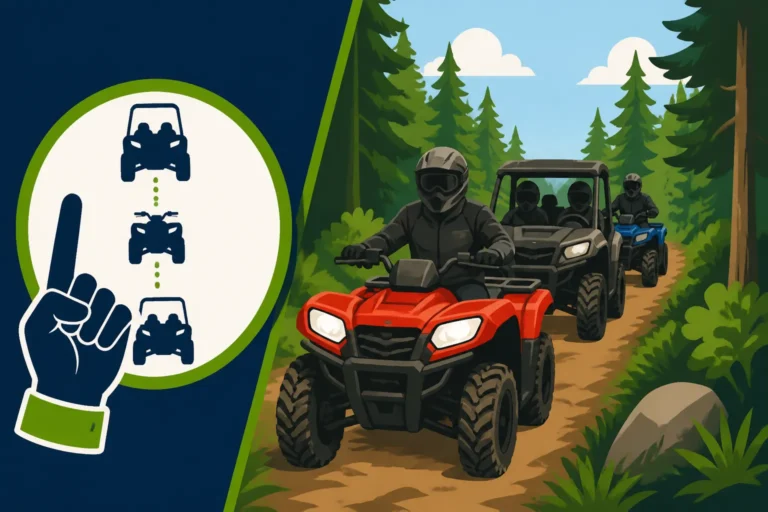
When you're out with a group after dark, the stakes for clear communication and predictable riding increase significantly. Staggered riding formations are always a good idea, as they allow each rider to have a clear view ahead without being obscured by the machine directly in front. Maintaining a slightly increased safe distance between machines is also crucial, giving everyone more reaction time in case of a sudden stop or hazard that might appear out of the darkness. You certainly don't want to be "outrunning your headlights"—that is, traveling so fast that by the time your lights illuminate an obstacle, it's too late to react.
Hand signals, which are standard for daytime group rides, become much harder to see at night. This is where modern communication tools, like helmet-mounted intercoms or two-way radios, truly shine. They allow for instant, clear communication about upcoming hazards, turns, or stops. Imagine a large group riding through a winding trail in Victoria County at night; without good communication and everyone's lights functioning, a simple stop by the lead rider could quickly cascade into a dangerous pile-up. Everyone in the group relying on the lighting of others underscores the importance of everyone's machine being properly equipped. Always ensure you ride with reliable lighting and communicate proactively to maintain group cohesion and safety.
Respecting Others and the Environment
Night riding offers a peaceful escape, but it's important to remember that not everyone on or near the trail shares your passion, especially after dark. One of the most important aspects of night riding etiquette is being considerate with your lighting. If you have powerful auxiliary lights or a high-beam setting, remember to dim them when approaching other riders, walkers, or any residential areas. Blinding someone, even for a moment, can be disorienting and dangerous. This courtesy extends to campers or cabins along the trail; blast-furnace lights shining into their windows won't make you any friends.
Noise is another key consideration. While your machine might have a perfectly legal exhaust system, sound travels further and can be more disruptive at night. Try to ride quietly, especially through or near populated areas. This demonstrates respect for the local communities and helps maintain a positive image for the OHV community. Finally, always be mindful of private property boundaries, which are much harder to discern in the dark. Straying off marked trails can lead to trespass issues, which are exacerbated when done at night. By being a considerate and responsible rider, you ensure that the trails remain open and enjoyable for everyone, respecting both fellow humans and the environment. [Nova Scotia Trail Etiquette Locals Expect] is a great resource to review.
| Equipment Type | Minimum Legal Requirement (Nova Scotia) | Recommended for Optimal Safety (Night Riding) | Notes |
|---|---|---|---|
| Headlight | White/amber, visible from 300 feet (90m) | Bright LED/HID, multiple beams, auxiliary light bar | Aimed to illuminate path without blinding oncoming |
| Tail Light | Red, visible from 200 feet (60m) | Bright LED, integrated brake light (if not separate) | Essential for group riding, visibility in dust/fog |
| Reflectors | Rear red reflector (if tail light not visible from certain angles) | Ample reflective tape (machine & helmet), reflective vest | Enhances visibility if lights fail or machine is stopped |
| Brake Light | Red, activates upon braking (UTVs, some ATVs) | Bright LED, clearly visible from rear | Critical for signaling intentions, especially on road trails |
| Turn Signals | Not always mandatory for all OHVs, but if equipped, must be working (mandatory on road trails if applicable to vehicle type) | Working, bright LEDs, front (amber) & rear (red) | Crucial for road trails, turning movements, especially if riding in traffic |
Disclaimer
This article is for general informational purposes only and does not constitute professional advice. Laws, prices and regulations vary by location and change over time. Consult a qualified professional for guidance on your specific situation.