Nova Scotia Controlled Access Highway Rules
It's incredibly frustrating when you just want to get out and enjoy the trails, but the rules about where you can and can't ride your ATV or UTV feel like a confusing maze, especially when it comes to major roadways. Many riders assume that because their machine is registered and insured, they have more freedom, but controlled access highways in Nova Scotia have very specific, strict regulations. This guide is here to untangle those rules, explaining exactly what a controlled access highway is, why OHVs are generally prohibited, and how you can ride safely and legally without risking hefty fines or, more importantly, your safety.
Understanding Controlled Access Highways in Nova Scotia
Let's start by clarifying what we're even talking about. In Nova Scotia, not all roads are created equal, and where you can legally operate your off-highway vehicle (OHV) changes dramatically depending on the type of road. Controlled access highways are at the top of the "no-go" list for most ATVs and UTVs, and understanding why is key to staying safe and compliant.
What Defines a Controlled Access Highway?
Imagine the busiest, fastest roads you drive on – the major provincial highways, often part of the 100-series (like Highway 102 heading to the airport or Highway 104 across the province). These are precisely what "controlled access highways" refer to. They are designed for high-speed, uninterrupted travel between specific points, meaning vehicles enter and exit only at designated interchanges. You won't find driveways, stop signs, or crosswalks popping up unexpectedly. Their main purpose is to move a large volume of traffic quickly and efficiently, often connecting major towns and cities. Because of this design, they typically have multiple lanes, higher speed limits, and are built to withstand the demands of heavier, faster vehicles like cars, trucks, and transport trailers.
The Legal Framework for OHVs on Public Roads
The Off-highway Vehicles Act in Nova Scotia is the primary piece of legislation that dictates where you can and cannot ride your ATV or UTV. While this Act has provisions for things like [Nova Scotia Registration and Insurance] and even specific [Nova Scotia Road Trails Act Explained] that allow OHVs on certain municipal roads under strict conditions, it draws a very clear line when it comes to controlled access highways. These major arteries are generally deemed off-limits for most OHV traffic. The law is designed to ensure public safety, and the characteristics of OHVs – their speed limitations, size, and protection levels – simply aren't compatible with the environment of a controlled access highway. Trying to operate an OHV on such a road would not only put you at extreme risk but also endanger other motorists, leading to severe penalties.
Why the Restrictions Exist: Safety First
It's easy to feel a pang of frustration when you see a direct route on a map that happens to be a controlled access highway, but you know you can't take your quad there. I get it! We all want convenience. However, these restrictions aren't arbitrary; they are rooted deeply in safety. Think about the massive difference in speed: an ATV or UTV might top out at a certain speed, while cars and trucks on a controlled access highway are often travelling at 100 km/h or more. This speed differential creates a dangerous situation where an OHV becomes a slow-moving obstacle, a hazard for rapidly approaching traffic.
Furthermore, OHVs offer minimal protection in the event of a collision. There's no steel cage, no crumple zones, no airbags to speak of. A collision between a large truck and an ATV, even at a relatively low speed for the truck, would be catastrophic for the ATV rider. The sheer volume of traffic, the lack of shoulders designed for OHV use, and the potential for reduced visibility all contribute to an environment where off-highway vehicles simply don't belong. Nova Scotia also has strict [Nova Scotia Helmet Law for Riders] and [Nova Scotia Passengers Must Be 9 or Older] which are critical for safety, but even these precautions are not enough for the high-speed environment of a highway. The rules exist to protect you, your passengers, and everyone else on the road.
Specific Prohibitions and Exceptions for OHVs
Now that we understand why these rules are in place, let's look at the specifics. It's crucial for every rider to know these details, not just to avoid tickets, but to ensure everyone makes it home safely.
General Prohibition on Controlled Access Highways
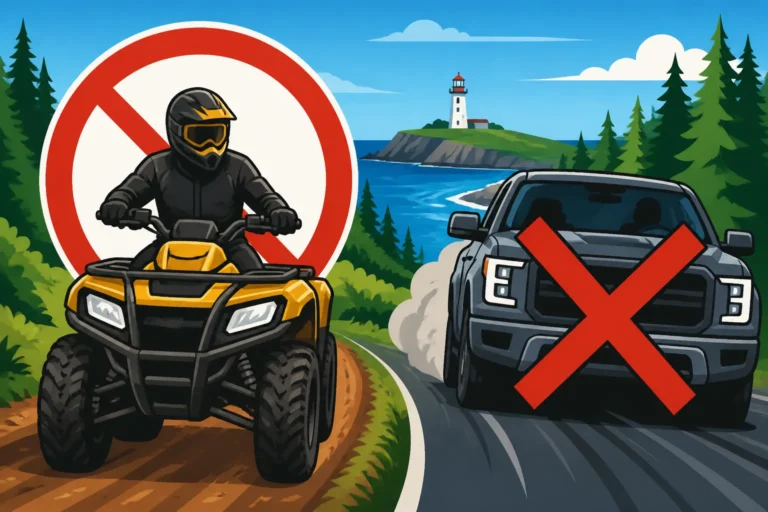
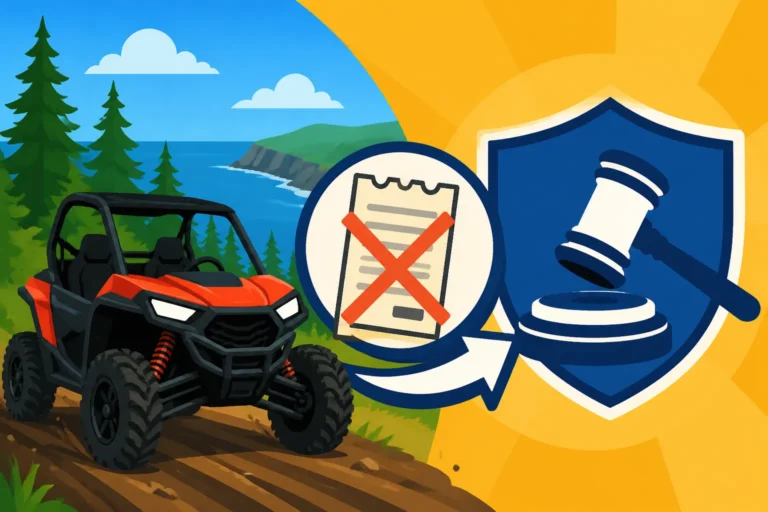
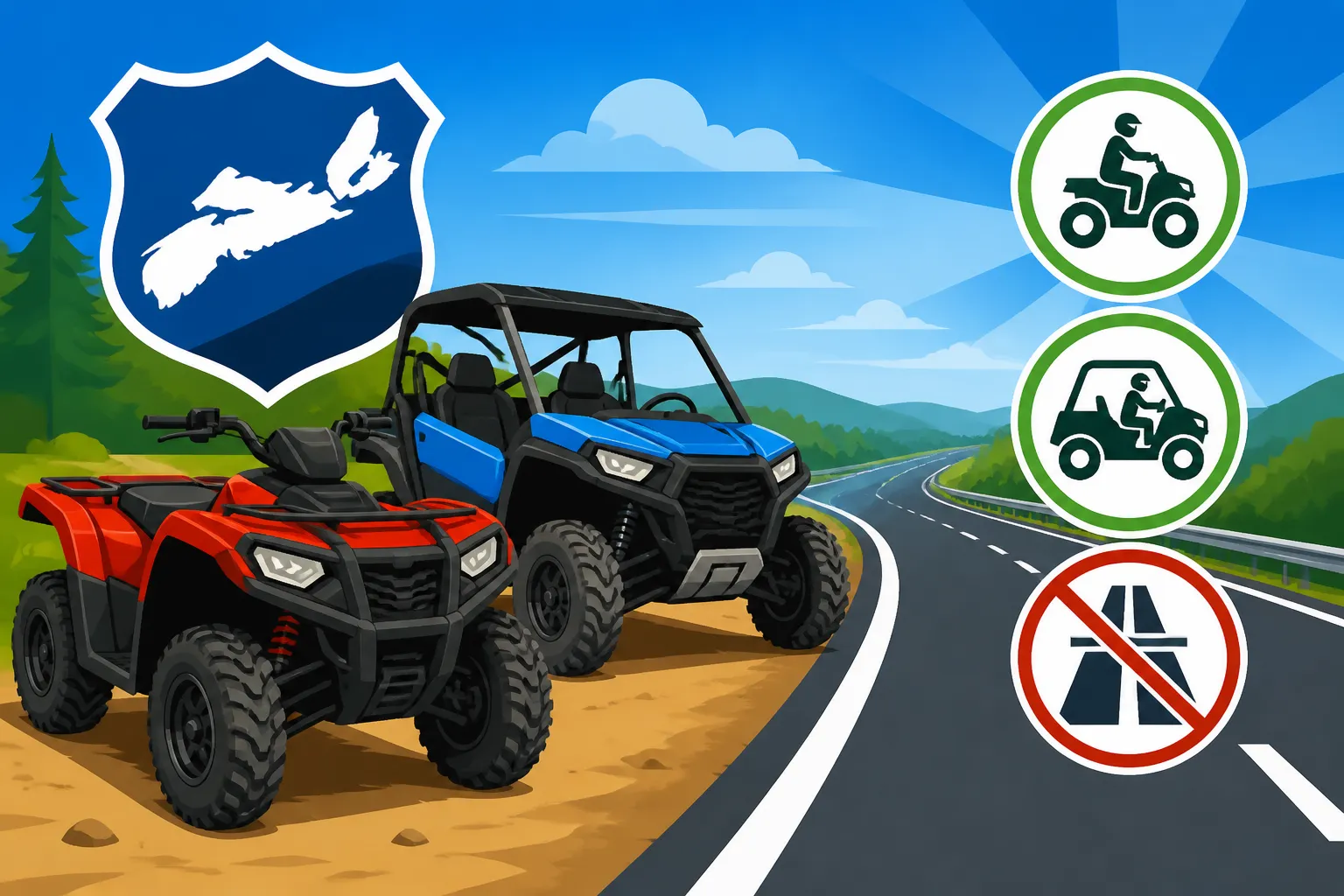
To be absolutely clear: ATVs and UTVs are generally prohibited from operating on controlled access highways in Nova Scotia. This isn't a suggestion; it's a legal mandate. This includes the main travel lanes, entrance ramps, and exit ramps. If you're caught riding your machine on one of these highways, you're looking at significant consequences. Penalties can range from [Nova Scotia Fines for an Unregistered Machine] (if your machine isn't properly documented, adding to your woes) to severe fines specifically for operating an OHV in a prohibited area. These [Nova Scotia Ticket Costs for Riders] can quickly add up, easily reaching into the hundreds or even thousands of dollars, depending on the specifics and whether other infractions (like lack of insurance or impaired riding) are also present. The enforcement is serious because the risk is so high.
Limited Exceptions: Emergency and Maintenance Situations
While the general rule is a firm "no," there are a very select few, highly specialized circumstances where an OHV might legitimately be found on a controlled access highway. These are not for recreational riders, ever.
Here are the typical exemptions you might encounter:
| Category | Description | Example Scenario |
|---|---|---|
| Emergency Services | Authorized emergency personnel (police, fire, search and rescue) may use OHVs on or alongside controlled access highways when responding to specific emergencies or conducting official duties where an OHV is the most appropriate vehicle for the terrain or situation. Their operations are under strict protocols and often involve specialized training. | A police ATV assisting with an accident investigation off the main shoulder, or a search and rescue team using a UTV to access a hard-to-reach area adjacent to the highway during a missing person search. |
| Highway Maintenance Crews | Workers performing official highway maintenance, construction, or inspection duties may use OHVs. This is typically for tasks that require accessing difficult terrain, performing inspections of culverts or drainage, or transporting small equipment along the right-of-way where conventional vehicles cannot go. These operations are usually clearly marked with safety vehicles and signage. | A provincial highway worker using a UTV to inspect bridge abutments or clearing brush from a ditch line that runs alongside the highway, all within the safety parameters of a marked work zone. |
| Utility Companies | Employees of utility companies (power, telecommunications, etc.) may be granted specific permissions to use OHVs to access infrastructure located within the controlled access highway's right-of-way for maintenance, repair, or installation, especially in areas difficult to reach otherwise. | A power company crew using a UTV to repair a power line that runs along the highway corridor, needing to access a remote part of the right-of-way that is overgrown or uneven. |
It's vital to reiterate: these are official, authorized uses, often involving specialized vehicles, training, and explicit permission. They are not loopholes for recreational riders. For the vast majority of ATV and UTV enthusiasts, these highways remain strictly off-limits.
Differentiating Controlled Access from Road Trails
One of the biggest areas of confusion for riders is the difference between a major controlled access highway and the [Nova Scotia Road Trails: Where You Can Ride] network. They are worlds apart, legally and practically! The Nova Scotia government, through the [Nova Scotia Road Trails Act Explained] has worked to create designated opportunities for OHV riders to connect trails by using certain municipal roads. These are typically lower-speed, local roads, not major highways.
On a designated road trail, you'll find strict rules: a speed limit of [Nova Scotia's 25 km/h Road Trail Limit], requirements for registration and insurance, and even specific times of day you can ride. This is a far cry from the multi-lane, high-speed environment of a controlled access highway. It's crucial not to confuse these two very different types of roadways. Just because you can ride your machine on a segment of municipal road near your camp, doesn't mean you can hop onto the 100-series highway. Always carry your [Nova Scotia Pink Card Rules] if you are ever riding near or on any public road, even permitted ones.
Practical Advice for Riders to Stay Compliant and Safe
Navigating Nova Scotia's diverse landscape on your ATV or UTV is an incredible experience, but it requires careful planning to ensure you're always riding within the law and, most importantly, safely. No one wants to end a great day on the trails with a citation or a dangerous encounter.
Planning Your Route to Avoid Prohibited Zones
The best defense is a good offense, and that means thorough route planning. Before you even fire up your machine, take the time to map out your journey. Here are some strategies:
- Consult Official Trail Maps: Start with resources like the [Nova Scotia ATV Trails: The ATVANS Network]. Member clubs work hard to maintain and map out legal trails. These maps clearly show designated OHV trails and often highlight areas to avoid.
- Use GPS and Digital Mapping Apps: Modern technology is your friend. Apps like Google Maps, Gaia GPS, or specialized trail apps can help you visualize your route. Pay close attention to road classifications. You might even consider a rugged, dash-mounted GPS unit from a brand like SuperATV, which is designed for off-road conditions and can help you stay on track, even if you lose cell signal in a remote area. Look for features that allow you to download offline maps, so you’re never caught without navigation.
- Identify Known Road Trails: If your route involves connecting via approved road trails, make sure they are indeed part of the official [Nova Scotia Road Trail Site Lists]. Do not assume a local road is an "OHV friendly" road trail without verifying it first.
- Ask Local Riders and Clubs: There's no substitute for local knowledge. Connect with local ATV clubs or experienced riders in the area you plan to visit. They can offer invaluable insights into common pitfalls, temporary closures, or areas that might look traversable on a map but are actually prohibited. They often know where the tricky crossings are, or which old woods roads might unexpectedly dead-end near a highway.
- Print Backup Maps: Technology can fail. Always carry a physical map as a backup, especially when exploring new areas or venturing into spots with unreliable cell service. Mark out your planned route and any known controlled access highways to ensure you don't inadvertently stray.
What to Do if You Accidentally End Up on a Controlled Access Highway
Despite all your careful planning, mistakes can happen. Maybe you took a wrong turn, followed an unmarked path, or misunderstood a sign. If you suddenly find yourself on an entrance ramp or, worse, the main lanes of a controlled access highway, your priority shifts immediately to safety and getting off as quickly and safely as possible.
- Stay Calm and Assess: Panicking is the worst thing you can do. Quickly assess your surroundings.
- Do NOT Ride on the Main Lanes: Absolutely do not continue to ride in the high-speed traffic lanes. This is incredibly dangerous.
- Move to the Shoulder (If Safe): If there is a shoulder and it's safe to do so, move onto it. Ride as far to the right as possible, being mindful of any debris or uneven terrain. If you have any sort of flashing beacon or marker lights on your machine (perhaps an aftermarket setup from SuperATV designed for increased visibility), now is the time to activate them.
- Proceed to the Nearest Exit: Drive slowly and cautiously on the shoulder to the very next exit. Do not attempt to cross lanes of traffic or make sudden movements. Signal clearly if you have turn signals.
- Exit Immediately: Take the first available exit. Once you are off the controlled access highway, pull over in a safe location (like a parking lot or a quiet side road) to re-evaluate your position and plan a legal, safe route away from the prohibited area.
- Do Not Turn Around: Never, under any circumstances, attempt to turn around or drive against traffic on a highway or ramp. This is an extreme hazard and highly illegal.
- Prepare for an Encounter: Be prepared for the possibility of being pulled over by law enforcement. Be courteous, explain what happened, and cooperate fully. It’s better to get a warning or a ticket than to be involved in a serious accident.
The Importance of Knowing Local Regulations
Laws are not always uniform, and what might be acceptable in one province or even one municipality, could be strictly forbidden in another. This applies to OHV use in Nova Scotia. While this guide covers the provincial stance on controlled access highways, specific local ordinances can impact your riding experience elsewhere.
- Municipal Road Access: As mentioned, some municipalities have embraced the [Nova Scotia Road Trails Act Explained] and allow OHVs on certain roads. However, not all municipalities participate, and even within those that do, the specific roads, hours, and conditions can vary. You must check the local rules for any area you plan to ride through.
- Private Land and Crown Land: Understanding [Nova Scotia Crown Land Riding Rules] and the need for [Nova Scotia Private Woodlot Permission] are separate but equally crucial aspects of responsible riding. Don't assume access.
- Ongoing Changes: Regulations can change. Stay informed by checking official government websites, following the Nova Scotia Off-highway Vehicle Association (ATVANS), and participating in local clubs. These organizations are often at the forefront of policy changes and can provide the most up-to-date information. Understanding nuances like [Nova Scotia's 2025 Road Trail Expansion] or [Nova Scotia Regulations Amended in 2023] ensures you're always riding legally. Always remember that for any legal riding on a public road, [Nova Scotia Requires Registration and Insurance].
- Consult a Professional: When in doubt about specific situations or complex legal questions, don't hesitate to contact Access Nova Scotia or a legal professional. It's always better to ask than to face the consequences of misinformation.
By being informed, planning diligently, and prioritizing safety, you can ensure your Nova Scotia ATV and UTV adventures are memorable for all the right reasons.
Disclaimer
This article is for general informational purposes only and does not constitute professional advice. Laws, prices and regulations vary by location and change over time. Consult a qualified professional for guidance on your specific situation.