Nova Scotia Riding in Guysborough County
Guysborough County’s mix of coastal communities, forest roads and multi-use corridors can make ATV trip planning feel less straightforward than it looks on a map. A route that appears connected may cross private land, a closed trail or a road where riding is not permitted. This guide explains how to plan a responsible ride, check access and prepare for changing conditions.
What Makes Guysborough County Different for ATV Riding
Coastal routes, inland woods and spread-out communities
Guysborough County offers a very different feel from a ride built around a single town trailhead. Communities such as Guysborough, Canso, Mulgrave, Sherbrooke and Liscomb are spread across a large area, with bays, inlets, wooded land and rural roads shaping how a day’s ride comes together. That variety can make a trip appealing, but it also means you should plan around confirmed access points rather than assume every visible road or track connects to a riding corridor.
The coast can bring fog, wind and damp conditions that change how a route feels, even when the forecast inland seems manageable. Away from the shoreline, wooded sections can bring softer ground, rough surfaces and limited cell coverage. A route that looks like a short hop between communities may take longer once you account for trail conditions, stops, detours and the need to turn back if a segment is closed.
Think of Guysborough as a region for planned, flexible outings rather than an area where you should simply point the machine toward the next town and improvise. Decide where the ride begins and ends, identify fuel and food options before leaving, and give yourself room to alter the plan. For broader context on the regional trail system, see [Nova Scotia ATV Trails: The ATVANS Network] and [Nova Scotia Riding in Guysborough County].
Map lines do not establish riding permission
A line on a phone map can represent a woods road, an old rail bed, a private access lane, a public road or a marked trail. Those are not interchangeable. A track that looks continuous does not prove that ATVs are allowed, that the landowner has granted permission, or that the route is open today. This is especially important in a rural county where routes may pass close to homes, working woodlots, farms or sensitive coastal areas.
Use a map as a planning aid, not as your permission slip. Look for current information from the responsible trail club or land manager, follow posted signs and gates, and confirm the status of any uncertain segment before riding. If the route crosses private property and you do not know whether it is an authorized trail, do not assume that an old tire track or an open-looking gate means access is allowed.
Digital navigation can help you compare possible routes and keep track of your position, but it cannot tell you every local restriction or short-notice closure. Riders may use tools such as onX Offroad to review mapped routes and plan navigation, then verify access with the relevant local sources. Keep an offline map or a second navigation option available, especially if your route moves away from larger communities. For help distinguishing a mapped corridor from an open riding route, see [Nova Scotia Crown Land Access Questions in Nova Scotia] and [Nova Scotia Trails That Cross Private Woodlots].
Finding Legal and Open Places to Ride
Start with the trail network and local confirmation
The safest starting point is a known, authorized trail corridor, not a promising-looking line on a general road map. Nova Scotia’s ATV trail network includes routes maintained or supported by local clubs, and those clubs are often the most useful place to ask about access, current conditions and local expectations. A segment may be closed for maintenance, weather damage, landowner concerns or another reason even if it appeared on a map last time you rode.
Before travelling to a trailhead, confirm that the segment is open to your type of machine and that you have the required trail access. Check whether a trail permit is needed, whether the route is suitable for your vehicle and whether there are restrictions on the day you plan to ride. Do not treat a permit as universal permission to ride anywhere: it does not override closures, private-property restrictions or rules for roads and other land.
When you contact a club or check its updates, ask practical questions rather than only asking whether the trail is “open.” Is the parking area usable? Are there washouts or reroutes? Are there sections shared with other users? Is a route suitable for a beginner or a youth rider? A short conversation can prevent a long drive to a closed gate. Helpful background includes [Nova Scotia Clubs and What They Maintain], [Nova Scotia Trail Conditions and Closures] and [Nova Scotia Trail Maps Worth Downloading].
Know the difference between a trail, a road and a woods road
A club trail, a public road and a private woods road can look similar from the seat of a machine, but the rules and permissions are different. Some public roads may be part of an authorized road-trail system, while other roads are not open to ATV use. A private woods road does not become a legal ATV route just because it is wide enough to ride or has been used by someone before you.
Before including a road in your plan, confirm that ATV access is permitted there and that you meet the operating requirements. Road-trail riding can involve rules about licensing, insurance, registration, speed, riding position and operating hours. Do not infer permission from a route drawn between two trail segments. Check the current official road-trail information for the specific road and municipality, then follow signs on the ground.
The same care applies to rail beds, shoulders, beaches and water crossings. A route that appears to offer a convenient shortcut may be closed to machines or may require a different kind of authorization. If a sign conflicts with your saved map, follow the sign and find another route. For a useful overview, read [Nova Scotia Road Trails: Where You Can Ride], [Nova Scotia Rules for Riding a Woods Road] and [Nova Scotia Rules for Riding a Rail Bed].
| Route type | What to confirm before riding | Common planning mistake |
|---|---|---|
| Club trail | Current opening status, permit requirements, trail suitability and any reroutes | Assuming a familiar trail is still open |
| Public road or road trail | Whether ATVs are authorized on that exact road and what operating rules apply | Treating every rural road as an ATV route |
| Private woods road | Landowner permission and any posted conditions | Assuming an open gate grants access |
| Coastal or beach area | Whether machine access is specifically allowed | Riding toward the shore because the route looks passable |
| Uncertain map segment | Current access from the responsible club or land manager | Treating a map line as proof of legal access |
Planning a Ride Around Guysborough County
Choose a manageable outing before building a long route
If you are unfamiliar with the area, plan a shorter outing around a confirmed trailhead or corridor before attempting a long point-to-point ride. This gives you a chance to learn how quickly conditions change, how far apart services are and how reliable your navigation is in the places you plan to ride. A modest first-day route is not a missed opportunity; it is a way to avoid running low on fuel or daylight far from your starting point.
Build your plan around a clear turnaround time, not just a distance estimate. A short route can take longer than expected if the surface is soft, a group needs frequent stops, or an open segment becomes a slow and technical ride. Decide in advance where you will turn back if the group is behind schedule. That makes it easier to enjoy the outing without feeling pressured to push on as the weather or daylight changes.
For a group ride, choose a pace that works for the least experienced rider and the least capable machine in the group. Keep the group together at turns and junctions, agree on a stopping place if riders become separated, and make sure everyone knows the basic route. If you are creating a route with onX Offroad or another navigation tool, save the plan before leaving and cross-check access with local trail information.
Plan fuel, parking and rest stops as part of the route
In a spread-out rural area, fuel and food should be deliberate stops rather than assumptions. Check which services are available near your route and confirm that they are practical for your machine and schedule. A business may be outside the riding corridor, require a road connection that is not open to ATVs, or have hours that do not line up with your arrival. Do not plan on riding to a gas station unless the route there is confirmed as legal.
Work out your machine’s usable range based on its condition, load, riding pace and terrain. A heavily loaded side-by-side, repeated low-speed riding or difficult ground can change fuel use compared with an easy, unloaded ride. Carry enough reserve to handle a detour or a return to the trailhead. If your group has machines with very different ranges, plan around the one that will need fuel first.
Parking deserves the same attention. Use a designated or clearly appropriate staging area, avoid blocking gates and access roads, and do not leave a trailer where it could interfere with residents, farm vehicles or emergency access. If the trailhead arrangement is unclear, ask the local club before arrival. For more trip-planning help, see [Nova Scotia Trailheads With Parking], [Nova Scotia Fuel Range Between Villages] and [Nova Scotia Trails With Fuel Stops].
Preparing Your Machine and Your Group
Carry the essentials for a remote or changing route
A coastal ride can shift from pleasant to uncomfortable quickly. Pack layers, rain protection, water, food, a basic first-aid kit and a way to contact someone if the group is delayed. A phone is useful, but it may not work everywhere; download maps before leaving and consider whether your route warrants another communication option. Tell someone who is not on the ride where you plan to go and when you expect to return.
Check the machine before loading it. Look over tires, brakes, lights, controls and visible fluid leaks, and confirm that the machine has the fuel and equipment needed for the planned outing. If your route includes rougher terrain, make sure the load is secured and that passengers are seated and equipped appropriately. A side-by-side and an ATV can have different handling characteristics, so do not assume a route that feels easy on one machine will be equally straightforward on another.
Bring only recovery equipment you know how to use. A tow strap, gloves and a basic tool kit can help with minor problems, but recovery on soft ground or a steep slope can become dangerous if riders rush or attach equipment incorrectly. Keep people clear of tensioned straps, avoid improvised recovery points and stop if the situation exceeds the group’s skill or equipment. More detailed preparation ideas are covered in [Packing for a Full Day on a Coastal Trail], [First Aid on a Remote Coastal Loop] and [Cell Dead Zones in the Highlands].
Match the route to the least experienced rider
A route that suits an experienced adult may be a poor choice for a new rider, a youth or someone who is not comfortable with mud, slopes or narrow corridors. Be honest about the skill level in the group before you start. It is much easier to choose an easier route at home than to turn a nervous rider around halfway through an unfamiliar section with limited space to stop.
Youth riding requires careful attention to age, supervision, machine suitability, safety training and equipment rules. A small rider should be able to reach and operate the controls properly, and the machine should be appropriate for that rider’s size and experience. Do not rely on engine size alone when deciding whether a machine is suitable. Review the applicable rules before the trip and make sure adults understand their supervision responsibilities.
Before setting out, agree on simple group habits: ride at a pace everyone can maintain, stop at junctions, leave enough space between machines, and wait at safe locations rather than around blind corners. Riders should know what to do if they lose sight of the group. For youth-specific guidance, review [Nova Scotia Rules for Riders Under 16], [Nova Scotia Supervision Requirements] and [Nova Scotia Safety Training at 16].
Riding Responsibly Through Changing Conditions
Treat closures, weather and landowner concerns seriously
Conditions can change after a storm, during spring thaw or when a landowner or club needs to protect a corridor. A route that was firm on a previous visit can become muddy, washed out or unsafe. If you encounter a closure, follow it. Do not ride around a barrier, cut a new path beside a wet section or detour onto nearby land without permission. Those choices can widen damage and threaten future access.
Weather affects more than traction. Fog can reduce visibility, rain can soften the surface and wind can make exposed sections uncomfortable. In wooded areas, recent weather may hide damaged culverts, fallen branches or standing water. If the route looks substantially different from what you expected, slow down, assess whether the group can continue safely and turn back when conditions are beyond your equipment or experience.
A responsible detour is not simply the quickest way around an obstacle. It needs to be an authorized route that is open to your machine. If there is no confirmed alternative, return the way you came or contact the responsible club for guidance. For more on changing trail conditions, see [Nova Scotia Trail Closures After a Storm], [Nova Scotia Spring Thaw and Trails] and [Why Riding Around a Wet Section Widens the Trail].
Share the corridor and leave a good impression
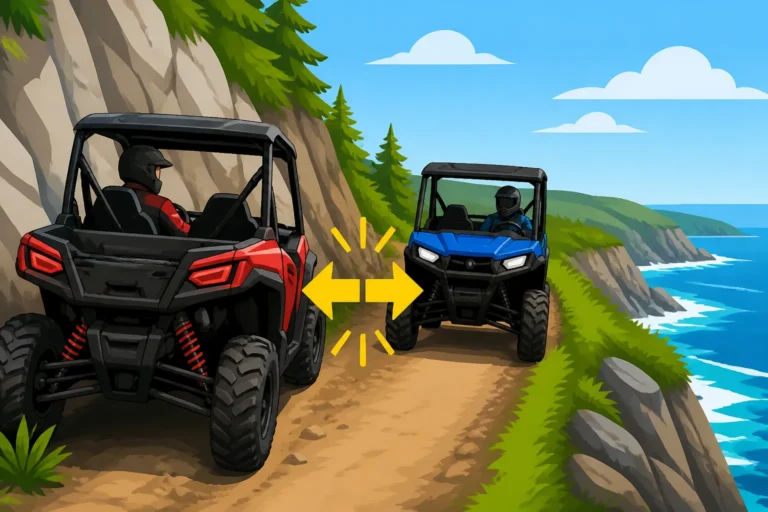
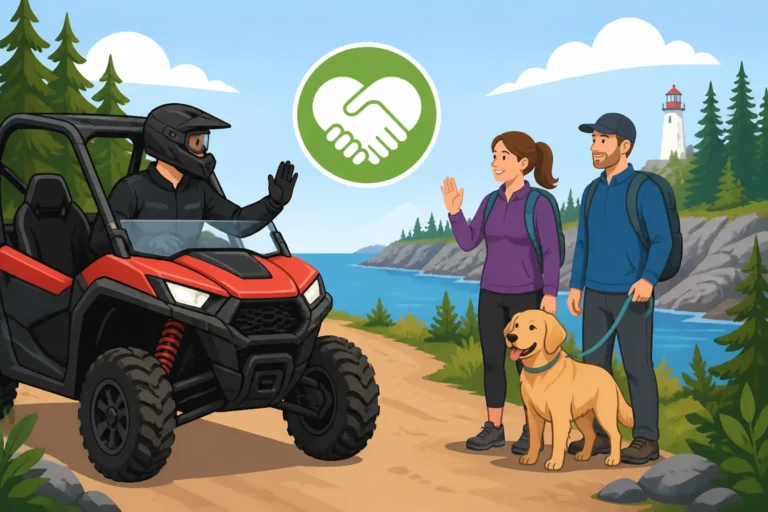
Guysborough County’s trails and rural roads are part of working, lived-in communities. You may encounter residents, cyclists, walkers, other riders, forestry activity or vehicles using a shared corridor. Slow down when visibility is limited, approach people and animals cautiously, and give other users room. On a narrow route, do not assume the other person has seen or heard you in time to react.
Keep noise and dust in mind, especially near homes and community roads. Avoid unnecessary revving, respect posted speed and operating rules, and take particular care when passing homes or meeting people on foot. Leave gates exactly as you found them, stay on the authorized corridor and pack out anything you brought in. A single careless shortcut can affect access for everyone who relies on the trail.
Before the ride, check that every rider understands the rules for the route type, carries required documents and has appropriate insurance and registration. A trail permit, registration and permission to use a particular road or piece of land are separate matters; one does not automatically replace the others. For a practical rules refresher, see [Nova Scotia Trail Etiquette Locals Expect], [Nova Scotia Rules for Riding With Walkers] and [Nova Scotia Insurance Proof at a Trailhead].
Disclaimer
This article is for general informational purposes only and does not constitute professional advice. Laws, prices and regulations vary by location and change over time. Consult a qualified professional for guidance on your specific situation.