Brushing a Corridor After a Storm
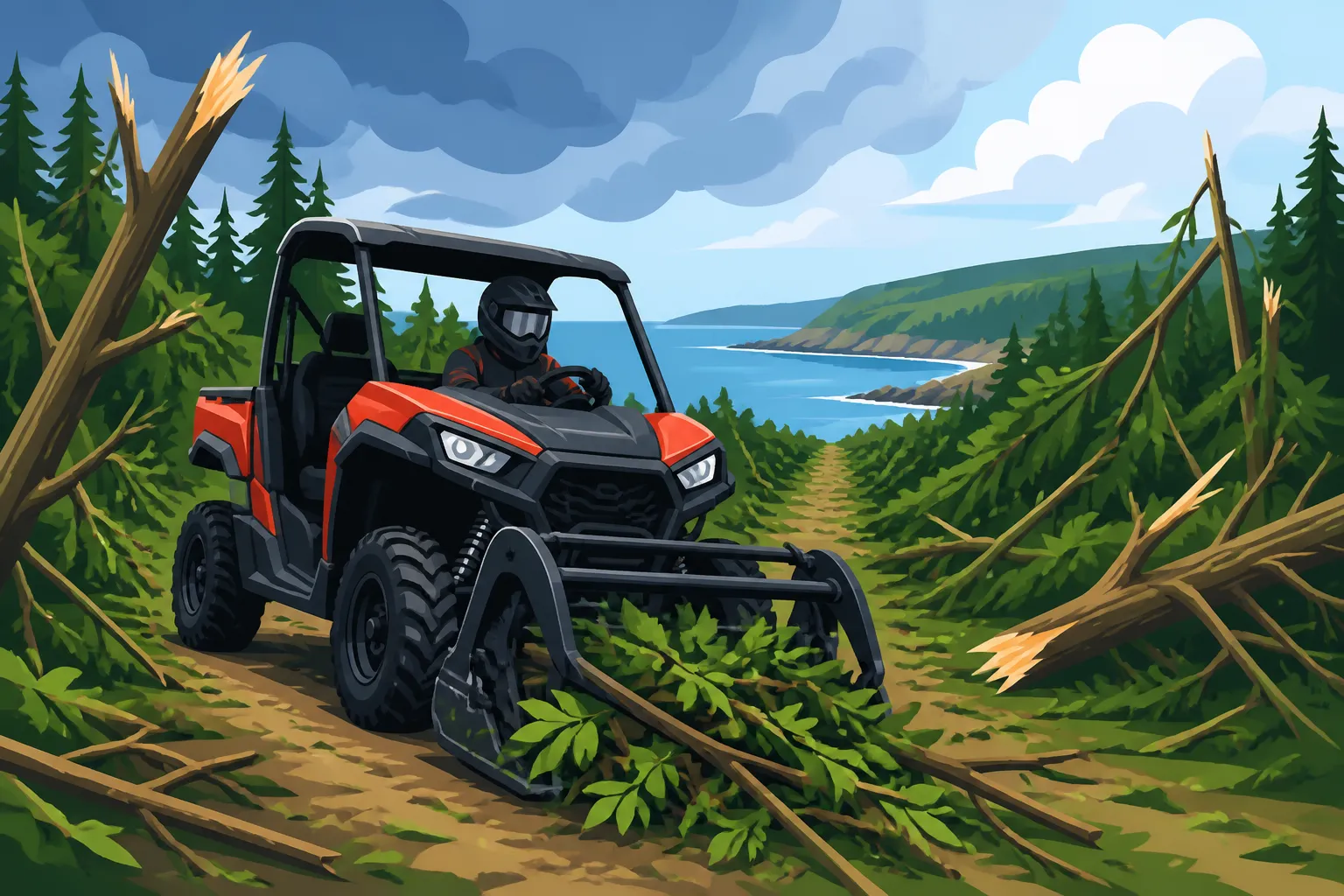
A storm can turn a familiar Nova Scotia ATV trail into a hazard overnight: branches across the route, trees leaning overhead, soft shoulders and washouts that weren’t there on your last ride. This guide explains how to assess a damaged corridor, report it clearly and understand when brushing is safe to do yourself—and when it belongs to an authorized club crew.
Assess the corridor before you start clearing
Check whether the route is open
The first decision is not what tool to bring; it’s whether you should be on that trail at all. Clubs and landowners may close a section after a storm while they inspect trees, bridges, culverts or water damage. A trail that looks passable from the entrance can still have a dangerous obstruction farther along, and an open gate is not proof that every section is safe.
Before heading out, check available club updates and Nova Scotia Trail Conditions and Closures. Look for notices about temporary closures, reroutes and work parties. Conditions can differ between regions: a storm may leave one route in Cape Breton blocked by fallen timber while another farther inland is merely muddy. If the information is unclear, contact the relevant club or land manager before riding or bringing clearing equipment.
A navigation app can help you understand where you are, but it does not establish permission to ride or clear a route. If you use onX Offroad to review a mapped corridor, treat it as a planning aid and verify closures and access with the club or landowner. A line on a map is not a substitute for current local guidance.
Identify hazards that are not ordinary brush
Small, loose branches on the trail surface are different from a tree under tension, a broken trunk leaning over the corridor or limbs caught high in the canopy. Those hazards can shift without warning. Wind-damaged trees may also look stable while their roots or supporting limbs are compromised. If a trunk is suspended, split, sharply bent or pressing against another tree, stay well back and leave it to people equipped and authorized to handle it.
Watch for less obvious storm damage, too. Water can wash out a trail edge, expose a culvert, undermine a bridge approach or leave a soft shoulder that gives way under a machine. A route that appears intact may have a hidden void beneath mud or standing water. Do not test a questionable crossing by riding onto it; turn around and report it.
Downed or sagging wires are an immediate stop-and-retreat hazard. Do not touch a wire, a tree in contact with it, or a machine that may be near it. Move away without approaching the area again and report the danger to the appropriate utility or emergency service. For other serious risks, such as an unstable tree across a public access route or a damaged bridge, notify the land manager or club and follow their directions.
Decide who should do the brushing
Know the difference between minor debris and trail work
Brushing is more than moving a twig out of the way. It can mean cutting vegetation back from a corridor, removing fallen limbs, clearing a blocked route or altering the trail edge. Those actions can affect private property, drainage, habitat and the way a trail is marked. A rider’s good intentions do not automatically provide permission to cut or move material.
If you encounter a small, loose branch that you can move safely without leaving the trail or disturbing vegetation, clearing it may be straightforward. Stop first, make sure other riders are aware of you, and avoid placing yourself beneath damaged trees. If the obstruction is heavy, tangled, under tension or requires cutting, do not improvise. Report it and let an authorized crew decide how to proceed.
For club-maintained routes, Nova Scotia Club Trail Maintenance offers useful context for why corridor work is coordinated rather than handled as a series of individual decisions. A club may need to arrange access with a landowner, check the route for additional hazards, use trained volunteers or bring suitable equipment. A quick report can help them decide whether to dispatch a crew or close the section temporarily.
Get permission before cutting or moving material
Before doing any cutting, confirm who manages the corridor and whether you have permission to work there. A route may cross land owned by several people, and the club responsible for maintaining a trail may still need to coordinate with a landowner. On a woodlot, do not assume that a path shown on a map gives you the right to remove trees or alter vegetation. Follow Nova Scotia Trails That Cross Private Woodlots and [Leaving Woodlot Gates Exactly as You Found Them] for related access and landowner considerations.
Even brushing that seems modest can change a corridor. Cutting back farther than necessary can widen the trail, disturb vegetation or create new places for riders to leave the established route. Avoid moving logs or branches into a ditch, stream or neighbouring property to make the path seem clear. Those materials may be blocking drainage or protecting a vulnerable section.
If you are joining an organized work party, ask the crew lead what the task includes and where the approved work area ends. Stay within the marked corridor, use only the tools and methods you have been assigned, and stop if the crew finds a hazard beyond its training or equipment. For more on responsible reporting and follow-up, see [Reporting Trail Damage to a Nova Scotia Club].
Report storm damage so crews can act
Give a precise location and a useful description
A report such as “the trail is blocked near the woods” is hard to act on, especially when a route passes through a large rural area. Include the trail or segment name if you know it, the nearest access point or intersection, and the direction you were travelling. If you can safely note a map pin or coordinates without approaching the hazard, include those too.
Describe what you saw rather than guessing about the cause. For example: “A large tree is across the marked route about a short distance beyond the second bridge heading east” is more useful than “the trail is destroyed.” Mention whether the trail is fully blocked, whether riders can turn around safely, and whether you saw water flowing across the route, a damaged structure or overhead limbs.
Photos can help, but only take them from a safe place. Do not walk beneath a hanging tree, climb onto an unstable bridge approach or stand in a travel lane to get a better angle. If you use onX Offroad to record a location, share that information with the club as a reference—not as a claim that the route is open or safe. Clear location details help a club compare the report with its own maps and decide where to inspect.
Keep riders informed without creating confusion
If the trail is blocked, turn around where it is safe and tell the riders with you what you found. Do not encourage others to squeeze around a tree or ride into an uninspected shoulder. A detour made by cutting through brush can quickly become a wider, unofficial route and may place riders on private land or unstable ground.
When sharing an update with a riding group, include when you encountered the damage and whether you reported it. Avoid posting an old picture without a date or describing an unconfirmed route as closed for good. Conditions can change after crews inspect the corridor, and an accurate report should distinguish between what you personally observed and what a club has confirmed.
Use Nova Scotia Trail Signage Explained as a reminder to pay attention to barriers and posted notices. If a route is marked closed or rerouted, follow the sign even if the obstruction seems minor from where you are. The club may know about hazards beyond the visible blockage, or it may need to protect the corridor while repairs are arranged.
What careful brushing protects
Keep the trail narrow and the ground stable
A storm can tempt riders to make their own bypass around mud, branches or a washout. That often causes more damage. Repeatedly riding around a wet patch can widen the disturbed area, strip vegetation and create a second route that needs maintenance. If the marked corridor is blocked, the safer choice is usually to stop and report it rather than create a shortcut.
This is especially important where a trail crosses a slope, a wet area or a route with drainage structures. Moving debris into a ditch or cutting a new path around a damaged section can redirect water and worsen erosion. For a broader look at how these problems affect routes, see Nova Scotia Washouts and Reroutes.
The same restraint applies when a branch or log is inconvenient but not immediately dangerous. If shifting it would require leaving the corridor, dragging it across soft ground or working beneath unstable trees, leave it in place and report it. The goal is not simply to make a trail passable; it is to keep the established route safe and maintainable.
Use a simple stop, report and wait routine
When you find storm damage, this sequence keeps the response practical:
- Stop before the obstruction. Give other riders time to slow down, and do not ride beneath hanging limbs or onto a damaged edge.
- Look for immediate hazards from a safe distance. Pay attention to unstable trees, wires, flowing water, exposed culverts and damaged bridges.
- Turn around if the route is unsafe or blocked. Do not cut a new path or attempt a crossing you cannot confidently assess.
- Record the location and condition. Note the nearest access point, direction of travel, type of damage and whether the route can be passed safely.
- Contact the responsible club or land manager. Follow any closure or reroute instructions and share updates with your group accurately.
- Join a work party only when invited and prepared. Confirm permission, task boundaries and safety instructions before using tools.
| What you find | Sensible response |
|---|---|
| A small, loose branch on the trail surface | Move it only if you can do so safely and without leaving the corridor |
| A heavy tree, tangled limbs or a tree under tension | Keep clear, turn around and report the location |
| A washout, soft edge or exposed culvert | Do not test it with a machine; report it and wait for guidance |
| A damaged bridge or unstable approach | Stay off it and notify the club or land manager |
| A downed or sagging wire | Retreat without touching it and contact the appropriate utility or emergency service |
| A marked closure or reroute | Follow the notice, even if the visible obstruction looks minor |
Storm recovery can take time, particularly when several sections need inspection or landowner coordination. Patience helps protect riders, volunteers and the property owners who make trail access possible. For more background on the broader network and its upkeep, see Nova Scotia ATV Trails: The ATVANS Network and Nova Scotia Trail Etiquette Locals Expect.
Disclaimer
This article is for general informational purposes only and does not constitute professional advice. Laws, prices and regulations vary by location and change over time. Consult a qualified professional for guidance on your specific situation.