Nova Scotia’s Grandfather Exemption
Nova Scotia’s grandfather exemption can save an eligible rider from having to complete mandatory ATV safety training, but it is tied to a specific set of historical conditions. Owning an ATV years ago may not be enough on its own. Here’s how to understand the exemption, what records can help establish eligibility, and what to do if you cannot confirm that you qualify.
What the grandfather exemption covers
Nova Scotia requires many off-highway vehicle riders to hold an approved safety certificate. The grandfather exemption is a limited exception to that training requirement for certain people who met historical age and ownership or registration conditions before the rules changed.
It is not a general exemption from ATV laws. Being grandfathered does not, by itself, let you ride an unregistered machine, go onto land without permission, ignore trail-permit requirements, or skip rules that apply to your age and riding location. It also does not necessarily exempt you from requirements that apply when you ride on a road trail.
That distinction matters. Riders sometimes hear that an older owner is “grandfathered” and assume the machine itself is exempt from all current requirements. The exemption is better understood as a rider’s status related to safety training—not a permanent free pass attached to a particular ATV.
| Question | What the exemption may affect | What it does not automatically settle |
|---|---|---|
| Do I have to take an approved safety course? | An eligible rider may be exempt from the training requirement | Whether you meet every condition for the exemption |
| Is my machine registered? | Nothing; registration is a separate matter | Registration, permit renewal, or proof of ownership |
| Can I ride club trails? | Nothing by itself; trail access has separate rules | A valid trail permit, land access, or trail closures |
| Can I ride a road trail? | Nothing by itself; road-trail rules still apply | Licence, insurance, helmet, equipment, and operating rules |
| Can a child use my exemption? | Generally, one person’s status does not establish another person’s status | A youth rider’s age, training, supervision, and machine requirements |
For the wider training framework, see Nova Scotia Safety Certificates Are Mandatory. If your question is specifically whether a pre-2006 history qualifies, Nova Scotia’s Pre-2006 Grandfather Rule is a useful companion.
The practical takeaway: treat grandfather status as one item in your compliance file. Keep proof of it, but also check your machine’s registration, trail permit, insurance, and the rules for the places where you plan to ride.
The historical conditions to check
The exemption is associated with a specific historical cutoff and registration history. The details can be easy to misremember, particularly if a machine has changed hands, sat unused for years, or been registered under more than one owner.
Eligibility is commonly described using several connected conditions. The relevant questions include whether you were old enough by the cutoff date, whether you owned an off-highway vehicle before that date, and whether the required registration record was established within the applicable period. Do not assume that meeting one condition means you meet all of them.
Age at the cutoff
The age condition is one part of the historical test. Being an adult now is not the same as having met an age threshold at the time the exemption was created. If you were not old enough by the relevant cutoff, your current age alone may not qualify you.
A rider may remember buying a quad “around 2006” without knowing the exact date or registration history. In that situation, establish the date as carefully as you can using purchase documents, old permits, insurance paperwork, or registry records. The dates matter because a purchase shortly before and shortly after a cutoff can lead to different results.
The reference title Nineteen Before April 2006 addresses the age point. If that question applies to you, compare your own date of birth with the exact cutoff used by the current rules rather than relying on a rough recollection.
Ownership before the cutoff
The historical ownership condition is about the rider’s situation at the time, not simply whether a similar machine existed in the household. A parent’s ATV, a borrowed machine, or a quad used at a camp does not necessarily establish that you personally met an ownership condition.
Try to distinguish among these situations:
- You bought and owned the machine yourself.
- A family member owned it, but you were the regular rider.
- You used a machine belonging to a farm, business, or club.
- You bought a machine before the cutoff but did not register it in your name.
- You acquired a different machine later, after the grandfather period.
Those details may affect which records matter and whether the exemption applies. The history of one machine should not be assumed to establish a rider’s status for another person.
Registration history
Registration records may be important even when a rider clearly remembers owning and using an ATV. Older paperwork can show who was recorded as the owner and when the registration was issued. A purchase receipt may establish a sale, but it may not answer every question about the registration condition.
The applicable rules may refer to a registration record from a defined historical period. Because older certificates can be missing, incomplete, or issued under a different name, confirm which records the registry will accept. The article A Certificate From 1991 Onward is relevant to the historical certificate question, while Registering by September 2007 covers the registration timing issue.
If your records point in different directions, do not choose the document that seems most favourable and assume the matter is settled. Ask the relevant provincial office to review the specific dates and documents.
How to find and organize proof
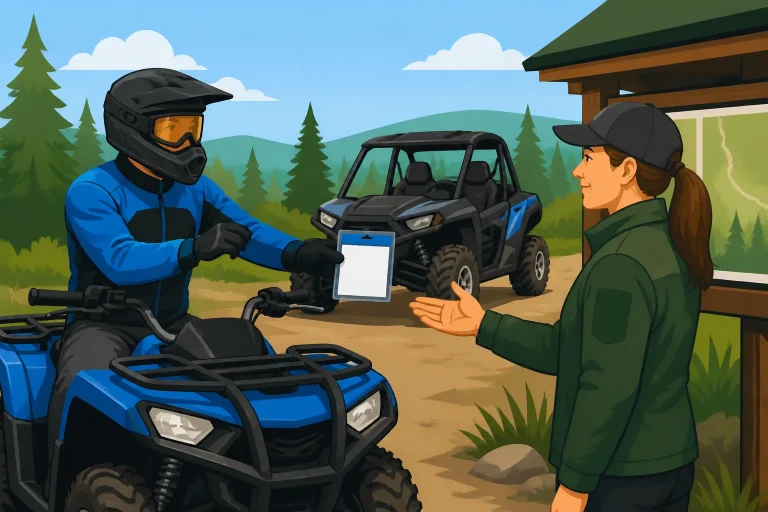
The easiest time to establish grandfather status is before you are stopped at a trailhead or asked about your training. Make a small file with the records that support your history and keep a copy where you can retrieve it.
Start with what you already have:
- Check your personal records. Look for an old certificate of registration, vehicle permit, purchase agreement, bill of sale, insurance policy, service invoice, or dated photograph that identifies the machine.
- Write down the ownership timeline. Note when you acquired the ATV, who owned it, whose name appeared on the paperwork, and whether it was transferred or replaced.
- Identify gaps. Be clear about what you cannot prove. For example, you may know the machine was in your family before the cutoff but not know when it was registered in your name.
- Contact the registry or the appropriate provincial office. Describe the facts and ask what records are accepted to establish the exemption. If possible, get the answer in writing or record the date, office, and details of the guidance.
- Keep the response with your documents. A written confirmation or a careful note can help you explain the issue later, though it does not replace any formal record the rules require.
If a document is in a former owner’s name, do not assume that it proves your own eligibility. Explain the relationship and ask whether additional evidence is needed. Similarly, a machine’s current registration does not necessarily prove that the historical conditions were met by the person who is now riding it.
Where older records may turn up
Search paper files, old insurance folders, storage boxes, and the records of a previous household member. A dealership, insurer, or registry may be able to explain whether any relevant records remain available, but do not assume that every organization can retrieve decades-old information.
Photographs can help establish that a machine existed or was in use at a particular time, especially if they have a reliable date. They may be supporting evidence rather than a substitute for a registration or ownership document. Keep the original files where possible, and avoid altering dates or details.
When you need to replace a current permit, that is a separate problem from proving grandfather status. See Nova Scotia Permit Replacement If Lost for current permit paperwork issues. A replacement document for a current registration may not reproduce every historical fact needed for the exemption.
Keep rider status separate from machine paperwork
Make a separate note for each rider and each machine. The rider’s safety-training status, the machine’s registration, and the machine’s trail permit are different records. Combining them in one folder is fine; treating them as interchangeable is not.
A useful personal checklist might include:
- Your name and date of birth
- The historical date or period you believe applies
- The machine’s make, model, and serial number, if known
- The date and manner of acquisition
- The name shown on any old registration
- Copies of the supporting documents
- The name of the office or person who reviewed the question
- Any written confirmation or instructions you received
If records contain inconsistent names, dates, or serial numbers, flag the discrepancy instead of trying to correct it yourself. An older machine may have faded or incomplete identification, and a mismatch can complicate the conversation. Serial Numbers on an Older Machine offers further context on older machine identification.
What the exemption does not let you skip
Grandfather status is narrow. Even if you qualify for the training exemption, you still need to check the rules that apply to the machine, the rider, and the route.
Registration and permits remain separate
A safety-training exemption does not register your ATV or UTV. Registration paperwork can still matter when you buy, sell, transfer, or use a machine where registration is required. For the basic registration process, see How to Register an ATV in Nova Scotia.
Trail access is also a separate issue. Club trails and other organized trail networks may require a valid trail permit, and access can depend on the specific corridor and its current status. A provincial registration document should not be assumed to serve as a trail permit. Check the rules in Nova Scotia’s Club Membership Trail Permit and Nova Scotia Trail Permit Without a Club.
Do not assume an exemption carries from one machine to another in the same way a permit might be displayed or transferred. Confirm what applies to each rider and each machine. If you have more than one ATV, [Nova Scotia Permit for a Second Machine] can help you distinguish machine-specific trail paperwork from rider-specific training status.
Age and supervision rules still apply
The grandfather exemption should not be used to decide whether a youth can ride. Children and teenagers may be subject to age, supervision, training, and machine-size rules that are separate from the status of a parent or other adult.
An adult who qualifies for the exemption does not automatically pass that exemption to a child. Nor does an adult’s presence by itself make every riding situation legal. Before a young person rides, check the current age and supervision requirements, and match the machine to the rider’s size and ability. See [Nova Scotia Rules for Riders Under 16] and [Nova Scotia Supervision Requirements] for more on those separate questions.
Road trails have their own requirements
Road-trail riding brings a different set of conditions. Depending on the route and the rider, requirements may include a full driver’s licence, valid registration and insurance, approved protective equipment, and compliance with operating rules. A training exemption does not replace those requirements.
Before riding a road trail, verify that the particular road is open to off-highway vehicles and that your machine and rider meet the applicable rules. Nova Scotia Road Trail Rules Explained covers the broader framework. If you are unsure whether your ATV is properly registered for the kind of riding you plan to do, start with Do You Need to Register an ATV in Nova Scotia?.
Insurance and land access are not training exemptions
Training status does not establish that you have insurance, nor does it give you permission to cross private property. Check your insurance documents and confirm that the policy applies to the activity and location. Then confirm whether the trail or land is open to riders and whether the owner or club has imposed additional conditions.
The same care applies to farm, forestry, or other work-related use. Work-related exemptions, where they apply, are different from the grandfather exemption for training. A machine used for work may still be subject to other rules when it is ridden recreationally or taken onto a trail. See Nova Scotia Work Use Exemptions Explained for that separate topic.
If you cannot confirm that you qualify
If you do not have enough evidence to establish the exemption, the safest course is to ask the appropriate provincial office how to verify your status before riding. Do not rely only on a family story, an old sticker, or the fact that you have ridden for years without being asked for proof.
You may find that the exemption applies but that you need to locate a particular document. You may also find that your history does not meet the conditions. In that case, ask what approved training route is available and what proof of completion you must keep.
A recognized safety certificate can make your status clearer for future rides, particularly if your paperwork is incomplete. Confirm that the course and certificate are accepted for Nova Scotia before enrolling. Keep the certificate in a secure place and retain a digital copy if permitted. If the certificate is later misplaced, check the process for confirming or replacing it rather than assuming that an old course record will be easy to retrieve.
Avoid these common assumptions
- “I owned a quad before 2006, so I’m automatically exempt.” Ownership may be only one part of the historical test.
- “My parent owned it, so I count as an owner.” A family member’s ownership may not establish your personal eligibility.
- “I’m old enough now.” Current age may not answer a condition tied to a past cutoff date.
- “The machine has a current permit, so my training status is settled.” Machine permits and rider qualifications are separate.
- “I have never been asked for proof.” Not being checked before does not confirm that you are exempt.
- “The rule applies to everyone who bought an older machine.” The conditions may be specific to the rider and the historical record, not just the machine’s age.
If you are buying a used ATV and the seller says it is “grandfathered,” ask what that means and whose exemption they are talking about. A rider’s status should not be treated as a feature that automatically transfers with the machine. Get the machine’s ownership and registration documents separately, and confirm your own training status independently. Buying From a Private Seller in Nova Scotia covers paperwork to review during a private sale.
A practical checklist before your next ride
Use this checklist as a quick pre-ride review. It does not replace confirmation from the provincial office, but it helps prevent a training exemption from being mistaken for broader permission.
- Confirm whose status is being checked. The exemption relates to a rider’s circumstances. Do not use another person’s records as proof of your own status.
- Review the historical conditions. Compare your age, ownership history, and registration documents with the exact requirements.
- Gather original or reliable records. Keep the strongest available evidence together and note any gaps.
- Ask for clarification where needed. If a date, name, or registration history is uncertain, ask the relevant office what evidence it accepts.
- Check the machine’s current registration. Make sure the machine’s paperwork is in order for the kind of use you plan.
- Check trail access and permits. Confirm that the route is open and that your permit is valid for that use.
- Review insurance and road-trail requirements. A training exemption does not replace insurance or road-trail operating rules.
- Check youth rules separately. A parent’s exemption does not settle a young rider’s age, supervision, training, or machine requirements.
- Carry or store proof sensibly. Keep required documents accessible in the way the current rules allow, and retain copies at home.
- Recheck before travel. Permit reciprocity and trail access can differ across provincial borders and between trail systems.
If you are visiting another province, do not assume Nova Scotia’s grandfather status is recognized there. Training rules, trail permits, and reciprocity arrangements are not the same thing. Check the destination’s requirements before crossing the border. For riders coming into Nova Scotia, Nova Scotia Visitors From New Brunswick and Nova Scotia Visitors From PEI discuss visitor questions separately from the grandfather exemption.
A little paperwork work now can prevent confusion later. The key is to prove the rider’s eligibility on its own terms, then separately confirm that the machine and route meet the requirements for the ride you intend to make.
Disclaimer
This article is for general informational purposes only and does not constitute professional advice. Laws, prices and regulations vary by location and change over time. Consult a qualified professional for guidance on your specific situation.