Nova Scotia Permits Run a Calendar Year
A Nova Scotia ATV or UTV trail permit is tied to the calendar year, not to the date you buy it. That can catch people who purchase a permit late in the season or assume it renews on the anniversary of purchase. Here’s how the annual term works, what it covers, and how to plan if you ride for only part of the year or visit from another province.
What a calendar-year permit means
A Nova Scotia trail permit generally runs from January 1 through December 31. Buying one in the middle of the year does not usually give you a full twelve months from the purchase date. It gives you permission for the remaining part of that permit year, subject to the permit’s terms.
For example, if you buy an annual permit in late summer, it does not normally carry through to the same date the following summer. Its calendar-year term ends on December 31. A new permit is needed for the next year if you plan to keep using trails that require one.
This is different from a permit whose term is measured from the day it is issued. The annual permit’s end date stays tied to the year, whether you buy near the start of the riding season or near its end. The exception is a separate short-term visitor option, which has its own validity period. Check the terms for the permit you are buying rather than assuming every option follows the annual calendar.
| Permit or document | What it is for | How to think about its term |
|---|---|---|
| Annual trail permit | Access to participating trails under the permit’s conditions | Calendar-year term, generally ending December 31 |
| Short-term visitor permit | Temporary trail access for eligible visitors | Separate term; check the stated start and expiry dates |
| Vehicle registration and permit | Registration requirements for the off-highway vehicle | Separate from the trail permit; check renewal requirements |
| Insurance | Required coverage for applicable riding situations | Separate policy with its own effective and expiry dates |
| Safety certificate | Proof of required training for riders who need it | Not a substitute for a trail permit |
The distinction matters because “permit” can refer to more than one thing. A trail permit is not the same as the government-issued vehicle permit associated with registration. It also does not replace insurance, safety training, or any permission required to ride on private land.
If you are sorting out your documents before your first outing, review Nova Scotia Registration Before Your First Ride alongside the trail permit rules. Having one document does not automatically satisfy the requirements for the others.
The calendar year is not the same as the riding season
A permit can be valid during the calendar year even if you do not ride every month. That does not mean every trail is open year-round. Trail access can change because of maintenance, weather, seasonal conditions, landowner arrangements, or local closures. Before setting out, check current information for the route you intend to use, including Nova Scotia Trail Conditions and Closures.
Nor does a January-to-December term mean that a permit automatically renews itself. Treat the end of the year as a planning deadline: check whether you need a new permit for the next year and allow time to obtain it before your first ride.
A permit’s term is not a guarantee of access everywhere
An annual trail permit is not a general licence to ride any road, woods road, beach, or open space in Nova Scotia. Its coverage depends on the permit terms and the trails where the permit is recognized. Access may also depend on the landowner, the club responsible for a corridor, municipal rules, and the route’s current status.
That is why it is worth checking both the permit requirements and the specific trail information. A valid permit does not make a closed route open, and it does not give permission to cross property that is not part of an authorized route.
Buying late, renewing, and avoiding a gap
The biggest practical effect of the calendar-year system is that the value of an annual permit depends partly on when you buy it. A permit purchased early in the year can cover a longer span before its stated expiry than the same type purchased late in the year. Whether buying late is worthwhile depends on how much riding you expect to do and whether the trails you plan to use require that permit.
Before purchasing, confirm the permit’s actual expiry date and the rules for the coming season. The name “annual” can sound like a rolling twelve-month period, but that is not necessarily how this permit works. The Nova Scotia Permit Expiry Date guide is useful if you want to focus on what to check on the permit itself.
A simple pre-purchase check can prevent confusion:
- Identify the exact permit option you need: annual, club-associated, permit-only, or short-term visitor.
- Confirm the date the permit becomes valid and the date it expires.
- Check whether the trails on your planned route accept that permit.
- Make sure the machine and rider meet other applicable requirements, including registration, insurance, and training.
- Keep a record of the purchase and follow the instructions for carrying or displaying the permit.
If you ride regularly, make the next permit part of your winter or early-season planning. Do not assume that last year’s permit remains valid because you bought it late in the year, or that the next year’s permit will begin automatically when the old one expires.
What happens if you buy near the end of the year?
A late purchase may still make sense if you expect to ride before December 31 and the trails you want to use require a permit. But consider how much of the term remains and whether the permit is the right option for your circumstances. If you are visiting briefly, compare the annual option with the short-term visitor option instead of automatically buying the full-year permit. Details for that option are covered in Nova Scotia’s Thirty-Day Visitor Permit.
If you are deciding between a club-based permit and one that does not include club membership, compare what each actually provides. The options are explained in Nova Scotia’s Club Membership Trail Permit and Nova Scotia’s Trail Permit Without a Club. Check the current terms directly before you buy; the useful choice depends on how and where you ride, not just on the name of the permit.
A rider who buys in autumn should also think about the next season. If the plan is to keep riding the same network after the calendar turns, the new permit may need to be arranged separately. Leave enough time to sort it out rather than discovering the expiry at a trailhead.
Do not confuse renewal with vehicle registration renewal
Trail permits and vehicle registration are separate administrative requirements. Their dates, issuing organizations, and purposes may differ. Renewing one does not renew the other, and a current trail permit does not establish that the machine is properly registered.
Keep the documents organized separately, even if you handle them around the same time. For a clearer breakdown of vehicle paperwork and renewal, see Nova Scotia ATV Permit Renewal. The word “permit” in that title concerns the vehicle paperwork, not the ATVANS trail permit.
The same separation applies to insurance. A trail permit does not itself provide the insurance coverage you need, and an insurance policy does not serve as trail authorization. Check the requirements for both before riding.
Choosing an annual, club, or visitor option
The best permit depends on how often you ride, where you ride, and whether you want to participate in a local club. For a resident who regularly uses participating club trails, a club-associated option may be useful. Someone who wants trail access without club membership may prefer the permit-only option, if it fits their intended use. A person visiting for a limited period should check whether the short-term visitor permit is available and suitable.
| Your situation | Option to investigate | What to check |
|---|---|---|
| You ride often and want a connection to a local riding club | Club membership with a trail permit | Which club area and benefits are included; confirm where the permit is accepted |
| You want trail access but do not plan to join a club | Permit-only option | Its coverage, conditions, and expiry date |
| You are visiting for a limited period | Short-term visitor permit | Eligibility, valid dates, and the routes where it is recognized |
| You have more than one machine | Permit requirements for each machine | Whether each machine needs its own permit |
| You ride in more than one province | Each province’s permit and reciprocity rules | Whether your home permit is recognized at your destination |
A permit that suits a local rider may not be the right option for someone who rides only during a holiday. Equally, a visitor permit should not be treated as a general substitute for an annual permit if you are a Nova Scotia resident. Read the eligibility and use conditions carefully.
Club membership and the permit-only option
Club membership can connect you with people who know the local trails and may provide benefits beyond the trail permit itself. Those benefits vary by club, so look at what a specific club offers rather than assuming all memberships are identical. Nova Scotia Club Membership Benefits explains what to consider.
The permit-only route may suit a rider who wants access under the applicable permit terms but does not want to join a club. That does not necessarily provide the same club participation or member benefits. Before choosing, compare the terms in What a Permit-Only Rider Gives Up with the membership option.
Neither choice should be understood as permission to ride everywhere. Confirm that the route is open to your type of machine and that the relevant land access is in place. A trail permit can be valid while an individual trail segment is closed or unavailable.
Riding more than one machine
Do not assume that one annual permit covers every ATV or UTV in your household. Permit requirements can be tied to the machine, and the conditions may differ by permit type. If you own more than one machine or share riding between family members, check the specific rules before relying on a single permit. See [Nova Scotia Permit for a Second Machine] for the question of additional machines.
This is worth settling before a group ride. A family may have one registered machine for a parent and another for a young rider, or a household may own both a quad and a side-by-side. Each machine and rider still needs to meet the requirements that apply to it. Do not infer coverage for a second machine from the fact that the owner has already purchased a permit.
Also check how the permit is meant to be carried or displayed. Some permits are provided as a letter rather than a conventional sticker. Follow the instructions supplied with the permit; do not invent a placement method or assume a sticker is required. Why Your Permit Arrives as a Letter, Not a Sticker and Nova Scotia Permit Placement on a Machine cover those practical questions.
Visitors and permits from other provinces
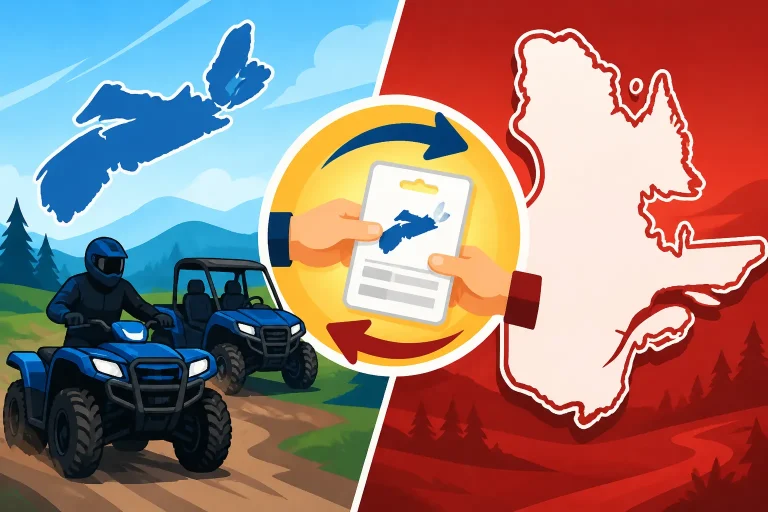
A calendar-year permit can create a particular puzzle for visitors. A rider may have a valid permit at home but still need to check whether Nova Scotia recognizes it. Reciprocity arrangements are not universal, and they can change. Being from a neighbouring province does not, by itself, make a home permit valid on Nova Scotia trails.
Before travelling, confirm the current rules for your home province and the kind of riding you plan to do. Do not rely only on an old permit, a previous trip, or a friend’s understanding of the rules. Check the current information from the organization responsible for the Nova Scotia permit and the relevant association or authority in your home province.
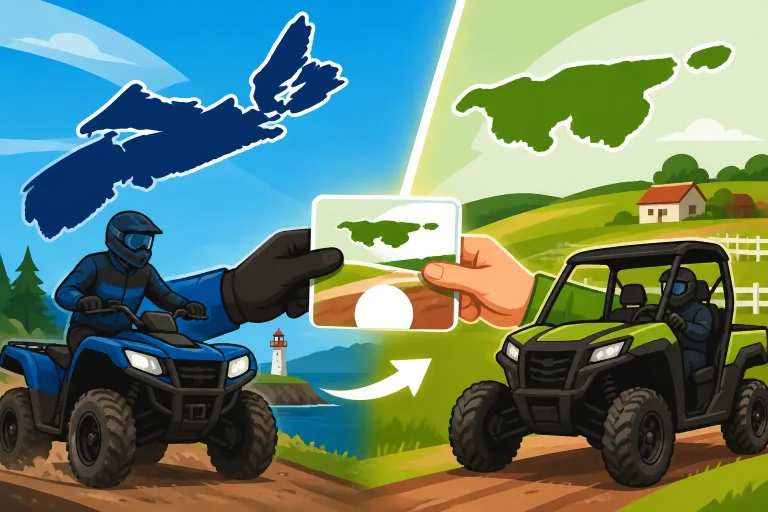
For riders from New Brunswick, review [Nova Scotia Riders Visiting New Brunswick] for the cross-border context and verify the current requirements before crossing. For PEI, the relevant details are in Nova Scotia Riders Visiting PEI. Ontario visitors can check Is an Ontario Permit Honoured in Nova Scotia?. These arrangements should be checked separately; permission in one direction does not necessarily establish the rule in the other.
A short-term permit may suit a short visit
If you are coming to Nova Scotia for a limited holiday, investigate the visitor permit rather than assuming you need the same annual option as a resident. Check who is eligible, what dates the permit covers, whether it applies to the trails you intend to ride, and what documents you must carry.
A short-term permit is not automatically a shortcut around other requirements. You may still need to meet applicable insurance, registration, safety training, and equipment rules. You also need to respect trail closures and local access conditions. The visitor permit addresses only the permit question described by its terms.
If your visit stretches into regular or extended use, revisit the permit choice rather than assuming the visitor option continues to fit. A short stay and ongoing local riding may be treated differently under the applicable rules. Ask the permit issuer if your circumstances are unclear.
Reciprocity is not the same as trail access
Even when a permit from another jurisdiction is recognized, that does not mean every Nova Scotia route is open to you. Trail-specific restrictions, land access, machine requirements, and rider rules still matter. Check the route before travelling, especially if your plan depends on connecting several trail systems or crossing a municipal boundary.
Likewise, a Nova Scotia permit should not be assumed to provide access in another province. If your itinerary crosses a provincial border, check each jurisdiction’s rules before departure. Keep proof of the relevant permits accessible, along with insurance and registration documents. Avoid waiting until you are stopped at a trail entrance to find out that your permit is not accepted there.
A practical way to plan your permit year
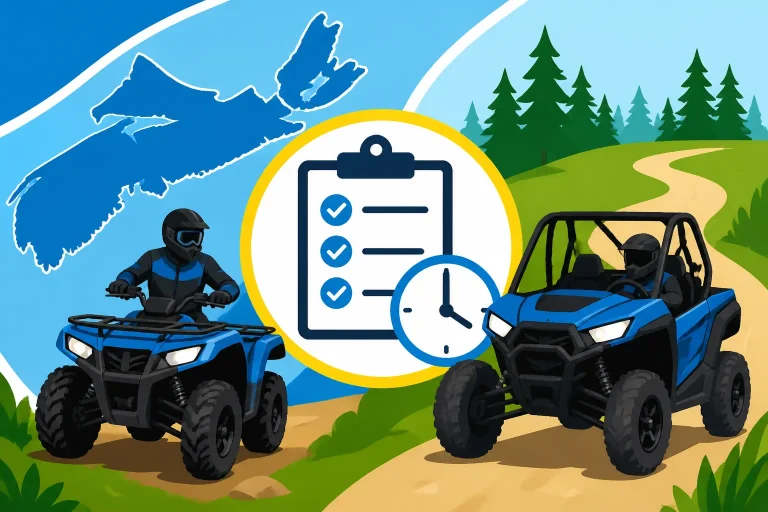
The calendar-year term is easiest to manage when you treat the permit as one part of an annual riding checklist. Before the season begins, confirm the dates, buy the correct option, and check what else you and your machine need. Before a trip, check the trail status and local access conditions. At the end of the year, make a note to arrange the next permit if you expect to ride again.
A useful checklist:
- Confirm the permit type. Decide whether club membership, permit-only access, or a visitor option fits your situation.
- Read the expiry date. Do not infer a rolling year from the purchase date.
- Check coverage for every machine. Ask whether additional machines need separate permits.
- Keep related documents distinct. Registration, trail permits, insurance, and safety certificates serve different purposes.
- Verify cross-border rules. Check reciprocity before travelling rather than relying on an old arrangement.
- Check route conditions. A valid permit does not override a closure or create access to a route that is not authorized.
- Save proof of purchase. Keep the confirmation or permit letter where you can find it and follow the issuer’s instructions for carrying it.
- Plan the next calendar year. If you expect to ride after December 31, confirm the new permit requirements before heading out.
Small practical steps can make the paperwork less of a distraction. Keep a dedicated document pouch or a secure spot in the vehicle for the permit instructions and related papers. If you shop on Amazon for a waterproof pouch, check that it fits the documents without folding them in a way that obscures important information. A pouch is only an organizational aid; it does not change what must be carried or how a permit must be displayed.
A calendar reminder can help with the year-end transition. Set it before the expiry date, not on the first day you hope to ride in the new year. If you order accessories such as a small folder or weather-resistant storage case through Amazon, choose one that stays secure during transport and does not interfere with the machine’s controls. Keep documents protected from moisture, but accessible if an officer or trail representative asks to see them.
For trip planning, separate the permit question from the route question. First confirm that the machine and rider qualify for the permit. Then check whether the intended trails are open and accept it. Finally, verify that the vehicle’s registration and insurance are in order. That sequence is more reliable than treating a permit as an all-purpose pass.
If the permit arrives by mail or email, review the instructions promptly. Confirm that the name, machine information, and validity dates are correct where applicable. Keep a copy of the receipt in a safe place, but do not assume a receipt alone replaces the permit unless the issuer says it does. When something is missing or unclear, contact the permit issuer before riding rather than trying to resolve it at the trailhead.
Use Amazon only as a source for ordinary storage or riding accessories, not for interpreting permit requirements. A document holder cannot compensate for an expired permit, and buying a new sticker or label does not alter the permit’s validity. The authoritative terms are the ones issued for the permit you actually hold.
The main takeaway is straightforward: an annual Nova Scotia trail permit generally follows the calendar year, so buying it late does not usually move its expiry into the following year. Confirm the exact term, select the right permit for your riding pattern, and keep trail access, vehicle registration, insurance, and training requirements separate in your planning.
Disclaimer
This article is for general informational purposes only and does not constitute professional advice. Laws, prices and regulations vary by location and change over time. Consult a qualified professional for guidance on your specific situation.