Nova Scotia Riding Near Antigonish
Antigonish is a handy base for exploring northeastern Nova Scotia, but nearby trails do not all connect, allow the same machines, or stay open in every season. This guide explains how to plan a ride around Antigonish, check access before unloading, choose a realistic route, and avoid the common mix-ups that can turn a pleasant day out into a frustrating one.
Planning an ATV Ride Near Antigonish
Think in ride areas, not assumed continuous routes
Antigonish sits within reach of varied rural and coastal landscapes, and riders may look toward areas such as Cape George, Pomquet, Heatherton, Monastery, and parts of Guysborough County when planning a day out. The important distinction is that being near a road, community, or visible trail corridor does not mean a route is open to ATVs. Trails may be managed by different clubs, cross private land, or end without connecting to another rideable segment.
Build your plan around specific, confirmed trail sections rather than drawing a long line between two place names on a map. A route that looks continuous on a screen may run into a closed gate, a private woodlot, a road where off-highway vehicle travel is not allowed, or a segment designated for a different use. Before leaving, identify the trailhead you intend to use, the turnarounds or exits available, and any places where the route depends on a road-trail connection.
For a broader picture of how organized riding routes are maintained and managed across the province, start with [Nova Scotia ATV Trails: The ATVANS Network]. It can help you understand the role of the provincial network, but it is not a substitute for checking whether the exact segment you want to ride is open and suitable for your machine.
Choose a ride that fits your day and your group
A short outing close to Antigonish can be a better choice than an ambitious all-day loop, particularly if it is your first time riding in the area. Shorter rides make it easier to account for unfamiliar junctions, changing trail surfaces, fuel needs, and a machine that is running differently than expected. They also give your group more flexibility if someone needs a break or weather turns unpleasant.
Before choosing a distance, consider the slowest machine and least experienced rider in the group. A route that feels easy to someone who rides every weekend may be tiring for a new rider, a youth, or a person operating a heavier side-by-side on a narrow corridor. Ask whether the trail is appropriate for your machine’s width and ground clearance, and whether all riders are comfortable with the likely surface and pace.
A practical plan has a clear start point, a reasonable turnaround time, and at least one way to shorten the ride. That matters even on a familiar-looking route: a group can lose time at confusing intersections, stop for a repair, or find that a trail is wetter than expected. Leave someone at home with your planned area and expected return time, and agree on what the group will do if you become separated.
How to Check Trail Access and Conditions
Confirm the status of each trail segment
Trail access can change because of maintenance, a washout, a landowner request, seasonal conditions, or a temporary closure. A route that was open the last time you visited may not be open now. Check current club or network information before driving to a trailhead, and look for notices that apply to the precise section you plan to use—not only the general area.
If a notice is unclear, ask the club or organization responsible for that section. A map line, an old social post, or a track saved on a phone can be useful for orientation, but none of those establishes that riding is permitted today. If you cannot confirm access, choose another route rather than treating uncertainty as permission.
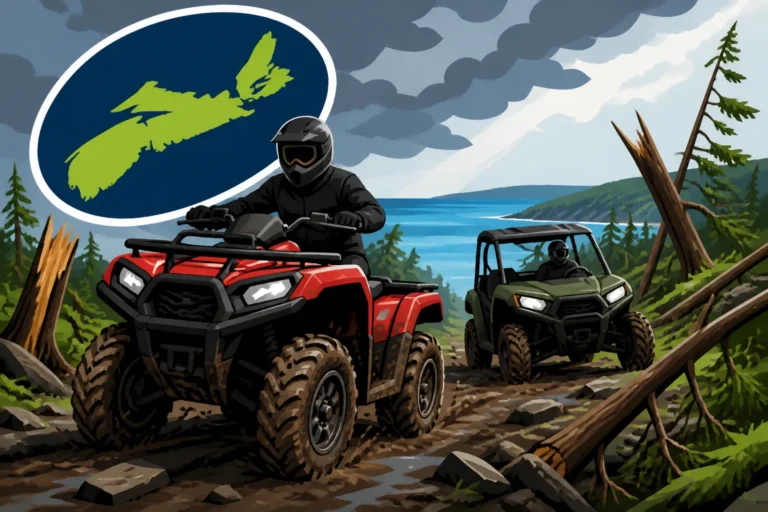
This extra check is especially worthwhile after heavy rain, a storm, or a spring thaw. Wet ground can be damaged quickly by repeated traffic, and a route may be closed to protect the trail or nearby property. Use [Nova Scotia Trail Conditions and Closures] as a reminder to make trail status part of your planning, not an afterthought once your machine is already off the trailer.
Understand maps, boundaries, and private land
Digital maps are helpful for locating roads, communities, and possible trail corridors, but they can leave out important local details. A line on a map might show an old track, a route intended for another user group, or a trail that crosses land where permission has changed. Carry a reliable map for navigation, but confirm permissions through the relevant club or land manager.
Some riders use tools such as onX Offroad to explore route options and keep track of their position. Treat any app as a planning and navigation aid—not as proof that a trail is open, legally accessible, or maintained for ATVs. Map layers may be incomplete, and boundaries can be difficult to interpret on a small screen. If a posted sign, gate, or local direction conflicts with what an app suggests, do not ride through until you have confirmed access.
On private woodlots, follow the permission and route instructions you have been given. Stay on the marked corridor, leave gates as you found them, and do not create a detour around a muddy or blocked section. Riding around a wet patch can widen the trail and damage the surrounding ground, creating a bigger problem for the landowner and everyone who hopes to use the route later. For more on responsible local access, see [Nova Scotia Trails That Cross Private Woodlots].
Choosing a Route and Preparing Your Machine
Match the route to your ATV or side-by-side
A recreational quad and a wide side-by-side do not always fit the same trail comfortably. A narrow wooded corridor, tight turn, or small bridge may be manageable on one machine but awkward or unsuitable on another. Before setting out, check any width, vehicle-type, or access guidance for the route. Do not assume that a trail shown as an ATV route will suit every UTV.
Think beyond whether your machine can physically squeeze through. You also want room to turn around without damaging the trail, safe clearance over rocks and ruts, and enough space to pass other users where passing is permitted. If the route includes narrower sections, ask whether a side-by-side is allowed and whether a different trail would be a better fit for your group.
A table can help you make that decision before loading up:
| Planning question | Why it matters near Antigonish | What to do |
|---|---|---|
| Is this exact trail segment open? | Access can differ from one section to the next | Check a current club or land-manager notice |
| Does the route allow my machine type? | Trail width and restrictions can vary | Confirm quad or side-by-side suitability |
| Is the surface appropriate for my group? | Mud, rocks, and rough sections can slow less experienced riders | Choose a route and pace the whole group can manage |
| Is there a safe turnaround or exit? | A closure or breakdown can make a long out-and-back difficult | Identify alternatives before departure |
| Can I refuel before range becomes a concern? | Rural distances and riding conditions affect fuel use | Start with a full tank and plan a conservative range |
If you ride a UTV with passengers, also consider the group’s comfort and the machine’s load. Extra passengers or gear can affect handling and clearance, especially on uneven ground. Stay within the manufacturer’s operating guidance, secure loose equipment, and make sure each person understands where to sit and how to hold on before moving.
Carry the equipment that solves common trail problems
A basic preparation check is more useful than packing for every imaginable emergency. Start with the machine’s condition: inspect tires, brakes, lights, steering, fluids, and visible belts or hoses as appropriate for your model. Check that the winch, if fitted, works before you need it, and carry the recovery gear you know how to use safely.
Bring enough water, food, weather-appropriate layers, a first-aid kit, a charged phone, and a way to navigate if mobile coverage is poor. A paper map or offline map can still be valuable when a phone loses service or its battery drains. If your group is riding unfamiliar trails, agree on a meeting point and a simple plan for what happens if one machine has a problem.
For a longer ride, consider spare items suited to your machine and the conditions: a tire repair kit, basic tools, a tow strap, and a small amount of emergency fuel where carrying it is safe and lawful. Do not rely on another rider having the right equipment. A group that has agreed in advance who carries what can avoid bringing a pile of unnecessary gear while still covering the basics.
Local Access, Etiquette, and Safety
Respect trail users and the communities around the route
Trails and rural roads around Antigonish are shared spaces. Depending on the corridor, you may meet other ATV riders, hikers, cyclists, snowmobilers, landowners, workers, or people using a road for local travel. Slow down when visibility is limited, approach blind corners carefully, and follow posted signs and instructions. If you meet another user, communicate clearly and give people room.
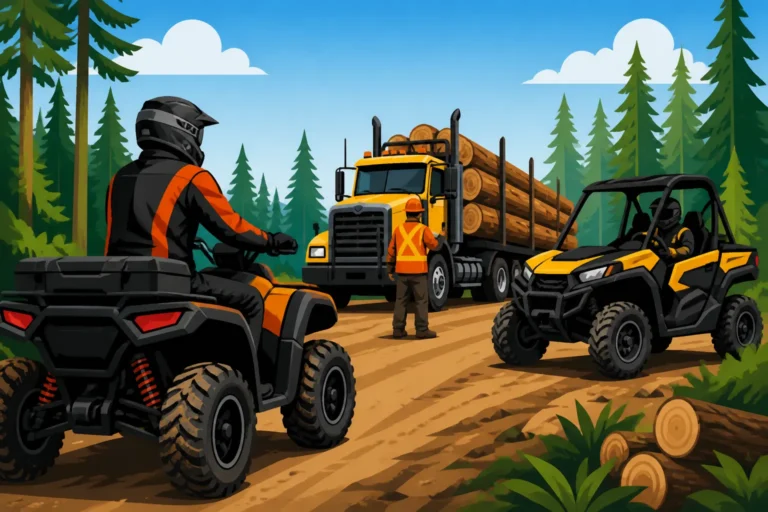
Noise and dust can matter just as much as access. Homes, farms, and small communities may sit close to a route, and a group moving quickly can create a lot of disturbance. Keep your machine in proper working order, avoid unnecessary revving, and reduce speed near homes and trailheads. If a route passes a working area, be prepared to stop and follow the directions of people managing the work.
Good etiquette also protects future access. Stay on the marked trail, pack out anything you bring in, avoid spinning tires, and never treat a gate or barrier as a suggestion. [Nova Scotia Trail Etiquette Locals Expect] is useful background if you are new to riding on shared corridors or want to set expectations before bringing a group out.
Know when a trail ride is not a road ride
A trail connection does not automatically give you permission to ride along a public road. Road-trail access is governed by specific rules and designated routes, and those rules may differ from the rules on a club trail. Check the local requirements before planning to use a road section between two trail areas. Do not assume that a shoulder, woods road, beach, or rail corridor is open to off-highway vehicles because it appears convenient.
Where a road-trail connection is authorized, treat it as a distinct part of the trip. Confirm which road or section is included, what operating rules apply, and whether your machine and rider meet the requirements. If your route depends on crossing a road, confirm that the crossing is allowed and understand how to make it safely. The detailed overview in [Nova Scotia Road Trail Rules Explained] can help you separate general trail riding from designated road-trail use.
If a route does not clearly authorize your machine to use a road, find another legal connection or return the way you came. A short road shortcut can create a safety and compliance problem that is not worth the saved time. Planning a route that stays on confirmed trails is the simplest way to avoid that pressure while you are already out riding.
Making a Full Day of Riding Near Antigonish
Sort out the practical details before you leave home
A successful day starts with the less exciting details: parking, trail access, machine paperwork, permits, insurance, and fuel. Check the requirements that apply to the kind of riding you plan to do. Registration, insurance, and a trail permit serve different purposes, so do not assume that having one means you have the others. If you are unsure where to start, [Nova Scotia Trail Permits From ATVANS] explains the trail-permit side of planning, while [Finding a Member Club Near You in Nova Scotia] can help you identify a local organization to contact about its routes.
Confirm that your planned trailhead can accommodate your trailer and that you are not blocking a gate, driveway, or working area. Arrive with enough daylight to unload and get oriented without rushing. If the parking area is busy, keep the group organized and avoid leaving straps, packaging, or equipment behind. A tidy trailhead is a small courtesy that makes a better impression on the next rider and the people who live nearby.
Fuel planning deserves particular attention on rural rides. Your machine’s range can change with mud, hills, load, tire choice, and how often you stop and start. Do not plan to use every bit of the range suggested by a calm ride on easy ground. Find out where fuel is available before departure, carry only what can be transported safely, and turn back while you still have a comfortable reserve. [Nova Scotia Fuel Range Between Villages] offers a useful way to think about fuel planning in a rural riding area.
Build a flexible itinerary rather than a rigid mileage target
A workable itinerary for a first visit might be to choose one confirmed trail area, ride a modest out-and-back, and leave time for a meal or fuel stop in Antigonish. If the group is comfortable and trail conditions are good, you can extend the outing using another verified segment. If a section is closed or wetter than expected, you can shorten the day without feeling that the whole plan has failed.
For a group travelling from elsewhere in Nova Scotia, consider separating the drive from the ride in your schedule. Towing to a trailhead, unloading, preparing the machines, and getting everyone equipped takes time. A plan that looks like a full day of riding on paper can become rushed if you have also scheduled a long drive, a late lunch, and a return trip after dark.
Leave room for a change of plan. A local closure, mechanical problem, fog, rain, or tired rider can make a shorter ride the right call. If you are hoping to explore beyond Antigonish toward Guysborough County, check the route and access separately rather than assuming the two areas form one continuous network. [Nova Scotia Riding in Guysborough County] and [Eigg Mountain Trails Association] are useful starting points for investigating nearby riding opportunities, but confirm current access directly before setting out.
Disclaimer
This article is for general informational purposes only and does not constitute professional advice. Laws, prices and regulations vary by location and change over time. Consult a qualified professional for guidance on your specific situation.