Nova Scotia Rules for Riding to a Gas Station
We've all been there: out on a fantastic trail ride, the sun setting, the kilometres flying by, and then that dreaded fuel light flickers on. Suddenly, the serene experience turns into a low-grade panic. You know there's a gas station just a kilometre or two down the road, but the thought of taking your ATV or UTV onto a paved road in Nova Scotia brings a wave of questions and uncertainty. This guide is here to clear up that confusion, explaining exactly when and how you can legally navigate your off-highway vehicle to fill up, and what you need to know to avoid a ticket.
Navigating Nova Scotia's Road Trail System to Reach Services
Riding an off-highway vehicle (OHV) on public roads in Nova Scotia isn't a free-for-all, and for good reason. Our beautiful province has specific regulations designed to keep everyone safe, both riders and other road users. However, the provincial government, recognizing the practical needs of riders, has made provisions for accessing essential services like fuel, food, and lodging through what are known as "road trails" or designated access points. It's not about joyriding on the highway; it's about connecting the dots responsibly.
The Legal Framework: Road Trails Act
The ability for off-highway vehicles to legally touch pavement in Nova Scotia stems primarily from the Off-Highway Vehicles Act and, more specifically, the Road Trails Act. This legislation was a game-changer for riders, as it provided a structured and legal pathway for OHVs to use certain sections of public roads. Before this, riders were often left in a grey area, sometimes resorting to questionable routes or even risking fines just to get from one section of trail to another or to access necessary services.
The intent behind the [Nova Scotia Road Trails Act Explained] is crucial to understand. It's not about turning every road into an OHV trail. Instead, it creates specific, approved corridors, often shorter segments, that act as connectors or allow direct access to communities and services. These aren't simply "any road you want to take"; they are specifically designated areas where municipalities have opted into the system, opening up certain streets for shared use. When you're running low on fuel, understanding that a specific road segment is part of this network is key to staying legal. The Act clarifies where you can go and, just as importantly, where you absolutely cannot, preventing dangerous situations on high-speed provincial highways or busy urban streets.
Designated Roadways and Exemptions for Access
So, how does this apply when you're looking for a gas station? The Road Trails Act identifies two main scenarios where OHVs might legally be on a public road:
- Designated Road Trails: These are specific segments of municipal or provincial roads that have been formally designated and signed for OHV use. They are part of the larger trail network, often connecting trail systems or providing access through a community. If a gas station is located directly on one of these designated road trails, then you're generally good to go, provided you follow all the rules for road trail operation. Many communities have embraced these, creating fantastic opportunities for riders to experience more of the province. [Nova Scotia Road Trails: Where You Can Ride] is an excellent resource for finding these.
- Shortest Practicable Route for Essential Services: This is the critical piece for those emergency fuel stops. Even if a road isn't a designated "road trail," the Act allows an OHV operator to travel on the shoulder, or if no shoulder exists, on the travelled portion of a public highway, for the shortest practicable distance to get to or from an essential service. This includes a gas station, a repair shop, food, or lodging. The emphasis here is on "shortest practicable route" and "essential service." You can't take the scenic route, and you can't just decide you want to cruise around town. It's about necessity, not leisure. This provision is a lifesaver when you're deep in the woods and the only gas station for miles is just off the main road. Remember, even with this exemption, you're still on a public road, and all other rules of the road, including speed, safety equipment, and yielding, apply rigorously.
When you're eyeing that gas station sign from the trail, take a moment to consider if the route to it falls under one of these two categories. Is it a clearly marked road trail, or is it a direct, unavoidable short hop on a public road to an essential service? Knowing the difference can save you a significant headache and potential fine. For example, if you're on a multi-use rail trail and see a gas station across a provincial highway, you likely can't just cross the highway and ride along its shoulder. However, if the trail leads directly to a secondary road with a gas station a few hundred metres down, you might be able to use the "shortest practicable route" provision. [Crossing a Road Legally in Nova Scotia] also outlines specifics for intersection navigation.
The Specifics of Riding Your Machine to a Gas Station
So, you've identified a legal route to the pumps. Great! But getting there isn't just about pointing your machine and going. There are very specific operational and equipment requirements you need to meet to ensure your journey is safe and compliant with Nova Scotia law. This isn't just common sense; it's the law, and police officers are well-versed in these nuances.
Speed Limits and Road Etiquette on Road Trails
The most crucial rule when operating an OHV on any public road segment, whether a designated road trail or a short access route, is the speed limit. In Nova Scotia, when your OHV is on a road trail or utilizing the essential services access exemption, your speed is capped at 25 kilometres per hour (km/h). That's right, it's not the posted speed limit for cars; it's a much slower, controlled pace. This limit is in place to ensure the safety of all road users, as OHVs handle differently on pavement than cars do, and their presence can be unexpected by other drivers. [25 km/h on a Road Trail] is a hard and fast rule.
Beyond speed, road etiquette is paramount:
- Single File: Always ride in single file, never side-by-side, even if the road seems wide enough.
- Yield to Traffic: You must yield the right-of-way to all other vehicular traffic, including bicycles and pedestrians. You are the guest on the road. [Nova Scotia Riders Yield to Traffic] is a fundamental principle.
- Stay to the Right: Keep as far to the right as safely possible. If there's a usable shoulder, utilize it.
- No Passing: Do not attempt to pass other vehicles, including other OHVs, on a road trail.
- Signage: Pay close attention to all road signs and traffic signals, just as you would in a car. Even if you're only going 25 km/h, stopping at a stop sign or red light is non-negotiable.
Imagine you're slowly making your way to the gas station, following the 25 km/h rule. A car comes up behind you. Your responsibility is to maintain your speed and position, allowing them to pass safely when the conditions are right. You shouldn't swerve or accelerate; just be predictable. This is especially true on rural roads where curves and sightlines can be limited. Operating with respect and caution is not just about avoiding a ticket; it's about being a good ambassador for the entire OHV community.
Essential Equipment for Legal Road Use
Taking your OHV onto a public road, even for a short distance, means it needs to be equipped for shared road use. This goes beyond what you might typically use on a remote trail.
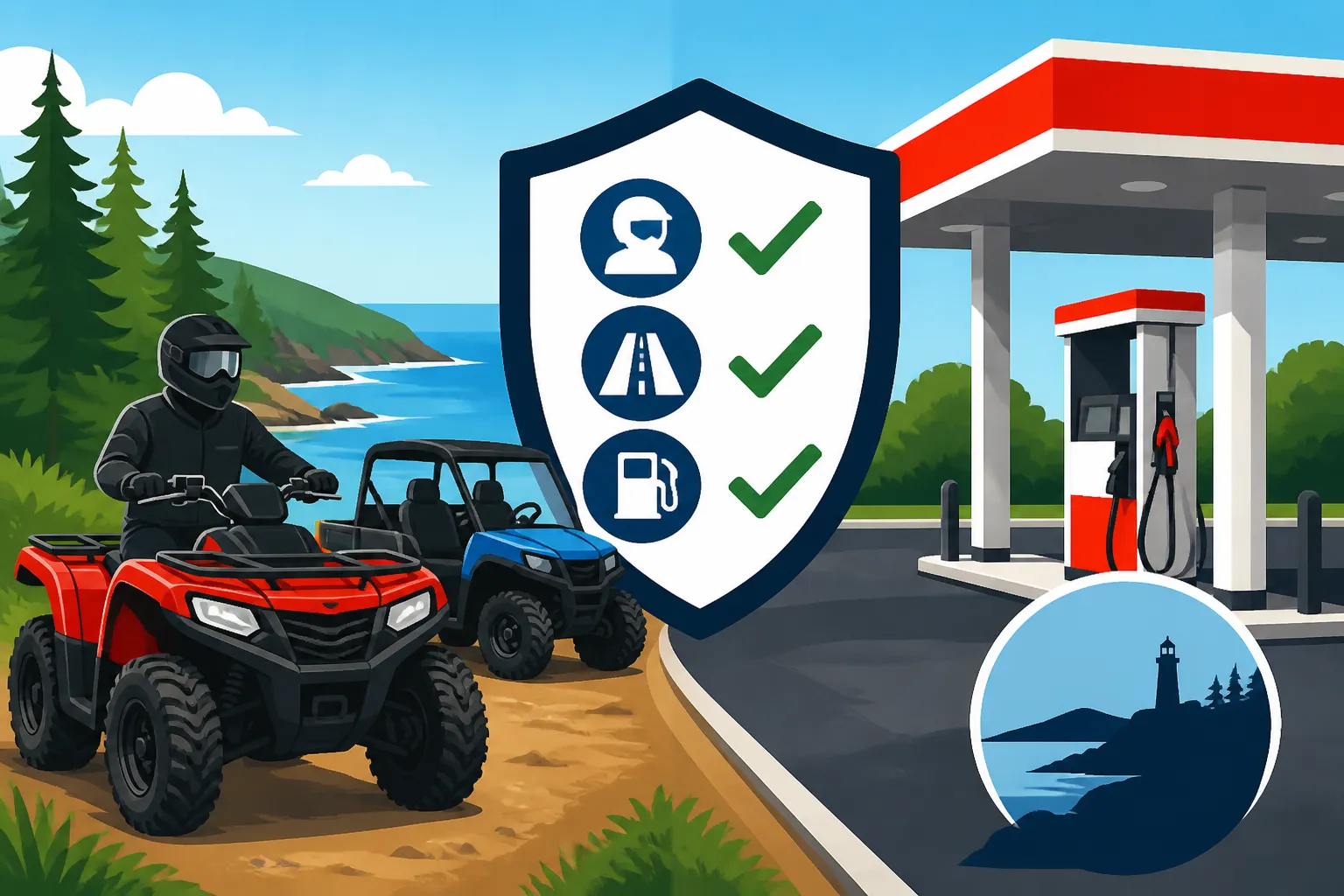
- Headlights and Tail Lights: These aren't just for night riding. Your machine must have a working headlight and tail light that are illuminated any time you're on a public road, regardless of the time of day. This significantly enhances your visibility to other drivers. [Nova Scotia Lighting Requirements] specifies these need to be visible at certain distances.
- Brakes: Your OHV must have fully functioning brakes, capable of stopping the machine safely. This might seem obvious, but well-maintained brakes are critical when you're sharing the road with faster vehicles.
- Muffler: The muffler must be in good working order and not modified to be excessively loud. Noise complaints are a real issue in communities, and loud machines can draw unwanted attention, not to mention violate noise ordinances.
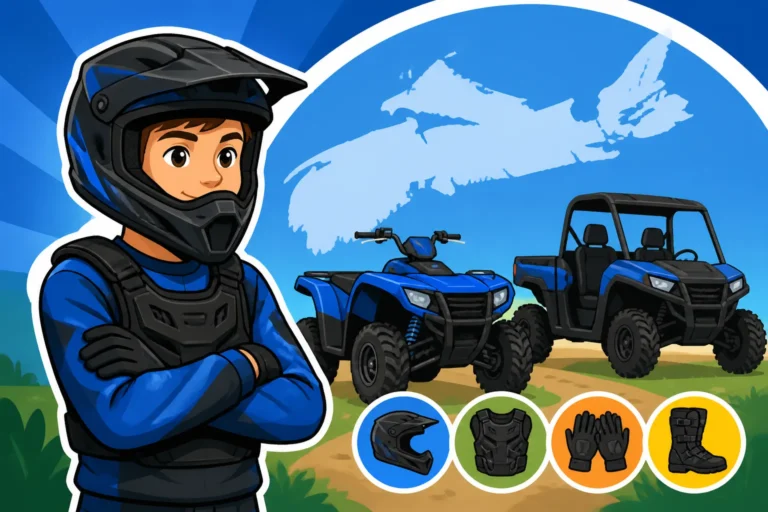
- Helmet: A properly fitted and approved helmet is mandatory for all OHV operators and passengers in Nova Scotia, whether on a trail or a road. This means a helmet meeting DOT, CSA, Snell, or BSI standards. [Nova Scotia Helmet Law for Riders] has no exceptions for road use.
- Mirrors: While not explicitly always required for all OHV operations, having at least one rear-view mirror (and ideally two) is highly recommended for road segments. It allows you to monitor traffic behind you, which is crucial for safety at slower speeds.
- Tires: Your tires should be in good condition, without excessive wear, and appropriate for the terrain. While knobby tires are great for mud, ensure they can safely handle asphalt for short stretches without causing control issues.
- Overall Machine Condition: Ensure your machine is mechanically sound. No loose parts, no major fluid leaks, and everything should be securely fastened. A well-maintained machine not only performs better but is also safer. Components from reliable brands like SuperATV can help ensure your machine's durability and compliance, especially if you've upgraded parts like heavy-duty axles or robust A-arms that can withstand varying terrain, including brief road transitions.
Failing to have proper equipment can lead to a roadside stop, a fine, and potentially your ride being parked. An officer might observe a missing headlight, a loud exhaust, or an unhelmeted rider and initiate a stop, immediately checking for all compliance points.
Documentation, Insurance, and Rider Responsibilities
Having your machine properly equipped and operating it cautiously are two critical pieces of the puzzle, but they're not the only ones. Before you even think about putting a tire on a paved road, you need to ensure your paperwork is in order and you understand your responsibilities as an OHV operator in Nova Scotia. This is where many riders get caught out, sometimes unknowingly.
What You Need to Carry With You
Think of your OHV like a car when it comes to documentation for road use. You wouldn't drive your car without your licence, registration, and proof of insurance, and the same applies to your OHV on a road trail or access route.
- OHV Certificate of Registration: Your off-highway vehicle must be properly registered with the Registry of Motor Vehicles. This is an annual requirement, and operating an unregistered machine carries significant penalties. Always carry your physical certificate, or at least a clear digital copy if permitted by law enforcement for quick verification. [Nova Scotia Requires Registration and Insurance] is non-negotiable.
- Vehicle Permit: Along with the certificate, you'll have a vehicle permit, which is also renewed annually. This permit, often a small card, contains vital information about your machine and its registration status.
- Proof of Insurance (Pink Card): Every OHV operated in Nova Scotia must carry valid liability insurance. Your insurer will provide you with a "pink card" or similar document as proof. This card must be carried with you on every ride. [Nova Scotia Pink Card Rules] are very specific about this. If you don't have it, you could face fines, even if you are insured.
- Driver's Licence: This is a big one. To operate an OHV on a designated road trail or public highway (even for the "shortest practicable route" exemption), you must possess a valid full driver's licence. A learner's permit or a restricted licence is generally not sufficient for this type of operation. This ensures that operators on shared roads have demonstrated a fundamental understanding of road rules and defensive driving. [Do You Need a Licence for an ATV in Nova Scotia?] explicitly covers this requirement.
An officer, seeing an OHV on a public road, will undoubtedly ask for these documents. Being prepared and having everything readily accessible not only makes the interaction smoother but also demonstrates you're a responsible operator. Imagine trying to explain you have insurance, but your pink card is at home, or your registration expired last month – it won't go over well.
Understanding Insurance for Road Trail Use
Nova Scotia has specific insurance requirements for off-highway vehicles, especially when they touch public roads. Since 2007, it's been mandatory for all OHVs to have a minimum amount of third-party liability insurance.
- Minimum Liability: The provincial requirement is generally $500,000 in third-party liability coverage. This means that if you are at fault in an accident that causes injury or damage to another person or their property, your insurance will cover costs up to this amount. [Nova Scotia's $500,000 Liability Minimum] is a significant figure, underscoring the potential for serious consequences if you're not adequately covered.
- Comprehensive Coverage: While liability is mandatory, many riders opt for more comprehensive coverage, which might include collision, specified perils, or all-perils coverage. This would protect your own machine against damage or theft.
- Mixed-Use Policy: It's crucial to discuss your riding habits with your insurance broker. Ensure your policy covers you adequately for both off-road trail riding and the occasional, legal use of public roads for accessing services. Some standard OHV policies might have exclusions that could leave you vulnerable if an incident occurs on a paved road. It's always best to be transparent about how and where you ride your machine to ensure you have the right kind of coverage.
Riding uninsured is a costly mistake. Not only are the fines substantial, but if you're involved in an accident, you could be personally liable for potentially millions of dollars in damages. This is a risk no rider should ever take.
The Importance of a Safety Certificate
While not strictly required for every OHV operator on the road, having a valid safety certificate is a cornerstone of responsible OHV operation in Nova Scotia. For anyone 16 years of age and older who acquired their machine after April 2006, a Canada Safety Council (CSC) ATV safety certificate (or an equivalent approved course) is mandatory to operate an OHV.
- Youth Riders: For younger riders (6 to 15 years old), specific safety training and supervision rules apply, and they are generally restricted from road use.
- General Competence: While the certificate primarily focuses on off-road safety, the skills and knowledge gained are invaluable for any riding scenario, including brief stints on public roads. Understanding machine dynamics, hazard perception, and responsible operation are universal safety principles. [Nova Scotia Safety Certificates Are Mandatory] for most riders these days, and it's simply a good idea for everyone. It demonstrates a commitment to safe riding practices, which can only benefit you when sharing roads with other traffic.
Avoiding Penalties and Common Pitfalls
Navigating the rules for riding your OHV to a gas station in Nova Scotia requires diligence. While the provisions are there to help riders, they come with clear boundaries. Ignoring these boundaries can quickly turn a quick fuel stop into a costly and frustrating encounter with law enforcement. Understanding the potential pitfalls and adopting best practices will ensure your ride stays enjoyable and legal.
Fines for Non-Compliance
The penalties for operating an OHV outside of the regulations in Nova Scotia are significant. An officer has the authority to issue tickets, and in some cases, even seize your machine. Here are some of the common infractions and their consequences:
- Unregistered Machine: Operating an OHV on any public land or road without current registration is a serious offense. Fines can range from a minimum of $250 and go up significantly. [Nova Scotia Fines for an Unregistered Machine] can quickly add up, easily exceeding the annual registration cost many times over.
- Uninsured Machine: This is perhaps one of the most severe infractions. Riding without valid liability insurance can lead to hefty fines, typically starting at a minimum of $500, and potentially much higher depending on the circumstances. [Nova Scotia Penalties for Riding Uninsured] also carry the risk of future insurance rate increases and even potentially having your machine impounded.
- No Valid Driver's Licence (for Road Use): If you're caught on a road trail or using the essential services exemption without a valid full driver's licence, you could face fines and potentially points against your driving record, similar to operating a car without the correct licence.
- Exceeding Speed Limit (25 km/h): Going faster than the 25 km/h limit on a road trail or access route is a violation and can result in a speeding ticket. This isn't just a minor infraction; it undermines the safety purpose of the speed restriction.
- Improper Equipment: Missing a working headlight or tail light, having a modified exhaust that's too loud, or not wearing an approved helmet can all lead to fines.
- Operating on Prohibited Roads: Taking your OHV onto a provincial highway or a municipal road that isn't designated as a road trail or doesn't fall under the essential services exemption is a clear violation, often carrying substantial fines.
It's not uncommon for an officer to issue multiple tickets if a rider is found to be non-compliant on several fronts. For example, an unhelmeted rider on an unregistered, uninsured machine exceeding the speed limit could face a stack of fines that would ruin anyone's day, not to mention their bank account.
Best Practices for Fuel Stops
To ensure your journey to the gas station is smooth and legal, integrate these best practices into your riding routine:
| Practice | Description | Why It Matters |
|---|---|---|
| Plan Your Route | Before heading out, check maps for designated road trails or plan essential service access points. Know exactly where gas stations are located relative to your trails. | Avoids guesswork and ensures you're using legal routes, preventing unnecessary risks or infractions. |
| Monitor Fuel Levels | Don't wait for the low fuel light. Keep an eye on your gauge and plan to refuel well before you're running on fumes. Carry extra fuel if venturing into remote areas. | Reduces the urgency and stress of finding fuel, allowing for a more relaxed and compliant approach to road use. |
| Be Highly Visible | Wear bright, reflective gear, especially if riding near dusk or dawn. Ensure your lights are on, even in daylight. Consider adding aftermarket lighting from brands like SuperATV for enhanced visibility if your stock lights are dim. | Maximizes your chances of being seen by other road users, reducing the risk of collisions, especially given your slower speed. |
| Exercise Extreme Caution | Assume other drivers don't see you. Be predictable, signal turns if your machine allows (or use hand signals), and maintain a safe following distance from vehicles ahead. Slow down further in residential or congested areas. | OHVs are less visible and slower than cars. Defensive riding is crucial to mitigate risks in a shared-road environment. |
| Respect Local Communities | When riding through a community to access a gas station, be mindful of noise levels and dust. Keep your speed low, and avoid sudden accelerations or aggressive riding. | Good neighbourly conduct helps maintain positive relationships between the OHV community and local residents, which can prevent negative perceptions and potential restrictions on future road trail access. |
| Keep Papers Accessible | Store your registration, permit, insurance, and licence in a waterproof, easily accessible pouch on your person or machine. | Facilitates quick and smooth interactions with law enforcement if you are stopped, demonstrating responsibility and compliance. |
| Maintain Your Machine | Regularly inspect your machine for mechanical soundness, especially brakes, lights, and tires. Ensure your exhaust system is stock or compliant with noise regulations. Aftermarket parts, like heavy-duty components from SuperATV, can contribute to a machine that reliably handles varying conditions, including road sections. | A well-maintained machine is safer, more reliable, and less likely to break down or draw unwanted attention from authorities due to mechanical issues or excessive noise. |
By internalizing these rules and practices, you can confidently navigate Nova Scotia's roads to access essential services, keep your machine fueled, and continue enjoying the incredible trails our province has to offer. Safe riding is always the best riding!
Disclaimer
This article is for general informational purposes only and does not constitute professional advice. Laws, prices and regulations vary by location and change over time. Consult a qualified professional for guidance on your specific situation.