What a Nova Scotia Officer Can Ask to See
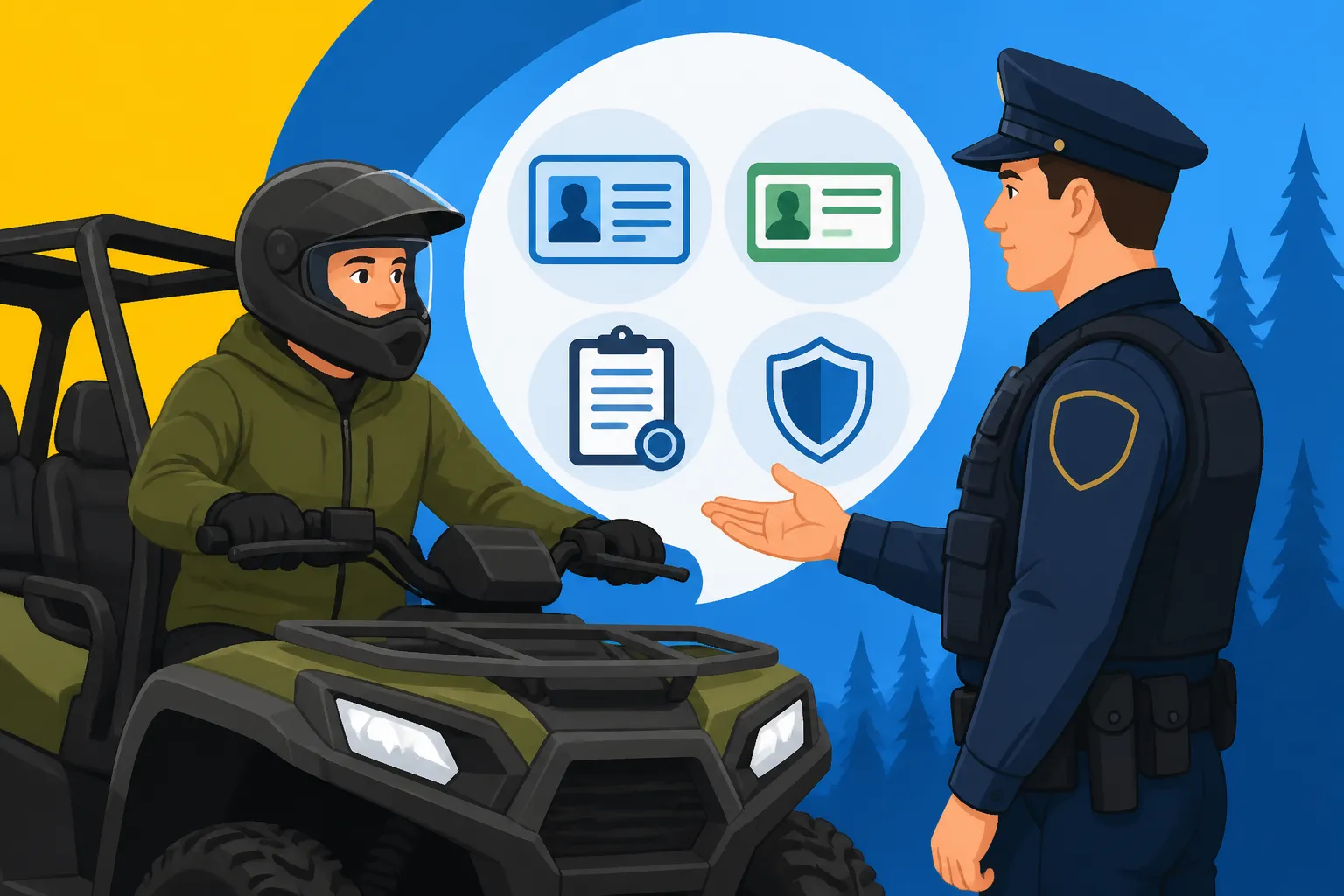
It's an all too common scenario: you're out enjoying a beautiful Nova Scotia trail on your ATV or UTV, soaking in the sights, when suddenly, you see those flashing lights or a uniformed officer waving you over. A knot tightens in your stomach. What do they need to see? What documents should you have? This guide will walk you through exactly what a Nova Scotia officer can legitimately ask for, helping you ride with confidence and avoid unnecessary stress or fines.
The Essentials: Registration and Insurance
When you're stopped by an officer while riding your off-highway vehicle (OHV) in Nova Scotia, the very first things they'll want to verify are that your machine is properly registered and insured. These aren't just suggestions; they're legal requirements designed to keep everyone safe and accountable on our trails and designated road sections. Thinking ahead and having these documents readily accessible can make a world of difference in how quickly and smoothly your interaction with law enforcement goes.
Proof of Registration Is Non-Negotiable
Having a valid registration for your ATV or UTV is absolutely critical in Nova Scotia. It's the official record that links you, the owner, to your specific machine. An officer will expect to see proof that your vehicle is properly on the books with the provincial registry. This usually means presenting your Certificate of Registration and your Vehicle Permit. These documents contain vital information like your vehicle identification number (VIN), make, model, and your name as the registered owner. It’s not enough to simply have registered it; you need to be able to prove it on demand.
Imagine you're deep on a trail in Cumberland County, far from home, and an officer stops you. If you can't produce these papers, it immediately raises red flags. Not having proper registration can lead to significant headaches, including fines that can really sting your wallet. For instance, an unregistered machine could result in a minimum penalty of $250, a sum nobody wants to pay unnecessarily. This is why many experienced riders choose to carry a laminated copy or a clear, legible digital photo of their current registration documents on their phone, alongside the original safely stored elsewhere. It's all about making sure that official piece of paper is there when you need it, proving your machine is legally allowed to be where it is. Having a valid registration ensures that your machine is accounted for and that you’ve contributed to the necessary fees that help maintain our trails through initiatives like the Nova Scotia OHV Infrastructure Fund.
Valid Insurance: Your Pink Card in Hand
Just like with a regular car or truck, insurance is a mandatory component of operating an ATV or UTV in Nova Scotia. The province requires all off-highway vehicles to carry a minimum level of liability insurance. When an officer asks for proof of insurance, they're looking for what many people affectionately call your "pink card" – a small, typically pink slip issued by your insurance provider. This card confirms that your machine is covered for liability, protecting you financially in case of an accident where you are at fault and cause damage or injury to others.
The minimum liability coverage required in Nova Scotia is usually $500,000, which might seem like a lot, but accidents can be costly. If you’re riding without valid insurance, the consequences can be severe. Not only could you face substantial fines for being uninsured, but you would also be personally liable for any damages or injuries you cause in an incident. This is a massive financial risk no one should take. Furthermore, an officer conducting a check might have access to a database that could confirm your insurance status electronically, but it's always best practice to have your physical or digital pink card ready to show. Ensuring your coverage is active before you hit the trail, and knowing you’re meeting [Nova Scotia's $500,000 Liability Minimum], provides peace of mind. Without it, you could be looking at [Nova Scotia Penalties for Riding Uninsured] which are far more significant than the cost of a policy.
Rider Identification and Eligibility
Beyond the machine itself, an officer will also need to confirm who is operating it. This means verifying your identity and ensuring you meet the legal requirements to be riding an OHV in Nova Scotia. This includes checks on your age, your ability to legally operate a vehicle, and sometimes even your specific training certifications. It’s all part of ensuring that riders are responsible and have the necessary skills and knowledge to navigate our trails safely.
Your Driver's Licence or ID
When an officer pulls you over, they need to identify you, the person in the operator's seat. Your valid driver's licence is the primary form of identification they will typically ask for. It not only confirms your identity but also indicates that you have passed the necessary tests to operate a motor vehicle. This becomes especially important if you are riding on any designated "road trails" or municipal road sections where a full driver's licence is a strict requirement. You might be asked, [Do You Need a Licence for an ATV in Nova Scotia?], and the answer often depends on where you are riding. On private property, the rules might be different, but on public trails or any road access points, your licence is key.
For situations where you might not be operating on a designated road trail, or if you don't possess a full driver's licence for other reasons (perhaps you're a younger rider or simply don't drive cars), an officer may still ask for photo identification to confirm your name and age. This could be a provincial identification card or even a valid passport. The key is to be able to clearly identify yourself. For younger riders, especially those between the ages of 16 and 18, Nova Scotia has specific rules. While you can register an ATV at 16 with parental permission, you might still need specific endorsements or supervision depending on the circumstances. Always be ready to present identification clearly and respectfully, as it's a routine part of any official stop.
Safety Training Certificate (If Applicable)
Nova Scotia takes OHV safety seriously, and for good reason. Accidents can happen, and proper training can significantly reduce risks. Because of this, certain riders are legally required to have completed an approved OHV safety training course and possess a valid certificate. This is a common point of confusion for many riders, especially those who have been riding for years. Generally, if you are a new rider, or if you were born after a certain date and did not own and register an OHV before a specific cutoff year (usually around 2006-2007), you are likely required to have this certificate. [Nova Scotia Safety Certificates Are Mandatory] for these newer riders.
The "grandfather" clause is an important consideration here: if you owned and registered your ATV or UTV before April 1, 2006, you might be exempt from the mandatory training requirement, regardless of your age. This [Nova Scotia's Pre-2006 Grandfather Rule] acknowledges that long-time riders already had experience. However, even if you are "grandfathered" in, an officer might still ask about your riding history or when you acquired your machine to determine if the exemption applies to you. For those who do need a certificate, carrying either the physical card or a clear digital copy is essential. It's proof that you've undergone training on safe operating practices, hazard awareness, and basic machine maintenance – all crucial skills for responsible trail riding.
Trail Permits and Operational Compliance
When you're riding on sanctioned trails within Nova Scotia, there's another crucial piece of documentation an officer might ask for: your trail permit. Beyond just documents, they'll also be looking at the machine itself to ensure it meets basic safety and operational standards. These checks help to maintain the integrity of our trail networks and ensure a safe environment for all users.
The All-Important Trail Permit
For many riders, accessing the extensive network of managed trails across Nova Scotia means holding a valid trail permit. These permits are typically issued by the ATV Association of Nova Scotia (ATVANS) in conjunction with local clubs, and the fees collected go directly back into trail maintenance, signage, and development. When you’re on an ATVANS-managed trail, an officer may ask to see your permit. While not all trails require one (some private lands or unmanaged Crown land might not), if you're on a designated club trail, it's a must-have. [Nova Scotia ATV Trails: The ATVANS Network] are vast and well-maintained thanks to these fees.
Often, these permits come as a sticker that should be affixed to a visible part of your machine, though sometimes an email confirmation or a membership card serves as proof. It's always a good idea to know [Nova Scotia Permit Placement on a Machine] so you can easily show it. Visitors to the province can often purchase a shorter-term pass, such as a [Nova Scotia's Thirty-Day Visitor Permit], which allows them to enjoy our trails without committing to a full annual membership. Understanding that a portion of the [Nova Scotia Permit Money Split With Clubs] directly supports the trails you ride on helps put the permit requirement into perspective. It’s not just another piece of paper; it’s your contribution to the vibrant riding community and infrastructure we enjoy.
Machine Condition and Equipment Checks
An officer isn't just checking your paperwork; they're also observing your machine itself. They have the authority to inspect your ATV or UTV to ensure it complies with provincial safety regulations. This means checking for things like proper lighting, acceptable exhaust noise levels, and sometimes even the condition of your tires or brakes. These checks are fundamental to safety, both for the rider and for others who might be sharing the trails or roads.
For example, if you're riding near dusk or in low-light conditions, they'll want to see that your headlight and tail light are fully functional. [Nova Scotia Headlight and Tail Light Rules] are in place to ensure you're visible to others and can see where you're going. Likewise, modified exhausts that produce excessive noise can be a nuisance to residents near trails and harm wildlife, so officers often enforce [Nova Scotia Noise Limits on a Machine]. Beyond the machine, they'll also be looking at your personal protective equipment. Helmets, for instance, are mandatory in Nova Scotia, and they must meet certain safety standards like DOT or CSA. [Nova Scotia Helmet Standards Accepted] clarifies what type of head protection is deemed sufficient. For riders under 16, there are additional gear requirements, such as long sleeves, gloves, and proper boots. Ensuring your machine is well-maintained and equipped as per regulations, and that you and your passengers are appropriately geared up, makes for a safer and more pleasant riding experience, and a much smoother interaction with law enforcement.
Special Situations and Documentation
Sometimes, an officer's inquiry goes beyond the standard registration, insurance, and identification checks. There are situations where they might ask for additional proof of ownership or inquire about specific exemptions that apply to your riding activity. Being prepared for these less common, but still possible, requests can save you time and potential complications.
Proof of Ownership (Beyond Registration)
While your vehicle permit serves as proof of registered ownership, there are instances where an officer might ask for additional documentation to confirm actual ownership, especially if there are any discrepancies or suspicions. This could happen if, for example, the name on the registration doesn't match the person claiming to be the owner, or if the machine has recently changed hands. In these scenarios, a bill of sale becomes a critical document. It explicitly states the transaction between a buyer and a seller, detailing the machine's VIN, purchase price, and the date of sale.
If you've bought your machine through a private sale, it's incredibly important to have a clear and comprehensive bill of sale. Without it, proving you lawfully acquired the ATV or UTV can become problematic if questions arise. This is where tools from companies like LawDepot can be incredibly helpful. Using a reliable template from LawDepot to create a detailed bill of sale for your private ATV or UTV purchase ensures all necessary legal information is included, making it much easier to present proof of ownership if ever required. Having this document, alongside your [Nova Scotia Used Machine Paperwork], provides an irrefutable paper trail that validates your ownership. If your original papers are missing, or if you've inherited a machine, an officer might require additional declarations or a sworn affidavit to establish legal ownership, highlighting why good documentation from the start is so important.
Exemptions and Specific Use Cases
Nova Scotia's OHV regulations include several exemptions for specific circumstances, and an officer might ask you to explain or prove why your machine or activity falls under one of these. The most common exemption is for riding on your own private land. If you're operating your ATV or UTV solely on property you own, you are often exempt from registration and insurance requirements. An officer might ask for proof of property ownership (e.g., a tax bill, deed, or even just confirming the address) to verify this [Nova Scotia Own-Property Exemption].
Beyond private property, there are also exemptions for machines used for bona fide farm or forestry operations. If you're using your ATV for legitimate agricultural tasks on your farm, or for forestry work on your woodlot, the registration and permit rules might not apply in the same way they do for recreational use. An officer may ask you to explain the nature of your work or ask for supporting documentation, such as farm registration numbers or woodlot plans, to confirm these [Nova Scotia Farmer and Forestry Exemptions]. While these exemptions exist, it's crucial to remember that they are specific to the activity and location. The moment your "farm quad" leaves your fields and heads onto a public trail for a recreational ride, all the standard registration, insurance, and permit rules snap back into place. Always be clear about why you believe an exemption applies and be prepared to provide context, as an officer’s primary goal is to ensure compliance with the law.
Here’s a quick overview of what an officer might ask to see and why:
| Document/Item | Purpose | Best Practice for Carrying |
|---|---|---|
| Certificate of Registration | Proof of legal registration for the machine. | Original in waterproof bag/safe place; clear photo on phone. |
| Vehicle Permit | Annual permit to operate the registered OHV. | Original in waterproof bag/safe place; clear photo on phone. |
| Proof of Insurance | Demonstrates required liability coverage (Pink Card). | Original Pink Card in waterproof holder; clear photo on phone. |
| Driver's Licence/ID | Identifies the operator; verifies legal age/licence for road trails. | Physical licence in wallet; clear photo of ID card if no licence. |
| Safety Training Cert. | Proof of mandatory OHV safety training (if applicable). | Physical card in wallet; clear photo on phone. |
| ATVANS Trail Permit | Required for legal access to ATVANS-managed trails. | Affixed to machine as sticker; digital confirmation on phone. |
| Bill of Sale/Ownership | Confirms legal ownership of the machine, especially after private sale. | Original in safe place; clear photo on phone (LawDepot template). |
| Property/Farm ID | Proof of land ownership or farm status for exemptions. | Supporting documents in safe place; general knowledge of property. |
Disclaimer
This article is for general informational purposes only and does not constitute professional advice. Laws, prices and regulations vary by location and change over time. Consult a qualified professional for guidance on your specific situation.