25 km/h on a Road Trail
It's incredibly exciting to see more and more areas in Nova Scotia embracing the idea of off-highway vehicle (OHV) road trails, connecting communities and opening up new riding possibilities. But let's be honest, trying to figure out all the nuances of riding your ATV or UTV on these designated public roads can feel like navigating a maze blindfolded, especially when it comes to that seemingly restrictive 25 km/h speed limit. This guide is here to untangle the specifics of that speed limit, explain why it's in place, and help you confidently and safely enjoy Nova Scotia's road trail network without a hitch.
Understanding the Road Trails Act and the 25 km/h Limit
Navigating the rules for riding your OHV on Nova Scotia's roads can feel like a bit of a balancing act. On one hand, you're thrilled to have new access; on the other, you're trying to wrap your head around regulations that are quite different from traditional trail riding. The 25 km/h speed limit is probably one of the most talked-about aspects, and for good reason—it requires a significant shift in mindset for many riders.
Why the Speed Limit Exists
The 25 km/h speed limit isn't just a number pulled out of thin air; it's a carefully considered measure designed to ensure safety and foster harmonious coexistence between OHVs and other road users. Think about it: when you're transitioning from a private trail to a public road, even a quiet one, you're entering a different environment with different expectations. This limit is a concession, a way for municipalities to open up roads while addressing concerns from residents, motorists, and pedestrians alike. It aims to reduce the perceived risk, lower noise levels, and simply make OHVs feel less intrusive in residential and shared spaces.
One major factor is the safety of everyone sharing the road. At higher speeds, an OHV, designed primarily for off-road use, can react differently than a conventional vehicle. Braking distances, turning radii, and overall stability become more critical. By limiting the speed, the risk of severe accidents is significantly reduced, giving riders more time to react to unexpected obstacles like a child darting out or a car backing out of a driveway. This speed also makes it easier for OHV riders to yield to other traffic, a mandatory requirement on these shared routes.
Furthermore, public perception plays a huge role. When OHVs are seen traveling at a controlled, considerate speed, it helps build trust within communities. It signals that riders are responsible and respectful of the areas they're passing through, which is vital for the continued expansion and acceptance of the road trail network. Noise reduction is another benefit; lower speeds generally mean less engine noise, a common point of contention for residents near trail access points. It's about blending in, rather than standing out in a way that creates friction.
Where the 25 km/h Limit Applies
This specific speed limit is crucial to understand because it doesn't apply to every single trail you ride in Nova Scotia. It's strictly enforced on the designated "road trails" that have been established under the [Nova Scotia's Road Trails Act Explained]. These are sections of public roads, often municipal roads, that have been explicitly identified and approved for shared use by OHVs. You'll typically find signage indicating these sections, so it's not a guessing game.
It's important to differentiate these road trails from the extensive network of traditional off-highway trails maintained by clubs like ATVANS. While you might reach those club trails via a designated road trail, the 25 km/h limit is for the road-shared segments only. Once you're on a private trail, or a Crown land trail that isn't part of a designated road trail system, the typical trail rules and speeds apply, within reason and safety limits of course. However, when you're on a segment that connects communities, allows you to get to a gas station, or links two parts of a major trail network by using a public street, that's where the 25 km/h rule becomes paramount.
Imagine you're riding your side-by-side from your cottage to access a main club trail. The first two kilometres might be on a quiet paved or gravel municipal road that's been designated a road trail. For that stretch, you must adhere to the 25 km/h limit. The moment you turn off onto the actual ATVANS trail, that limit no longer applies, though you'll still ride at a safe and responsible speed for the conditions. It's about understanding that specific transitions occur and adapting your speed accordingly. Always keep an eye out for the signage that denotes the beginning and end of these designated road trail sections, as they are your best indicators of when to adjust your speed.
The Legal Framework for Road Trails
The foundation for these road trails and their associated speed limits lies firmly within the [An Act Proclaimed in 2023], specifically the Off-highway Vehicles Act. This legislation empowers municipalities to designate certain roads as OHV accessible, subject to specific conditions set out by the province. The 25 km/h limit is one of these core conditions, a standardized approach to integrating OHVs into existing road networks safely and predictably across the province.
Prior to the full proclamation of the Act, Nova Scotia saw a [Nova Scotia's 2018 Road Trail Pilot] in several communities. This pilot program was invaluable in testing the waters, gathering feedback from riders, residents, and law enforcement, and ultimately informing the province-wide legislation. The success and lessons learned from that pilot, particularly regarding speed and safety, directly contributed to the current 25 km/h standard. It demonstrated that with clear rules and responsible riding, OHVs could share roads effectively.
The legislation clearly outlines the responsibilities of riders, including the need for proper registration, insurance, and licensing, as well as specific equipment requirements for riding on these shared road sections. The 25 km/h limit is an integral part of this regulatory package, designed to mitigate risks and ensure that the expansion of OHV access is sustainable and well-received. It's a legal obligation, and understanding its roots in provincial legislation helps underscore its importance for all riders utilizing these connecting routes.
Practical Implications of the Speed Limit for Riders
Let's face it, for many of us, the thrill of riding an ATV or UTV often involves a bit more speed than 25 km/h. So, when you're suddenly asked to slow down to what feels like a snail's pace on a paved or gravel road, it can be a real adjustment. But it's an adjustment that's absolutely critical for the long-term success of Nova Scotia's road trail system and your continued access to it.
Adjusting Your Riding Style
Slowing down to 25 km/h on a road trail is more than just easing off the throttle; it's about shifting your entire riding mindset. You're no longer in "trail attack" mode; you're sharing a public thoroughfare. This means a slower pace, increased vigilance for other traffic (cars, bicycles, pedestrians), and a focus on being a courteous road user. It can feel a bit frustrating at first, especially if you're used to hitting higher speeds on open trails, but it’s part of the agreement for gaining access to these valuable connecting routes.
Patience becomes a virtue. You might find yourself behind a slow-moving car, or perhaps a cyclist. On a road trail, you must [Nova Scotia Riders Must Not Pass] other vehicles in your lane, and you certainly can't weave around them. You're expected to maintain your position, ride [Nova Scotia Riders Travel Single File], and wait for safe opportunities. This can be a mental game, but it's essential for maintaining the good public image of OHV riders. Think of it as a low-stress cruise, an opportunity to take in the scenery, rather than a high-adrenaline dash.
This adjusted riding style also extends to how you approach intersections and driveways. Even at 25 km/h, coming to a complete stop, looking both ways, and signaling your intentions are paramount. It’s about acting like a responsible driver of any vehicle, understanding that you are sharing space and must be predictable. This disciplined approach not only keeps you safe but also helps solidify the positive perception of OHV riders among other road users and the communities you pass through.
Safety Considerations at Lower Speeds
While 25 km/h might seem slow, it doesn't mean you can let your guard down. Far from it. You're still operating a powerful machine in a dynamic environment, sharing the road with everything from bicycles to delivery trucks. The types of hazards might change from fallen trees to potholes or distracted drivers, but vigilance remains absolutely critical. A moment's inattention, even at low speed, can lead to trouble.
Consider unexpected maneuvers from other vehicles. A car pulling out of a side street might not anticipate an OHV traveling at a lower speed than a typical car. Similarly, pedestrians might step out without looking. Your focus should be on anticipating these possibilities, maintaining a safe following distance from vehicles ahead, and being prepared to stop or swerve. Your machine's brakes are designed for off-road conditions, which can differ on pavement or gravel roads.
Furthermore, ensure your machine is road-ready in terms of its condition. Proper tire pressure for road surfaces, working lights, and functional brakes are non-negotiable. Even at 25 km/h, a mechanical failure can lead to an accident. Regularly inspect your machine, especially before hitting the road trails. Investing in high-quality accessories like those from SuperATV, such as durable mirrors for better visibility, or brighter, street-legal LED lights, can significantly enhance your safety and awareness when sharing the road, making sure you see and are seen effectively.
Equipment for Road Trail Riding
When you're riding on designated road trails, your OHV needs to be equipped to meet the standards for a public road, not just an off-road trail. This often means more than just having a helmet. Essential lighting is paramount; your machine absolutely must have working headlights and tail lights. [Nova Scotia Night Riding Equipment Rules] are in effect, so if you're riding a road trail during the half hour before sunrise or after sunset, or in conditions of poor visibility, those lights are not just recommended, they're legally required to be on and fully functional.
Beyond the basics, think about enhancing your visibility and awareness. Adding turn signals, while not always explicitly mandated for all OHVs, is a fantastic idea for road trails, especially if you're frequently turning onto or off these routes. Mirrors are another often overlooked but vital piece of equipment. Having a good set of side mirrors, like those durable options from SuperATV designed for UTVs, allows you to constantly monitor traffic behind you without having to twist your body, which can be less stable on an OHV. It's about maximizing your field of vision and communicating your intentions clearly to other road users.
Finally, ensure your machine's tires are suitable for varied terrain. While your knobby off-road tires are great for mud and rocks, they can handle paved and gravel road trails, albeit with different traction characteristics. It's not just about what's legally required, but what makes for a safer, more predictable ride when you're sharing the pavement. Always check your tire pressure before heading out, as the recommended pressures for road riding might differ slightly from aggressive off-road use, influencing handling and grip.
Navigating Road Trails: What to Expect and How to Comply
Riding on Nova Scotia's road trails is a unique experience that blends the freedom of off-roading with the structure of shared public roads. To truly enjoy it and contribute to its success, understanding the practicalities of compliance is key. It's about being prepared, being visible, and being a good neighbour to everyone you encounter.
Identifying Designated Road Trails
So, how do you know which roads are actually part of the OHV road trail network? This is crucial, as riding on an undesignated public road is illegal and can lead to penalties. The primary source for this information will be municipal governments that have opted into the program. They are responsible for designating these routes and putting up clear signage. Always look for official road trail signs, usually displaying an OHV symbol, indicating where the road trail begins and ends, and often specifying the 25 km/h limit.
Many municipalities also publish maps or lists of their designated road trails online. A good starting point is to check the provincial government's official OHV information pages, which often link to these municipal resources. Additionally, local OHV clubs, such as those affiliated with ATVANS, are often excellent sources of information. They maintain their own trail maps and are usually very much aware of local road trail designations, as these routes often connect to their club trails. Websites and social media groups for these clubs are goldmines of up-to-date local information, including any changes or new designations.
It's tempting to assume that any quiet road is fair game, but that's a mistake that can cost you. Always confirm a route's designation before you ride. If in doubt, don't ride it. The [Nova Scotia Road Trail Site Lists] provides information that can help you plan your route and ensure you're only riding on approved sections. This due diligence not only keeps you compliant with the law but also helps maintain the positive relationship between the OHV community and local residents and authorities.
Interaction with Other Vehicles and Pedestrians
This is where the "sharing the road" aspect truly comes into play. On a designated road trail, you are not the only user, and your OHV must operate in a way that respects all others. You will encounter cars, trucks, bicycles, and pedestrians. The rule of thumb is always to [Nova Scotia Riders Yield to Traffic]. This means if a car is approaching an intersection or needs to pass you, you should do everything you can to facilitate their movement safely. Pull over to the side of the road when it's safe to do so to allow faster traffic to pass, or simply slow further and be highly visible.
Riding single file is not just good practice; it's a legal requirement on Nova Scotia road trails. Never ride side-by-side with another OHV on these routes, even if the road seems wide enough. This ensures you take up minimal space and appear less intimidating to other road users. [Nova Scotia Riders Travel Single File] and maintain a safe distance from the machine in front of you. This also applies when crossing roads where OHVs are permitted, or when joining or leaving a road trail. The intent is to minimize your footprint and present a clear, predictable profile.
When encountering pedestrians or cyclists, always slow down significantly, give them a wide berth, and be prepared to stop if necessary. A friendly nod or wave can go a long way in fostering positive interactions. Remember, many people aren't used to seeing OHVs on public roads, and some may have preconceived notions. Your responsible and courteous behaviour helps to break down those barriers and supports the overall acceptance of OHV road access in the province.
Permitted Operating Hours and Off-Limit Areas
Just like the speed limit, road trails come with specific rules regarding when and where you can ride. Generally, OHVs are permitted on road trails during daylight hours, specifically from half an hour before sunrise to [Half an Hour After Dusk]. This is a critical safety measure, as visibility is dramatically reduced at night, making it harder for OHV riders to see and be seen by other traffic. Riding outside these hours on a road trail is a violation and can result in fines.
It's essential to understand that even within designated road trail communities, certain areas might remain off-limits. For example, [Nova Scotia Beach and Dune Riding Bans] are very strict, and these natural environments are typically never included in road trail designations. Similarly, private property, even if it borders a road trail, is off-limits unless you have explicit permission from the landowner. The road trail designation applies specifically to the public right-of-way, not adjacent land.
Always pay close attention to local signage, as municipalities may have additional bylaws or restrictions for specific sections of their road trails. Some areas might have seasonal closures, or temporary restrictions due to events or road work. Always check for current conditions and rules before you head out. The [Nova Scotia Road Trail Operating Hours] are clearly defined to prioritize safety and minimize disruption to residents, so adhering to them is not just about legality, but also about responsible community integration.
The Broader Context: Registration, Insurance, and Licensing
Riding on Nova Scotia's road trails introduces another layer of responsibility beyond just speed and etiquette. Because you are now operating a machine on public roads, even designated ones, you are subject to the same fundamental requirements as any other vehicle owner in many respects. Ignoring these can lead to significant penalties, overshadowing any enjoyment of the ride.
The Absolute Essentials: Permit, Insurance, and Licence
Before you even think about putting a wheel on a Nova Scotia road trail, you must ensure your off-highway vehicle is properly registered, insured, and that you, as the operator, hold the appropriate license. There are no shortcuts or exemptions when it comes to these core requirements for road trail use. Your machine needs to have a valid [Nova Scotia's Certificate and Vehicle Permit], which proves its registration with the province. This isn't just a suggestion; it's a legal mandate.
Equally important is valid liability insurance. The province has specific requirements, often aligning with the [Nova Scotia's $500,000 Liability Minimum]. This insurance protects you financially in case of an accident where you are at fault, covering damages to property or injuries to others. Riding without it is not only incredibly risky financially but also illegal on road trails. You need to carry proof of this insurance with you, typically your "pink card," whenever you're riding. [Nova Scotia Insurance Requirements for Riders] are very clear on this.
Finally, you, the operator, must possess a valid driver's licence. [Do You Need a Licence for an ATV in Nova Scotia?] The answer is unequivocally yes when operating on a road trail. A regular Class 5 (or equivalent) driver's licence is required; learner's permits are not sufficient for road trail operation. This ensures that anyone operating an OHV on a road trail has demonstrated a basic understanding of road rules and safe driving practices. These three elements—registration, insurance, and a valid driver's licence—form the bedrock of legal and responsible road trail riding in Nova Scotia.
Carrying Your Documentation
When you're out on the road trails, think of it like driving your car: you need to have your essential documents with you. This means carrying your OHV's valid registration papers (the vehicle permit), proof of insurance (your pink card), and your personal driver's licence. An officer conducting a routine stop, or responding to an incident, will undoubtedly ask to see these. [Carrying Papers on a Coastal Ride] is not just good advice; it's a legal expectation.
Having your paperwork readily accessible means you can present it quickly and efficiently, making any interaction with law enforcement smoother and quicker. Fumbling around or admitting you don't have them can lead to unnecessary delays, or worse, a citation. Consider a small, waterproof pouch or compartment on your machine specifically for these documents. Ensure they are protected from the elements, as a soggy permit can be hard to read and potentially damaged.
Remember, the purpose of carrying these documents isn't to be an inconvenience, but to prove that you are a legal and responsible OHV operator. It demonstrates that your machine meets provincial requirements and that you are authorized to operate it. This helps build confidence in the road trail system and reinforces the message that OHV riders are taking their responsibilities seriously.
Penalties for Non-Compliance
Let's not sugarcoat it: the penalties for non-compliance with road trail regulations can be significant, and they're designed to be a deterrent. Riding an unregistered or uninsured machine, or operating without a valid driver's licence, isn't just a minor infraction; these are serious offenses. For instance, riding an unregistered machine can lead to a [Nova Scotia Minimum Fine of $250], and that's just the starting point. These fines can escalate dramatically, potentially reaching up to a [A Maximum Fine of $2,000] in some cases, not to mention court costs.
Beyond monetary fines, you could face other consequences. Operating an uninsured machine, particularly if involved in an accident, could leave you personally liable for potentially massive damages, a financial burden that most individuals cannot shoulder. Furthermore, repeated offenses or very serious infractions could lead to your OHV being impounded, or even the suspension of your driver's licence. These are not outcomes any rider wants to experience.
The provincial government is serious about the safety and integrity of the road trail network, and they enforce these rules to ensure its success. Understanding the potential ramifications of riding an [Nova Scotia Penalties for Riding Unregistered] or [Nova Scotia Penalties for Riding Uninsured] machine should serve as a strong incentive to always ensure you are fully compliant before you even start your engine. It's an investment in your safety, your finances, and the future of OHV access in Nova Scotia.
Enhancing Your Road Trail Experience Safely and Responsibly
Riding Nova Scotia's road trails is an opportunity to explore our beautiful province from a unique perspective, but it comes with the responsibility of doing so safely and respectfully. By preparing properly, choosing the right gear, and maintaining a considerate approach, you can ensure a fantastic experience for yourself and contribute positively to the OHV community.
Choosing the Right Gear for Road Trails
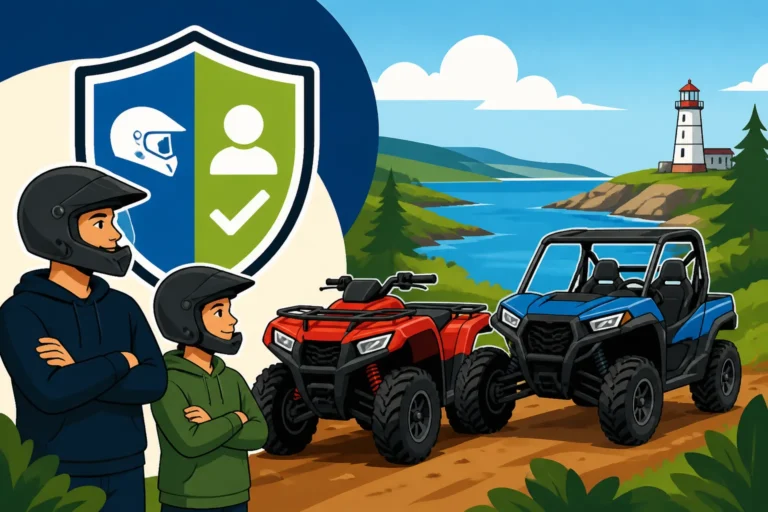
Your personal protective equipment (PPE) is just as critical on a road trail as it is on the most rugged off-road path. A helmet is non-negotiable and legally required. It must meet recognized safety standards such as DOT, CSA, Snell, or BSI. [Nova Scotia Helmet Standards Accepted] are in place to ensure you have adequate head protection. Don't skimp on this vital piece of gear; a good helmet is your brain's best friend.
Eye protection is also a must. Whether it's the visor on your helmet, goggles, or safety glasses, your eyes need to be shielded from dust, debris, and insects. This is especially true at 25 km/h, where even small particles can cause significant distraction or injury. For riders under 16, there are [Nova Scotia Gear Rules for Riders Under 16] that mandate eye protection along with long sleeves, long pants, gloves, and boots. It's smart for all riders to adopt these practices regardless of age.
Appropriate clothing is equally important. Long sleeves and pants, sturdy gloves, and over-the-ankle boots provide protection from scrapes, sun exposure, and unexpected encounters. Think about layers, especially if you're riding along the coast where fog can roll in quickly, or as you move between shaded trails and open roads. While the 25 km/h limit means you're not likely to be doing extreme acrobatics, a low-speed tip-over can still result in injuries if you're not properly dressed.
Respecting the Community and Environment
One of the biggest challenges, and opportunities, for road trails is integrating OHV use into communities. Riding responsibly means being a good neighbour. This includes keeping your machine's exhaust system within factory noise limits. Loud, modified exhausts can be a significant source of contention for residents and lead to complaints, potentially jeopardizing future road trail access. [Nova Scotia Noise Limits on a Machine] are in place for a reason, so ensure your machine complies.
Dust control is another important consideration, especially on gravel road trails or when riding through residential areas. Riding at the prescribed 25 km/h limit naturally helps reduce dust, but being mindful of local conditions, especially during dry spells, is key. If you're kicking up a lot of dust, consider slowing down even further if safe to do so. It's about minimizing your impact on the homes and properties you pass by.
Always stay on the designated road trail. Veering off onto private property, even for a quick photo, is trespassing and can damage the reputation of the entire OHV community. Treat the land with respect, pack out everything you pack in, and avoid disturbing wildlife. The continued success of Nova Scotia's road trail network relies heavily on the responsible and respectful behaviour of every single rider.
Planning Your Road Trail Adventures
Thorough planning can make all the difference between a frustrating ride and an epic adventure. Start by researching your route. Use available maps and resources, like those from ATVANS, to identify designated road trails and how they connect to the broader trail network. Knowing your route in advance helps you anticipate where the 25 km/h limits apply, where you might encounter more traffic, and where fuel stops are located. [Nova Scotia Trail Maps Worth Downloading] can be invaluable here.
Consider the length of your ride and ensure your machine has enough fuel. While road trails might pass through communities with gas stations, don't assume one will always be conveniently located. Plan your fuel stops, especially if you're venturing into more remote areas or linking long sections of trail. Carrying a small emergency fuel can is never a bad idea. For longer, more complex rides, using a GPS device or a smartphone app with offline maps can be a lifesaver, especially in areas with spotty cell coverage.
Finally, think about riding with a group, especially if you're new to the area or trying a new route. Group riding can enhance safety, as there's always someone to help in case of a breakdown or accident. Before setting out, brief your group on the road trail rules, emphasizing the 25 km/h limit and the importance of single-file riding. Communication within the group, whether through hand signals or helmet-mounted comms systems, is key to a smooth and enjoyable experience.
Here's a quick checklist to help you stay compliant and have a great time on Nova Scotia's road trails:
| Requirement | Details | Checkpoint |
|---|---|---|
| Speed Limit | Adhere strictly to 25 km/h on all designated road trail segments. | Throttle control, patience, adjust riding style. |
| Documentation | Carry valid OHV registration, proof of insurance (pink card), and your driver's licence. | Waterproof pouch for papers, accessible on person or machine. |
| Operating Hours | Ride only between half an hour before sunrise and half an hour after sunset. | Check local sunrise/sunset times before departure. |
| Helmet | Wear a helmet meeting DOT, CSA, Snell, or BSI standards. | Ensure proper fit, good condition. |
| Eye Protection | Use a visor, goggles, or safety glasses. Mandatory for all, especially under 16. | Clear vision, protection from debris. |
| Machine Equipment | Functional headlights, tail lights, and brakes. Consider mirrors, turn signals (SuperATV options). | Pre-ride inspection, visible and working lights. |
| Road Etiquette | Ride single file, yield to other traffic, do not pass. | Anticipate, be courteous, minimize impact on others. |
| Environment | Stay on designated trails, respect private property, no littering, minimize dust/noise. | Plan route, factory exhaust, responsible riding. |
Disclaimer
This article is for general informational purposes only and does not constitute professional advice. Laws, prices and regulations vary by location and change over time. Consult a qualified professional for guidance on your specific situation.