Nova Scotia Safety Course for a 16-Year-Old
A 16-year-old in Nova Scotia may be old enough to ride without the supervision rules that apply to younger children, but age alone does not settle the safety-course question. The key is whether the rider has the required training certificate or qualifies for an exemption. Here’s how to check the requirement, choose a course and avoid confusing training with registration or trail access.
Does a 16-year-old need an ATV safety course in Nova Scotia?
For many riders, yes. Nova Scotia requires qualifying riders to complete recognized safety training and hold proof of certification before operating an off-highway vehicle. A 16-year-old who does not meet an exemption should plan to take the course before riding, rather than assume that turning 16 replaces training.
The requirement is about the person operating the machine, not just the person who owns or registers it. A parent can own a machine, and a 16-year-old can ride it, but the parent’s registration does not replace the rider’s own training obligation. Likewise, being supervised by an experienced adult does not automatically satisfy a requirement for the rider to hold a certificate.
Nova Scotia’s training rules include an older-rider exemption associated with the province’s pre-2006 cutoff. It is not a general exemption for anyone who has ridden for years, nor does it automatically apply because a parent owned the machine. The rider needs to meet the applicable conditions. If you think an exemption applies, confirm what evidence is accepted before riding; see Nova Scotia’s Grandfather Exemption and Nova Scotia’s Pre-2006 Grandfather Rule.
| Situation | What to check before riding |
|---|---|
| The rider is 16 and has no safety certificate | Take a qualifying course and keep the completion record or certificate. |
| The rider has an older certificate | Confirm that the certificate meets Nova Scotia’s requirements and can be verified. |
| The rider believes they qualify for a grandfather exemption | Check the exact eligibility conditions and what proof is needed. |
| A parent or another person owns the machine | Check the rider’s training requirement separately from the owner’s registration. |
| The machine will be used on a club trail | Check trail-permit and insurance requirements as well as training. |
The age change matters, but it does not erase other rules. Rules for children under 16 include supervision and age-related requirements; those are separate from the safety-certificate requirement. A 16-year-old should not rely on a parent’s presence as a substitute for training. For the younger-rider rules, see Nova Scotia Rules for Riders Under 16 and [Nova Scotia Supervision Requirements].
It also helps to separate four things that are easy to mix up:
- Safety training: Whether the rider must complete a recognized course and hold a certificate.
- Registration: Whether the machine is registered and has the required vehicle documents.
- Insurance: Whether the machine has the insurance required for the intended use.
- Trail access: Whether the rider and machine have the required trail permit for a particular trail network.
A training certificate does not register the machine, provide insurance or buy a trail permit. Conversely, registering a quad does not prove that a 16-year-old rider has completed required training. Nova Scotia Safety Certificates Are Mandatory explains the certificate requirement, while Nova Scotia Registration Before Your First Ride covers a separate part of getting ready to ride.
Choosing a course and getting proof of completion
Before paying for a course, check that it provides a certificate accepted for Nova Scotia’s OHV safety-training requirement. A course can be useful and well taught yet still not meet a particular province’s certification rules. Ask the provider what certificate is issued, whether it applies to the type of machine the 16-year-old will ride, and how to confirm the credential afterward.
Course providers may vary in how they deliver instruction. Depending on the course, training may cover machine controls, pre-ride checks, protective equipment, safe riding practices and responding to hazards. Do not assume that every course has the same format, practical component or assessment. Confirm the details with the provider before registering, especially if the rider needs to finish training before a planned trip.
A sensible check-in process is:
- Confirm the rider’s status. If the rider has never completed recognized training, or cannot establish that an older certificate is acceptable, ask what course is required for their situation.
- Verify the provider and certificate. Get confirmation that the course leads to a certificate accepted in Nova Scotia, rather than relying on a generic course description.
- Ask about age and participation requirements. Check whether the provider has rules for 16-year-old participants, including any permission or registration forms.
- Complete the course and keep the paperwork. Save the certificate and any completion confirmation. Keep a copy where a parent or responsible adult can find it, and ask how to request a replacement if it is lost.
- Check whether the certificate can be verified. If the rider already trained elsewhere or has an older record, ask what information is needed to confirm it. Nova Scotia Safety Certificate Lookup is a useful next step when the issue is proving an existing credential.
If a certificate is missing, do not assume that a verbal account of taking a course will be enough during a check. Contact the training provider to ask whether it can reissue or verify the record. If the provider cannot locate the record, ask the provincial office responsible for OHV rules what evidence it will accept and whether the rider needs to complete training again.
The training requirement is not a driver’s licence. Completing an OHV safety course does not give a 16-year-old permission to ride on every road, trail, woodlot or other property. Access depends on the location, the machine, the relevant rules and the landowner’s permission where applicable. If the ride involves a designated road trail, check the separate operating requirements in Nova Scotia Road Trail Rules Explained.
Exemptions, age rules and ownership are separate questions
The main complication for a 16-year-old is that exemption rules can depend on facts other than current age. The province’s older-rider exemption is tied to specific historical conditions. It should be treated as a narrow eligibility rule, not as a general waiver for riders who learned informally or have years of experience.
If an exemption might apply, gather the relevant information before making a decision. That could include the rider’s date of birth, any certificate already earned, and records that may show whether the exemption’s conditions are met. Ask the appropriate provincial office to confirm the rule and acceptable proof. Do not rely solely on a family member’s recollection or on a course provider’s interpretation of an exemption.
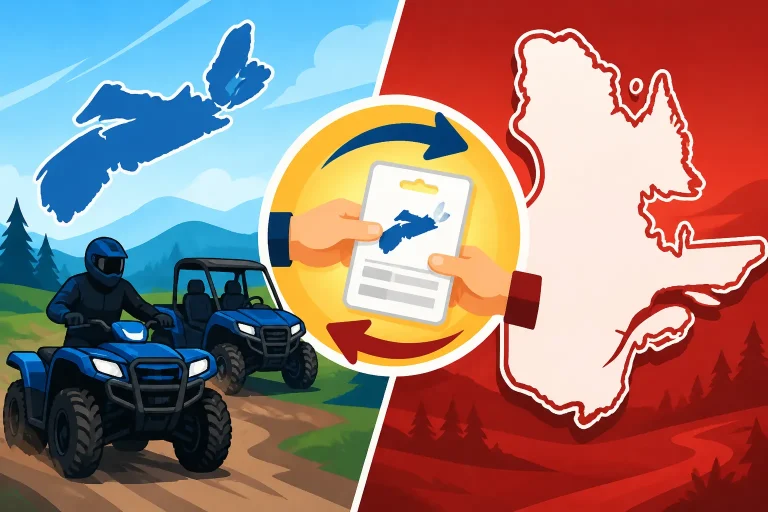
A certificate from another place also deserves a check. Training standards and accepted credentials can differ, and a card that was valid for riding elsewhere may not automatically satisfy Nova Scotia’s requirement. Give the provider or provincial office the certificate’s name, issuing organization and completion details, and ask whether it is recognized. The same caution applies to an old certificate: its age does not necessarily make it invalid, but the rider should confirm that it meets the applicable standard.
Ownership is another separate issue. Rules about who can operate a machine are not the same as rules about who can be its registered owner. A 16-year-old may face different conditions when a machine is being registered in their name, even if they have completed training and are permitted to ride it. Check Nova Scotia’s 19-Year-Old Registered Owner Rule—or, if the question is about a younger owner, Nova Scotia Registration at 16 With Permission—for the ownership side.
The same separation applies when an adult is riding with the 16-year-old. A trained adult can offer practical guidance, but that does not necessarily exempt the younger rider from an individual training requirement. Nor does a safety certificate make an adult automatically qualified to supervise a younger child under the separate youth rules. If the group includes children under 16, check the supervision requirements for those riders rather than applying the 16-year-old’s rules to everyone.
Before the first ride: a practical checklist
Once the rider has settled the training question, check the rest of the ride preparation. This prevents a common problem: having the course certificate in order but discovering that the machine or chosen route is not ready for use.
- Carry proof of training. Keep the certificate or acceptable proof accessible. Ask the issuing provider what to do if the original is lost.
- Confirm machine registration. Check that the machine has the required registration and documents for its use. Start with How to Register an ATV in Nova Scotia if the paperwork is not complete.
- Check insurance. Confirm that the policy covers the machine and the type of riding planned. Do not assume that a safety certificate provides insurance.
- Check trail access. A trail permit may be separate from provincial registration. Confirm the rules for the exact trail network and machine type; How to Buy a Nova Scotia Trail Permit covers the permit process.
- Review location rules. A certificate does not grant permission to ride on private land or open a closed trail. Confirm access and restrictions before setting out.
- Prepare the machine and rider. Review the owner’s manual, inspect the machine, use required protective equipment and make sure its size and controls suit the rider.
- Plan for the conditions. Choose a route appropriate for the rider’s experience, check for closures and let someone know the plan if riding away from a familiar area.
A short conversation with the training provider or provincial office can prevent an avoidable delay, especially if the rider has an older certificate or thinks a grandfather exemption applies. The useful questions are specific: Is this certificate accepted for Nova Scotia? What proof should the rider carry? Does the exemption apply to this person, and what documents establish it? Are there separate requirements for the machine or the planned trail?
For a 16-year-old with no qualifying exemption, the practical answer is straightforward: complete an accepted safety course, retain the certificate and then check registration, insurance and access separately. For someone who may be exempt, confirm eligibility before riding rather than treating age, experience or family ownership as proof.
Disclaimer
This article is for general informational purposes only and does not constitute professional advice. Laws, prices and regulations vary by location and change over time. Consult a qualified professional for guidance on your specific situation.