Nova Scotia Towns With Whole-Town Access
For many off-highway vehicle (OHV) enthusiasts in Nova Scotia, the dream is to simply hop on their quad or side-by-side and cruise directly from their driveway to the local store, a friend's house, or a nearby trail system without the constant worry of illegal road use. This desire for seamless access, however, often clashes with traditional road rules, leading to frustration and confusion. This comprehensive guide is here to shed light on Nova Scotia's unique "whole-town access" initiatives, explaining where these opportunities exist, the rules you need to follow, and what it truly means for your riding adventures.
What "Whole-Town Access" Truly Means for Riders in Nova Scotia
When we talk about "whole-town access" for off-highway vehicles in Nova Scotia, it's not just a casual phrase; it represents a significant shift in how some communities integrate OHV use into their daily fabric. Historically, ATVs and UTVs were largely confined to designated trails and private lands, with road use strictly limited to brief crossings or very specific, signed routes. The idea of riding down the main street of a village to grab a coffee or run an errand felt like a pipe dream for many.
Beyond Standard Road Crossings
The typical scenario for OHV riders involved meticulously planning routes to avoid public roads wherever possible, or only using them for the absolute minimum distance required to connect trails. This meant loading machines onto trailers, driving to a trailhead, unloading, riding, and then reversing the process. It was a logistical challenge that often dampened the spontaneity of a ride. Even when [Nova Scotia Road Trails: Where You Can Ride] became a reality, opening up certain stretches, it was still often about connecting points, not necessarily about truly living within a community on your machine.
Whole-town access changes this dynamic entirely. Instead of mere crossings or limited road trail segments, certain communities have taken the bold step of allowing OHVs on all or nearly all municipal roads within their boundaries. This means residents can genuinely use their OHVs for transportation within the town, whether it’s a quick trip to the hardware store, visiting neighbours, or accessing the broader trail network that often radiates from these communities. It’s about more than just recreation; it’s about utility and integration.
The Freedom of Integrated Riding
Imagine being able to start your day by riding your side-by-side from your home to the local gas station, filling up, and then continuing on to a winding backcountry trail without ever needing to load your machine onto a truck. This is the freedom that whole-town access offers. It eliminates the friction points of traditional OHV use, transforming machines from purely recreational toys into legitimate modes of local transport. This integration fosters a stronger sense of community among riders and helps local businesses thrive as OHV users can more easily access services.
However, this freedom comes with significant responsibilities. Riders must still adhere to all provincial OHV regulations, including [Nova Scotia Helmet Law for Riders], [Nova Scotia Requires Registration and Insurance], and local bylaws that govern speed, noise, and behaviour. The expectation is that riders will operate their machines respectfully, safely, and quietly, particularly when sharing roads with traditional vehicles, pedestrians, and cyclists. It's a privilege, not an inherent right, and maintaining it relies heavily on the responsible actions of every rider.
The Genesis of Whole-Town Access: Nova Scotia's Road Trail Pilot Project
The journey towards whole-town access didn't happen overnight. It was a gradual evolution, driven by a desire to both enhance the riding experience for OHV enthusiasts and explore economic opportunities for rural communities. The provincial government recognized the growing popularity of off-highway vehicles and the potential benefits of integrating them more formally into the transportation landscape.
The 2018 Pilot Program
The seeds of whole-town access were truly planted with [Nova Scotia's 2018 Road Trail Pilot] project. This initiative was designed to test the feasibility and impact of allowing OHVs on specific sections of public roads in select communities. The goal was to assess rider compliance, public acceptance, safety implications, and the economic benefits for local businesses. This wasn't just about opening roads; it was about gathering data and understanding the real-world implications of such a policy shift.
The pilot began in a handful of communities, carefully chosen to represent different demographics and geographical locations across the province. These initial sites served as living laboratories, where provincial officials, local authorities, and OHV associations like ATVANS worked together to monitor the project. It was a cautious but forward-thinking approach, recognizing that while there was enthusiasm among riders, there were also valid concerns from other road users and residents about noise, safety, and environmental impact. The initial feedback and data collected from these pilot areas were crucial in shaping subsequent policy decisions and expanding the program.
Evaluating Early Successes and Challenges
The early phases of the pilot project yielded valuable insights. Many communities experienced a positive economic impact, with riders frequenting local shops, restaurants, and gas stations. This was a significant boon for rural economies, demonstrating that OHV tourism and local integration could be a real driver of growth. Rider compliance with rules like [Nova Scotia's 25 km/h Road Trail Limit] and general safe operating procedures was generally high, indicating a responsible riding community.
However, there were also challenges. Some residents expressed concerns about increased noise levels, especially with modified exhausts, and occasional instances of riders not adhering to speed limits or proper etiquette. These issues highlighted the importance of clear signage, consistent enforcement, and ongoing public education campaigns for both riders and non-riders. It became clear that for whole-town access to be truly successful and sustainable, it required a delicate balance between opening up opportunities and ensuring community harmony and safety for everyone. These lessons learned from the pilot were instrumental in refining the legal framework, culminating in [Nova Scotia's Road Trails Act Explained] and subsequent expansions.
Current Towns Embracing Full ATV Access
While the provincial government has been gradually expanding the road trail network, some municipalities have gone a step further, embracing a comprehensive "all-roads" approach within their boundaries. These are the pioneers, the places where you can truly experience the integrated riding freedom that many OHV owners dream of. It’s important to remember that these initiatives are often a result of local council decisions, working within the framework of provincial legislation.
Notable Pioneers and Their Unique Approaches
One of the most prominent examples of a community embracing full municipal road access is Pictou. This historic town, known for its beautiful waterfront and strong community spirit, undertook a bold "all-roads trial" as part of the provincial pilot. The success of this trial led to Pictou officially becoming one of the first communities to designate all municipal roads for OHV use. This means you can ride your machine from your campsite to the grocery store, then take a scenic loop through town before hitting a connecting trail. The town has seen a positive impact on local businesses, becoming a popular destination for riders. [Pictou's All-Roads Trial in Nova Scotia] was a pivotal moment for the province.
Other communities have also adopted similar models or are actively exploring them, often after participating in the initial pilot phases. While not every community has designated all municipal roads, many have extensive networks of designated roads and road trails that effectively provide seamless access. Riders often find themselves in areas like sections of Annapolis County, Cumberland County, and Guysborough County where the interconnectedness of trails and permissible road segments creates a similar experience of broad access. Each municipality often has its own set of detailed maps and local regulations, so it's always wise to check with the local government website or OHV club before heading out.
Mapping Your Whole-Town Access Route
To make the most of whole-town access, having reliable navigation is key. While paper maps are still valuable, many riders now rely on GPS devices or smartphone apps loaded with trail and road data. These tools often show designated OHV routes, including permissible municipal roads. Websites for ATVANS (ATV Association of Nova Scotia) and local clubs are excellent resources for up-to-date information and downloadable maps. For instance, if you're planning a trip to Pictou, checking their municipal website for OHV information, or looking for local club contacts, will give you the most accurate picture of where you can ride.
When preparing for a ride that includes mixed terrain, consider equipment that enhances both comfort and safety. For instance, a quality windscreen from a brand like SuperATV can make road portions more comfortable, protecting you from wind and debris. Good tires that perform well on both pavement and dirt are also essential. Remember that while you have access, these are still shared roads, and paying attention to [Nova Scotia Road Trail Operating Hours] and local signage is paramount. Always plan your route, share it with someone, and carry appropriate communication devices, especially when venturing further afield.
Navigating Whole-Town Access: Rules and Rider Responsibilities
With the privilege of whole-town access comes a significant responsibility to uphold the rules and ensure the safety and comfort of all community members. It's not a free-for-all; it's a carefully managed integration that relies on every rider's adherence to provincial laws and local bylaws. Breaking these rules risks not only personal fines and penalties but also jeopardizes the future of OHV access in these communities.
Specific Local By-Laws and Provincial Regulations
Even in towns with whole-town access, provincial regulations still form the backbone of OHV operation. This means your machine must be registered, you must carry proof of insurance (your "pink card"), and you need a valid driver's license – a learner's permit won't cut it on public roads. [Nova Scotia Requires a Full Driver's Licence] for operating an OHV on any public road, including designated road trails and municipal roads with whole-town access. Additionally, wearing an approved helmet is non-negotiable, as detailed in [Nova Scotia Helmet Law for Riders].
Beyond these provincial mandates, individual municipalities often implement their own bylaws to address specific local concerns. These might include stricter noise ordinances than the provincial standard, limitations on engine size for certain roads, or specific parking regulations for OHVs. For example, while provincial law covers general [Nova Scotia Exhaust Noise Rules], a town might have a bylaw specifying even lower decibel limits within residential zones. It's crucial for riders to seek out and understand these local nuances before riding in a new community. A quick call to the municipal office or a check of their official website can save a lot of headaches.
Maintaining Public Harmony and Safety
The success of whole-town access hinges on mutual respect between OHV riders and other road users and residents. This means operating your machine courteously and safely at all times. Riders are expected to maintain the posted speed limits, which are often lower for OHVs on road trails (e.g., [Nova Scotia's 25 km/h Road Trail Limit]), and drive defensively. Yielding to pedestrians, cyclists, and other vehicles, riding single file, and avoiding unnecessary noise are all critical behaviours.
Consider the visual impact as well. Keeping your machine clean and well-maintained helps present a positive image to the community. While a lift kit from SuperATV might be great for trail clearance, ensure your machine still meets all provincial and local specifications for road use, including proper lighting and mirrors. Remember, every time you ride through a town, you are an ambassador for the entire OHV community. Instances of reckless riding, excessive noise, or disregard for rules can quickly erode public support and lead to restrictions being reimposed, undoing years of advocacy and effort by groups like ATVANS. Therefore, [Nova Scotia Rules for Riding Quietly Through a Cape Breton Village] applies everywhere, not just in specific regions.
Future Outlook: Expansion and Community Impact
The success of existing whole-town access initiatives has paved the way for further expansion and a deeper understanding of how OHVs can positively contribute to Nova Scotia's rural landscape. The future looks promising for riders, with ongoing efforts to connect more communities and integrate OHVs more seamlessly.
Anticipated Expansions and Upcoming Designations
The provincial government continues to evaluate and expand the road trail network, with a clear focus on connecting more communities and creating longer, more integrated routes. Riders can expect to see more towns and villages applying for or being designated with road trail segments, and potentially more communities adopting the "all-roads" approach based on the successful models established by pioneers like Pictou. These expansions are often driven by local demand, with communities recognizing the economic and recreational benefits of embracing OHV tourism.
Information regarding [Nova Scotia's 2025 Road Trail Expansion] and [Nova Scotia's 2026 Road Trail Expansion] suggests a phased increase in accessible kilometers, aiming to create comprehensive networks that allow riders to travel across larger regions without constant trailering. This ongoing commitment indicates a provincial strategy to solidify Nova Scotia's position as a premier OHV destination. Keeping an eye on announcements from the provincial Department of Public Works and organizations like ATVANS is the best way to stay informed about new access points and whole-town designations.
Community Benefits and Potential Roadblocks
The benefits of expanded whole-town access extend far beyond just the riding community. Economically, it can revitalize rural areas by attracting OHV tourism, supporting local businesses, and creating jobs. Local gas stations, restaurants, convenience stores, and accommodations all see increased traffic from riders. Furthermore, increased OHV access can contribute to community pride and offer residents more options for local transportation and recreation. It fosters a sense of unity among outdoor enthusiasts and provides a unique draw for visitors.
However, potential roadblocks still exist. Issues such as managing environmental impacts, addressing concerns about noise and dust in residential areas, and ensuring adequate funding for trail maintenance and enforcement are ongoing challenges. Public perception remains a critical factor; isolated incidents of irresponsible riding can quickly sway public opinion against OHV access. Continued education for riders, robust enforcement of regulations, and open communication between OHV associations, municipalities, and residents are vital to overcoming these hurdles and ensuring the long-term success and growth of whole-town access in Nova Scotia. The proactive work of clubs, often supported by provincial funding, in maintaining [Nova Scotia ATV Trails: The ATVANS Network] is a key part of this.
Preparing Your Machine for Town and Trail Riding
Riding through a town with whole-town access means your machine needs to be ready for a diverse range of conditions, from paved roads and gravel shoulders to rugged trails. This isn't just about throwing on some bigger tires; it's about a holistic approach to equipping and maintaining your OHV for optimal performance, safety, and compliance across all terrains.
Equipping for Mixed-Use Environments
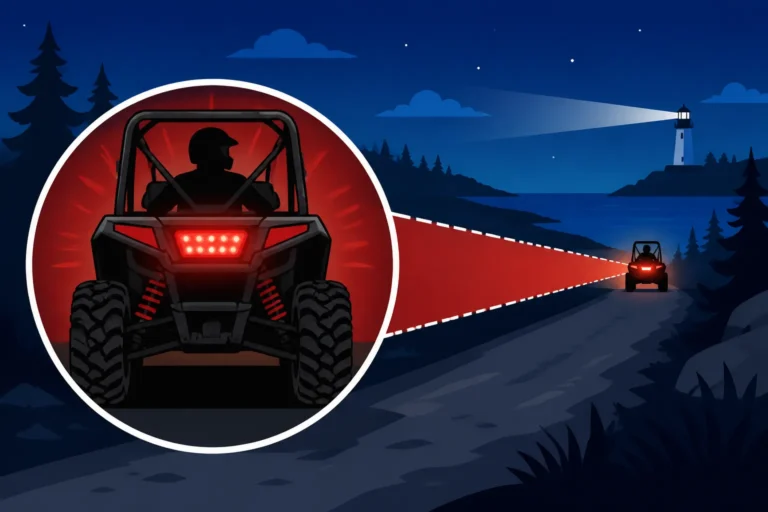
When your machine will be transitioning between street and trail, certain accessories become less of a luxury and more of a necessity. For visibility on public roads, ensure your machine has working headlights, taillights, brake lights, and turn signals. If your machine didn't come with them from the factory, aftermarket kits are widely available. Mirrors are also critical for awareness of traffic around you. Consider robust tires that offer good grip on both hard-packed earth and pavement, and resist punctures. A solid set of skid plates, perhaps an underbody armor kit from SuperATV, will protect vital components whether you're encountering an unexpected pothole in town or a rocky section on the trail.
Beyond these practicalities, think about comfort. A windshield can significantly reduce wind fatigue during longer stretches on roads. A comfortable seat is always a bonus, and storage solutions like cargo boxes or bags can be invaluable for carrying supplies, groceries, or even trailside repair kits. Remember to carry your registration, insurance, and driver's license at all times. [Nova Scotia Equipment Checks by Officers] are a reality, and being prepared means a smoother experience.
Maintenance for Urban and Off-Road Demands
The varied demands of mixed-use riding mean your OHV will likely experience different types of wear and tear. Paved roads can be harder on tires and suspension components than soft dirt trails, and frequent braking on inclines in town can put more stress on your brake system. Therefore, a diligent maintenance schedule is crucial. Regularly check your tire pressure – often different pressures are recommended for road versus off-road use, so you might need to adjust. Inspect your brakes, lights, and signals before every ride, especially if you plan to venture onto public roads.
Engine and drivetrain maintenance, such as oil changes, filter replacements, and belt inspections, should be performed according to manufacturer recommendations, potentially more frequently if you're putting a lot of hours on your machine across diverse terrains. Keeping your machine clean isn't just for aesthetics; it helps prevent rust and allows you to spot potential issues like fluid leaks or damaged components more easily. A well-maintained machine is not only safer but also more reliable, ensuring you can enjoy the full scope of Nova Scotia's whole-town access without unexpected breakdowns.
Disclaimer
This article is for general informational purposes only and does not constitute professional advice. Laws, prices and regulations vary by location and change over time. Consult a qualified professional for guidance on your specific situation.