Nova Scotia Rules for Riding a Shoulder
It's incredibly frustrating when you just want to get your off-highway vehicle (OHV) from point A to point B—maybe to a trail, a gas station, or even just across the road to a friend's place—and the rules about riding on road shoulders feel like a grey area. Many Nova Scotia riders wrestle with understanding exactly where they can and can't legally operate their ATVs and UTVs on or near public roads. This guide aims to clear up that confusion, diving deep into Nova Scotia's regulations concerning riding on road shoulders, so you can ride confidently and safely, without worrying about tickets or fines.
Understanding the Legal Landscape for OHVs in Nova Scotia
Before we zero in on shoulders, it’s important to grasp the broader legal framework governing off-highway vehicles in Nova Scotia. The province has put rules in place to ensure safety for everyone, whether they're on a multi-use trail or near a public road. Riders often find these regulations complex, especially with the ongoing developments around [Nova Scotia Road Trails Act Explained]. It’s not simply about having a machine; it's about knowing where it belongs.
The Off-highway Vehicles Act: Your Primary Guide
The main piece of legislation that dictates where and how you can ride your ATV or UTV in Nova Scotia is the Off-highway Vehicles Act. This Act lays out everything from registration requirements to operating restrictions. For many years, the general rule of thumb for OHVs was simple: stay off public roads. This was largely due to safety concerns and the fact that these machines aren't designed or insured for typical road use. However, like any law, there are nuances and specific exceptions that have evolved over time, particularly with the introduction of designated road trails.
Imagine you're trying to connect two sections of your favourite trail, and a short stretch of public road, or its shoulder, seems like the only logical link. This is where the Act becomes crucial, outlining very specific circumstances under which such movement might be permissible. It's not a free-for-all, but it's also not an absolute ban in every single scenario. The spirit of the law is to protect both OHV riders and other road users by keeping these powerful machines in appropriate environments.
The Role of Road Trails and Municipal Bylaws
More recently, Nova Scotia has introduced a network of designated road trails under its Road Trails Act, designed to connect existing trail systems and allow riders to access amenities like fuel or food in communities. These are specific, marked sections of roads where OHVs are permitted to operate under very strict conditions, including speed limits, times of day, and driver requirements. [Nova Scotia Road Trails: Where You Can Ride] delves deeper into these specific routes.
Crucially, just because there's a "road trail" doesn't mean you can ride on any road or any shoulder. These are specific, approved segments. Outside of these designated areas, the traditional rules apply. Furthermore, some municipalities have their own bylaws that can either open up specific roads or shoulders or restrict them even further. This patchwork can make understanding the rules a real headache for riders. You might be allowed to ride a short shoulder section in one community to cross a road, but absolutely forbidden to do the same in the next town over. Always check local signage and municipal regulations in addition to provincial laws. It’s a bit like navigating a maze, but knowing your local government's stance is just as vital as knowing the provincial Act.
Specific Rules for Riding a Shoulder in Nova Scotia
Let's get right to the heart of the matter: riding on the shoulder of a public road in Nova Scotia. The general consensus, and the safest approach, is to assume you cannot ride on a road shoulder unless a specific exemption or designated road trail rule applies. This isn't a suggestion; it's a legal reality that has significant implications for riders.
Crossing Roads and Accessing Property
The most common scenarios where an OHV might briefly operate on or near a shoulder involve crossing a paved road or accessing private property directly adjacent to a public road. Even in these situations, there are strict stipulations. You can't just cruise down the shoulder for a kilometre to your buddy's house.
For instance, if you need to cross a public highway to get from one section of a trail to another, or to reach your own private land, Nova Scotia law does allow you to do so at a right angle to the road, after yielding to all traffic. This usually means crossing directly from one shoulder or ditch to the other, or from the shoulder into a driveway. This is not "riding the shoulder"; it's a quick, perpendicular crossing. The moment you turn parallel to the road and begin travelling any significant distance along the shoulder, you're likely in violation. It’s a very fine line, and an officer’s interpretation of "briefly" and "at a right angle" can lead to a ticket if you're pushing the limits. Think of it as crossing a busy street on foot – you do it quickly and directly, not by walking down the sidewalk for blocks.
Designated Road Trails and Shoulder Use
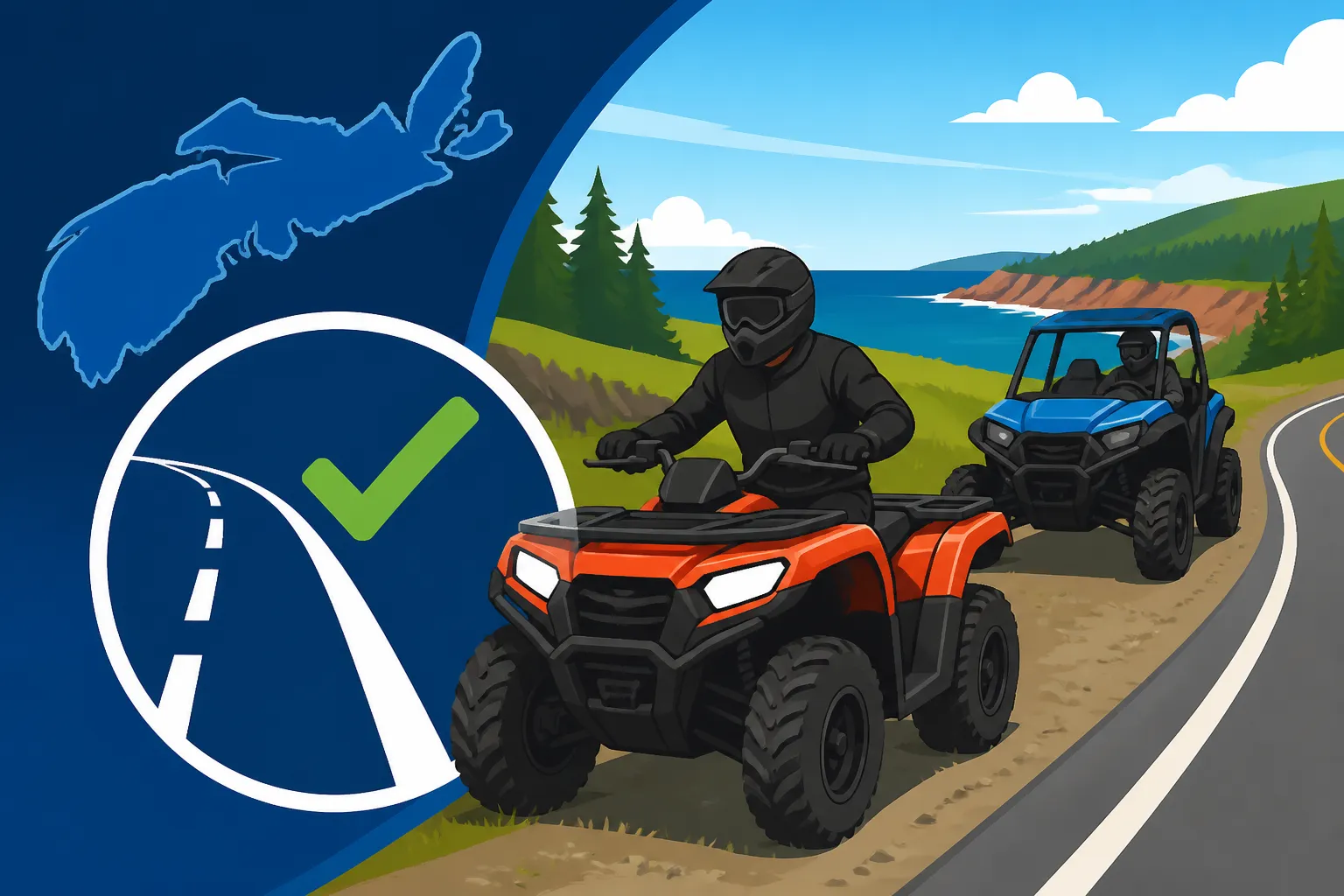
Within the framework of Nova Scotia's designated road trails, there might be specific instances where shoulder use is implicitly or explicitly permitted. However, it's crucial to understand that "road trail" does not automatically mean "shoulder trail." Often, these designated routes might use the travelled portion of a low-traffic road, or a specific widened shoulder that has been officially signed and marked as an OHV route.
Even on these designated road trails, there are strict rules. For example, [Nova Scotia's 25 km/h Road Trail Limit] is a common speed restriction. If a road trail does utilize a shoulder, it will be clearly marked, and riders are still expected to adhere to all other operating conditions, such as maintaining single-file operation and yielding to other traffic. Never assume a shoulder is part of a road trail unless it's explicitly signed as such. To ensure you're on a legal route, it's always best to consult official maps provided by ATVANS or the provincial government. A generic dirt path beside a paved road is not a designated trail, no matter how convenient it might seem.
Riding Shoulders in an Emergency or for Maintenance
There are, of course, extreme circumstances. If your machine breaks down on an approved trail section that happens to parallel a road, and the safest way to get it off the trail is to push it onto a shoulder to await transport, this might be viewed differently than actively riding. Similarly, if you're involved in trail maintenance work and need to briefly use a shoulder to access a work site, specific exemptions might apply to authorized personnel.
However, these are highly specific exceptions tied to legitimate emergencies or authorized work, not general riding. For the average recreational rider, relying on an "emergency" excuse for extended shoulder travel is a risky gamble. Always prioritize safety, but be aware that legal allowances for these situations are very narrow and require clear justification. It's a "call your tow truck" situation, not a "limp it home" situation if it means riding a shoulder illegally.
Safety and Practical Considerations for Road-Adjacent Riding
Beyond the legalities, there are significant safety and practical considerations when your OHV is anywhere near a public road or its shoulder. Even if you're just crossing or briefly using a designated road trail section, you're entering a very different environment than a secluded wooded trail. The risks are amplified, and your awareness needs to be dialled up to eleven.
Visibility is Key: Be Seen!
When you're operating an OHV near roads, your machine is simply not as visible as a car or truck. Its size, speed, and often its colour can blend into the background, especially at dusk, dawn, or in poor weather conditions. This is where you, as the rider, need to take proactive steps to make yourself and your machine stand out.
- Lighting: Ensure your headlights and tail lights are fully functional, even in daylight. Consider adding extra LED lights or light bars. Brands like SuperATV offer a range of aftermarket lighting solutions that can significantly improve your machine's visibility. Think about side-facing lights if you're often turning or crossing roads.
- Reflective Gear: Wear bright, high-visibility clothing, especially a reflective vest or jacket. This isn't just a good idea; it can be a lifesaver. Your helmet should also be brightly coloured or have reflective decals.
- Flags: A tall, brightly coloured flag on the rear of your machine can dramatically increase your visibility to drivers, especially when you might be obscured by hills, bends, or brush. This is particularly crucial for smaller youth machines. [What a Rider Under 16 Must Wear] includes guidelines for visibility.
Remember, drivers on public roads are often travelling at higher speeds and may not be expecting to see an OHV on the shoulder or crossing their path. Anything you can do to make yourself more noticeable gives them more time to react.
Anticipating Traffic and Road Conditions
Riding an OHV on a dirt trail is one thing; riding near pavement where cars, trucks, and even large commercial vehicles are moving at speed is another entirely. The dynamics are completely different.
- Speed Differentials: Your OHV, even if you’re trying to keep up, will be much slower than most road traffic. This speed differential creates a risk, as vehicles approaching from behind will close the distance rapidly.
- Road Surface vs. Shoulder Surface: While a road shoulder might look solid, it can often be uneven, soft, gravelly, or full of potholes and debris not found on a main road. This can make controlling your OHV more challenging, increasing the risk of losing control, especially if you have to react quickly to traffic. Your knobby tires, while great for mud, can be a handful on hard, uneven shoulders.
- Driver Behaviour: Not all drivers are attentive. Some might be distracted, speeding, or simply not aware of OHV regulations. Assume that drivers don't see you and don't know your intentions. Always make eye contact if possible before crossing or making a move near traffic.
- Noise: Your machine, while loud to you, might not be as audible to a driver in a sealed vehicle with the radio on. Don't rely on sound to announce your presence.
A responsible rider understands these risks and operates with extreme caution. Taking a quick glance over your shoulder isn't enough; you need to constantly scan your surroundings, anticipating potential hazards from all directions.
Essential Gear for Road-Adjacent Travel
When you’re near roads, certain gear becomes even more critical for your safety and for compliance.
| Item | Why It's Essential for Road-Adjacent Riding |
|---|---|
| DOT/CSA Approved Helmet | Mandatory for all riders. Protects against head injury in collisions. |
| Eye Protection | Prevents debris from roads (gravel, dust) from impairing vision. |
| Gloves | Improves grip, protects hands in a fall, and from road debris. |
| Long-Sleeve Shirt/Jacket | Protects skin from abrasions, branches, and adds a layer of visibility. |
| Long Pants | Similar to shirts, protects legs from debris and abrasions. |
| Over-the-Ankle Boots | Crucial for ankle support and protection from impact or exhaust heat. |
| Bright/Reflective Clothing | Significantly increases rider visibility to other road users. |
| Operational Head/Tail Lights | Legal requirement; critical for being seen, especially at dawn/dusk. |
| Functioning Brakes | Absolutely vital for quick stops in traffic situations. |
| Rearview Mirrors | Helps monitor traffic approaching from behind without twisting around. |
| Horn | Can be used to alert drivers to your presence in an emergency. |
Always carry your registration, proof of insurance, and any necessary permits. [Carrying Papers on a Coastal Ride] is more than just good practice; it's a legal obligation for Nova Scotia riders. You never know when you might encounter an officer who needs to verify your compliance.
Penalties for Illegally Riding a Shoulder
Ignoring the rules about where you can and cannot ride your OHV in Nova Scotia, especially concerning public roads and shoulders, isn't just a minor infraction. The province takes these regulations seriously, and the penalties can be substantial, ranging from significant fines to having your machine impounded. It’s a very costly lesson to learn the hard way.
Fines and Your Record
If you're caught operating your ATV or UTV illegally on a road shoulder where it's not permitted, you're looking at a pretty hefty fine. Nova Scotia has set a [Nova Scotia Minimum Fine of $250] for operating an unregistered machine, and similar or higher fines apply to other violations of the Off-highway Vehicles Act, including illegal road use. This isn't just a slap on the wrist; it's a financial hit that can really sting, especially for something that could have been avoided by understanding the rules.
Beyond the immediate fine, an infraction could also go on your driving record if it's tied to your driver's license, potentially impacting your insurance rates for your car or truck. While OHV operation is distinct from regular driving, serious violations can sometimes cross over. It’s also worth noting that repeated offences or more egregious violations can lead to even higher penalties, potentially reaching [How High an Unregistered Machine Fine Can Go], which can be thousands of dollars. An officer's discretion can also play a role, but generally, they are there to enforce the law as written.
Machine Impoundment and Other Consequences
In more severe cases, or for repeat offenders, officers have the authority to impound your off-highway vehicle. Imagine having your machine towed away, then having to pay towing fees, storage fees, and still face the original fine, just to get it back. This can quickly add up to hundreds, if not thousands, of dollars. Losing access to your machine, even temporarily, can also put a damper on your riding season or hinder any work you use it for.
Furthermore, if you are riding illegally on a shoulder without proper [Nova Scotia Insurance Requirements for Riders], the consequences escalate dramatically. If you're involved in an accident while uninsured and riding illegally, you could be held personally liable for damages, medical expenses, and more, which could be financially devastating. That small stretch of shoulder suddenly becomes a massive liability.
Why Enforcement Matters
The strict enforcement of these rules isn't meant to spoil your fun; it's primarily for public safety. OHVs are powerful machines, and their interaction with traditional road traffic can be incredibly dangerous. When riders illegally use road shoulders, they put themselves, other drivers, and even pedestrians at risk. The penalties are designed to deter this behaviour and encourage responsible riding habits.
It’s about protecting the future of OHV riding in Nova Scotia too. When incidents occur due to illegal operation, it often leads to public outcry and calls for stricter regulations, which can impact all riders, even those who follow the rules. By adhering to the designated road trails and understanding where shoulders are off-limits, you're not just protecting your wallet; you're contributing to a positive image for the entire riding community in Nova Scotia. So, always assume "no" to shoulder riding unless you are absolutely certain it is permitted and clearly marked.
Disclaimer
This article is for general informational purposes only and does not constitute professional advice. Laws, prices and regulations vary by location and change over time. Consult a qualified professional for guidance on your specific situation.