Why a DOT or CSA Mark Matters
Riding an ATV or UTV in Nova Scotia offers an incredible sense of freedom, but let's be real, navigating all the safety requirements can feel like trying to untangle a fishing net after a busy day on the water. One of the biggest questions I hear from riders, new and seasoned alike, is about helmets: what kind do you really need, and what do all those little stickers and marks like DOT or CSA even mean? This guide is here to clear up that confusion, explaining why those certifications are more than just alphabet soup and why they genuinely matter for your safety and compliance on our beautiful trails and [Nova Scotia Road Trails: Where You Can Ride].
Understanding Helmet Safety Standards: DOT, CSA, and Beyond
When you're looking at a helmet, whether it's for a dirt bike, an ATV, or a side-by-side, you'll see a lot of different markings and labels. It's easy to dismiss them as technical jargon, but these certifications are actually your first line of defense in protecting your most valuable asset – your brain. They indicate that a helmet has been rigorously tested against specific safety criteria, often by independent labs. Without these marks, you're essentially guessing whether your helmet will perform when it truly counts.
What the DOT Mark Signifies
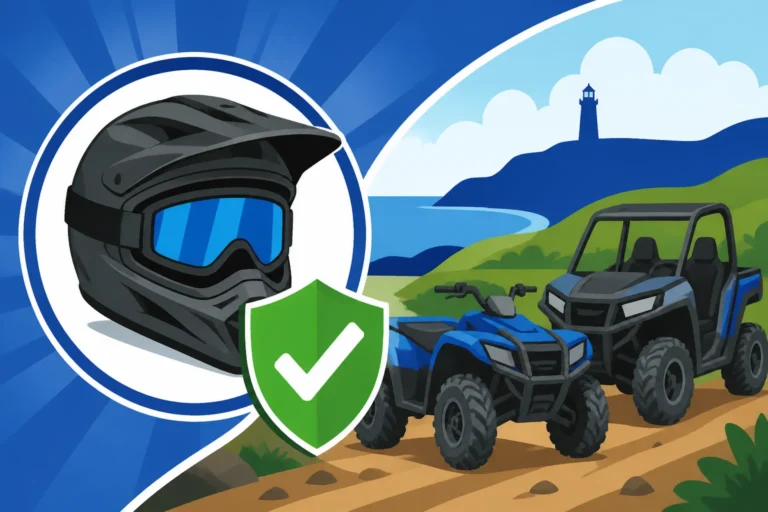
The DOT mark, which stands for the Department of Transportation, is a mandatory standard for all helmets sold for on-road use in the United States, but it's widely recognized and often accepted as a minimum standard here in Canada, including Nova Scotia, for off-highway vehicles. When you see a DOT sticker, it means the helmet manufacturer certifies that the helmet meets Federal Motor Vehicle Safety Standard (FMVSS) 218. This standard includes tests for impact absorption, penetration resistance, chin strap strength, and peripheral vision. It's not just a suggestion; it’s a declaration that the helmet is designed to offer a certain level of protection in a crash scenario. For riders in Nova Scotia, understanding this baseline is crucial because it ensures a basic level of safety for your head, whether you're cruising through a woodlot or crossing a paved road. [Nova Scotia Helmet Standards Accepted] will often reference this standard directly or implicitly.
The testing for DOT certification involves dropping helmets from specific heights onto different types of anvils to measure how much force is transferred to a dummy head inside. There are also tests to make sure the helmet won't easily penetrate from a sharp object and that the chin strap will hold fast. This might sound clinical, but think of it this way: these tests simulate some of the most common and dangerous types of impacts you could experience. A helmet that passes these tests is designed to distribute the impact force across a wider area, reducing the direct shock to your skull. It’s about mitigating severe injury, not just preventing a bump or scrape. Without this certification, you have no guarantee that your helmet will stand up to even a moderate impact.
The CSA Mark and Canadian Standards
The CSA Group (Canadian Standards Association) is a leading standards organization in Canada. While DOT is primarily US-based, the CSA mark indicates compliance with Canadian safety standards. For helmets, specifically those used for motorcycling and sometimes applied to OHV use, the CSA standard aims to provide similar assurances of quality and protection as DOT. In some cases, a helmet might carry both DOT and CSA certifications, offering an even broader assurance of compliance across different regulatory landscapes. This is especially relevant in Nova Scotia, where regulations often blend federal and provincial guidelines. Choosing a helmet with a CSA mark gives you confidence that it meets Canadian-specific safety benchmarks, which are sometimes tailored to our unique conditions and legal requirements. [Nova Scotia Helmet Law for Riders] explicitly states the need for an approved helmet, and CSA is one such approval.
The CSA testing process for helmets is similarly rigorous, focusing on impact attenuation, shell integrity, and retention system effectiveness. They look at factors like how well the helmet stays on during an impact and its ability to absorb energy. For off-highway vehicle riders, this means the helmet is built to protect you from the kinds of falls and impacts common to trail riding – whether that's a sudden stop, a low-speed tip-over, or a more serious collision. These standards aren't just arbitrary rules; they are developed by experts based on accident data and biomechanical research to offer the best possible protection. When you’re out on the trails of Cape Breton or exploring the Annapolis Valley, knowing your helmet has a recognized Canadian standard like CSA can offer significant peace of mind.
Other Important Certifications: Snell and ECE
Beyond DOT and CSA, you might also come across Snell and ECE certifications. Snell is a non-profit organization dedicated to helmet safety research and testing, and their standards are often considered more stringent than DOT. A Snell certification means the helmet has passed an even higher battery of tests, often with multiple impact strikes on the same spot and more aggressive penetration tests. Many serious riders, especially those involved in racing or high-performance riding, actively seek out Snell-certified helmets for that extra layer of protection.
ECE, or Economic Commission for Europe, is another widely recognized international standard. Helmets with an ECE 22.05 (or newer 22.06) approval are certified for use in over 50 countries, primarily across Europe. ECE testing is very comprehensive, covering everything from impact absorption and abrasion resistance to chin strap durability and retention. For anyone who might ride outside of North America or simply wants a helmet that meets a broad international safety benchmark, ECE is an excellent indicator of quality and protection. While not explicitly mandated in Nova Scotia like DOT, a helmet with Snell or ECE certification will almost always meet or exceed the provincial requirements, ensuring you're well-protected. These additional certifications demonstrate a manufacturer's commitment to going above and beyond minimum requirements.
Nova Scotia's Helmet Law and Compliance
It's one thing to understand what these marks mean globally, but it's another to know how they apply directly to you when you're riding your ATV or UTV right here in Nova Scotia. Our provincial laws are quite clear about helmet requirements for off-highway vehicles, and understanding these rules isn't just about avoiding a fine; it's about staying safe and ensuring you're covered if something unfortunate happens. Ignoring the law can have serious consequences, both legally and for your personal well-being.
What Nova Scotia Requires for Riders
In Nova Scotia, it is mandatory for all riders and passengers of off-highway vehicles to wear an approved helmet. And what constitutes an "approved" helmet? Generally, this means a helmet that meets recognized safety standards like those set by the Department of Transportation (DOT), the Canadian Standards Association (CSA), Snell, or the Economic Commission for Europe (ECE). The law aims to ensure that everyone operating or riding on an ATV, UTV, or dirt bike on trails or public lands has adequate head protection. This isn't just a suggestion for rough trails; it applies to all riding, whether you're on a designated [Nova Scotia Road Trails Act Explained] segment or a private woodlot with permission. Even if you're just moving your machine across a field on your own property, wearing a helmet is a smart habit to cultivate.
The emphasis on approved helmets is non-negotiable. An officer conducting [Nova Scotia Equipment Checks by Officers] can and will verify if your helmet bears the necessary certification. If it doesn't, you could be facing penalties. This isn't about bureaucracy; it's about mitigating the severe risks associated with head injuries in off-highway vehicle accidents. A simple baseball cap or a bicycle helmet won't cut it, as they're not designed to withstand the types of impacts common with ATVs and UTVs. This commitment to safety extends to all riders, including youth. Special attention is paid to [Nova Scotia Gear Rules for Riders Under 16], ensuring our younger generation is protected with properly certified and fitted helmets.
The Consequences of Non-Compliance
Riding without an approved helmet in Nova Scotia can lead to more than just a stern warning. You could face significant fines, and repeated offenses might even lead to more severe penalties. Beyond the immediate legal repercussions, there are other, more serious consequences. If you're involved in an accident and weren't wearing an approved helmet, your insurance coverage could be jeopardized. Most [Nova Scotia Insurance Requirements for Riders] policies have clauses related to legal compliance, and failing to wear proper safety gear could be seen as negligence. This means that instead of your insurance company covering your medical bills or liability, you could be on the hook for substantial costs.
Imagine the scenario: you're out enjoying a beautiful fall ride, and you have a low-speed tip-over. If you're wearing an uncertified helmet or no helmet at all, a seemingly minor incident could turn into a life-altering head injury. The financial burden of long-term medical care, lost income, and rehabilitation can be astronomical. The fines associated with not wearing a proper helmet pale in comparison to the costs of a severe head injury. It's a risk simply not worth taking. Ensuring your helmet has the DOT or CSA mark is a small step that provides a huge layer of protection, both physically and financially.
The Real-World Impact of Certified Helmets
It's easy to think of safety gear as a hassle or an expense, but when you consider the real-world impact of a certified helmet, it quickly becomes clear why it's an indispensable part of your riding kit. These aren't just pieces of plastic and foam; they are carefully engineered devices designed to absorb energy and protect your brain in a moment of crisis. The peace of mind that comes with knowing you're protected by a quality, certified helmet is priceless.
Accident Scenarios and Helmet Performance
Let's talk about what happens in an accident, even a relatively minor one. When you fall off an ATV or UTV, especially at speed, your head can hit the ground with considerable force. A certified helmet, with its multi-layered design, is engineered to manage this kinetic energy. The hard outer shell spreads the impact force over a wider area, preventing penetration and protecting against abrasions. Beneath that, the EPS (Expanded Polystyrene) foam liner crushes on impact, absorbing much of the energy that would otherwise be transmitted directly to your skull and brain. Without this energy absorption, even a seemingly minor fall can lead to concussions, skull fractures, or worse.
Consider a scenario where you're navigating a rocky section of trail, perhaps on the Eigg Mountain Trails, and hit an unexpected obstacle. Your front wheel tucks, and you're thrown over the handlebars. In that split second, your certified helmet becomes your guardian. The force of hitting the ground is distributed and absorbed, significantly reducing the likelihood of a severe brain injury. An uncertified helmet might crack, fail to absorb energy effectively, or even detach, leaving your head vulnerable. This isn't just theoretical; countless accident reports highlight the critical difference a certified helmet makes in preventing fatal or debilitating head injuries. Even a robust off-road accessory like a SuperATV winch or heavy-duty bumper can't protect you from head trauma if you're not wearing the right helmet.
Peace of Mind and Insurance Benefits
Beyond physical protection, wearing a certified helmet provides immense psychological benefits. Knowing that you've taken every precaution to protect yourself allows you to ride with greater confidence and focus. You're not distracted by nagging doubts about your safety gear; instead, you can fully immerse yourself in the experience of riding through Nova Scotia's stunning landscapes. This peace of mind isn't just for you; it extends to your family and friends who worry about you when you head out on the trails. They know you're taking your safety seriously.
From an insurance perspective, this choice can literally save you thousands, if not hundreds of thousands, of dollars. As mentioned earlier, wearing an approved helmet ensures you're complying with the law and, by extension, likely adhering to the terms of your [Nova Scotia Insurance Requirements for Riders] policy. If you're involved in an accident and sustain injuries, having that certified helmet on your head can mean the difference between having your medical bills covered and facing them entirely on your own. Insurance companies look for compliance, and a visible DOT or CSA mark on your helmet is clear evidence that you're meeting your end of the safety bargain. It's a small investment for a massive return in security and financial protection.
Beyond the Mark: Choosing the Right Helmet for Nova Scotia Riding
While the DOT or CSA mark is foundational, choosing the right helmet for Nova Scotia riding goes a bit deeper. It’s about ensuring a proper fit, selecting a style appropriate for your riding, and maintaining it correctly. A certified helmet that doesn't fit well or isn't designed for ATV/UTV use won't offer optimal protection. Think of it as buying a high-performance vehicle but then using cheap tires; you're not getting the full benefit of your investment.
Sizing and Fit Are Paramount
Even the most highly certified helmet is useless if it doesn't fit properly. A helmet that's too loose can shift during an impact, exposing vulnerable areas of your head, or even come off entirely. One that's too tight can be incredibly uncomfortable, leading to distractions and headaches on longer rides, not to mention pressure points that affect blood flow. When trying on a helmet, it should feel snug all around your head, with no pressure points. Your cheeks should feel a slight squeeze, and when you try to move the helmet from side to side or up and down, your skin should move with it. If the helmet slides around independently, it’s too big.
Many manufacturers offer detailed sizing charts, but there's no substitute for trying a helmet on in person. Different brands and models have varying internal shapes, so what fits one person perfectly might not work for another. If you're riding with children, this is even more critical. [Nova Scotia Rules for a 6-Year-Old Rider] and other youth age groups have specific guidance on machine size and supervision, but the helmet fit is universally important. Always ensure the chin strap is securely fastened and adjusted correctly – it should be tight enough that you can't easily slip a finger between the strap and your chin.
Types of Helmets for OHV Use
For ATV and UTV riding, you'll typically be looking at off-road or motocross-style helmets. These helmets are designed with a large peak (visor) to protect from sun glare and roost (debris kicked up by other riders), and they have an extended chin bar for maximum face protection. They are also designed to be worn with goggles, which provide essential eye protection from dust, debris, and branches – a crucial consideration when navigating wooded trails or open fields.
Full-face street helmets, while DOT-approved, often lack the ventilation needed for strenuous off-road riding and typically don't accommodate goggles as comfortably. Some side-by-side riders might opt for dual-sport helmets, which offer a blend of street and off-road features, including a shield that can be removed for goggle use. The key is to choose a helmet that aligns with the demands of your riding environment and machine. For example, if you're driving a UTV with a windshield, you might have different ventilation needs than someone on an open ATV. Brands like SuperATV, while not helmet manufacturers themselves, offer a range of accessories like visors, goggles, and cleaning kits that complement your chosen helmet, ensuring your complete head protection system is ready for any Nova Scotia adventure.
Maintenance and Replacement
A certified helmet isn't a "set it and forget it" piece of gear. Like any safety equipment, it requires proper care and maintenance to remain effective. Regularly inspect your helmet for any signs of damage, such as cracks in the shell, fraying chin straps, or compressed foam. If your helmet has been involved in any kind of impact, even if it looks fine on the outside, it's generally recommended to replace it. The internal EPS foam is designed to crush on impact, and once it has done its job, it won't be able to absorb energy effectively again.
Clean your helmet regularly according to the manufacturer's instructions, especially the interior padding, to prevent odors and maintain hygiene. Store it in a dry, cool place away from direct sunlight and harsh chemicals, which can degrade helmet materials over time. Helmets also have a lifespan, typically around five years from the date of manufacture (check the sticker inside your helmet for this). Over time, materials can degrade, even if the helmet hasn't been in an accident. Replacing your helmet at recommended intervals ensures you always have the most up-to-date protection available. This might feel like an added cost, but it's a small price to pay for your ongoing safety.
Helmet Certification Comparison
Here’s a quick overview of the primary helmet certifications you'll encounter and what they generally signify:
| Certification | Primary Authority/Origin | Key Focus | General Stringency (Relative) | Nova Scotia Relevance |
|---|---|---|---|---|
| DOT | U.S. Department of Transportation | Minimum safety for on-road use | Standard | Accepted as a minimum |
| CSA | Canadian Standards Association | Canadian-specific safety standards | Standard | Accepted as a minimum |
| Snell | Snell Memorial Foundation (Non-profit) | Enhanced impact & penetration | Higher than DOT/CSA | Exceeds requirements |
| ECE | Economic Commission for Europe | International standard, comprehensive | Higher than DOT/CSA | Exceeds requirements |
This table provides a snapshot, but remember that specific standards within each certification can evolve. Always look for the most current versions where applicable.
In Nova Scotia, whether you're taking your UTV on [Nova Scotia Road Trails: Where You Can Ride] or exploring remote logging roads in the Highlands, your helmet is your most critical piece of safety equipment. Don't skimp on it. Invest in a certified helmet, ensure it fits perfectly, and maintain it diligently. It’s not just about adhering to the law; it’s about protecting your future and enjoying every ride to the fullest.
Disclaimer
This article is for general informational purposes only and does not constitute professional advice. Laws, prices and regulations vary by location and change over time. Consult a qualified professional for guidance on your specific situation.